About
About Our Shop and How We Work for Westminster Owners
In short
We are a 35,000 square foot collision and repair facility for RVs, campers, trailers, vans, commercial trucks, and fleets, operating since 2015 and moving roughly 75+ vehicles a month. All work is performed in shop, and our labor rates are published.
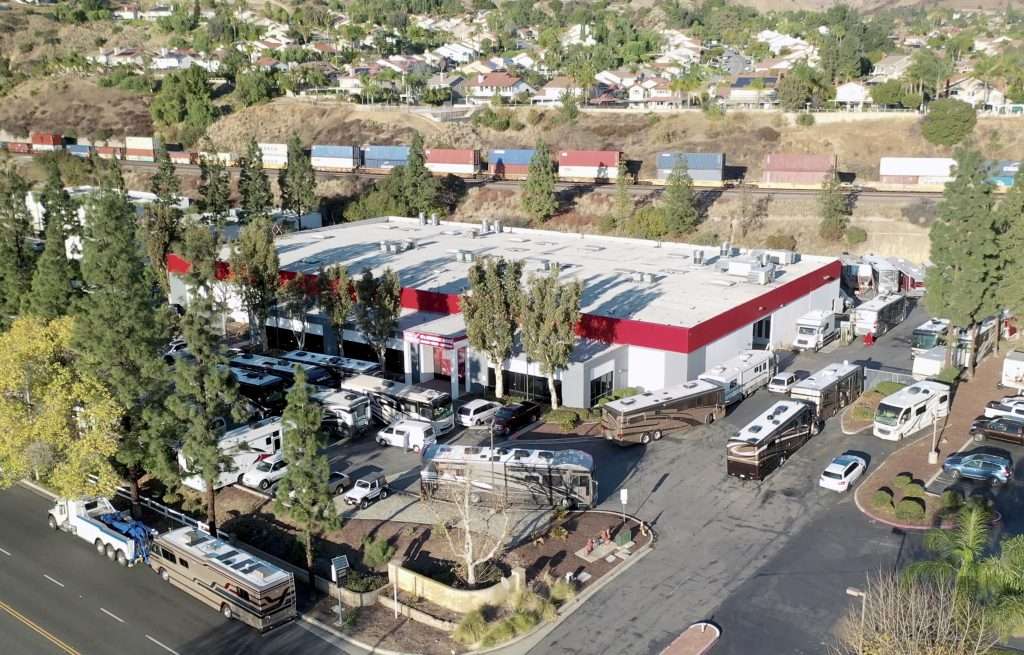
Most shop about pages are written to sound impressive. This one is written to tell you whether we are the right building for your vehicle, because on a coach or a fleet truck that question has a real answer and it is not always yes.
- Square feet under one roof
- 35,000Square feet under one roof
- Operating since
- 2015Operating since
- Vehicles through the floor monthly
- 75+Vehicles through the floor monthly
- Posted body and paint labor rate
- $210 per hourPosted body and paint labor rate
Who we are
A specialty facility, not a general body shop
We are a collision, paint, structural, and systems repair facility for large vehicles. The building covers 35,000 square feet at 23281 La Palma Ave, Yorba Linda, CA 92887, and it was set up around the constraints of the work rather than adapted to them afterward. That means bay depth that will take a forty five foot coach with the slide rooms out, a paint booth with the volume and airflow to refinish that coach in one pass, and a frame rack rated for a chassis that weighs more than a dozen passenger cars.
The shop has been licensed and operating since 2015. We hold California Bureau of Automotive Repair registration ARD00288521 and EPA identification CAL000367879. Those two numbers are the only credentials you will find claimed anywhere on this site, because they are the only ones we can point you to a public record for. We do not list association logos or training badges that a customer has no practical way to verify.
Roughly 75+ vehicles come through the floor in a month. That mix runs from a single owner with a cracked front cap on a travel trailer, to a municipal department cycling shuttle buses through on a schedule, to a total loss evaluation on a diesel coach that came in on a flatbed. The staffing, the scheduling, and the estimating discipline all exist to keep those three jobs from interfering with each other.
Scope of work
What the shop actually does day to day
The largest single category is collision. Something hit the vehicle or the vehicle hit something, and now there is damage that runs from a scuffed cap to a bent frame rail. That work starts on the rack with measurement, moves through structural correction, then body, then refinishing, and ends with systems verification because a hard impact frequently disturbs plumbing runs, wiring harnesses, and slide mechanisms that nobody listed on the original loss report.
The second category is water. Sidewall delamination, soft floors, separated roof seams, failed slide seals, and the interior rot that follows all of it. This work is unpopular with general shops because the wet area is almost always larger than the stain that started the conversation, and scoping it honestly means telling an owner a number they did not want to hear. We map moisture before we commit repair scope, every time, because repairing the visible half of a wet wall guarantees a return visit.
Beyond those two, the floor handles full repaints and color matched blend work, fiberglass and gelcoat repair, roof replacement, slide room mechanisms and seals, awning assemblies, interior rebuilds down to cabinetry and flooring, electrical and solar, generators, plumbing, appliances, climate systems, brakes and suspension on heavy chassis, welding and custom fabrication, and detail and reconditioning. Fleet operators also use us for scheduled body work and for repeat damage patterns across a group of identical units.
The difference
Why an RV specialist is not an automotive body shop with a bigger door
A passenger car is a steel or aluminum structure with panels fastened to it. Damage propagates through a load path that is documented, and repairing it means restoring measurements the manufacturer publishes. A recreational vehicle is a laminated sandwich: an outer skin bonded to a foam or block core, bonded again to an inner panel, with a wood or aluminum framework running through it. There is no bolt to remove. The panel is the structure, and the structure is glue.
That changes everything downstream. Impact energy on a laminated wall travels along the bond line rather than crumpling in place, so the damage you can see is often the smallest part of what happened. Heat behaves differently in a cure cycle across three bonded materials than it does across sheet steel. Color match on a coach is complicated by large flat surfaces, multi stage graphics, and years of ultraviolet exposure that no paint code accounts for. A shop that does this occasionally learns these things one expensive mistake at a time, usually on a customer's vehicle.
The other half of the gap is physical. A general body shop cannot get a thirty eight foot coach into a booth, cannot anchor a motorhome chassis to a rack designed for unibody cars, and cannot lift a loaded box truck. What usually happens instead is that the shop takes the job and sublets the parts it cannot do, which means your vehicle spends time in transit between buildings and the responsibility for the finished result gets diluted across two or three companies. We built the facility specifically so that does not have to happen.
Estimating
How we write an estimate and why it is longer than you expect
The estimate starts with the vehicle on the floor, not in the parking lot. We pull trim and panels where we need to see behind them, take moisture readings on anything that touches a seam or a seal, put a chassis on the rack when the impact suggests structural involvement, and photograph every stage of that process before anything is written. The fees for a systems assessment and for an in depth diagnostic exist because that work is real labor by a real technician in a real bay, and both are credited against an authorized repair.
What you receive is line by line. Each part with its number and its expected lead time, each labor operation with its hours and the posted rate applied, materials calculated per paint hour and per body hour rather than dropped in as a lump, and the tax treatment shown separately because in California labor is not taxed and parts and materials are. Nothing is bundled into a single figure. A total you cannot break apart is a total you cannot question, and a customer who cannot question anything has no protection at all.
Our opening estimates run long compared to what owners are used to, and that is intentional. Where teardown is likely to expose additional damage, we say so in writing on day one, describe what we expect to find, and give the probable range. Owners occasionally read that as pessimism. It is the opposite. It is the difference between hearing a difficult number at the counter with the vehicle still on the trailer, and hearing it three weeks in when the interior is out and you have no options left.
Claims
Our approach to carrier documentation
Adjusters approve what they can see and verify. That is not obstruction, it is the job: an adjuster who authorizes work without documentation is exposed, so the reasonable response from a shop is to make verification easy rather than to argue. On a large vehicle the difficulty is that the person reviewing the file has probably spent the week on sedans and pickups, and a bonded sidewall assembly does not resemble anything in that experience.
So we build files that explain themselves. Staged photographs at each disassembly step, not just an after shot. Moisture readings recorded with their locations. Structural measurements before and after correction, printed from the rack. Part numbers with real supplier lead times attached. And written reasoning under each labor line that says why the operation is required and why it takes the hours it takes. When a supplement becomes necessary, it arrives with the same supporting material rather than as a request to trust us.
We bill direct to every major carrier, which means for a covered claim your out of pocket is normally your deductible plus anything the policy does not reach. We do not promise you a claim outcome, because no shop controls that and any shop that says otherwise is describing something it cannot deliver. What we control is the quality of the file, and a well documented file gets approved more often and faster than a thin one.
Boundaries
What we do not do
We do not offer mobile service. Every repair happens at our facility, because the frame rack, the booth, the extraction system, and the lift capacity are here and none of them fit in a van. A technician sent to your driveway could look at a panel and form an opinion, and that opinion would be worth roughly what any opinion is worth when it is formed without opening anything.
We do not run roadside assistance or recovery. If your vehicle is disabled, call your roadside provider or your carrier first, then call us before the tow is dispatched so we can confirm we have the space and the right equipment staged for the arrival. Sending a forty foot coach to a shop that cannot receive it that day is an expensive way to lose a week.
We also do not provide on site fleet route service. Some fleet operators want a technician who visits the yard on a rotation and handles small items in place. That is a legitimate service and it is not ours. What we do instead is schedule fleet units into the shop in planned groups so a department can cycle vehicles through without losing the whole fleet at once. Finally, we do not sell vehicles, we do not broker them, and we do not perform work that requires a credential we do not hold.
More detail
Go deeper on the shop itself
Three pages that answer the questions owners and fleet managers ask once they get past what we repair.
Our facility
What 35,000 square feet buys: a booth sized for a coach, a full frame rack, and lift capacity for heavy chassis.
Read moreOur team
How the floor is organized across estimating, structural, body, paint, systems, and final quality control.
Read moreLicensing and compliance
Our California BAR license, our EPA identification number, and what each one actually obligates a shop to do.
Read moreQuestions
Frequently asked questions
How long has the shop been operating
We opened in 2015 and have run continuously since. The floor moves roughly 75+ vehicles a month, which matters less as a bragging number than as a description of what the staff sees. A technician who repairs one delaminated sidewall a year is guessing at the second one. A technician who sees several a month knows what the substrate under that panel usually looks like before the panel comes off, and knows which of the three likely conditions he is dealing with within about ten minutes of opening it. Volume in a specialty trade is really just accumulated pattern recognition, and pattern recognition is what keeps an estimate honest.
Where are you located and who do you serve
The facility is at 23281 La Palma Ave, Yorba Linda, CA 92887. We serve Westminster owners and fleet operators, the wider Orange County area, and customers who bring vehicles to us from across Southern California. There are no satellite locations and no second yard. Everything we do happens at that one address, which is deliberate. A shop with the equipment split across two sites ends up moving vehicles between them, and every move is a day the vehicle is not being worked on. Keeping the frame rack, the booth, the fabrication area, and the systems bays in one building is what allows a job to run without gaps between stages.
What kinds of vehicles do you take
Motorhomes of every class, fifth wheels, travel trailers, toy haulers, pop up campers, truck campers, camper vans and van conversions, cargo vans, box trucks, semi tractors, flatbeds, refrigerated bodies, buses, shuttles, municipal units, ambulances and fire apparatus, mobile business vehicles such as food trucks and mobile medical units, and standard fleet pickups. The common thread is size and construction. These are vehicles built in layers, on chassis that a passenger car lift will not hold, in dimensions that a standard booth will not accept. If it fits through the door and it is built that way, we can work on it.
Do you work directly with insurance carriers
Yes, and it is a large share of what we do. We bill direct to every major carrier, communicate with the adjuster on your behalf, and submit the photographic and measurement documentation that supports each line on the estimate. The reason that matters on this type of vehicle is that most adjusters spend the majority of their week on passenger cars. A laminated coach sidewall or a fifth wheel front cap is unfamiliar ground for them. Our job is to build a file that lets someone outside the trade follow why the labor reads the way it does, rather than asking them to take our word for it.
Is your work priced differently from an automotive body shop
Our labor rates are published rather than quoted verbally. Body and paint is $210 per hour, mechanical is $260 per hour, diagnostics are $285 per hour and credited against an authorized repair, and detail is $95 per hour. Parts, materials, deposits, and tax treatment are all listed on the prices page. What differs from automotive work is not usually the hourly figure, it is the hours. A panel on a coach is bonded into a laminated wall assembly rather than bolted to a frame, so replacing it involves substrate work an automotive estimate would never contain.
Do you offer mobile or roadside service
No. All work is performed in shop. The equipment that makes this work correct does not travel: a full frame rack, a downdraft booth sized for a coach, lift capacity for a heavy chassis, and the compressed air and extraction infrastructure that regulated refinishing requires. A mobile visit could produce an opinion, but it could not produce a repair, and an opinion formed in a parking lot without pulling a panel is worth very little on a vehicle built in layers. We also do not run roadside recovery or on site fleet route service.
What happens if the damage turns out to be worse than the first estimate
That is normal on this type of vehicle and it is planned for rather than treated as a surprise. When teardown exposes something the first inspection could not see, we stop, photograph it, and write a supplement before continuing. If a claim is involved, the supplement goes to the adjuster with the supporting images and the reason the additional work is required. You are told what changed and what it costs before it is performed, not after. The alternative, which some shops use, is to write a low opening number to win the job and let the corrections accumulate quietly. That produces an invoice nobody can defend.
Can I see the work before I commit to it
You can see the estimate, the photographs, and the reasoning behind each line before you authorize anything, and you are welcome to walk the floor during business hours. What we will not do is give you a repair figure over the phone from a description. On a laminated vehicle, the visible damage and the actual damage are frequently different sizes, and a phone number pulled out of the air becomes the number you remember and the number you feel cheated by later. The assessment fees exist for that reason and are credited against an authorized repair.
Talk to a repair specialist today
Tell us what happened and we will tell you what the repair actually involves, what it costs, and how long it takes. We work directly with every major carrier and serve Westminster owners and fleets from our 35,000 square foot facility.
Posted labor rates are published on our prices page. Diagnostic and systems assessment fees are credited against an authorized repair.