Buses and Municipal Fleet
Shuttle Bus Repair for Cutaway Bodies
In short
Shuttle bus repair runs from about $1,500 for door and panel work to past $35,000 for structural repairs at the cab to body joint. Nearly every shuttle is a body bolted to a cutaway chassis, and the joint between the two is where damage, leaks and flex concentrate.
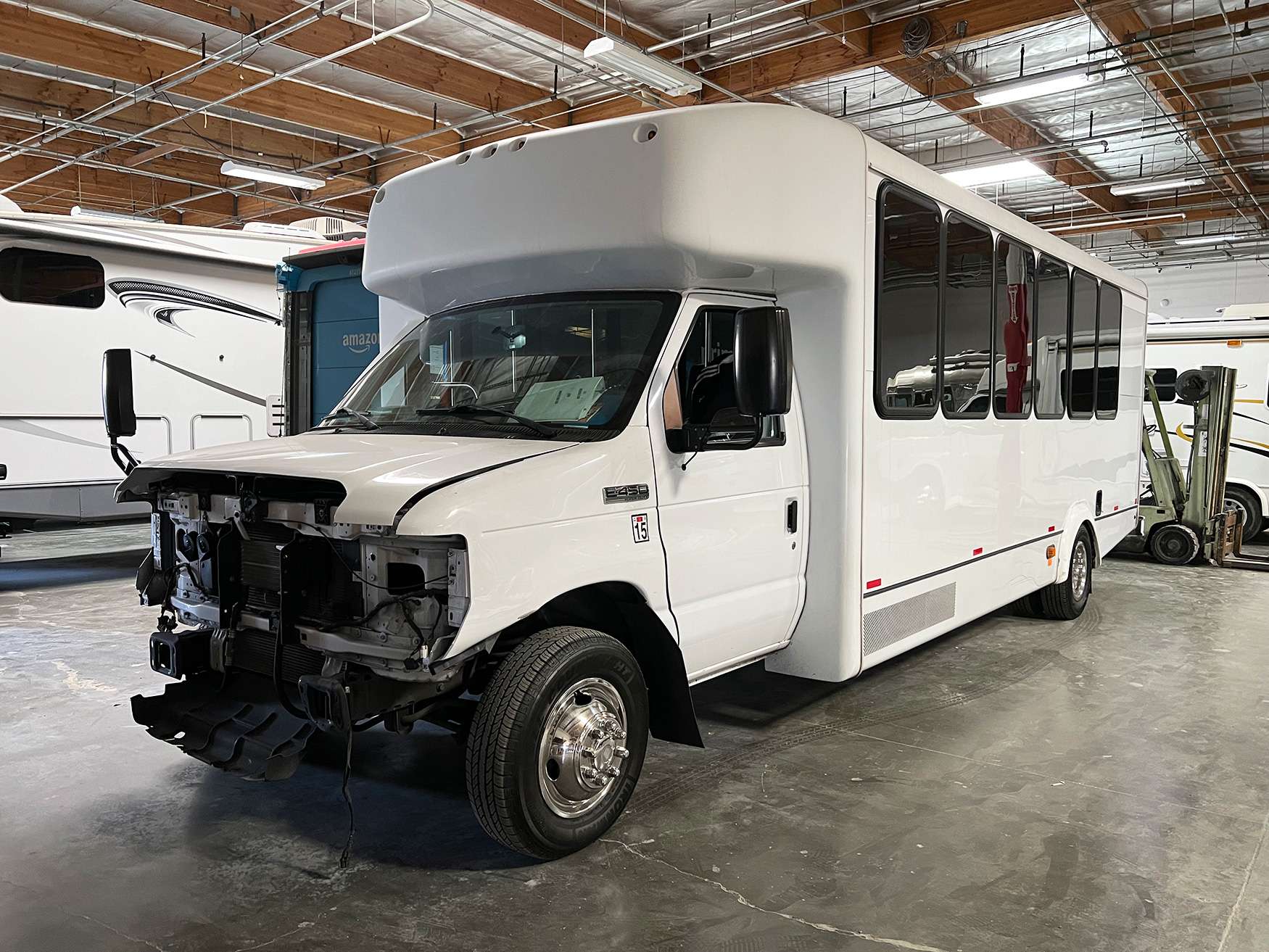
Shuttle bus repair almost always comes back to one joint. Westminster operators running parking shuttles, senior transport and hospitality routes bring us cutaway units where the factory cab and the bolted on body have been working against each other for years. This page covers that joint, the wheelchair lift door opening, entry stepwells, luggage bays and rear doors, and how we schedule around a vehicle with daily obligations.
The Cab to Body Joint Does the Suffering
A cutaway shuttle is a factory cab and chassis with an entirely separate body built and bolted on behind it. The two structures have different stiffness and they move relative to each other on every driveway and every speed bump. The joint between them absorbs all of that.
What we find there is sealant that has hardened and cracked, fasteners that have loosened, corrosion where water has been sitting in the joint, and on higher mileage units, elongated mounting holes where the body has been working against the chassis.
This is also the first place to look when a shuttle has water inside with no obvious roof leak. Water entering that joint runs into the floor structure at the front of the body and shows up as a soft floor near the stepwell, often years before anyone connects it to the joint.
- Inspect the cab to body joint sealant condition annually
- Check body mounting fasteners for looseness and hole elongation
- Look for corrosion in the joint before it reaches the floor
- Meter the floor near the front of the body for moisture
- Verify the body has not shifted relative to the chassis after any impact
Wheelchair Lift Door Openings
The lift door opening is a large hole cut into the side of the body, and everything around it is reinforced structure carrying loads that the rest of the wall does not see. The lift itself mounts into that structure and cycles under load repeatedly.
The failures follow the loads. Cracks radiating from the corners of the opening, doors that no longer close square, lift mounting fasteners that have loosened, and a threshold that has worn or corroded. All of them are structural rather than cosmetic.
We inspect the opening structure whenever a lift door problem comes in, because a door that will not close square on a shuttle is usually reporting a moved opening rather than a bad hinge. Repair means restoring the opening, then addressing the door and the lift mounting, in that order.
Stepwells, Entry Doors and Passenger Wear
The entry door and stepwell on a shuttle in daily service take an extraordinary number of cycles, and both are safety relevant. Worn step surfaces, edge trim that has lifted, a door seal that has taken a set and linkage pivots that have developed play are all normal high mileage findings.
The stepwell is also a water entry point that gets ignored. Rain and cleaning water run into the well, and if the drainage has been blocked by debris or a previous repair, that water sits against the floor structure below.
Grab rails and stanchions are the other item worth checking at the same time. They anchor into floor and wall structure and they get pulled on thousands of times, so anchorage that has begun to work is a real finding rather than a nuisance.
Luggage Bays, Rear Doors and Low Speed Damage
Shuttles that run hospitality and airport parking routes carry luggage, and the bay doors take constant handling plus the occasional hard closure with a bag in the way. Hinges elongate, latches wear and the bay opening takes hits from bags and carts.
Rear doors and bumpers take the low speed contact that comes with parking in tight lots multiple times a day. On a body bolted to a cutaway chassis, a rear hit can move the body on its mounts, which shows up as doors that no longer align and, again, as that cab to body joint opening up.
We measure the rear opening on any rear contact rather than assuming the doors just need adjustment, for the same reason we do it on every other vehicle on this site: hanging a door onto a distorted opening produces a door that never seals.
- Inspect bay door hinges and latches for elongation and wear
- Measure the rear opening after any rear contact
- Check body mount condition following a rear impact
- Look for new gaps at the cab to body joint after any incident
- Verify seal contact around doors after realignment
Scheduling a Vehicle With Daily Obligations
Shuttle operators generally run thin. A parking operation, a senior transport program or a hotel route often has one or two spares at most, and a unit down for three weeks is a service problem rather than an inconvenience.
So the schedule is part of the scope from the start. We book intake for when parts arrive rather than taking the unit in to sit, we stage larger jobs so the shuttle can return to service between phases where that is safe, and where an operator has multiple units we sequence them so only one is out at a time.
A worked example: lift door opening repair with crack repair at two corners, door realignment and refinish, no lift replacement, typically 22 to 34 hours of body labor at $210 for $4,620 to $7,140, plus $800 to $2,600 in structure, door hardware and refinish materials.
Questions
Frequently asked questions
There is a gap opening between the cab and the body. Is that a problem?
It depends on whether it has changed. On a cutaway shuttle the factory cab and the bolted on body are separate structures with different stiffness that move relative to each other constantly, so the joint between them is designed to accommodate movement and is filled with a flexible sealant that has a service life. A joint that has hardened and cracked is due for service. A gap that has changed since an incident, or one that is wider at the top than the bottom, means the body has shifted on its mounts, and that is structural. We measure rather than guess.
How much does shuttle bus repair cost?
The range is about $1,500 to past $35,000. Cab to body joint service with sealant and fastener work is typically $1,200 to $3,500. Lift door opening repair with corner crack repair, door realignment and refinish runs $6,000 to $10,000. Rear door and bumper repair after low speed contact is $2,500 to $6,000. Structural repair where the body has shifted on its mounts is $12,000 to $28,000. Body and paint labor is $210 per hour, mechanical is $260, and authorized repairs above $2,000 carry a 50 percent deposit.
My floor is soft near the front stepwell. Where is the water coming from?
Two likely sources, and both are commonly missed. The first is the cab to body joint, where hardened sealant lets water into the floor structure at the front of the body. That water travels and shows up at the stepwell area years later. The second is the stepwell itself, where rain and cleaning water run in and cannot drain because debris or a previous repair blocked the path. We check both with a water test and a moisture map before quoting, because repairing the floor without stopping the entry means doing the floor again in two years.
The wheelchair lift door will not close square. Is the hinge worn?
Sometimes, but more often the opening has moved. The lift door opening is a large hole cut into the side of the body with reinforcement around it carrying loads the rest of the wall never sees, and the lift cycles under load into that structure repeatedly. Cracks radiating from the corners of the opening are the usual finding, and once the opening has distorted, the door will not close square no matter what you do to the hinge. We inspect the opening structure first, restore it, then address the door and the lift mounting in that order.
How long will our shuttle be out of service?
Joint service is two to four business days. Rear door and bumper repair is one to two weeks. Lift door opening repair with crack repair and refinish is two to three weeks. Structural repair where the body has shifted on its mounts is four to seven weeks. Because most shuttle operators run one or two spares at most, we book intake for when parts arrive rather than taking the unit in to sit, and we stage larger jobs so the vehicle can return to service between phases where that is safe. Tell us your spare situation and we will schedule around it.
Can you handle the interior as well, grab rails and flooring?
Yes, and it is worth bundling with body work rather than booking a separate visit. Grab rails and stanchions anchor into floor and wall structure and get pulled on thousands of times, so anchorage that has begun to work loose is a genuine finding rather than a nuisance. Flooring, stepwell surfaces, edge trim and seat upholstery are all conventional work we do in the same visit. We scope interior items as separate lines so they can be approved or deferred independently of a collision repair, which is usually what a supervisor needs for their budget.
Do you work with agency purchase orders?
Yes. We produce a written line itemized scope with parts identified and labor operations described before a purchase order is cut, and anything outside that scope requires a written change order with photographs of the finding, the additional parts and labor, and the revised completion date, approved before we proceed. The invoice comes with photographs at intake, teardown, key stages and completion, plus measurement records where the repair was structural. If your maintenance system needs a specific format, tell us during scoping and we will produce it that way.
Our shuttles are all the same model. Does that help?
It helps considerably. We keep color formulas, decal layouts, seat and flooring specifications and body configurations on file, so the second and third units of the same model move through faster than the first, and parts identification takes less time. It also means we can anticipate the failures: on a fleet of identical cutaways of similar age, the cab to body joints, the lift door openings and the stepwell drainage tend to reach end of life around the same time, and scoping the whole fleet at once often turns an emergency into a planned program.
How the work runs
Our six step repair process
The same sequence on every vehicle, whether it is a single coach or a fleet of box trucks.
- 01
Assessment and documentation
We put the vehicle on the floor, pull panels where we need to see behind them, and photograph everything. Hidden damage found now is damage that does not become a supplement argument later.
- 02
Written estimate
You get a line by line estimate with parts, labor hours, materials, and the posted rate applied to each. Nothing is bundled into a single number you cannot check.
- 03
Carrier coordination
If a claim is involved we deal with the adjuster directly, submit the documentation, and handle supplements when teardown reveals more than the first inspection showed.
- 04
Authorization and scheduling
Once the scope is approved we confirm the deposit, order parts, and give you a realistic slot. Special order parts drive the timeline more often than labor does.
- 05
Repair
Structural first, then body, then paint, then systems and interior. The sequence is not negotiable because each stage has to be right before the next one covers it up.
- 06
Quality check and delivery
Multi point inspection, systems tested under load, paint inspected under corrected lighting, and a walkthrough with you before the vehicle leaves.
Keep reading
Related pages
Related vehicles
Services we perform
Talk to a repair specialist today
Tell us what happened and we will tell you what the repair actually involves, what it costs, and how long it takes. We work directly with every major carrier and serve Westminster owners and fleets from our 35,000 square foot facility.
Posted labor rates are published on our prices page. Diagnostic and systems assessment fees are credited against an authorized repair.