Vans
Cargo Van Repair for Working Fleets
In short
Cargo van repair runs from about $1,000 for a panel and door repair to past $25,000 for structural collision work. These vans earn money, so the scheduling matters as much as the estimate: we stage fleet work so an operator is never down more than one vehicle at a time.
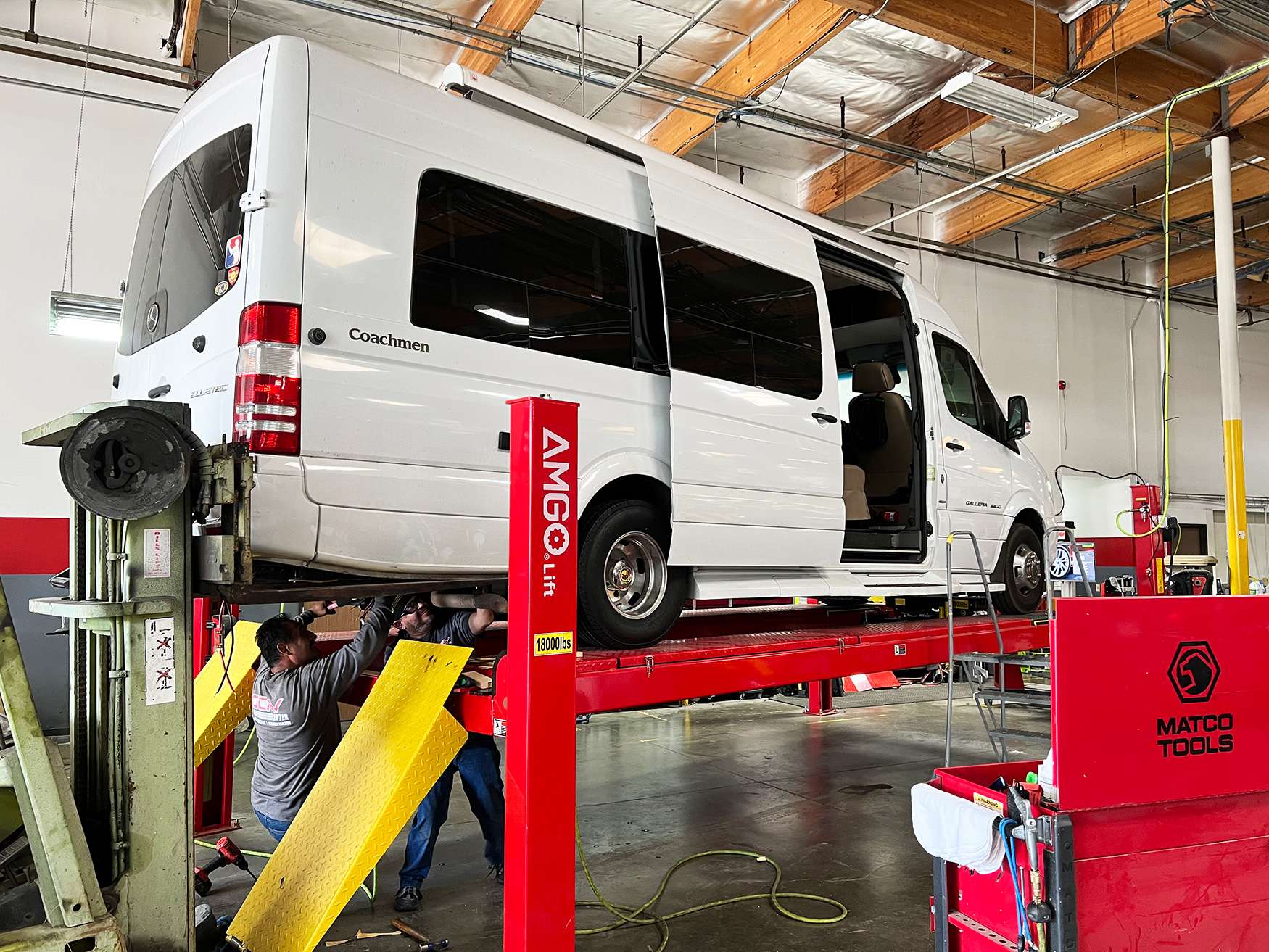
Cargo van repair is the most schedule sensitive work we do, because a van in our bay is a van not making deliveries. Westminster contractors and service companies bring us the same three jobs over and over: loading dock damage to rear corners, sliding doors worn out by thousands of cycles a month, and livery that has to be reproduced exactly after a panel is replaced. This page covers all of it.
Loading Dock Damage Is Its Own Category
Dock hits do not look like road collisions. They happen at very low speed with enormous force concentrated on a small area, usually the rear corner, the rear bumper, the door edge or the roof line where the van backed under something it should not have. The panel damage is often modest and the structural damage is not.
The rear corner is the specific concern. On a unibody van, that corner ties the floor, the side structure and the rear pillar together, and a hard dock hit can move the pillar enough to put both rear doors permanently out of alignment while the sheet metal looks repairable.
So we measure the rear opening on every dock hit before quoting. A repair that straightens the panel and leaves the pillar out is a van that never seals again, and on a cargo van that means dust and water in your load for the rest of its service life.
- Measure the rear opening before pricing panel work
- Check both door gaps for taper, not just the damaged side
- Inspect the rear crossmember and floor at the corner
- Look for buckling above the door line where a roof strike occurred
- Verify seal contact after repair, all the way around
Sliding Doors on High Cycle Duty
A delivery van can cycle its sliding door two hundred times a day. Nothing else on the vehicle sees that duty. Rollers flat spot, tracks distort at the ends of travel, the lower track packs with debris, and the detent that holds the door open stops holding, which then lets the door swing closed on a driver's arm.
This is genuine maintenance rather than repair, and treating it that way saves fleets money. A roller and track service on schedule is a few hundred dollars. A door that has been binding for six months has usually distorted the track and worn the guides, and now it is a parts job.
The one thing we always check first is whether the body is square, because a door that suddenly changed behavior after an incident is reporting structure. Servicing rollers on a distorted opening is money spent to learn that.
Shelving, Partitions and Floor Systems
Most working vans carry a shelving package, a bulkhead partition and a floor system, and all three affect body repair. Shelving bolted through the side panel means the panel cannot be worked from behind until the shelving comes out, and every one of those bolt holes is a corrosion site and a potential water path.
We remove and reinstall these packages as part of the job, and we take the opportunity to address what is behind them: corrosion at the fastener holes, worn floor covering, and partition mounts that have elongated. Reinstalling a shelf into a hole that has been working for eight years without addressing it just continues the problem.
Where a shelving package has been damaged in a collision, replacement is usually cheaper than repair. These are commodity components and the labor to straighten a bent shelf upright exceeds the cost of a new one nearly every time.
- Remove shelving to work a panel properly from behind
- Address corrosion at every fastener hole while it is open
- Replace bent shelf components rather than straightening them
- Check bulkhead partition mounts for elongation
- Inspect floor covering and the metal beneath it
Racks, Roof Loads and What They Do to a Thin Skin
Ladder racks and roof racks are standard on service vans and they are a chronic source of leaks and skin damage. Fasteners driven through a thin roof skin between ribs will eventually flex the metal open, and a loaded rack accelerates it. The visible sign is an oil canning ripple in the roof, usually before any water appears inside.
Proper mounting lands fasteners on ribs with backing where the load justifies it, and seals the penetration rather than coating over it. When we reinstall a rack after body work, that is how it goes back on, even if that is not how it came off.
The other rack related job is damage from what the rack is carrying. Ladders that shift and score the roof, pipe that slides forward into the roof line at a stop. Both are repairable and both are cheaper to prevent with proper tie down points than to fix repeatedly.
Livery, Graphics and Fleet Color Discipline
Commercial vans carry graphics, and reproducing them correctly is a bigger part of the job than owners expect. Before any disassembly we photograph and measure the layout: distance from body lines, from door edges, from the wheel arch. Reinstalling approximately where it was reads as wrong to anyone who looks at the fleet daily.
Color is the other discipline. Matching the paint code does not mean matching the van parked beside it, because commercial whites in particular drift after a few years of Southern California sun. We spray out and compare in daylight against the actual vehicle, then set the blend boundary by eye. Where possible we plan the repair edge to fall under a decal, which hides it completely.
A worked example: rear corner dock damage with panel repair, no structural involvement, and graphics reproduction, typically 12 to 20 hours of body and paint at $210 for $2,520 to $4,200, plus $400 to $1,600 in panel, hardware, refinish and graphics materials.
Questions
Frequently asked questions
How much does cargo van repair cost?
The range is about $1,000 to past $25,000. Rear corner dock damage with panel repair and graphics reproduction, no structural involvement, is typically $3,000 to $6,000. Sliding door roller and track service is a few hundred dollars, while a full track and door realignment after an impact is $1,500 to $4,000. A rear corner hit that moves the pillar and requires structural measurement and repair runs $6,000 to $14,000. Serious collision work can pass $25,000. Body and paint labor is $210 per hour and jobs above $2,000 carry a 50 percent deposit.
How fast can you turn a van around?
A panel and paint repair is typically five to nine business days. Sliding door service is one to two days. Structural repair with measurement is two to four weeks. What we do differently for fleets is schedule intake around parts rather than taking the van in to sit: if a component is three weeks out, we book you for when it lands and you keep the van working. We also stage multi vehicle work so you are down one unit at a time. Tell us your operating constraint when you call and we will build the schedule around it rather than around our bay availability.
My rear doors will not seal after backing into a dock. Why?
Almost certainly because the rear pillar moved. Dock impacts happen at very low speed with a large force concentrated on a small area, and on a unibody van the rear corner ties the floor, side structure and pillar together. The pillar can shift enough to put both doors permanently out of alignment while the sheet metal still looks straightforward. If the gap tapers, even at one end and wide at the other, that is geometry. We measure the rear opening before quoting any panel work, because straightening the panel and leaving the pillar out gives you a van with dust and water in the load forever.
Do I need to empty the van and remove the shelving first?
Empty it of tools and inventory, yes. Leave the shelving to us. Proper body repair needs access to the back of the panel, so the shelving has to come out anyway, and we would rather remove and reinstall it ourselves so we can address what is behind it: corrosion at the fastener holes, worn floor covering, partition mounts that have elongated. Reinstalling a shelf into a hole that has been working for eight years without treating it just continues the problem. If any shelf components were bent in the incident, replacement is nearly always cheaper than straightening them.
Can you match my company colors and reproduce the graphics?
Yes. We photograph and measure the graphic layout before any disassembly, recording distances from body lines, door edges and the wheel arch, so the livery goes back exactly where it was rather than approximately. On color, matching the paint code and matching the van beside it are different goals, because commercial whites drift after a few years of sun. We spray out and compare against the actual vehicle in daylight, then set the blend boundary by eye. Where we can, we plan the repair edge to fall under a decal, which hides the transition completely. Fleet formulas stay on file for the next vehicle.
Why does my sliding door keep failing?
Because nothing else on the van works that hard. A delivery unit can cycle that door two hundred times a day, which flat spots rollers, distorts the track at the ends of travel, packs the lower track with debris and wears out the detent that holds it open. Treated as scheduled maintenance, roller and track service is a few hundred dollars. Left until the door has been binding for six months, the track is distorted and the guides are worn and it becomes a parts job. The one thing we check first is body squareness, because a door that changed behavior after an incident is reporting structure rather than wear.
Water is getting in around my ladder rack. Is that normal?
It is common and it is not acceptable. Most rack installations put fasteners through a thin roof skin between the ribs with a bead of sealant over the top. That holds for a couple of years, then the skin flexes under the load and the joint opens. The usual first sign is an oil canning ripple in the roof rather than water. Proper mounting lands fasteners on ribs with backing plate where the load justifies it, and seals the penetration itself rather than coating over it. When we reinstall a rack after body work, that is how it goes back on even if it did not come off that way.
Do you handle several vans for one company at once?
We schedule them so you are not down several at once, which is usually what an operator actually wants. Vehicles come in as the previous one leaves, and we keep your color formulas, graphic measurements and shelving configurations on file so each subsequent van takes less shop time than the first. For larger fleets we will hold recurring slots so routine damage does not sit waiting for an opening. Any authorized repair above $2,000 takes a 50 percent deposit, which is what lets us order parts the day you approve rather than after an invoice cycle.
How the work runs
Our six step repair process
The same sequence on every vehicle, whether it is a single coach or a fleet of box trucks.
- 01
Assessment and documentation
We put the vehicle on the floor, pull panels where we need to see behind them, and photograph everything. Hidden damage found now is damage that does not become a supplement argument later.
- 02
Written estimate
You get a line by line estimate with parts, labor hours, materials, and the posted rate applied to each. Nothing is bundled into a single number you cannot check.
- 03
Carrier coordination
If a claim is involved we deal with the adjuster directly, submit the documentation, and handle supplements when teardown reveals more than the first inspection showed.
- 04
Authorization and scheduling
Once the scope is approved we confirm the deposit, order parts, and give you a realistic slot. Special order parts drive the timeline more often than labor does.
- 05
Repair
Structural first, then body, then paint, then systems and interior. The sequence is not negotiable because each stage has to be right before the next one covers it up.
- 06
Quality check and delivery
Multi point inspection, systems tested under load, paint inspected under corrected lighting, and a walkthrough with you before the vehicle leaves.
Keep reading
Related pages
Related vehicles
Services we perform
Talk to a repair specialist today
Tell us what happened and we will tell you what the repair actually involves, what it costs, and how long it takes. We work directly with every major carrier and serve Westminster owners and fleets from our 35,000 square foot facility.
Posted labor rates are published on our prices page. Diagnostic and systems assessment fees are credited against an authorized repair.