Services
RV Mechanical Repair and Systems Service in Orange County
In short
Mechanical and systems work on an RV covers the three electrical systems, the LP system, fresh and waste plumbing, heating and cooling, and the running gear under the floor. Most jobs land between $600 and $5,000 and sit in the shop 2 to 10 business days. Diagnostic time bills at $285 per hour and the first hour is credited against an authorized repair.
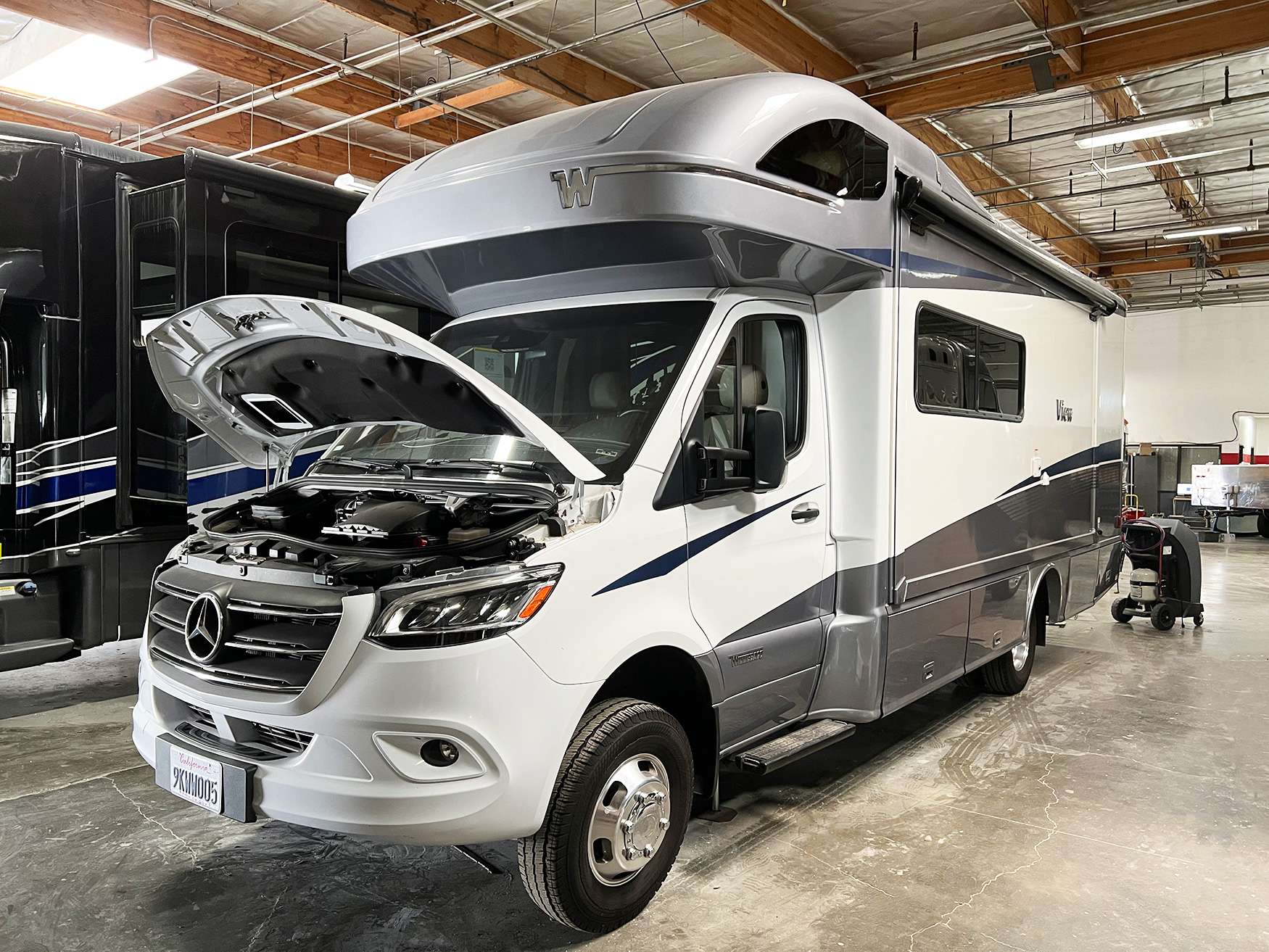
Owners searching for RV mechanical repair Orange County wide usually show up with a symptom instead of a diagnosis. The lights dim when the slide moves. The water heater lights on LP but not on electric. The brakes grab on one side. Our shop works through those complaints in order, system by system, because on an RV the systems share grounds, share space, and share failures. Westminster owners get a written estimate before anything is disassembled.
The Three Power Systems Living in One Coach
Almost every motorhome and travel trailer carries three electrical systems that share a floor plan and very little else. The chassis 12 volt system runs the starter, the engine controls, the dash, and the exterior lighting off the vehicle battery. The house 12 volt system runs interior lights, the water pump, furnace and refrigerator control boards, slide motors, and leveling jacks off a separate battery bank. The 120 volt system feeds outlets, roof air, the microwave, and the converter whenever the coach is on shore power or the generator is running.
Those three systems meet at a small number of parts, and almost every confusing electrical complaint starts at one of them. A battery isolation solenoid or a DC to DC charger links chassis to house. The converter turns 120 volt input into house 12 volt output. An inverter runs the other direction. An automatic transfer switch decides whether shore power or generator power reaches the panel. When one of those parts fails halfway, symptoms appear in a system that is not actually broken.
That is why we test in a fixed order. Battery state of charge and resting voltage first, then voltage under load, then the ground path, then the device itself. Skipping to the device is how people end up replacing a converter that was never bad. The chassis battery reads 12.7 volts at rest and 9.8 volts while cranking, and the problem is a cable end, not a battery. The order of testing is most of the job.
- Chassis 12 volt: starter, engine control module, dash gauges, running lights
- House 12 volt: interior lighting, water pump, furnace board, slide and jack motors
- 120 volt: outlets, roof air, microwave, residential refrigerator, converter input
- Bridge parts: isolation solenoid, DC to DC charger, converter, inverter, transfer switch
- Shared weak point: chassis and house grounds landing on painted or corroded steel
How the LP System Feeds Heat, Cooking, and Hot Water
Liquid propane leaves the tank as a liquid, boils to vapor, and passes through a two stage regulator that has to hold the coach side at roughly 11 inches of water column. That is a low pressure, and a manometer is the only honest way to read it. A regulator that has drifted down to 9 inches makes a furnace short cycle and a cooktop burn lazy and yellow. A regulator that has drifted high makes the same appliances soot. Owners usually blame the appliance. We test the regulator first.
After the regulator, the LP line branches to the furnace, the water heater, the cooktop, the oven, and on many coaches the absorption refrigerator. Each of those has an orifice sized in thousandths of an inch, and each of them collects spider webs in the burner tube during storage. A furnace that lights, runs 30 seconds, and shuts down is usually a sail switch or a partly blocked burner, not a bad board. A water heater that lights on LP but stays cold on 120 volts has a bad element or thermostat on the electric side only.
We also run a timed lock up test on the whole system before the coach leaves. Pressurize, close the tank valve, and watch the manometer for a set period. If the reading falls, there is a leak somewhere in the line, and we soap every fitting until we find it. A slow LP leak in a stored coach is the failure that turns into something much worse than a repair bill, so this test is not optional on any job that opens a gas line.
Fresh Water, Waste, and the Plumbing Between Them
The fresh side starts at either the pump or the city inlet. The pump pulls from the onboard tank and holds pressure through a built in switch, usually cycling around 45 psi. The city inlet takes whatever the campground gives it, and campgrounds sometimes give 90 psi. That is why an inline regulator set at 40 to 50 psi is the cheapest protection in the trade. Most of the split fittings and blown toilet valves we replace were killed by unregulated city pressure, not by age.
PEX runs behind cabinets and under the floor with crimp rings or expansion fittings. A leak at a crimp ring drips down a wall and shows up ten feet away as a soft spot in the floor, which is why we trace water uphill instead of patching where we see it. On the waste side, gray and black tanks drain through gate valves that stick when the seals dry out, and the vent stack has to breathe or the toilet gurgles and the tank reads wrong.
Level sensors are the most common complaint and the least common actual failure. Probes on the inside of the tank get bridged by paper and residue, so the panel reads three quarters when the tank is empty. That is a cleaning problem. A real sensor failure is a broken wire at the probe or a corroded board, and it takes a meter to tell the difference. We check probe resistance before anyone starts talking about replacing a tank.
- Fresh side: pump, accumulator, PEX runs, city inlet, backflow check
- Regulator: hold city pressure at 40 to 50 psi to protect fittings and valves
- Waste side: gray and black tanks, gate valves, seals, vent stack
- Common leak points: pump fittings, toilet supply, water heater inlet, tank flange
- Sensor faults: paper and residue bridging the probes, not a failed tank
Roof Air, Furnaces, and the Ducting Between Them
A rooftop air conditioner is a sealed system with a compressor, a fan motor, and a run capacitor, and the capacitor is the part that fails first. A unit that hums and trips the breaker almost always has a capacitor that has lost capacitance or a compressor with locked rotor. We clamp the amp draw on startup and compare it to the data plate. A 13,500 BTU unit that pulls 12 amps steady is healthy. The same unit pulling 20 amps and climbing is on its way out.
Furnaces follow a strict sequence. The thermostat calls, the blower spins up, the sail switch closes when airflow is proven, the gas valve opens, the igniter sparks, and the flame sensor confirms. Break any link and the furnace either does nothing or runs the blower and shuts down. Most no heat calls are a sail switch that will not close because the return air path is blocked by storage boxes, a dirty blower wheel, or a duct that came loose behind a cabinet. That is a cheap fix once somebody actually looks.
Ducting matters more than people expect. RV ducts are thin, taped, and easy to crush during a slide repair or a floor replacement. If one bedroom never gets cool and the rest of the coach is fine, we are looking for a collapsed duct or a missing divider in the plenum, not a weak air conditioner. Measuring temperature drop across the evaporator and again at each register tells us whether the problem is the machine or the path it feeds.
Running Gear, Brakes, and What Carries the Weight
Most towable trailers use electric drum brakes. A magnet in each drum pulls against the armature surface when the controller sends voltage, and the shoes wedge outward. Brakes that grab on one side are almost never a controller problem. They are a magnet with a shorted winding, a scored armature surface, or shoes that were never adjusted after the last replacement. We measure magnet resistance at each wheel and compare all four before anyone touches the controller in the tow vehicle.
Bearings are the other half of the axle story. Repack interval depends on how the trailer is used, but a hub that runs hot after an hour on the road is telling you the seal failed and the grease left. Dexter and Alko axles both use standard bearing sets and the parts are not expensive. The damage from ignoring it is expensive, because a spun bearing takes the spindle with it and then a whole axle gets replaced instead of a twenty dollar seal.
Suspension wear shows up as tire wear. Worn shackle bushings and a tired equalizer let the axles shift out of parallel, and the tires scrub sideways every mile. If the inside edge of one tire is feathered and the others look normal, we measure axle spacing and check the shackle holes for elongation. On motorhome chassis we look at bushings, sway bar links, and steering play before anyone spends money on a steering stabilizer that only masks the symptom.
- Trailer brakes: magnets, shoes, drums, and controller output measured at the connector
- Bearings: repack interval, seal condition, hub temperature after a road run
- Suspension: shackles, equalizer, bushings, U bolts, spring center bolts
- Tires: date codes checked against actual scaled axle weight
- Tracking: bent spindle, shifted axle, or elongated shackle holes
What Diagnostic Time Costs and Why It Is Billed
Diagnostic labor bills at $285 per hour. That rate covers a technician plus a scope, a clamp meter, a manometer, refrigerant gauges, and the shop time to reproduce a fault that may only happen when the coach is warm or the slide is halfway out. When you authorize the repair, the first diagnostic hour is credited against that repair. If you take the findings elsewhere, you paid for real work and you own a written report of what was measured and where.
There is also a $150 RV systems assessment. That is the broad pass, not the deep one. We check battery health, converter output, LP regulator pressure, water heater and furnace operation, roof air amp draw and temperature drop, water pump pressure, tank sensor behavior, and brake magnet resistance, then hand you a prioritized list. It is credited against an authorized repair as well. Owners buying a used coach or waking one up after a long storage period usually start there.
Repair labor is $260 per hour for mechanical and systems work. Parts carry 100 percent markup at or under $100 and 35 percent above $100. California charges 7.75 percent sales tax on parts and materials and does not tax labor. Any authorized job above $2,000 takes a 50 percent deposit before parts are ordered. A common example: 3 hours of repair labor at $260 is $780, a $310 control board at 35 percent is $418.50, tax on the part is $32.43, and the invoice is $1,230.93.
- RV systems assessment: $150, credited against an authorized repair
- Diagnostic labor: $285 per hour, first hour credited against an authorized repair
- Mechanical and systems labor: $260 per hour
- Parts: 100 percent markup at or under $100, 35 percent above $100
- Sales tax: 7.75 percent on parts and materials, none on labor
- Deposit: 50 percent on any authorized job above $2,000
License ARD00288521 and What California Requires
OCRV Center is a registered automotive repair dealer, license ARD00288521, and we hold EPA ID CAL000367879 for the hazardous waste our processes generate. Registration is not decoration. It puts a set of specific obligations on us and it gives you a specific place to complain if we fail them. Any shop working on your RV in this state should be able to give you that number without hesitating, and you should be able to look it up before you leave a deposit.
The first obligation is a written estimate before work begins, showing parts and labor. You sign it. If the job turns out to need more than the estimate covers, we stop and get your authorization for the additional amount before we continue. That call happens more often on RVs than on cars, because water damage and corrosion hide behind panels. Nobody enjoys the phone call. Everybody prefers it to an invoice that is 40 percent higher than the number they agreed to.
The invoice has to itemize what was done, list parts and whether they were new, used, or rebuilt, and separate labor from parts. You can ask for your replaced parts back, and we will set them aside if you tell us before the work starts. Keep the invoice. It is the document that matters when you sell the coach, when an insurer asks what was repaired, and when a component fails again and we need to know exactly what went in.
In this category
Services we perform
Electrical Repair
RV electrical work runs from $285 for a single diagnostic hour plus a small part up to $5,000 or more for a coach that needs feede...
Read moreInverter and Converter Repair
Converter and inverter work runs from about $750 for a converter section replacement to $4,500 or more for a pure sine inverter ch...
Read moreSolar Panel Installation
Most RV solar work at our shop lands between $1,500 and $12,000, and a typical 400 to 600 watt rooftop array with an MPPT controll...
Read moreGenerator Repair
Most RV generator repair falls between $400 and $8,500, and the most common cause we see is varnished fuel sitting in a carburetor...
Read morePlumbing Repair
RV plumbing repair runs from about $285 for a single valve or seal up to $4,500 or more when a line splits inside a wall cavity an...
Read moreWater Heater Repair
Most RV water heater faults are ignition or heating element problems, and they run 350 to 900 to put right. A full tank or tankles...
Read moreHolding Tank Repair
Holding tank work runs from about 750 for a gate valve and cable to 8,500 or more for dropping and replacing tanks on a coach with...
Read moreAppliance Repair
RV appliance jobs in Westminster run from about 400 for an igniter or thermostat to 4,500 or more for an absorption cooling unit o...
Read moreAir Conditioner Repair
Most rooftop RV air conditioner failures are electrical, not refrigerant related, and a failed capacitor is the single most common...
Read moreFurnace and Heating Repair
Most RV furnace faults in Westminster coaches are a blocked exhaust, a sail switch that will not close, or a tired blower motor, n...
Read moreBrake, Axle and Suspension
Trailer brake and axle work in our Westminster shop runs from about $300 for a single magnet and seal up past $6,500 for a bent ax...
Read moreTransmission and Driveline
Driveline and transmission work in our Westminster shop runs from about $2,500 for a shaft rebuild with u joints and a center supp...
Read moreQuestions
Frequently asked questions
Why do I have to pay for a diagnosis when the repair seems obvious?
Because on an RV the obvious repair is wrong more often than it is right. Dim lights look like a battery and turn out to be a ground strap. A refrigerator code looks like a board and turns out to be low house voltage. Diagnostic labor is $285 per hour, and that hour buys a technician with a scope, a clamp meter, and a manometer working through the system in order instead of guessing with your money. When you authorize the repair, $285 comes off the ticket. If you decide to go elsewhere, you leave with a written record of every measurement we took.
What is the difference between the $150 systems assessment and diagnostic labor?
The assessment is broad and shallow. For $150 we go through battery health, converter output, LP regulator pressure, furnace and water heater operation, roof air amp draw and temperature drop, water pump pressure, tank sensor behavior, and brake magnet resistance, then hand you a prioritized list of what is worn, what is failing, and what is fine. Diagnostic labor at $285 per hour is deep and narrow. It is what we do when one specific fault has to be chased to its root cause. The assessment is credited against an authorized repair, and so is the first diagnostic hour.
My interior lights dim and my slide moves slowly. Is the battery bad?
Maybe, but that pair of symptoms points harder at a connection than at a battery. Both loads share the house ground path, and a corroded ground adds resistance that only shows up under current. A bank that reads 12.7 volts sitting still can collapse to 10 volts when the slide motor pulls 40 amps. We load test the bank, then run a voltage drop test across the ground connections and the positive feed while the slide runs. If the drop is high, cleaning and retorquing one connection fixes both complaints for far less than a set of batteries.
Do you work on the chassis engine and transmission, or only the house side?
Both. Mechanical labor at $260 per hour covers chassis work as well as house systems, including brakes, axles, suspension, driveline, and transmission service on RV chassis. Where we draw the line honestly is deep internal engine machine work and some manufacturer specific chassis programming, which belongs at a chassis dealer with the factory tooling. We will tell you when a job falls on that side of the line rather than take it apart and discover it halfway through. Most owners come to us because a chassis shop cannot lift a 40 foot coach and our shop can.
How long will my RV sit in the shop for a systems repair?
Most systems jobs run 2 to 10 business days. The variable is almost never labor. It is parts. Common items like capacitors, sail switches, pumps, converters, and brake magnets are usually in hand within a day or two. Control boards for specific appliance models, slide motors, and anything discontinued can take a week or more, and a discontinued board sometimes means converting to a current model. We tell you the parts timeline when we quote, and we do not disassemble a coach until the parts that put it back together are ordered and confirmed.
My refrigerator cools on LP but not on shore power. What is wrong?
An absorption refrigerator has two heat sources for the same boiler, an LP burner and a 120 volt electric element. If it cools on gas, the cooling unit is fine and the fault is on the electric side only. That is usually the heating element itself, its thermostat or thermal cutoff, the relay on the control board, or the 120 volt supply to the refrigerator. Testing element resistance and confirming voltage at its terminals takes under an hour. It is a good example of why we test before quoting, because a cooling unit and an element are very different numbers.
When is a deposit required and what happens if the repair grows?
Any authorized job above $2,000 takes a 50 percent deposit before parts are ordered. That protects both sides, because most RV parts are not returnable once they are ordered against a specific coach. If the job grows past the estimate, we stop and call you with the new number and the reason before doing the additional work. You authorize it or you do not. That is not a courtesy, it is what a registered repair dealer owes you in California, and it is the single most common complaint we hear about other shops.
Is it ever smarter to leave a system broken?
Yes, and we will say so. A 20 year old absorption refrigerator with a leaking cooling unit is often worth more as an opening for a compressor refrigerator than as a rebuild. A rusted axle under a trailer with a soft floor and delaminated sidewalls is money spent on a coach with bigger problems. If you never dry camp, a dead inverter can honestly wait. We would rather give you a ranked list and let you spend on the items that keep the coach safe and dry than sell you a full repair you do not need.
Keep reading
Related pages
Other service areas
Vehicles we repair
Talk to a repair specialist today
Tell us what happened and we will tell you what the repair actually involves, what it costs, and how long it takes. We work directly with every major carrier and serve Westminster owners and fleets from our 35,000 square foot facility.
Posted labor rates are published on our prices page. Diagnostic and systems assessment fees are credited against an authorized repair.