Mechanical and Systems
RV Black and Gray Tank Repair That Actually Holds
In short
Holding tank work runs from about 750 for a gate valve and cable to 8,500 or more for dropping and replacing tanks on a coach with a full belly pan. Cracked polyethylene tanks are repaired by plastic welding, not epoxy, because nothing bonds reliably to poly. Most jobs take 3 to 12 business days.
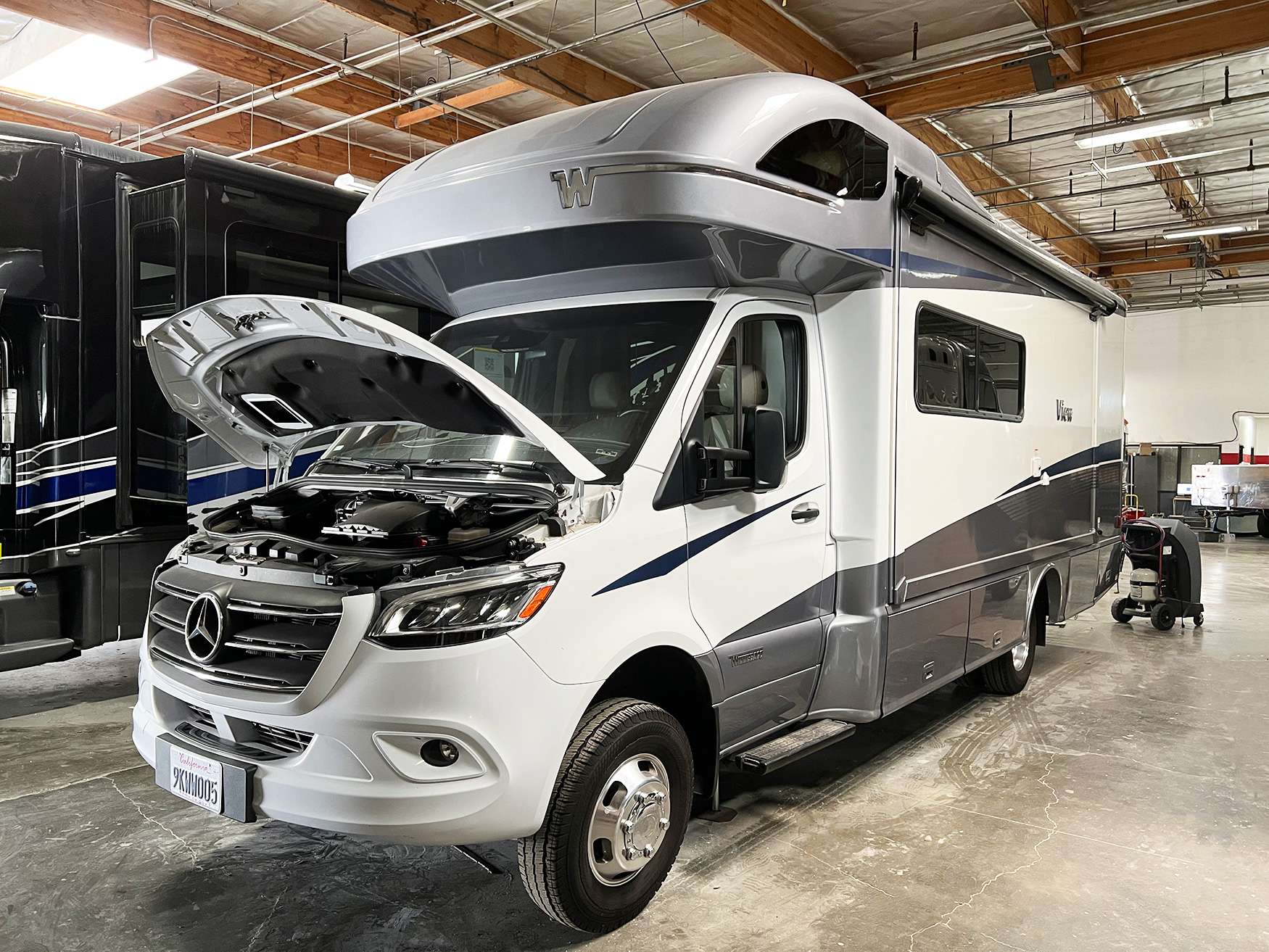
RV black and gray tank repair covers a lot of ground: a cracked polyethylene tank, a gate valve that will not seat, a sensor board that reads full on an empty tank, or a vent stack that pushes odor back into the coach. Westminster owners usually call after they smell something or find a drip on the driveway. The repair path depends on what the tank is made of, how the coach is built underneath, and whether the belly pan has to come down.
Why Polyethylene Tanks Crack
Nearly every RV holding tank is rotationally molded polyethylene. It is light, chemically inert, and cheap to produce in odd shapes that fit around frame rails. What it is not is stiff. A full black tank can carry three hundred pounds of water, and that mass swings on every dip and expansion joint. Over years, the plastic work hardens at the stress points, which are almost always the corners where the tank sits on a strap edge or a sharp bracket.
The second cause is impact. A road hazard, a curb strike, or a hard bottom out on an uneven driveway puts a point load into a hanging tank. Sometimes the crack shows up right away as a drip. More often it starts as a stress whitening line you can only see with the tank down and a light behind it, and it opens up months later when the tank is full and the coach is moving.
The third is heat and sun on a tank that sits low with no shielding, combined with chemicals. Harsh drain openers and some tank treatments attack the plastic and the seals around the fittings. Most of the leaks we trace are not in the tank wall at all, they are at a molded in fitting or a spin weld that has fatigued. That distinction matters, because a fitting failure is a much smaller repair.
- Stress cracks at the corners where a strap edge or bracket bites into the wall
- Impact damage from a road hazard or a hard bottom out on an uneven approach
- Fatigued spin welds and molded fittings at the inlet, outlet, or vent boss
- Chemical attack from harsh drain openers and aggressive tank treatments
- Seam splits on a tank that was left full through a hard cold snap
- Abrasion from a missing or sagging belly pan letting the tank ride on a crossmember
Plastic Welding Beats an Epoxy Patch
Polyethylene has very low surface energy. In plain terms, adhesives do not stick to it. Epoxy, marine sealant, and fiberglass patches all bond to the surface film rather than the plastic, and every one of them we have seen on a customer tank was already lifting at an edge. It might hold through one dump cycle. It will not survive a season of the tank flexing under load, and when it lets go it usually takes a piece of the crack edge with it.
The correct repair is extrusion or hot air welding with polyethylene rod that matches the tank material. The tank has to be clean, dry, fully vented, and completely purged before any heat gets near it. We vee out the crack, drill stop holes at each end so it cannot propagate, and lay in welded rod in passes until the repair is thicker than the original wall. Then it gets a backing plate welded across the area if the crack was in a flex zone.
Every welded tank is pressure tested with low pressure air and soapy water before it goes back up, and again with water once installed. If the crack runs through a molded fitting boss or across a large radius corner, we will tell you the weld is not the right answer and quote replacement instead. There are tanks that are not worth repairing, and pretending otherwise just means the rig comes back.
Straps, Supports, and Road Impact Damage
A tank does not fail in isolation. It fails because whatever was holding it stopped doing the job. Most coaches carry tanks on steel or aluminum straps bolted to the frame or to a subfloor structure. Those straps rust at the fastener, elongate at the bolt hole, or simply loosen. Once one strap is slack, the tank hangs on the others at an angle and starts loading a corner that was never meant to carry weight.
After a road impact we inspect the whole support system, not just the obvious dent. We look for elongated bolt holes, bent brackets, cracked welds at the frame tab, and compression marks in the tank wall where it contacted a crossmember. A tank that hit something hard enough to crack usually also moved, and if it moved the drain plumbing and the vent line got stretched or pulled at a joint.
The fix is normally new strap material, correct hardware with proper backing, and a rubber or felt isolation layer between metal and plastic so the strap edge does not saw into the tank again. On coaches where the factory support was marginal to begin with, we will fabricate an additional cradle or a spreader plate. That is a small addition during a job where the tank is already down, and it is what keeps this from being a repeat repair.
- Elongated bolt holes and loose fasteners at the frame tabs
- Rusted or stretched straps that let the tank hang at an angle
- Compression witness marks where the tank rides on a crossmember
- Cracked welds at factory support brackets after an impact
- Missing isolation material letting a metal edge cut into the plastic
- Stretched drain and vent connections from a tank that shifted position
Gate Valves, Cables, and Termination Leaks
The gate valve is a flat blade sliding through a housing between two rubber seals. It fails when solids build up on the seal faces, when the seals take a set from sitting closed for months, or when the blade itself gets scored. The symptom owners notice is a valve that will not fully close, so the black tank slowly drains into the sewer hose bay and the smell arrives before the leak does. A valve that will not open is usually a bent or seized blade.
Cable operated valves add a second failure point. The push pull cable runs from a handle at the service bay to the valve body, and the inner cable corrodes, kinks, or pulls out of the swage at the end. You get the sensation of a valve moving at the handle while nothing happens at the tank. Cable replacement is usually straightforward if the routing is accessible, and it is a lot cheaper than the valve.
Termination leaks are separate again. The bayonet fitting, the slip joints, and the ABS glue joints at the sewer outlet all live in a spot that gets hit by road debris and dragged over curbs. We pressure test the whole termination assembly rather than replacing the one part you can see dripping, because a joint that is weeping under gravity will fail outright under a full tank dump.
Sensor Probes and the Tank That Always Reads Full
The traditional level sensor is a set of metal probes penetrating the tank wall at different heights. Waste conducts between the probe and the tank ground, closing the circuit. The problem is that toilet paper and residue drape over the probe and never leave, so the circuit stays closed and the panel reads full on an empty tank. This is not a broken sensor. The sensor is doing exactly what it was designed to do with a probe that has a rag hanging off it.
What actually cleans them is mechanical action plus a surfactant, not a magic additive. We fill the tank part way with water, add an enzyme or detergent based treatment, and drive the coach or agitate the contents so the water sloshes and shears the buildup off the probes. Repeat cycles do more than one heroic soak. A tank wand or a rotating spray nozzle through the toilet gets the black tank probes directly, and that fixes most of them.
When the probes are genuinely corroded through or the tank wall is scaled, the durable answer is an external sensor system that reads through the wall with no penetration. Those mount to the outside of the tank and cannot foul because nothing touches the waste. On a coach where the tank is already coming down for other work, adding external sensors costs very little extra labor and it ends the problem permanently.
- Probe fouling from paper and residue is the cause, not a failed gauge
- Enzyme or detergent treatment plus agitation removes buildup, additives alone rarely do
- A tank wand or rotating spray nozzle reaches black tank probes directly
- Corroded probes can leak at the tank wall and should be replaced, not ignored
- External read through sensors eliminate fouling entirely and never touch the waste
- Gray tanks foul with grease and soap film and need detergent rather than enzymes
Vent Blockage, Odor Diagnosis, and Toilet Flange Leaks
Odor inside the coach is a diagnosis, not a symptom to mask. Every holding tank needs a vent stack running to the roof so air can enter as liquid leaves and gases can escape upward. When that stack is blocked by a wasp nest, a collapsed vent cap, or a crushed line behind a wall, the tank cannot breathe. Gases take the only other available path, which is back through the toilet seal or up through a dry gray trap into the living space.
We diagnose odor by isolating paths. Smoke or a low pressure air test through the vent shows a blockage. A dry P trap under a sink or shower is checked and refilled. Then we look at the toilet itself: the floor flange seal, the closet bolts, and the ball seal inside the toilet that holds water in the bowl. A toilet that will not hold water in the bowl overnight is an open pipe from the black tank to your nose.
Flange leaks show up as a soft spot or a stain in the subfloor around the toilet base, and by the time you can see it the plywood is usually compromised. That turns a seal job into a floor repair. We check the flange condition and the subfloor while the toilet is off, and we tell you honestly if the floor needs attention before the toilet goes back down, because setting a new seal on rotted plywood accomplishes nothing.
Dropping a Tank, Belly Pan Access, and What It Costs
Access drives the price of this work more than the repair itself. On a travel trailer with an open underbelly, a tank might be four bolts and a drain line. On a diesel pusher with a full insulated belly pan, skirting, and a run of hydraulic and air lines crossing the area, getting to the same tank can take five hours before the first strap comes loose. We quote after we look underneath, not from a phone description, because the two jobs are not remotely the same.
Containment matters as much as access. Tanks come down with residue in them regardless of how carefully they were dumped, and we handle that under our EPA ID CAL000367879 with proper capture, containment, and licensed disposal. That is time and material on the invoice, and it is not optional. Anyone quoting a tank drop without accounting for containment is either doing it in a way you would not want or leaving it off the estimate to look cheaper.
Worked example, gate valve replacement. Half an hour of diagnostic bills 142.50 and is credited on authorization. Repair labor of 2.5 hours at 260 is 650. A 34 dollar three inch valve is under 100, so it marks up 100 percent to 68, with 5.27 in tax. The invoice is 723.27, which is the realistic bottom of this range and covers valve replacement, new seals, and a fill and dump test before it leaves.
Worked example, cracked black tank welded on a coach with a full belly pan. Labor of 8.5 hours at 260 is 2,210, covering pan removal, tank drop, containment, vee and weld, pressure test, and reinstallation. Welding rod, strap hardware, isolation material, and sealant at 145 mark up 35 percent to 195.75, with 15.17 in tax. Total 2,420.92, with a 1,210.46 deposit since the job crosses 2,000.
- Bottom of the range: gate valve, cable, termination fitting, or sensor cleaning
- Middle of the range: single tank drop with a plastic weld and new strap hardware
- Top of the range: replacing two tanks with full belly pan and skirting removal
- Full replacement example: 22 hours labor at 260 is 5,720, tanks and hardware at 1,780 mark up to 2,403, tax 186.23, total 8,309.23
- Containment and licensed disposal are line items on every tank drop
- Deposit of 50 percent applies to any authorized job above 2,000
Questions
Frequently asked questions
Can a cracked black tank just be patched with epoxy?
No, and this is the most common thing owners try before calling us. Holding tanks are polyethylene, which has a very low surface energy, meaning adhesives cannot get a real mechanical or chemical bond. Epoxy, marine sealant, and fiberglass all stick to the surface film rather than the plastic. It might survive a few dump cycles, then it lifts at an edge and leaks again, usually worse than before. The correct repair is plastic welding with matching polyethylene rod, with the crack veed out, stop holes drilled at each end, and welded passes built up thicker than the original wall. Then it gets pressure tested before reinstallation.
Why do my tank sensors always read full?
Because the probes are fouled, not because the gauge is broken. Factory sensors are metal probes penetrating the tank wall, and waste completes a circuit between the probe and ground. Toilet paper and residue drape across a probe and stay there, holding the circuit closed permanently so the panel reads full on an empty tank. Additives alone almost never clear it. What works is mechanical action: fill the tank part way, add an enzyme or detergent treatment, and agitate or drive so the water shears the buildup off. A rotating tank wand through the toilet reaches black tank probes directly. If probes are corroded through, external read through sensors solve it permanently.
How much does it cost to replace a gate valve?
Roughly 700 to 1,100 depending on access and how many valves are involved. A representative job: half an hour of diagnostic at 285 per hour bills 142.50 and is credited back when you authorize the repair. Repair labor of 2.5 hours at 260 per hour is 650. A three inch valve at 34 dollars marks up 100 percent to 68 since it is under 100, plus 5.27 in tax at 7.75 percent. That comes to 723.27 including new seals and a fill and dump test. If the valve is cable operated and the cable is also shot, add roughly 200 to 350 for the cable and the extra routing time.
What does it cost to drop and replace a holding tank?
It depends almost entirely on what is between us and the tank. On an open underbelly trailer, a single tank replacement can land near 2,000 to 3,000. On a coach with a full insulated belly pan, skirting, and service lines crossing the area, a two tank replacement is a genuine 8,000 plus job. A worked example at the top end: 22 hours of labor at 260 per hour is 5,720, tanks and support hardware at 1,780 mark up 35 percent to 2,403, and tax at 7.75 percent adds 186.23, for 8,309.23. A 50 percent deposit applies. We quote after inspecting underneath, never from a description.
There is a sewer smell inside the coach even when the valves are closed. Why?
Closed valves do not stop odor, because odor travels through the vent path, not the dump path. Every tank has a vent stack to the roof, and if that stack is blocked by a wasp nest, a crushed line, or a collapsed cap, gases take the next available route into the living space. The usual entry points are a toilet ball seal that no longer holds water in the bowl, a dry P trap under a shower or sink that has not been used, or a failed floor flange seal. We test the vent for blockage, check every trap, and inspect the toilet seal and flange in that order.
My tank is sagging. Is that a strap problem?
Usually yes, and it needs attention before it becomes a crack. Tanks hang from steel or aluminum straps bolted to the frame or subfloor. Those fasteners loosen, the bolt holes elongate, and the straps rust or stretch. Once one strap goes slack, the full weight redistributes onto the remaining supports and starts loading a tank corner that was never designed to carry it. That is exactly where stress cracks start. The repair is new strap material, correct hardware with backing plates, and isolation material between metal and plastic so the strap edge stops sawing into the wall. On coaches with marginal factory support, we fabricate an added cradle.
Do I have to dump and rinse the tanks before I bring the rig in?
Yes, please dump and rinse both tanks as thoroughly as you can before drop off. It makes the job cleaner, faster, and cheaper for you, because containment and handling time on a full tank is billable labor. That said, no tank comes down truly empty, and we plan for residue on every job. We capture, contain, and dispose of what comes out under our EPA ID CAL000367879. If you cannot dump before arriving, tell us when you schedule so we can allocate the extra time rather than discovering it on the lift.
How long does holding tank work take?
Most jobs run 3 to 12 business days. A gate valve, a cable, or a termination fitting is often two to three days including the fill and dump test. A single tank drop with a plastic weld is usually four to seven days, since the weld needs to cool fully and pressure test before it goes back up. A full replacement on a coach with a belly pan runs eight to twelve days, and longer if the tank is a discontinued size that has to be sourced or fabricated. Sensor cleaning and vent clearing are usually same day or next day work.
Standard on every job
What is included
These are not upgrades. They are how the work is run on every vehicle that comes through the building.
Full teardown where it is needed
We do not estimate through a closed panel. If the damage path runs behind trim or skin, we open it and document what is actually there.
Written, itemized scope
Parts, labor hours, and materials listed separately against the posted rate, so every line is something you can question.
Direct carrier communication
We talk to the adjuster so you are not relaying technical detail between two parties who both expect you to already understand it.
Supplement handling
When teardown finds more than the original inspection, we document and submit the supplement rather than absorbing it into a vague overage.
Correct repair sequence
Structural before cosmetic, every time. A straight body over a bent frame is a repair that fails its second life.
Systems tested under load
Electrical, plumbing, generator, and climate systems are run and verified before delivery, not just reconnected and assumed good.
Photo documentation throughout
Before, during, and after. Useful for your records, and decisive if a claim is ever revisited.
Delivery walkthrough
We go over what was done, what was replaced, and what to watch, in person, with the vehicle in front of you.
How the work runs
Our six step repair process
The same sequence on every vehicle, whether it is a single coach or a fleet of box trucks.
- 01
Assessment and documentation
We put the vehicle on the floor, pull panels where we need to see behind them, and photograph everything. Hidden damage found now is damage that does not become a supplement argument later.
- 02
Written estimate
You get a line by line estimate with parts, labor hours, materials, and the posted rate applied to each. Nothing is bundled into a single number you cannot check.
- 03
Carrier coordination
If a claim is involved we deal with the adjuster directly, submit the documentation, and handle supplements when teardown reveals more than the first inspection showed.
- 04
Authorization and scheduling
Once the scope is approved we confirm the deposit, order parts, and give you a realistic slot. Special order parts drive the timeline more often than labor does.
- 05
Repair
Structural first, then body, then paint, then systems and interior. The sequence is not negotiable because each stage has to be right before the next one covers it up.
- 06
Quality check and delivery
Multi point inspection, systems tested under load, paint inspected under corrected lighting, and a walkthrough with you before the vehicle leaves.
Keep reading
Related pages
Related services
Vehicles we repair
Talk to a repair specialist today
Tell us what happened and we will tell you what the repair actually involves, what it costs, and how long it takes. We work directly with every major carrier and serve Westminster owners and fleets from our 35,000 square foot facility.
Posted labor rates are published on our prices page. Diagnostic and systems assessment fees are credited against an authorized repair.