Vans
Sprinter Van Repair for the Chassis Platform
In short
Sprinter van repair here means the platform itself, not what somebody built inside it. The same tall body, thin high strength panels and sliding door geometry show up in our bays as a contractor's work van one week and a camper the next. Work runs from about $1,500 for panel and door repair to past $40,000 for structural collision work.
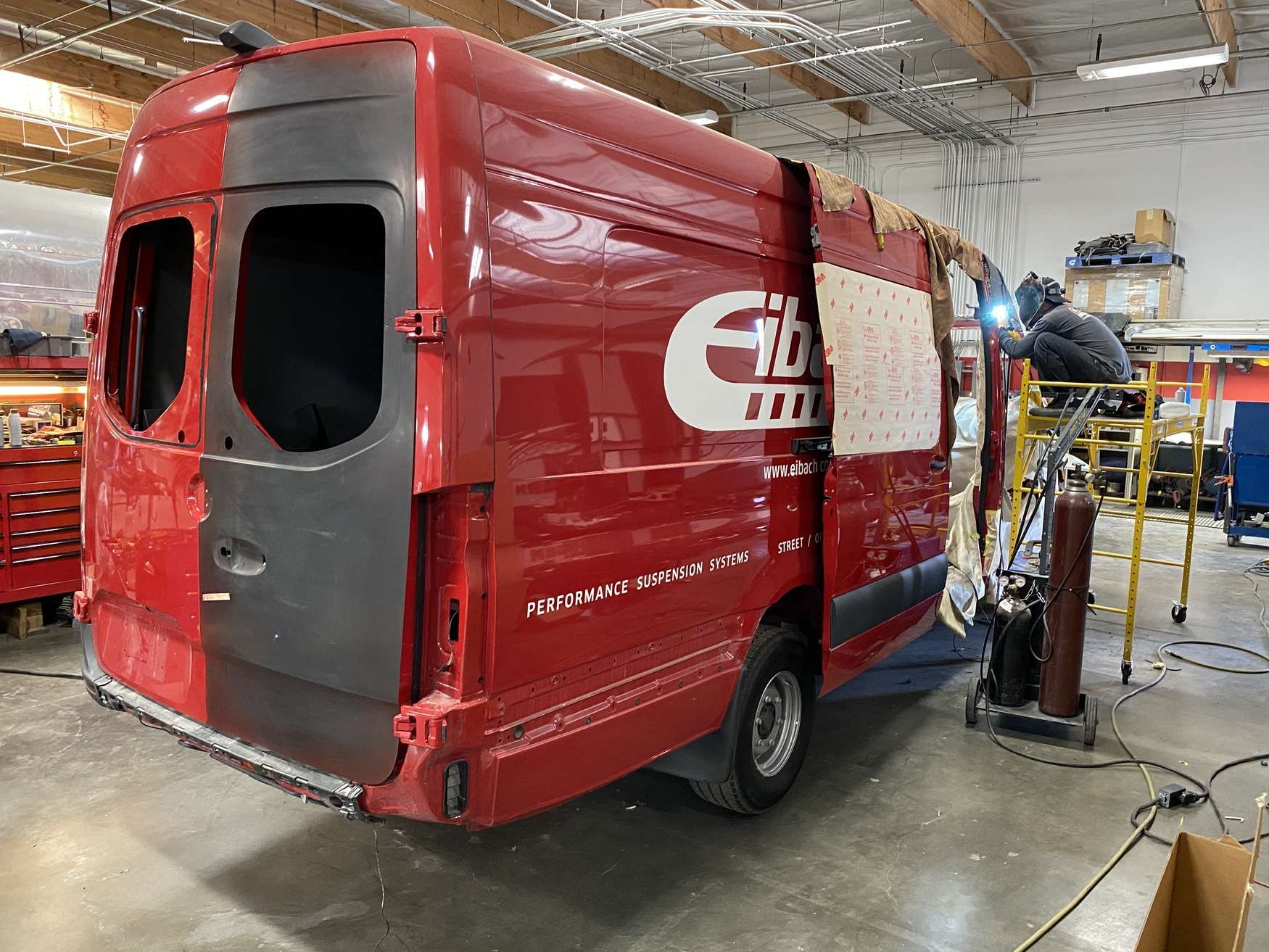
Sprinter van repair is chassis specific work, and that is exactly how we treat this page. Westminster owners run these as plumbing vans, delivery units, shuttles and campers, and the body, doors, roof structure and drivetrain are the same underneath all of it. Our separate pages cover factory built camper coaches and upfitter conversions, because what happens inside the van is a different job from what happens to the van.
One Platform, Two Completely Different Owners
The reason this page exists separately is that the same vehicle serves two populations. A contractor with shelving and a ladder rack, and an owner with a bed and a galley, both drive the identical chassis, body shell, doors and drivetrain. The body repair on a dented rear quarter is the same job in both vans until you have to get to the backside of the panel.
That is the line we draw. This page covers the platform: the shell, the doors, the roof structure, the suspension and the drivetrain. Our factory coach page covers vehicles a recognized OEM built and sold as complete motorhomes. Our conversion page covers upfitter and owner builds where nobody documented what is behind the wall.
Owners find that distinction useful when they call, because it tells us immediately whether the estimate needs interior removal hours in it and whether we are going to have to survey an undocumented build before quoting anything.
- This page: the chassis, shell, doors, roof and drivetrain
- Factory coach page: OEM built complete motorhomes with a build plate
- Conversion page: upfitter and owner builds on any chassis
- Same body repair, very different access and interior hours
- Tell us which you have when you call and the estimate gets accurate faster
Tall Thin Panels and High Strength Steel
The body sides on these vans are large, tall, lightly crowned panels made of thin high strength steel. That combination is efficient and it is unforgiving to repair badly. A large flat area shows every ripple, and high strength steel does not take heat the way mild steel does, so the old approach of shrinking a panel with a torch destroys the material properties.
Correct repair means working the panel cold where possible, following published rules about where sectioning is allowed, and replacing rather than pulling where the material has been stretched past recovery. On a large side panel we often replace a section rather than fight a dent, because the finished surface on a flat panel has to be genuinely flat.
Filler is a legitimate material used correctly and a disaster used to hide a stretched panel. On a tall van side, sun raking across the surface will show a poorly worked repair from fifty feet, which is why we plan these repairs around the reflection rather than the dent.
Sliding Door Geometry Is a Structural Report
The sliding door on these vans runs on three tracks: upper, lower and a center rail on the body side. All three depend on the body being square. When a door starts binding, catching at one end of travel or refusing to seal at the top, that is frequently the body telling you something moved.
So the diagnostic order matters. We measure the opening and check the body structure before condemning rollers or a track. Where the body is true, roller and track service is straightforward and inexpensive, and on a high cycle work van it is normal maintenance rather than a repair.
Where the body has moved, the fix is structural: restore the opening, then align the door and verify seal contact all the way around. Adjusting a door onto a distorted opening produces a van whose door you fight every day and a seal that lets water and road noise in.
- Check all three tracks and the center rail together
- Measure the opening before replacing rollers
- Look for uneven seal witness marks as an alignment clue
- Clean and inspect the lower track on high cycle vans regularly
- Verify the door holds at the detent under its own weight
Rear Doors, Hinges and the Pillars They Hang On
Rear barn doors on a tall van are heavy and they hang off hinges bolted into the rear pillars. Two things go wrong. Hinge holes elongate over years of the doors being swung against wind, and rear corner impacts move the pillar, which throws both doors out of alignment at once.
The tell is a gap that tapers: even at the bottom and wide at the top, or the reverse. That is geometry, not hinges. Shimming will make the doors latch and will not fix the seal contact, so water and dust keep coming in.
Proper repair restores the opening first, repairs the hinge mounting rather than just re drilling it, then hangs and aligns the doors with the seal contact checked around the full perimeter. On a work van that seals properly, the difference in cargo dust and noise is immediate.
Roof Ribs, Racks and Everything Bolted Through
The roof on these vans is a thin skin over ribs, and every rack, solar panel, vent, air conditioner and antenna mounted on it passes fasteners through that skin. Each fastener is a water path unless it was installed into a rib with proper sealing, and a very large share of them were not.
The failure shows up as water inside along a rib line, or as an oil canning ripple where a rack has been loaded and the skin has flexed between ribs. Neither is dramatic and both get worse.
When we repair or reinstall roof mounted equipment, we land fasteners on structure, use backing where the load justifies it, and seal properly rather than relying on a bead of sealant over a hole in a thin skin. That is the difference between a rack that lasts the life of the van and one that leaks in two years.
Drivetrain, Emissions Hardware and What We Take On
These platforms are commonly diesel, with the emissions hardware that comes with it. We handle brake, suspension, steering, cooling, driveline and general mechanical work at the $260 per hour rate, with diagnostic time at $285 credited against an authorized repair.
Where we are straight with owners is on the limits. Some faults on modern diesel emissions systems require manufacturer specific tooling and programming, and if yours is one of them, we tell you at the diagnostic stage rather than billing hours to prove it. That honesty saves people real money and is the reason a lot of fleet customers keep calling.
A worked example on the most common body job: a sliding door side impact with panel section and refinish, no structural involvement, typically 16 to 26 hours of body and paint at $210 for $3,360 to $5,460, plus $800 to $2,400 in panel, hardware and refinish materials.
- Brake, suspension, steering and driveline work at $260 per hour
- Diagnostic at $285 per hour, credited against an authorized repair
- Cooling system and charge air plumbing after a front hit
- Alignment and tracking verification following structural repair
- Honest limits stated at diagnosis, not after the bill
Questions
Frequently asked questions
Is this page about camper vans or work vans?
Both, because it is about the platform rather than the use. The chassis, shell, doors, roof structure, suspension and drivetrain are identical whether the van is carrying pipe or carrying a bed. Where the paths split is access: on a camper the interior has to come out to reach the backside of a panel, and that changes the hours substantially. We run a separate page for factory built camper coaches from an OEM, and another for upfitter and owner conversions, because those involve surveying and rebuilding a living space. Tell us which you have when you call and the estimate will be accurate the first time.
How much does Sprinter van repair cost?
The range is about $1,500 to past $40,000. A sliding door side impact with panel section and refinish, no structural involvement, is typically $4,000 to $8,000. A rear corner hit that reaches the pillar and requires measurement and structural repair runs $6,000 to $16,000. Serious front collision work with drivetrain and cooling involvement can pass $40,000. Body and paint is $210 per hour, mechanical is $260, diagnostic is $285 credited against an authorized repair, and any repair above $2,000 carries a 50 percent deposit.
Why can a dent in the side panel be expensive on this van?
Because the panel is large, tall, lightly crowned and made of thin high strength steel. A big flat area shows every ripple in raking sunlight, and high strength steel cannot be heat shrunk the way mild steel can without ruining its properties. That means working the panel cold, respecting published sectioning rules, and frequently replacing a section rather than fighting a stretched dent. Filler used correctly is a legitimate material and filler used to hide a stretched panel is a repair you will see from fifty feet within a year. We plan these repairs around how the surface will reflect, not just around the dent.
My rear doors do not seal since a parking lot hit. Can you adjust them?
We can, but adjusting them is usually the wrong first move. If the gap tapers, even at one end and wide at the other, that is geometry rather than hinges, and it means the rear pillar has moved. Shimming will make the doors latch and will not restore seal contact, so dust and water keep getting in and you will be back. We measure the rear opening, repair the structure if it has moved, repair the hinge mounting rather than just re drilling elongated holes, then hang and align the doors and check seal witness all the way around the perimeter.
Water is getting in around my roof rack. Can you fix it properly?
Yes, and properly is the operative word. The roof is a thin skin over ribs, and most leaking rack, vent and solar installations we see put fasteners through the skin between ribs with a bead of sealant over the top. That works for a couple of years and then flexes open. The correct fix lands fasteners on structure, adds backing where the load justifies it, and seals the penetration rather than coating it. We also check for oil canning ripple in the skin where a loaded rack has been flexing it, because that is the sign the load path was wrong from the start.
Do you service the diesel drivetrain or only the body?
We do brake, suspension, steering, cooling, driveline and general mechanical work at $260 per hour, with diagnostic time at $285 credited against an authorized repair. Where we stop is honest: some faults on modern diesel emissions systems require manufacturer specific tooling and programming that we do not hold, and if yours is one of them we say so at the diagnostic stage rather than billing hours to discover it. Fleet customers tend to appreciate that more than a shop that takes on everything and returns the vehicle three times. Alignment and tracking verification after structural repair is always part of our scope.
How long will my van be down?
A door, panel and refinish job is typically five to ten business days. Structural repair with measurement and pillar work is two to four weeks. Front collision work involving cooling and drivetrain is three to six weeks, mostly parts driven. For fleet customers we schedule intake for when the parts land rather than taking the van in to sit, and we stage multiple units so you are down one vehicle at a time. The 50 percent deposit on repairs above $2,000 is what lets us place the parts order on the day you authorize rather than a week later.
Can you handle a tall van in your shop?
Yes. Our floor is 35,000 sq ft with door height and bay length sized for full length motorhomes and heavy trucks, so a high roof van is routine and we can get it into the paint booth rather than doing panel only work outside a booth. That matters more than it sounds: a large flat van side needs booth conditions to come out clean. We handle roughly 75 vehicles a month across all categories, and vans move through faster than most because parts availability on current platforms is generally good.
How the work runs
Our six step repair process
The same sequence on every vehicle, whether it is a single coach or a fleet of box trucks.
- 01
Assessment and documentation
We put the vehicle on the floor, pull panels where we need to see behind them, and photograph everything. Hidden damage found now is damage that does not become a supplement argument later.
- 02
Written estimate
You get a line by line estimate with parts, labor hours, materials, and the posted rate applied to each. Nothing is bundled into a single number you cannot check.
- 03
Carrier coordination
If a claim is involved we deal with the adjuster directly, submit the documentation, and handle supplements when teardown reveals more than the first inspection showed.
- 04
Authorization and scheduling
Once the scope is approved we confirm the deposit, order parts, and give you a realistic slot. Special order parts drive the timeline more often than labor does.
- 05
Repair
Structural first, then body, then paint, then systems and interior. The sequence is not negotiable because each stage has to be right before the next one covers it up.
- 06
Quality check and delivery
Multi point inspection, systems tested under load, paint inspected under corrected lighting, and a walkthrough with you before the vehicle leaves.
Keep reading
Related pages
Related vehicles
Services we perform
Talk to a repair specialist today
Tell us what happened and we will tell you what the repair actually involves, what it costs, and how long it takes. We work directly with every major carrier and serve Westminster owners and fleets from our 35,000 square foot facility.
Posted labor rates are published on our prices page. Diagnostic and systems assessment fees are credited against an authorized repair.