Collision and Structural
RV Chassis Repair and Alignment After an Impact
In short
RV chassis repair and alignment typically runs $1,200 to $9,500 or more, with a straightforward heavy chassis alignment near the low end and bent axle or spindle replacement at the top. Diagnostic time bills at $285 per hour and mechanical labor at $260 per hour, both quoted before work starts. Our Westminster shop measures thrust angle and ride height, not just toe.
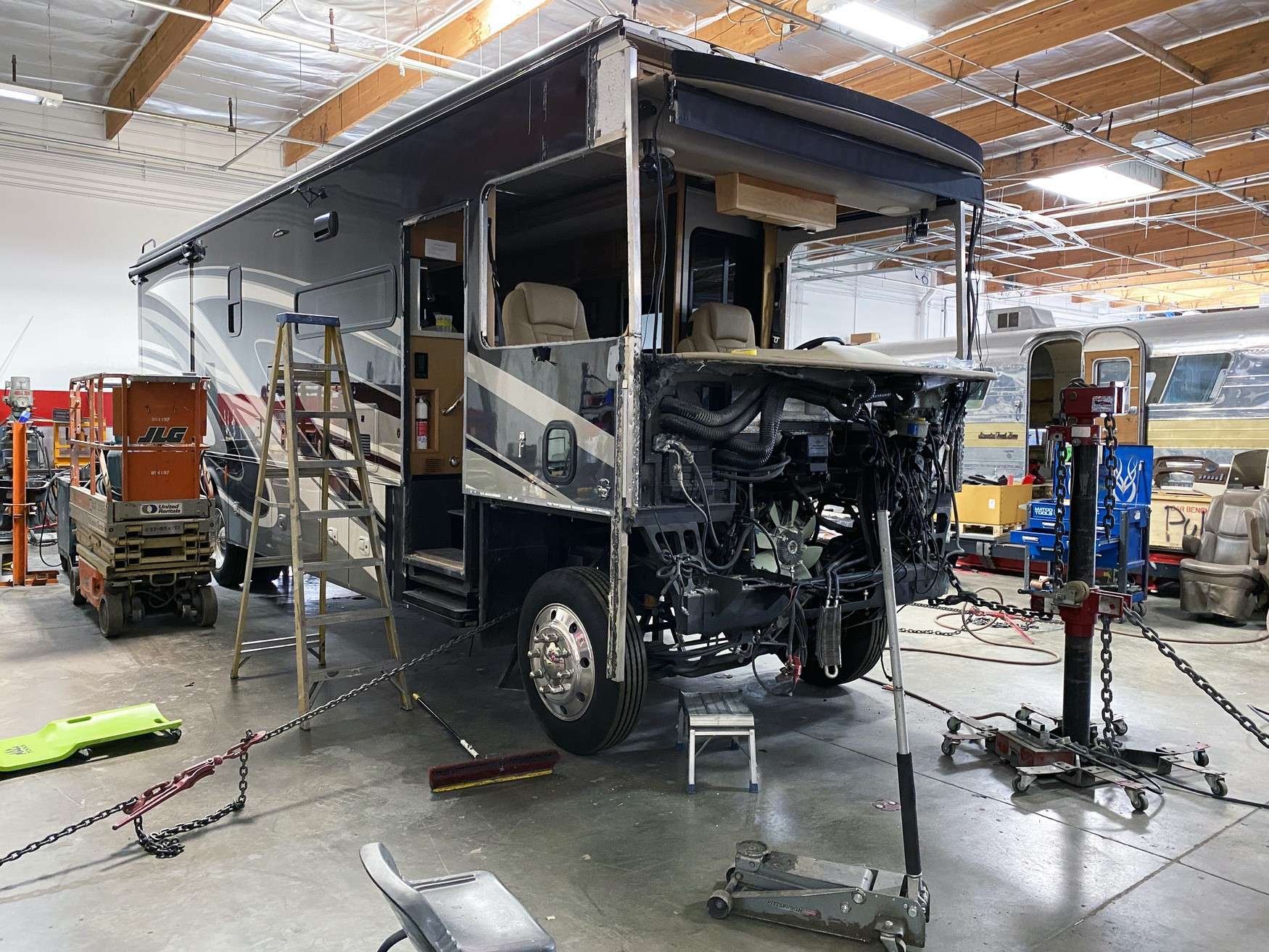
RV chassis repair and alignment after an impact starts with why the coach pulls, not with the alignment rack. A steering pull, a scrubbed inside shoulder on one front tire, or a trailer that tracks off center are symptoms, and the cause can be a bent spindle, a shifted axle, a collapsed spring shackle, or a tweaked frame rail. We diagnose first at $285 per hour, then quote. Owners across Westminster and Orange County hit this after low speed impacts.
Diagnosing a Pull and Reading Tire Wear
Tire wear is the cheapest diagnostic tool on the property and most owners drive past it for months. Feathering across the tread, where one edge of each rib is sharp and the other is rounded, is a toe problem. Wear concentrated on one shoulder only is a camber problem. Cupping and scalloping usually means a damping or bearing issue rather than an alignment issue. Wear on the inside of one front tire only, after an impact, points at a bent component rather than a setting.
A pull tells you something different. A pull that follows the road crown and disappears on flat pavement is normal. A pull that stays consistent regardless of road shape means unequal caster or camber side to side. A pull that appears only under braking is a brake or bearing problem, not alignment. A wander that requires constant correction, with no consistent direction, is usually looseness in steering linkage, king pins, or bushings.
On trailers we look for the same evidence in different places. A trailer that tracks off to one side, wears the inside of one tire, or shows a scrubbed pattern only on the rear axle almost always has an axle alignment problem, a bent spindle, or a collapsed shackle. Owners frequently blame the tow vehicle for a symptom that a fifteen minute measurement under the trailer would have identified.
- Feathering across the tread points to a toe setting problem
- Single shoulder wear points to a camber problem or a bent component
- Cupping and scalloping suggest damping or bearing issues
- A consistent pull on flat pavement means unequal caster or camber
- Wander with no fixed direction means looseness in linkage or bushings
- One tire wearing on a trailer usually means axle or spindle damage
Why Coach Alignment Is Not Car Alignment
A car alignment is a rack, a set of heads, and a database of factory settings. A heavy coach is a different problem in three ways. The vehicle weight and length require equipment rated for it and a rack long enough to hold it. The suspension geometry is built for load carrying rather than handling, so settings change meaningfully with how the coach is loaded. And ride height is a setting on many coaches rather than a fixed dimension, which changes every other angle when it is wrong.
That last point catches people out. On an air suspension coach, if the ride height valves are out of adjustment, the alignment you paid for is measured at the wrong geometry and the coach will still handle badly. Ride height gets set and verified before any angle is measured. On a leaf sprung chassis, sagged or broken springs do exactly the same thing, so the springs get inspected and measured before we touch a tie rod.
Loading matters too. A coach aligned empty and then driven at full water, full propane, and a loaded basement sits differently. We ask how the unit is normally loaded and set it up accordingly rather than aligning an empty shell and handing you a printout that describes a condition you never drive in. That conversation takes two minutes and it is the difference between a printout and a coach that actually tracks straight.
Caster, Camber, and Toe on a Heavy Chassis
Caster is the steering axis tilt viewed from the side, and on a heavy coach it is what gives you straight line stability and steering return. Too little caster and the coach wanders and requires constant correction. Unequal caster side to side pulls toward the side with less. On a straight axle chassis, caster is adjusted with shims or wedges between the axle and the spring, and after a front impact it is frequently the angle that moved.
Camber is the wheel tilt viewed from the front. On many heavy front axles camber is not adjustable at all, which makes it a diagnostic value rather than a setting. If camber is out on one side and there is no adjustment provision, something is bent, most commonly the spindle, the axle beam, or the king pin bore. That finding turns an alignment job into a component replacement job, and it is why we measure before quoting.
Toe is the last setting and the one that destroys tires fastest. A quarter inch of toe error will scrub a set of front tires down in a few thousand miles. Toe is set with the tie rod adjuster after caster and camber are correct and after ride height is verified, never before. Setting toe on a coach with a bent spindle just moves the wear pattern around without fixing anything.
- Ride height verified and corrected before any angle is measured
- Caster adjusted with shims or wedges on a straight axle chassis
- Camber often non adjustable, so an out of spec reading means bent parts
- Toe set last, after caster, camber, and ride height are correct
- Thrust angle checked so the rear axle is square to the frame
- Printout provided with before and after readings for every angle
Axle Alignment and Suspension Damage on Trailers
Trailer alignment is a different exercise entirely because there is no steering to adjust. What you are checking is whether each axle is square to the frame centerline and parallel to the other axles. We measure from the coupler to each spindle end on both sides, then hub to hub between axles. On a tandem or triple axle trailer those measurements need to match side to side within about an eighth of an inch, and they very often do not after a curb strike or a pothole.
The common failure points are the spring hangers, the equalizer, and the shackles. A hard impact or long term overloading bends a shackle or elongates a bolt hole, which lets one end of a spring move rearward and pulls that axle out of square. You get a trailer that dog tracks behind the tow vehicle and eats the inside edge of one tire. Replacing worn shackles, bolts, and bushings with heavy duty components is a common and reasonably priced repair.
Axle correction itself depends on the damage. A mildly bent axle tube can sometimes be straightened. A tube that is bent enough to change camber noticeably, or one with a damaged spindle, gets replaced, because a spindle is welded to the tube on most trailer axles and is not a separate serviceable part. Replacement axles typically run $600 to $1,600 each in parts before installation labor at $260 per hour.
- Coupler to spindle measured on both sides, matched within about an eighth inch
- Hub to hub measured between axles on tandem and triple setups
- Bent shackles and elongated bolt holes as the most common cause
- Equalizer and bushing replacement as a routine correction
- Mildly bent axle tubes sometimes straightened, damaged spindles replaced
- Replacement trailer axles commonly $600 to $1,600 each in parts
King Pins, Bushings, Spindles, and Ride Height
King pins carry the steering knuckle on a straight axle chassis and they wear. The symptom is wander, a vague on center feel, and often a shimmy at certain speeds. We check them by lifting the axle and measuring lateral play at the top and bottom of the tire with a dial indicator. Replacing king pins means pressing out the old pins and bushings, reaming the new bushings to size, and setting end play with shims, which is several hours of mechanical labor per side.
Bushings elsewhere matter just as much and get ignored. Spring eye bushings, shackle bushings, torque rod bushings, and sway bar bushings all wear, and worn bushings let the axle move under load in ways no alignment setting can compensate for. On a coach with any age on it, we inspect all of them during an alignment diagnosis, because setting angles on worn bushings produces a printout that looks correct and a coach that still handles poorly.
Ride height ties it all together. On air suspension, height control valves get set to the manufacturer specification and verified at each corner. On leaf springs, sagged or broken leaves are measured and replaced. A coach sitting an inch low on one corner has different camber, different caster, and different load distribution at that corner than the specification assumes. Fix height first and a surprising number of complaints resolve without touching an adjustment.
What the $260 and $285 Rates Actually Cover
Two different rates apply on this work and the difference is worth understanding. Diagnostic labor is $285 per hour and covers measurement, inspection, road testing, and the analysis that produces a repair plan. Mechanical labor is $260 per hour and covers the actual repair operations, component replacement, and the alignment itself. Diagnostic time is credited against an authorized repair, so if you approve the work the diagnostic hours come off the bill.
A typical diagnosis on a pull complaint is one to three hours. That includes a road test, a full suspension and steering inspection, tire wear documentation, ride height measurement, and a set of alignment readings. You get the numbers, not just a recommendation. If the answer is a straightforward alignment, the total is often $1,200 to $2,200. If the answer is a bent spindle and a replacement axle, the number moves toward the top of the range.
Parts carry 100 percent markup at or under $100 and 35 percent over $100, and sales tax at 7.75 percent applies to parts and materials but not to labor. Anything authorized over $2,000 takes a 50 percent deposit before parts are ordered. All of it appears as line items so you can see the split between diagnosis, repair labor, and parts rather than getting a single number with no breakdown.
Questions
Frequently asked questions
My motorhome pulls to one side after a minor impact. What is wrong?
Most commonly unequal caster side to side, which is exactly what a front corner impact produces on a straight axle chassis by shifting the axle on its springs. It can also be a bent spindle, a collapsed or broken spring leaf, or a shifted frame rail. The way to tell them apart is measurement rather than guessing. A one to three hour diagnosis at $285 per hour gives you ride height at each corner, caster, camber, and toe readings, a suspension and steering inspection, and a road test. That diagnostic fee is credited against an authorized repair.
How is aligning an RV different from aligning my car?
Three ways. Equipment has to be rated for the weight and long enough for the wheelbase, which most general shops do not have. Ride height is a variable on a coach rather than a fixed dimension, so on air suspension the height control valves have to be set and verified before any angle is measured, and on leaf springs sagged leaves have to be addressed first. And loading changes geometry meaningfully, so we set the coach up the way you actually drive it rather than aligning an empty shell. Skipping any of those produces a correct looking printout and a coach that still tracks badly.
Why does my trailer wear out the inside of one tire?
Almost always an axle that is not square to the frame centerline, or a bent spindle on that side. The usual mechanical cause is a bent shackle or an elongated bolt hole at a spring hanger, which lets one end of the spring shift rearward and pulls the axle out of square. We measure coupler to spindle on both sides and hub to hub between axles. Those measurements should match within about an eighth of an inch. Correction can be as simple as replacing worn shackles, bolts, and bushings, or as involved as replacing an axle if the spindle is bent.
Can a bent trailer axle be straightened or does it need replacing?
A mildly bent axle tube can sometimes be straightened, and on a lightly loaded single axle trailer that is a reasonable repair. Once the bend is enough to change camber noticeably, or once the spindle itself is damaged, replacement is the correct call. On most trailer axles the spindle is welded to the tube and is not separately serviceable, so a damaged spindle means a new axle. Replacement axles typically run $600 to $1,600 each in parts, plus installation at $260 per hour. We always measure both axles on a tandem, because they usually get hit together.
How much does an RV alignment cost?
A straightforward heavy chassis alignment with no damaged components generally lands in the $1,200 to $2,200 range including the diagnostic time, which is credited against the work. Where it climbs is when the measurements reveal something bent or worn. King pin replacement is several hours of mechanical labor per side at $260 per hour plus parts. A replacement trailer axle adds $600 to $1,600 in parts each. Spring, shackle, and bushing replacement sits in between. The full range on this page tops out around $9,500 because that is what a heavily damaged suspension actually costs to make right.
What is thrust angle and why does it matter on a coach?
Thrust angle is the direction the rear axle actually points relative to the geometric centerline of the frame. If the rear axle is not square, the coach travels slightly crab wise, which is why some units go down the road with the steering wheel off center even though the front alignment reads correct. On a motorhome this usually comes from a shifted rear spring or a frame issue after an impact. On a trailer it is the same problem and produces dog tracking. Correcting front toe without checking thrust angle just moves the steering wheel and leaves the coach tracking sideways.
Do I need an alignment after frame work?
Yes, always, and it should be the last operation before the road test. Frame correction changes where every suspension mounting point sits, so any alignment done before the steel was straightened is no longer valid. The sequence is frame correction, remeasurement against factory reference points, suspension component replacement as needed, ride height setting, then alignment, then a road test with the coach loaded the way you use it. Skipping the alignment after frame work is how a properly straightened coach still comes back with a pull complaint and a chewed set of front tires.
My steering feels loose but the alignment reads fine. What now?
Loose steering with correct alignment readings is a wear problem, not a setting problem, and the usual suspects are king pins, tie rod ends, drag link ends, steering gear, and bushings. We check king pins by lifting the axle and measuring lateral play at the top and bottom of the tire with a dial indicator. Tie rod and drag link ends get checked for play with the wheels loaded. Spring eye, shackle, torque rod, and sway bar bushings all get inspected too, because worn bushings let the axle move under load in ways no alignment setting can compensate for.
Standard on every job
What is included
These are not upgrades. They are how the work is run on every vehicle that comes through the building.
Full teardown where it is needed
We do not estimate through a closed panel. If the damage path runs behind trim or skin, we open it and document what is actually there.
Written, itemized scope
Parts, labor hours, and materials listed separately against the posted rate, so every line is something you can question.
Direct carrier communication
We talk to the adjuster so you are not relaying technical detail between two parties who both expect you to already understand it.
Supplement handling
When teardown finds more than the original inspection, we document and submit the supplement rather than absorbing it into a vague overage.
Correct repair sequence
Structural before cosmetic, every time. A straight body over a bent frame is a repair that fails its second life.
Systems tested under load
Electrical, plumbing, generator, and climate systems are run and verified before delivery, not just reconnected and assumed good.
Photo documentation throughout
Before, during, and after. Useful for your records, and decisive if a claim is ever revisited.
Delivery walkthrough
We go over what was done, what was replaced, and what to watch, in person, with the vehicle in front of you.
How the work runs
Our six step repair process
The same sequence on every vehicle, whether it is a single coach or a fleet of box trucks.
- 01
Assessment and documentation
We put the vehicle on the floor, pull panels where we need to see behind them, and photograph everything. Hidden damage found now is damage that does not become a supplement argument later.
- 02
Written estimate
You get a line by line estimate with parts, labor hours, materials, and the posted rate applied to each. Nothing is bundled into a single number you cannot check.
- 03
Carrier coordination
If a claim is involved we deal with the adjuster directly, submit the documentation, and handle supplements when teardown reveals more than the first inspection showed.
- 04
Authorization and scheduling
Once the scope is approved we confirm the deposit, order parts, and give you a realistic slot. Special order parts drive the timeline more often than labor does.
- 05
Repair
Structural first, then body, then paint, then systems and interior. The sequence is not negotiable because each stage has to be right before the next one covers it up.
- 06
Quality check and delivery
Multi point inspection, systems tested under load, paint inspected under corrected lighting, and a walkthrough with you before the vehicle leaves.
Keep reading
Related pages
Related services
Vehicles we repair
Talk to a repair specialist today
Tell us what happened and we will tell you what the repair actually involves, what it costs, and how long it takes. We work directly with every major carrier and serve Westminster owners and fleets from our 35,000 square foot facility.
Posted labor rates are published on our prices page. Diagnostic and systems assessment fees are credited against an authorized repair.