Vehicles We Repair
Municipal Fleet Repair Orange County Agencies Rely On
In short
Municipal fleet repair for public agencies is a documentation job as much as a repair job. Work runs from about $2,000 for panel and door repairs to past $60,000 for structural rebuilds on a transit unit. What agencies need from a shop is a written scope before the purchase order, change orders in writing, and an invoice that survives an audit.
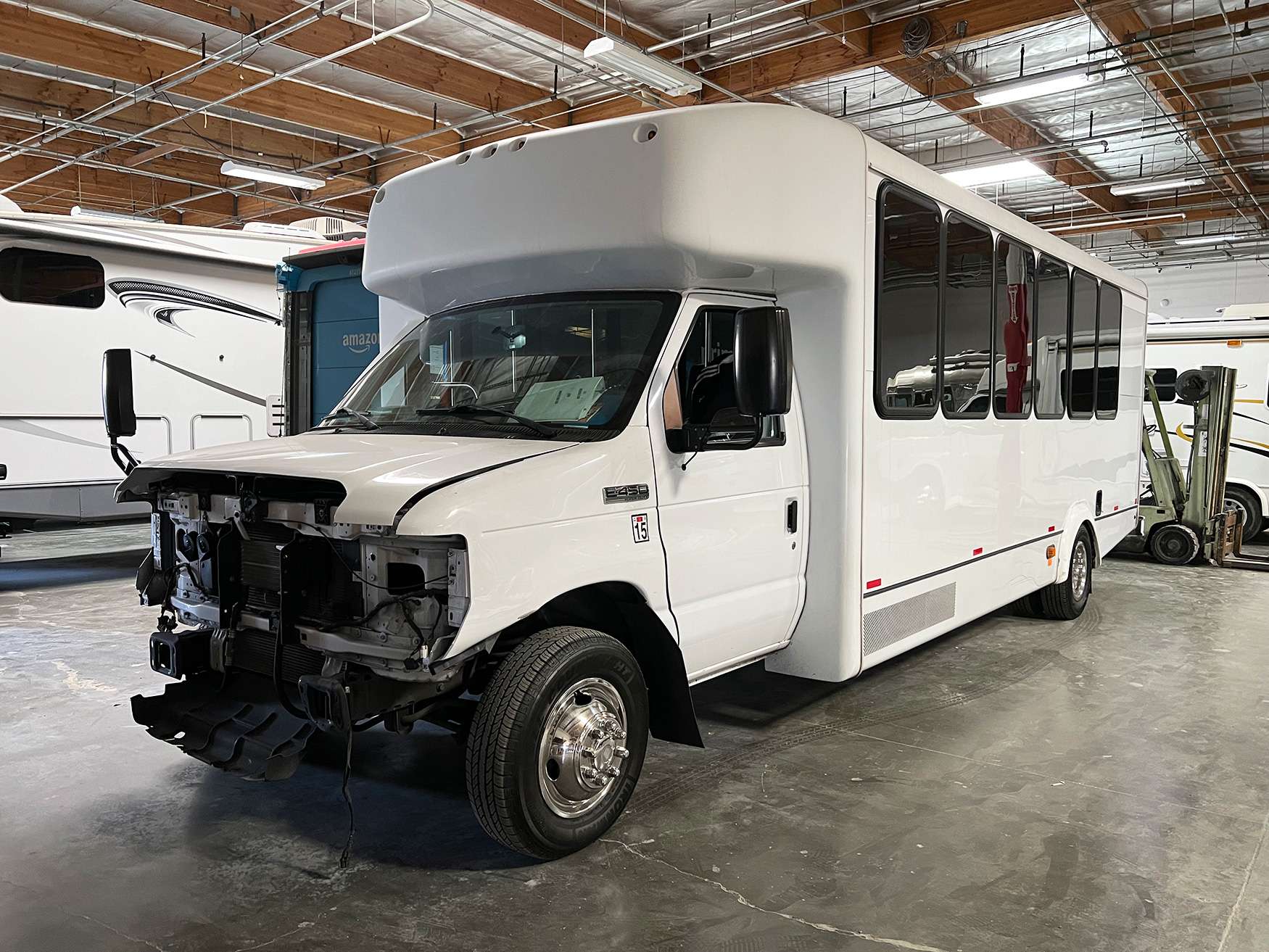
Municipal fleet repair Orange County agencies need has a different shape than retail collision work, and supervisors in Westminster tell us the same thing every time: the repair is rarely the hard part, the paperwork and the downtime window are. This page is written for fleet supervisors and transportation directors. It covers scoping before a purchase order, staged authorization, multi unit coordination and documentation that stands up to review.
Written Scope Before a Purchase Order Is Cut
Agency procurement does not work like retail. A supervisor cannot authorize discovery and sort out the number later, because the purchase order has to be written against a defined scope before the work begins. A shop that hands over a rough figure and expects to true it up afterward creates a problem that lands on the supervisor, not the shop.
So we write scope first. Inspection, measurement, photographs, and a line itemized scope of work with parts identified and labor operations described. That document is what your PO gets written against, and it is specific enough that nobody is guessing what was included.
Where the vehicle has damage we genuinely cannot assess without disassembly, we say so explicitly and scope the teardown as its own line rather than burying an assumption inside a repair number. That is the honest way to handle it and it keeps the second document, the change order, small.
- Line itemized scope with parts identified and labor described
- Teardown scoped separately when assessment requires disassembly
- Photographs attached to the scope document
- Rates stated on the document: $210 body, $260 mechanical, $285 diagnostic
- A realistic completion date rather than an optimistic one
Change Orders in Writing, Every Time
Additional findings are normal on collision work, especially on older units and on anything with water intrusion. What is not normal, and what causes real problems for an agency, is finding out about them on the invoice.
Our rule is simple: nothing outside the authorized scope gets performed without a written change order that includes the finding, photographs of it, the additional parts and labor, and the revised completion date. Your supervisor signs it, or does not, before we proceed.
That discipline occasionally slows a job by a day while an approval moves through your process. Every fleet supervisor we work with says that is the trade they want, because the alternative is an invoice they cannot defend in a review.
Photo Documentation Built for the File
We photograph at intake, at teardown, at each significant stage, and at completion, on every agency job. That is not a marketing gesture. Once a vehicle is disassembled the evidence of its condition is gone unless somebody recorded it, and a fleet file needs that record for its own purposes years later.
The photographs go with the invoice, along with measurement records where the job was structural, parts by number, and the labor operations performed. If your maintenance system needs a particular format or naming, tell us at scoping and we will produce it that way rather than making your staff reprocess it.
This matters most on units that will be audited, sold at auction, or transferred between departments, because the repair history is what determines how the asset is valued and treated later.
Scheduling Around Service Obligations
An agency vehicle usually has an obligation attached to it: a route, a shift, a season, a coverage requirement. The number on the estimate matters, and the date the vehicle is back matters just as much, sometimes more.
We plan around that in three ways. We book intake for when parts arrive rather than taking a unit in to sit. We schedule heavy work into whatever your low demand window is, which for school transportation is summer and for other operations is whatever your seasonal pattern happens to be. And on large jobs we stage the work so a unit can return to service between phases where that is appropriate.
None of that is possible if the first contact is the day the vehicle needs to leave. Bring us into the planning early and the schedule usually works. Bring us in at the deadline and we will be honest that it does not.
- Book intake for parts arrival, not for bay availability
- Target heavy work into your low demand season
- Stage large jobs so the unit earns between phases
- Sequence multiple units so you keep your spare ratio
- Give the real date, not the one anyone wants to hear
Moving Several Units Without Stranding a Route
Agencies rarely have one damaged vehicle. Hail, a yard incident, a run of similar failures across a fleet of the same age, or a deferred maintenance backlog all produce multi unit work, and the temptation is to send everything at once and get it over with.
That is usually the wrong call, because it collapses your spare ratio. We sequence instead: units come in as previous ones leave, with the schedule built around how many spares you actually have. On repeat work we keep your color formulas, decal layouts, seat specifications and body configurations on file, so the fifth unit takes noticeably less shop time than the first.
Our floor is 35,000 sq ft and we handle roughly 75 vehicles a month, which means we can hold several large units at once when the situation calls for it. Whether we should is a question about your operation, not our capacity.
What Agency Work Costs and How It Is Billed
Rates are posted and do not change by customer or by funding source. Body and paint labor is $210 per hour. Mechanical labor is $260 per hour. Diagnostic labor is $285 per hour and is credited against an authorized repair. Parts carry 100 percent markup at or under $100 and 35 percent over $100, plus 7.75 percent California tax on parts and materials. Labor is not taxed in California.
Authorized repairs above $2,000 carry a 50 percent deposit, and on agency work we will discuss how that interacts with your payment terms during scoping rather than discovering a conflict after the PO is issued.
A worked example: exterior panel damage between the rub rails on a bus body with refinish and decal reproduction, no structural involvement, typically 18 to 30 hours of body and paint at $210 for $3,780 to $6,300, plus $900 to $3,000 in panel, rail, hardware, decal and refinish materials.
In this category
Types we work on
School Bus
School bus repair runs from about $2,000 for panel and door work to past $40,000 for structural body repairs. Two things separate...
Read moreShuttle Bus
Shuttle bus repair runs from about $1,500 for door and panel work to past $35,000 for structural repairs at the cab to body joint....
Read moreTransit Bus
Transit bus repair runs from about $2,500 for panel and fascia work to past $60,000 for structural repairs to a low floor body. Pa...
Read moreAmbulance and Fire Apparatus
Ambulance and fire apparatus repair runs from about $3,000 for compartment door and striping work to past $75,000 for module remou...
Read moreQuestions
Frequently asked questions
Can you provide a written scope before we issue a purchase order?
Yes, and it is how we prefer to work with agencies. We inspect, measure, photograph and produce a line itemized scope of work with parts identified and labor operations described, plus the rates and a realistic completion date. That is the document your PO gets written against. Where damage genuinely cannot be assessed without disassembly, we scope the teardown as its own separate line rather than burying an assumption in a repair number. That keeps the eventual change order small and keeps your supervisor from having to defend a figure that moved for reasons nobody documented.
How do you handle additional damage found after the work starts?
With a written change order, every time. Nothing outside the authorized scope gets performed without a document that includes the finding, photographs of it, the additional parts and labor, and the revised completion date, signed by your authorized person before we proceed. Additional findings are normal on collision work and on anything with water intrusion, so this comes up regularly. It occasionally costs a day while approval moves through your process. Every fleet supervisor we work with says that is the trade they want, because the alternative is an invoice that cannot be defended in a review.
What documentation do we receive with the invoice?
Photographs at intake, at teardown, at each significant stage and at completion. Measurement records where the repair was structural. Parts identified by number. Labor operations described rather than summarized. Change orders with their supporting photographs. If your maintenance system needs a particular file format or naming convention, tell us during scoping and we will produce it that way rather than making your staff reprocess it. This file matters most later, when a unit is audited, transferred between departments, or sold, because the repair history is what determines how the asset gets valued.
Can you work around our downtime windows?
Yes, if we are in the conversation early enough. We book intake for when parts arrive rather than taking a unit in to sit in a bay, we target heavy work into whatever your low demand window is, and on large jobs we stage the work so a unit can return to service between phases where that is appropriate. School transportation usually means summer for heavy work. Other operations have their own patterns. What we cannot do is compress a parts lead time, so the sooner a damaged unit is scoped the more options exist for scheduling it.
We have several damaged units. Should we send them all at once?
Usually not, because it collapses your spare ratio and strands routes. We sequence instead, with units coming in as previous ones leave and the schedule built around how many spares you actually have available. On repeat work we keep your color formulas, decal layouts, seat specifications and body configurations on file, so the fifth unit takes noticeably less shop time than the first. Our floor is 35,000 sq ft and we handle roughly 75 vehicles a month, so capacity to hold several large units at once is there when a situation genuinely calls for it.
Do you certify that a repaired vehicle meets our inspection requirements?
No. We repair to the body manufacturer's published procedures, document what was done with measurements and photographs, and return that file to you. Whether a unit satisfies your agency's inspection and re approval process is a determination for your inspection authority, made with our documentation in hand. Be cautious of any shop that offers to certify compliance outcomes on your behalf. What we can do is make sure the documentation is complete enough that your own process has everything it needs, and we will format it to your requirements if you tell us at scoping.
What are your rates and how does the deposit work with our payment terms?
Body and paint labor is $210 per hour, mechanical is $260, and diagnostic is $285 credited against an authorized repair. Parts carry 100 percent markup at or under $100 and 35 percent over $100, plus 7.75 percent California tax on parts and materials, with labor untaxed in California. Authorized repairs above $2,000 carry a 50 percent deposit. On agency work we raise that during scoping specifically so any conflict with your payment terms is worked out before the PO is issued rather than discovered afterward, since that deposit is what lets us order long lead parts on authorization day.
Do you work on emergency apparatus as well as buses?
Yes. Ambulances and fire apparatus are modular bodies on a chassis, usually aluminum, with compartment doors, roll up doors, emergency lighting and reflective markings, and they come with their own priority scheduling reality because most districts run very thin on spares. We handle the body, the module mounting, compartment doors, lighting removal and documented reinstallation, and striping reproduction. We repair to the body manufacturer's published procedures and return documented work for your own inspection and re approval process. We do not hold or claim certification from any certifying authority.
How the work runs
Our six step repair process
The same sequence on every vehicle, whether it is a single coach or a fleet of box trucks.
- 01
Assessment and documentation
We put the vehicle on the floor, pull panels where we need to see behind them, and photograph everything. Hidden damage found now is damage that does not become a supplement argument later.
- 02
Written estimate
You get a line by line estimate with parts, labor hours, materials, and the posted rate applied to each. Nothing is bundled into a single number you cannot check.
- 03
Carrier coordination
If a claim is involved we deal with the adjuster directly, submit the documentation, and handle supplements when teardown reveals more than the first inspection showed.
- 04
Authorization and scheduling
Once the scope is approved we confirm the deposit, order parts, and give you a realistic slot. Special order parts drive the timeline more often than labor does.
- 05
Repair
Structural first, then body, then paint, then systems and interior. The sequence is not negotiable because each stage has to be right before the next one covers it up.
- 06
Quality check and delivery
Multi point inspection, systems tested under load, paint inspected under corrected lighting, and a walkthrough with you before the vehicle leaves.
Keep reading
Related pages
Related vehicles
Services we perform
Talk to a repair specialist today
Tell us what happened and we will tell you what the repair actually involves, what it costs, and how long it takes. We work directly with every major carrier and serve Westminster owners and fleets from our 35,000 square foot facility.
Posted labor rates are published on our prices page. Diagnostic and systems assessment fees are credited against an authorized repair.