Mobile Business Vehicles
Mobile Medical Unit Repair and Structural Service
In short
Mobile medical unit repair runs from about $2,500 for jack and door work to past $80,000 for structural repairs on a large expandable coach or trailer. Installed equipment weight is the constraint that shapes everything, because you cannot cut structure near a mounted imaging system without a plan.
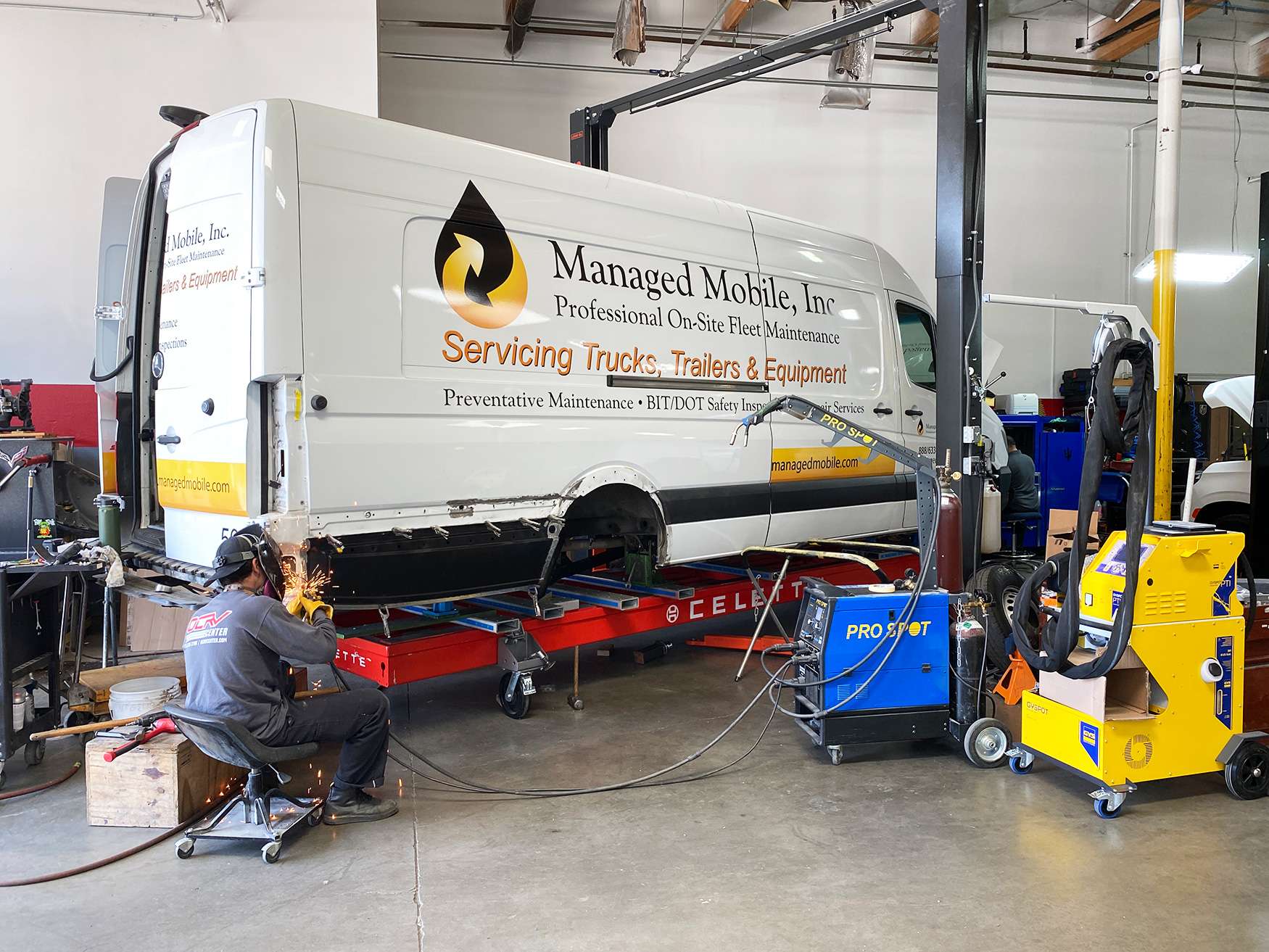
Mobile medical unit repair is the heaviest and most constrained work in this category, and Westminster operators running clinics and imaging units cannot simply park one for a month. These are large coaches and trailers with expandable rooms, hydraulic leveling, patient lifts and installed equipment weighing thousands of pounds. Everything about the repair sequence is shaped by that equipment and by the surfaces that have to stay sealed and cleanable.
Installed Equipment Decides the Repair Sequence
A mobile clinic or imaging unit carries equipment that was installed into structure specifically engineered to carry it, often with reinforcement added by the upfitter that is not documented anywhere obvious. That equipment can weigh more than everything else in the unit combined.
So the first question on any structural repair is what the damaged area is carrying and what is mounted near it. We survey and document that before disassembly, because cutting into a reinforced area without knowing why it was reinforced is how a repair creates a problem far worse than the damage.
Where equipment has to be moved or supported during a repair, that is planned work with its own line on the estimate. We do not improvise supports for something that heavy, and we would rather add a day to the plan than take a shortcut with an asset worth more than the vehicle.
- Survey and document equipment mounting before any disassembly
- Identify upfitter added reinforcement and why it exists
- Plan supports for heavy equipment as a scoped line item
- Never cut into reinforced structure without knowing its purpose
- Photograph mounting hardware and shimming before removal
Expandable Rooms and Their Mechanisms
Many of these units expand on site to create usable clinical space, using hydraulic or electric mechanisms that push a room section out on rails. Those mechanisms are heavily loaded, they cycle at every location, and they depend on the opening staying square.
The failure pattern matches what we see on RV slide rooms, with higher stakes. A room that drifts, sits proud on one side or binds is usually reporting a structural condition rather than a mechanism fault, and replacing the mechanism buys a few months.
Seals are the other half. A room that sits out of square wears its seals unevenly, and a seal that no longer contacts admits water at the floor edge every time it rains while the unit is deployed. On a clinical interior, water in the floor is not a cosmetic problem.
Hydraulic Leveling and the Frame Under It
Leveling jacks on a heavy unit put enormous point loads into the frame, and the frame reinforcement under each jack is doing serious work. Jacks that have been deployed onto uneven or soft ground for years transmit twisting loads that the design assumed would be occasional.
What we find is cracked welds at the jack mounting, frame members that have taken a set, and in bad cases a unit that no longer sits square when leveled. That last one then shows up as expandable rooms that bind and doors that will not close.
Repair means restoring the frame and the jack mounting properly, with the load spread rather than concentrated. On a unit that gets leveled at a different site every week, that reinforcement pays for itself.
Patient Lifts, Ramps and Access Openings
Lifts and ramps mount into the body structure at an opening, and both the opening and the mounting take repeated loading under patient weight. The failures are the same ones we see on shuttle lift doors: cracks radiating from opening corners, mounting fasteners that have loosened, and thresholds that have worn or corroded.
Because access is the point of a mobile clinic, we treat lift and ramp structure as priority work rather than as a convenience item. A unit that cannot load a patient safely is out of service regardless of what else works.
We inspect the opening structure whenever a lift or ramp fault is reported, and we address the structure before the mechanism. Repairing the mechanism onto a distorted opening is a repair with a short life and a bad failure mode.
- Inspect opening corners for cracking at every service
- Check lift and ramp mounting fasteners for loosening
- Look at threshold wear and corrosion
- Address structure before mechanism, always
- Verify operation under load, not just unloaded
Sealed, Cleanable Interior Surfaces
Clinical interiors need surfaces that can be cleaned, which means continuous finishes, sealed joints, coving where the original had it, and no unsealed penetrations. A body repair that opens a wall has to close it back to that standard.
We match the existing surface material, seal the joints properly, restore coving, and reseal any penetration we disturbed. Where the original detail was poor, we will point it out and offer to improve it rather than reproducing a defect.
HVAC and power redundancy are the related systems, since a clinical unit that loses conditioning or power in the middle of a day is out of service. Where we are inside the unit anyway, inspecting the generator, transfer arrangement, shore inlet and HVAC condition is inexpensive compared to a separate visit.
Documentation for Whatever Approval You Need
Any structural or interior change on a clinical unit typically means the operator has to have the unit reviewed again by whoever authorizes it. We are not that authority, we do not speak for them, and we will not tell you what will be accepted.
What we provide is a complete record: what was damaged, what was replaced, what materials were used, how joints were made and sealed, photographs at every stage, measurements where the repair was structural, and any equipment that was removed and reinstalled with its mounting documented.
A worked example: expandable room seal replacement with opening squaring and floor edge repair, typically 30 to 46 hours at $210 for $6,300 to $9,660, plus $1,800 to $5,000 in seals, structural material, flooring and finish materials.
Questions
Frequently asked questions
Can you work around our installed imaging or clinical equipment?
Yes, and planning for it is the first thing we do rather than the last. That equipment was installed into structure engineered to carry it, often with upfitter added reinforcement that is not documented anywhere obvious, and it can weigh more than everything else in the unit combined. We survey and photograph the mounting before any disassembly, identify why reinforcement exists where it does, and where equipment must be moved or supported during a repair, that is a scoped line item with a proper plan. We do not improvise supports for something that heavy.
How much does mobile medical unit repair cost?
The range is about $2,500 to past $80,000. Leveling jack mounting repair with frame reinforcement is typically $6,000 to $14,000. Expandable room seal replacement with opening squaring and floor edge repair runs $9,000 to $16,000. Lift or ramp opening structural repair is $7,000 to $18,000. Major structural work with equipment supported and interior surfaces rebuilt can pass $80,000. Body labor is $210 per hour, mechanical is $260, diagnostic is $285 credited against an authorized repair, and repairs above $2,000 carry a 50 percent deposit.
Our expandable room binds on one side. Is the mechanism failing?
Usually the mechanism is reporting a structural condition rather than having a fault of its own. These rooms run on rails that assume the opening stays square, and on a heavy unit that gets leveled on different ground every week, the frame and the opening can take a set. A room that drifts, sits proud on one side or binds is the symptom. We check the opening, the floor and the frame for square, inspect the seals, and look at the jack mounting before pricing a mechanism. Replacing the mechanism on a distorted opening buys a few months at considerable cost.
The unit does not sit level anymore even with the jacks out. Why?
Most likely the frame or the jack mounting has taken a set. Leveling jacks put enormous point loads into the frame, and years of deployment onto uneven or soft ground transmit twisting loads that the design assumed would be occasional. What we find is cracked welds at the jack mounting, frame members that have moved, and a unit that no longer sits square when leveled. That then shows up downstream as expandable rooms binding and doors not closing. The repair restores the frame and the jack mounting with the load spread rather than concentrated at a point.
Will the interior still meet our surface requirements after a repair?
That determination belongs to whoever authorizes your unit, not to us, and we will not make claims on their behalf. What we control is building to the standard: matching the existing surface material, sealing joints properly, restoring coving where the original had it, and resealing any penetration we disturbed. Where the original detail was poor, we will point that out and offer to improve it rather than faithfully reproducing a defect. You get a written record of what was replaced, what materials were used and how the joints were made, which is what a review process needs.
How long will our unit be out of service?
Jack mounting repair with frame reinforcement is two to four weeks. Expandable room seal and opening work is three to five weeks. Lift or ramp opening structural repair is two to four weeks. Major structural work with equipment supported and interior surfaces rebuilt runs eight to sixteen weeks. These are large, heavy, complex units and we will not quote an optimistic date on one. What we can do is scope early, order long lead components against the deposit before the unit comes in, and work continuously once it is here rather than in gaps around parts.
Can you also check the generator, HVAC and power systems?
Yes, and it is worth bundling with any visit. A clinical unit that loses conditioning or power mid day is out of service regardless of what else is working, so the generator, transfer arrangement, shore power inlet and HVAC condition are all worth inspecting while we already have the unit. That work bills at $260 per hour with diagnostic at $285 credited against an authorized repair. We scope these as separate optional lines so you can approve or defer them independently rather than having them folded into a structural repair number.
What documentation do we get?
A complete record: what was damaged, what was replaced, what materials were used, how joints were made and sealed, photographs at intake, teardown, each significant stage and completion, measurement records where the repair was structural, and documentation of any equipment removed and reinstalled including its mounting. Any structural or interior change on a clinical unit typically triggers a review by whoever authorizes you, and that file is what the review needs. Tell us at scoping what format your organization requires and we will produce it that way rather than making your staff reprocess it.
How the work runs
Our six step repair process
The same sequence on every vehicle, whether it is a single coach or a fleet of box trucks.
- 01
Assessment and documentation
We put the vehicle on the floor, pull panels where we need to see behind them, and photograph everything. Hidden damage found now is damage that does not become a supplement argument later.
- 02
Written estimate
You get a line by line estimate with parts, labor hours, materials, and the posted rate applied to each. Nothing is bundled into a single number you cannot check.
- 03
Carrier coordination
If a claim is involved we deal with the adjuster directly, submit the documentation, and handle supplements when teardown reveals more than the first inspection showed.
- 04
Authorization and scheduling
Once the scope is approved we confirm the deposit, order parts, and give you a realistic slot. Special order parts drive the timeline more often than labor does.
- 05
Repair
Structural first, then body, then paint, then systems and interior. The sequence is not negotiable because each stage has to be right before the next one covers it up.
- 06
Quality check and delivery
Multi point inspection, systems tested under load, paint inspected under corrected lighting, and a walkthrough with you before the vehicle leaves.
Keep reading
Related pages
Services we perform
Talk to a repair specialist today
Tell us what happened and we will tell you what the repair actually involves, what it costs, and how long it takes. We work directly with every major carrier and serve Westminster owners and fleets from our 35,000 square foot facility.
Posted labor rates are published on our prices page. Diagnostic and systems assessment fees are credited against an authorized repair.