Resources
RV Insurance Awareness Booklet
In short
This page describes a downloadable resource for recreational vehicle owners facing a claim. It covers what happens in the first 24 hours, why documentation determines the outcome more than the damage itself does, how coach claims differ from automotive claims, and the specific steps owners most often skip. Read the summary here, then take the download with you.
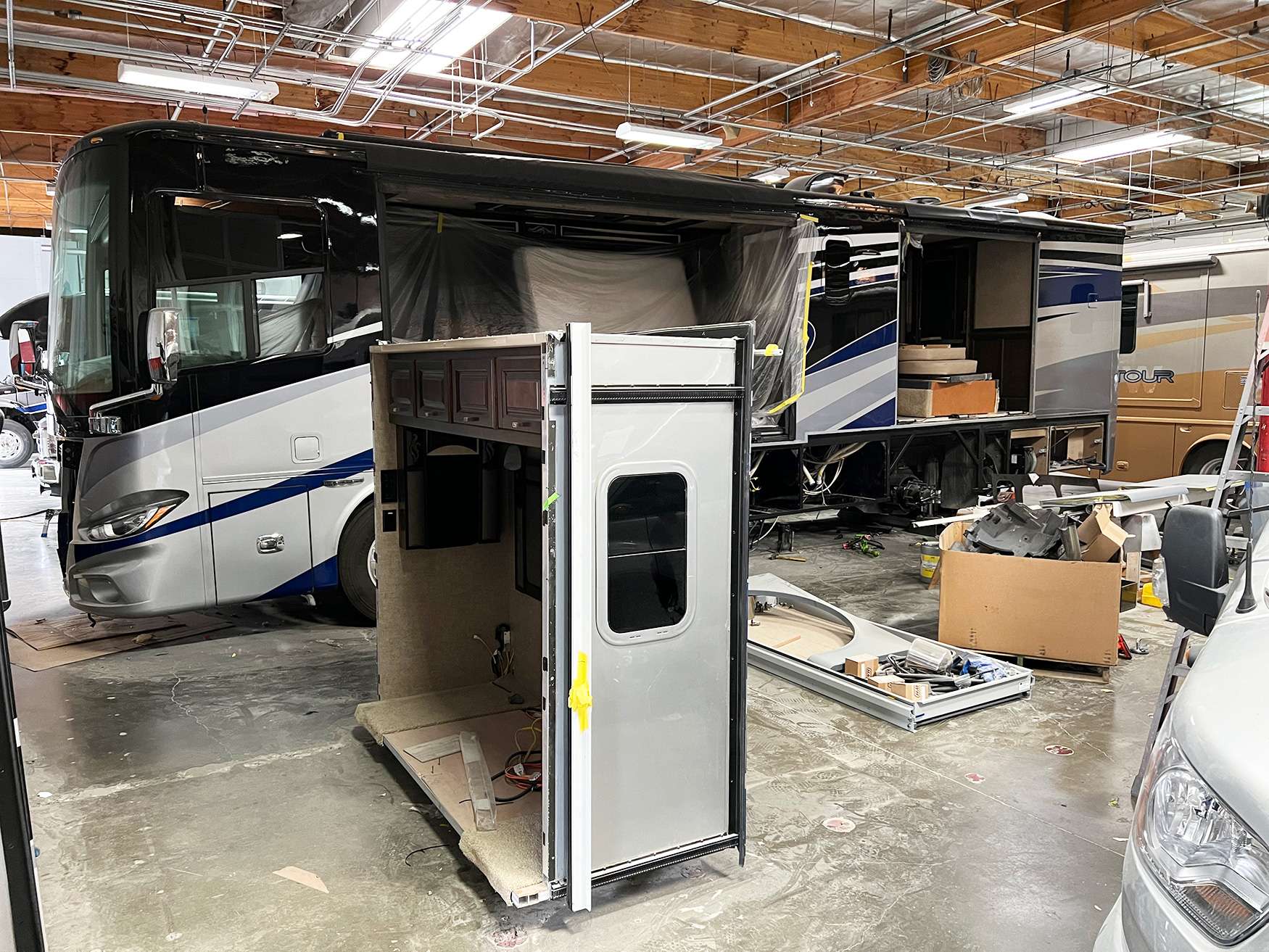
This rv insurance claim resource was written because owners keep arriving at our counter having already made decisions that narrowed their options. Claims on recreational vehicles are not automotive claims with bigger numbers. The policies read differently, the valuation methods differ, the adjusters usually have less exposure to coach construction, and the damage is far harder to see. The booklet summarized below walks through that territory in the order an owner actually encounters it.
What the Download Covers
The booklet is organized around sequence rather than topic, because owners do not experience a claim as a set of subjects. They experience it as a series of decisions arriving faster than they can research them. It opens at the moment of discovery and follows through reporting, inspection, estimating, supplements, and settlement, with the specific pitfalls at each stage called out where they occur.
It is written for owners rather than for adjusters. There is no attempt to be neutral about whose interests are served by which practice, and there is no advice that depends on a shop being chosen. Where the correct move is to slow down, get a second opinion, or read the policy before answering a question, the booklet says so.
It also covers what is not covered. Wear, gradual deterioration, maintenance related water intrusion, and pre-existing conditions are excluded under most policies, and a large share of owner frustration comes from discovering those exclusions during a claim rather than before one. Knowing where the line sits changes what you maintain and what you document. It is also the section owners tell us they wish they had read a year earlier, because most of what it describes is preventable with records.
- Reporting sequence and what to say, and not say, in the first call
- Documentation standards that hold up under carrier review
- How estimates, supplements, and teardown fit together on coach work
- Valuation basics: actual cash value, agreed value, depreciation, and betterment
- Total loss thresholds and what happens when a unit crosses one
- Your right to select a repair facility and how that works in practice
- Common exclusions and the maintenance records that keep you on the right side of them
- A worksheet for tracking correspondence, deadlines, and approvals
Why Documentation Decides Claim Outcomes
Two owners with identical damage routinely receive materially different settlements, and the variable is almost never the damage. It is the file. An adjuster is reviewing a claim they will likely never see in person, from photographs and written scope, against policy language and a valuation tool. Everything that is documented is real to that process. Everything that is only described is contestable.
This asymmetry is more pronounced on recreational vehicles than on cars. An adjuster looking at a rear quarter on a sedan has seen a thousand of them and can infer what is behind it. An adjuster looking at a laminated coach sidewall has an accurate mental model of neither the construction nor the failure mode, so inference works against you. Photographs taken at each stage of disassembly are what replace that missing intuition.
The practical consequence is that documentation is leverage, and it is the only leverage available to an owner that costs nothing. A file with staged teardown photography, moisture readings recorded in a grid, part numbers with sourcing and lead times, and written reasoning per line item does not need to be argued. A file without those things needs to be argued constantly, and arguments are decided by whoever has evidence.
The First 24 Hours
Nearly everything that damages a claim happens in the first day, and none of it looks harmful at the time. Owners clean up. They accept a quick verbal assessment from someone at the scene. They answer questions about cause before they know the cause. They agree to a tow without asking where the vehicle is going or who chose it. Each of these is reasonable in the moment and each narrows what can be established later.
The correct posture for the first 24 hours is to document exhaustively and commit to nothing. Report the loss, because most policies require prompt notice, but reporting is not the same as characterizing. Describe what you observed. Decline to speculate about cause, extent, or fault, because a casual guess entered into a claim file is treated as a statement and is difficult to correct afterward.
Be equally careful with the vehicle's physical custody. Where a damaged unit is towed and stored has real consequences: storage fees accumulate, access for inspection may be restricted, and an incorrectly rigged tow on a structurally compromised coach can add damage that then becomes its own dispute. You generally get to decide where it goes. Decide deliberately. Ask before the tow truck arrives, not after it leaves.
- Confirm safety before anything, including propane, electrical, and structural stability
- Photograph the full scene and the full vehicle before moving or cleaning anything
- Report the loss promptly, since most policies require prompt notice
- Describe observations only, and decline to speculate about cause or extent
- Ask where the vehicle is being towed and stored, and who selected that facility
- Get the claim number, the adjuster's name, and direct contact information in writing
- Start a written log of every conversation with date, name, and content
- Do not authorize any repair, teardown, or disposal until you have decided where the work will be done
What Owners Consistently Miss
There is a short list of omissions that appear over and over, and none of them are exotic. They are ordinary steps that get skipped under stress, and each one costs money at settlement. The booklet covers all of them in detail, but the list itself is short enough to be useful on its own. Read it once now, and read it again if you ever have a loss.
The most consequential is failing to read the declarations page before a loss. Owners routinely do not know whether they carry actual cash value or agreed value, whether contents are covered, whether there is coverage for the time the unit is out of service, or what the deductible actually is on the coach as opposed to the chassis. All of that is knowable in ten minutes on a quiet afternoon and unknowable in a useful way once a claim is open.
- Not reading the declarations page until after a loss occurs
- Not knowing whether the policy settles on actual cash value or agreed value
- Assuming full time occupancy is covered when the policy was written for recreational use
- Accepting the first estimate without teardown, then being surprised by supplements
- Cleaning or repairing before documenting, which removes the evidence of extent
- Not keeping maintenance records, which are the primary defense against exclusion and betterment arguments
- Not photographing the undamaged condition of the vehicle before anything happens
- Missing policy deadlines for proof of loss or for supplement submission
- Not asking whether depreciation is recoverable under their specific policy language
- Signing a settlement before teardown has established the full scope
How Coach Claims Differ From Automotive Claims
A recreational vehicle is two things insured as one: a vehicle and a dwelling. That single fact generates most of the differences. Contents coverage, occupancy status, attached versus unattached equipment, and appliances all raise questions that never arise on a passenger car, and policies vary widely in how they treat them. Two owners with the same coach and the same carrier can end up with meaningfully different coverage depending on how the policy was written and what was disclosed at issue.
Valuation also works differently. Passenger cars have deep, liquid comparable sales data and valuation tools built on it. Coaches are lower volume, heavily configured, and often modified, so comparable sales are thinner and the resulting valuations vary more between sources. That variance is what makes agreed value coverage worth understanding before a loss, and what makes documented condition and upgrades worth keeping records of.
The third difference is inspection. An adjuster can assess a car in a parking lot in twenty minutes with reasonable confidence. That does not transfer to a coach, where the damage that drives the cost is behind a bonded skin. An adjuster who scopes a coach visually and writes a number is not being unreasonable by automotive standards. They are applying a method that does not fit the vehicle, which is why teardown documentation matters so much here.
Working With the Adjuster
The adjuster is not your adversary and treating them as one produces worse outcomes. They are working a large caseload under time pressure, mostly on vehicles unlike yours, against policy language they did not write. The owners who do best are the ones who make the adjuster's job easy: organized files, clear photographs, specific questions, and no drama. None of that is capitulation. It is removing every available reason for the file to stall.
Be precise about the difference between cooperation and concession. You should provide access, documentation, and prompt answers to factual questions. You are not obligated to accept a scope written without disassembly, agree to a valuation you believe is unsupported, or use a facility you did not select. Those are separate matters, and declining one does not make you uncooperative on the others.
When you disagree, disagree in writing with evidence attached. A phone call where you express dissatisfaction accomplishes very little. An email that identifies the specific line item, states why the scope is insufficient, and attaches the photographs and measurements supporting that position tends to get resolved, because it gives the adjuster something they can act on and put in the file.
- Provide organized documentation before it is requested
- Answer factual questions promptly and decline to speculate
- Keep every disagreement in writing with supporting evidence attached
- Ask for the specific policy language behind any denial or reduction
- Request the carrier's estimate in full, including any notes and adjustments
- Confirm in writing who has authority to approve supplements and how long approval takes
- Know your state level right to select the repair facility
- Escalate through the carrier's own process before considering outside options
How to Use This Resource
Download it before you need it. A claim resource read during a claim is useful. The same resource read on a quiet weekend, with your declarations page next to it, is worth considerably more, because most of the highest value actions in it are things you do in advance: photographing the undamaged vehicle, organizing maintenance records, confirming your valuation basis, and knowing your deductible structure.
If you are already in a claim, start at the stage you are actually in rather than at the beginning. The sections are sequenced so that each one stands alone, and the worksheet at the back works regardless of where you enter. If you have already made one of the mistakes on the list, most of them are recoverable if caught early, and the booklet says which ones are and which ones are not.
- Download and read it before a loss, with your declarations page in hand
- Photograph your vehicle in undamaged condition and store those images off your phone
- Assemble maintenance and repair records into one dated folder
- Confirm whether you carry actual cash value or agreed value coverage
- Confirm your deductible structure and whether contents are covered
- Keep the worksheet with your registration so it is in the vehicle when something happens
Questions
Frequently asked questions
What does the download cost?
Nothing is charged for it. It is a resource we produced because the same questions arrive at our counter every week and a booklet answers them better than a rushed conversation in a service drive. There is no obligation attached and no requirement to bring your vehicle here, which we mention because owners reasonably assume otherwise. What the booklet does not do is replace reading your own policy. Every carrier writes different language, and the specifics that determine your outcome are in your declarations page and your policy form, not in any general resource. The booklet tells you which provisions to look for and what the terms mean, so that reading your own documents becomes productive rather than opaque. That is the honest limit of what a general resource can do.
Will this help if my claim is already open?
Yes, though the value depends on where you are in the process. If the vehicle has not yet been torn down, most of the material is directly actionable, because scope, supplements, and valuation are all still open. If you have received an estimate but not accepted it, the sections on estimating and supplements are the ones to read first. If you have already signed a settlement, your options are considerably narrower, which is the reason the booklet says repeatedly not to sign before teardown. Enter at the stage you are actually in rather than reading from the front. Each section is written to stand alone, and the worksheet for tracking correspondence, approvals, and deadlines is useful at any point in a claim, including one that is already contentious.
Does using this resource commit me to repairing here?
No. There is no condition attached to it and no follow up obligation. We would rather owners make informed decisions somewhere else than uninformed decisions here. The material is deliberately shop neutral in the sense that following it does not require choosing us, and where the right answer is to get a second opinion or to slow down, it says that plainly. What we do state clearly is what a properly documented coach repair looks like, because that is the standard we work to and because owners need something concrete to compare against. If another facility meets it, that is a good outcome. If a facility cannot explain its scope line by line or will not photograph teardown, that tells you something useful regardless of which shop you ultimately choose.
My carrier wants me to use their preferred shop. Do I have to?
Generally not, though the practical answer depends on your state and your policy language. Many states have consumer protections establishing that the vehicle owner selects the repair facility, and the carrier's role is to pay a reasonable and necessary repair cost rather than to direct where the work occurs. Network shops are not automatically worse, and some are very good. The relevant question for a coach is different from the usual one: does that facility actually perform recreational vehicle work routinely, with the equipment and space to handle a 40 foot unit, or is it an automotive collision shop that will subcontract the parts of the job it cannot do. Ask directly. Ask how many coaches they complete in a month. If the answer is vague, that is your answer.
How much does documentation actually change a settlement?
More than any other factor an owner controls. The damage is what it is, the policy is what it is, and neither is negotiable. What is negotiable is scope, and scope is settled on evidence. In practice, the difference between a thin file and a thorough one shows up in three places: which operations get approved, whether supplements are paid without argument, and how quickly the whole thing resolves. Supplements supported by staged teardown photographs and measurement records are routinely approved as submitted. The identical supplement with no images attached generates questions, requests for a reinspection, and weeks of delay, and sometimes gets reduced simply because nobody can verify it. Documentation does not create damage that is not there. It prevents damage that is there from being treated as unproven.
What is the single most common mistake in the booklet?
Not reading the declarations page until after a loss. It sounds trivial and it is the most expensive omission on the list. Owners discover during a claim that they carry actual cash value rather than agreed value, that contents are limited or excluded, that full time occupancy voids coverage written for recreational use, or that the deductible is structured differently than they assumed. Every one of those is knowable in advance, in about ten minutes, and none of them can be changed once a loss has occurred. The second most common is cleaning up before documenting, which is universal and understandable and permanently removes evidence of extent. Between them, those two account for the majority of the avoidable losses we watch owners take, and both are entirely preventable on an ordinary afternoon with no expertise required.
Does the booklet cover total loss situations?
Yes, including the parts owners find most surprising. It explains how a total loss threshold works, why the threshold varies by carrier and by state, and why a coach can be declared a total loss at a repair cost that seems low relative to what the owner believes the unit is worth. That gap is usually a valuation disagreement rather than a repair cost disagreement, and the booklet covers how valuation is built and what evidence moves it: documented upgrades, maintenance history, comparable listings, and independent appraisal. It also covers the appraisal clause, which exists in most policies and which many owners never learn about, and it explains salvage retention along with the title consequences of keeping a settled unit. Those consequences are permanent and are worth understanding before the decision rather than afterward.
Keep reading
Related pages
More resources
Insurance reading
Talk to a repair specialist today
Tell us what happened and we will tell you what the repair actually involves, what it costs, and how long it takes. We work directly with every major carrier and serve Westminster owners and fleets from our 35,000 square foot facility.
Posted labor rates are published on our prices page. Diagnostic and systems assessment fees are credited against an authorized repair.