Licensing and compliance
Our State Registration, EPA Compliance, and How to Verify Both
In short
We hold California Bureau of Automotive Repair registration ARD00288521 and EPA identification CAL000367879. Those are the only credentials claimed anywhere on this site, because they are the two you can check against a public record yourself.
Two numbers, both verifiable, and nothing else claimed. A credential you cannot check is decoration, and decoration is what most shop credential pages consist of.
California BAR registration
ARD00288521
Registered automotive repair dealer with the California Bureau of Automotive Repair. Verifiable through the Bureau's public license lookup by number or business name.
EPA identification
CAL000367879
Facility identification for regulated hazardous waste generation, which is what a real refinishing and mechanical operation produces and must manifest for disposal.
What it obligates
A BAR registration is a set of duties, not a trophy
Shops display the license as though it were an award. It is not. It is the state saying this business is permitted to perform repairs and is bound by a specific set of consumer protections while it does. Understanding what those protections are is far more useful to you than knowing that a certificate exists, because they are the rules you can hold any registered shop to, including this one.
The core of it is consent. You are entitled to a written estimate before work begins, and the shop cannot charge beyond that estimate without obtaining your authorization first. That single rule is the reason a shop cannot legally start low and correct upward once your vehicle is disassembled and you have no practical alternative. On laminated vehicles where teardown regularly reveals more than the exterior showed, it is the protection that matters most.
The rest is transparency and recourse. An itemized invoice that identifies parts as new, used, rebuilt, or reconditioned. Your replaced parts back if you ask for them in advance. The registration posted at the facility and printed on the paperwork. And a complaint route to the Bureau itself, which can investigate and act against a registration, meaning your only remedy is not the shop's willingness to help you.
| Obligation | What it means for you |
|---|---|
| Written estimate first | You get a written estimate for the agreed work before any repair begins. A verbal number is not an estimate. |
| Authorization before extra work | No charge beyond the estimate without your prior authorization. Teardown findings become a supplement you approve, not a surprise on the invoice. |
| Replaced parts returned | You may request the parts that came off your vehicle back, subject to the exchange and hazardous waste exceptions in the regulation. |
| An itemized invoice | The final invoice must describe the work performed, the parts supplied, and the labor charged, and must identify parts as new, used, rebuilt, or reconditioned. |
| Registration displayed | The registration is posted at the facility and the number appears on estimates and invoices, so it can be checked against the state record. |
| A complaint path that is not us | The Bureau accepts complaints directly, investigates, and can act against a registration. That is a real remedy that does not depend on our cooperation. |
Verification
How to check a shop's registration in about a minute
The Bureau of Automotive Repair publishes a license verification lookup on its website. Enter a registration number or a business name and it returns the record: status, registered business name, and facility address. Ours is ARD00288521. Run it. Then run it on every other shop you are considering, because the exercise is only useful as a comparison.
Three things are worth noticing in the result. First, whether the registration is current rather than expired or suspended. Second, whether the address on the record matches the building you visited, because a mismatch can mean the work is actually performed somewhere other than where you were shown. Third, whether the registered business name matches the name on the estimate you were handed. Paperwork issued under a different entity than the registered one is a problem you want to identify before you hand over a vehicle, not after.
The EPA identification can be checked through the federal hazardous waste facility records, searchable by identification number or by site name and address. Ours is CAL000367879. It confirms the facility is enrolled as a generator and subject to the manifest and reporting obligations that go with it. That is a narrower statement than people assume, and it is the reason we describe it as compliance rather than as a certification.
Environmental
What regulated paint and hazardous material handling involves
Refinishing is one of the most heavily regulated things a repair facility does, and almost none of it is visible from the customer side. The coatings themselves are limited in volatile organic content by California air quality rules. The application equipment is specified. Spraying happens inside a booth with capture and filtration rather than in open air. Gun cleaning happens in enclosed equipment that contains solvent instead of evaporating it into the building. Filters come out on a schedule and leave as regulated waste rather than as trash.
The waste side is where the EPA identification does its work. Waste paint and solvent, contaminated rags and filters, used oil and coolant, recovered refrigerant, and batteries are all tracked from this facility to a licensed disposal site on manifested paperwork. That paper trail is the entire mechanism. It is what allows an inspector to reconstruct where a drum of solvent went, and it is why a facility that generates this waste has to be identified in the system in the first place.
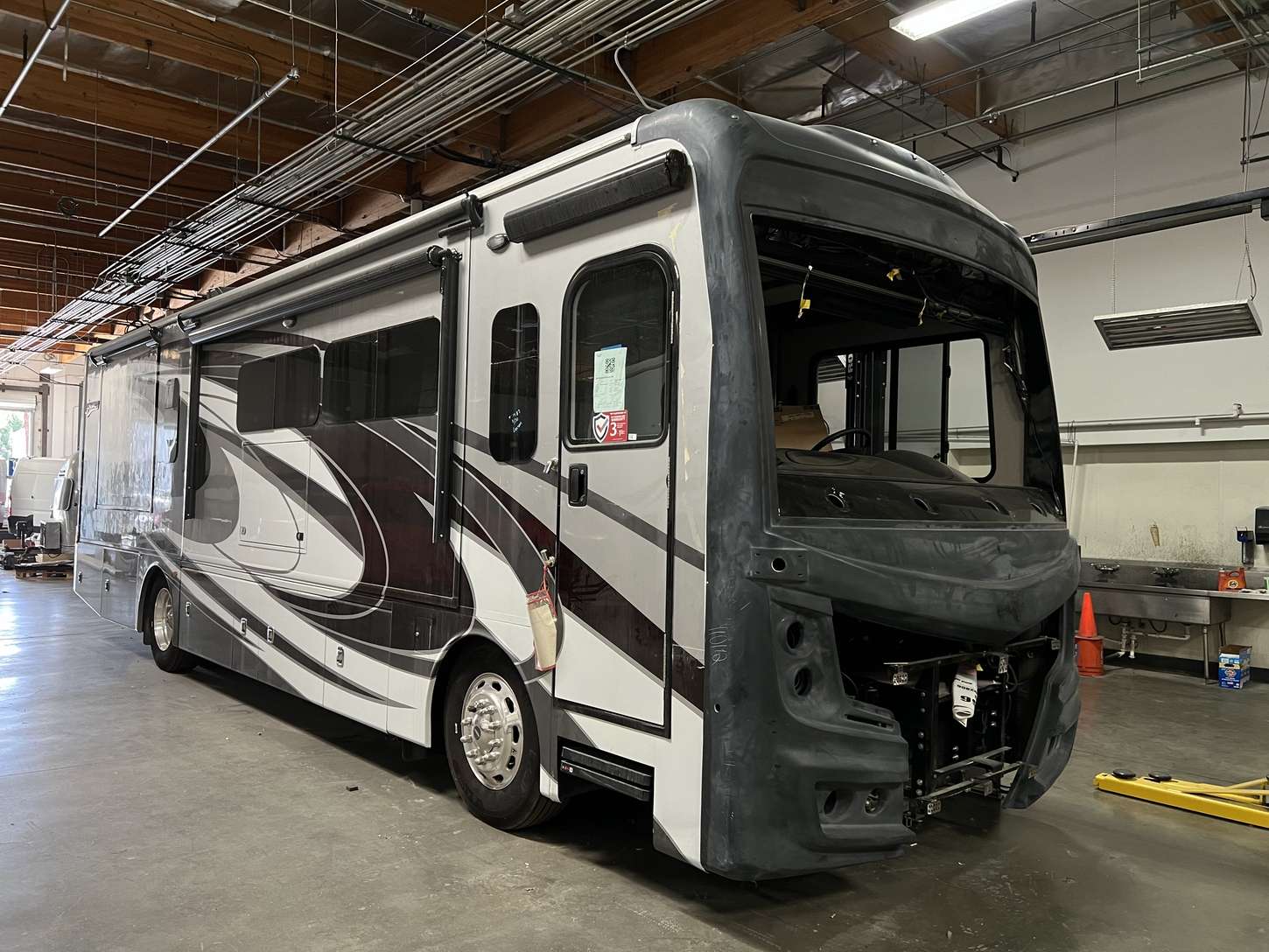
On our vehicles there is an additional layer, because recreational vehicles carry propane, refrigerant, sealed absorption refrigeration systems, batteries in configurations passenger cars do not use, and increasingly high voltage packs. Handling those safely during a collision repair is partly a compliance question and mostly a competence question. The hazardous material line on an invoice covers the containment and the manifested disposal of whatever of that came off your vehicle.
What we do not claim
The credentials deliberately absent from this site
You will not find training organization logos, trade association badges, manufacturer certification marks, awards, or third party accreditation seals anywhere on this site. Not because those things have no value, but because a customer has no realistic way to confirm any of them, and an unverifiable credential functions as decoration regardless of whether it happens to be true.
The test we apply is simple. Can you check it from your phone in a minute, against a record we do not control? The state registration passes. The EPA identification passes. A logo in a website footer does not. If we add anything to this page later it will come with the issuing body, the certificate number, and the expiration date attached, because those three details are what turn a claim into something you can audit.
The same discipline applies to everything else published here. We do not state a star rating, we do not publish reviews we wrote, and we do not describe outcomes on insurance claims as though a shop controls them. What we substitute for all of that is posted labor rates, a documented process, and two license numbers you can verify without asking us.
Questions
Frequently asked questions
What does a BAR registration actually mean
The Bureau of Automotive Repair is the California agency that registers and regulates automotive repair dealers. Our registration number is ARD00288521. Being registered is not a quality award and no honest shop should present it as one. What it is, is a set of enforceable obligations: a written estimate before work starts, no charges beyond that estimate without your prior authorization, replaced parts returned on request, an itemized invoice identifying whether parts are new, used, rebuilt, or reconditioned, and the registration posted where you can see it. It also gives you somewhere to complain that is not the shop, with an agency that can investigate and act against the registration.
How do I verify your license myself
Go to the Bureau of Automotive Repair website and use its license verification lookup, then enter ARD00288521 or the business name. The record will show the registration status, the registered business name, and the facility address. Do this for any shop you are considering, not just ours. It takes about a minute and it answers a question you otherwise have to take on faith. If a shop's number does not return a record, or the address on the record does not match the building you are standing in, that is worth understanding before you leave a vehicle there. You can also ask to see the posted registration at the counter.
What is the EPA number for and why does a body shop have one
Our EPA identification number is CAL000367879. It identifies the facility as a generator of hazardous waste, which any real refinishing operation is. Waste paint and solvent, used gun cleaning solvent, spent booth filters and rags, used oil and coolant, recovered refrigerant, and batteries are all regulated streams. The number is how those streams are tracked from our building to a licensed disposal facility on manifested paperwork. A shop that paints vehicles and cannot give you an EPA identification number is either not doing the work it claims, or is not handling the waste the way the rules require, and both of those should concern you for different reasons.
Do you hold I-CAR, ASE, or manufacturer certifications
We do not claim any of them on this site. The only credentials stated anywhere here are the state registration and the EPA identification, because those are the two you can independently verify against a public record in under a minute. Certification logos are the easiest thing in this industry to display and one of the hardest for a customer to check, which is exactly why they are so commonly displayed by shops that do not hold them. If we add a credential in the future it will appear together with the issuing organization, the certificate number, and the expiration date, so that you can confirm it rather than trust it.
What are you required to do if the repair costs more than the estimate
Stop and get your authorization before performing the additional work. Under California repair regulations a shop cannot exceed the estimated amount without your consent, and that consent has to be obtained before the work is done, not explained afterward. Our practice goes a step further: when teardown exposes damage the first inspection could not see, we photograph it, write the supplement with the reasoning attached, and send it to you and to the carrier if a claim is involved. You then decide. On laminated vehicles this happens often enough that it should be treated as a normal stage of the job rather than an exception.
Can I get the old parts back
Yes, if you ask for them, and the request needs to be made before the work is performed. The regulation carves out exceptions that are worth knowing about: parts being returned to a manufacturer or distributor under an exchange or core arrangement cannot be given to you, and parts that are themselves regulated waste, such as recovered refrigerant or certain fluids and batteries, have to go through the licensed disposal path instead. Everything else is yours if you want it. Owners who are uneasy about whether a part was actually replaced sometimes ask for exactly this reason, and that is a perfectly reasonable use of the right.
What does regulated paint handling involve day to day
Coatings sprayed in California are subject to air quality limits on their volatile content, and the equipment and practices are regulated alongside the products. In practice that means compliant spray equipment used at the specified pressures, a booth with capture and filtration rather than open air spraying, gun cleaning in enclosed equipment that contains solvent, filters changed on schedule and disposed of as regulated waste, and records kept for the coatings used. None of that is visible to a customer, which is the point of the licensing structure: the record exists so the practice can be inspected by someone whose job it is.
Why does hazardous material handling show up as a charge on my invoice
Because it is a real cost with a real regulatory paper trail behind it, and burying it inside a labor rate would make the invoice less honest rather than more. When a job involves chemicals, refrigerant, or LP, a hazardous material and disposal line appears at $45 flat when chemicals, refrigerant, or LP is involved. That covers the containment, the manifested pickup, and the licensed disposal of what came off your vehicle. Every material charge on our invoices works the same way: paint supplies and body supplies are calculated per paint hour and per body hour and shown separately, rather than bundled into a single number that cannot be checked.
Talk to a repair specialist today
Tell us what happened and we will tell you what the repair actually involves, what it costs, and how long it takes. We work directly with every major carrier and serve Westminster owners and fleets from our 35,000 square foot facility.
Posted labor rates are published on our prices page. Diagnostic and systems assessment fees are credited against an authorized repair.