RVs and Motorhomes
Luxury Coach Repair Where the Finish Is the Value
In short
Luxury coach repair is different from ordinary RV work because the finish and the interior carry most of the value. Expect about $5,000 for a contained panel and graphic repair to past $200,000 for a full structural and refinish program. Multi stage paint on a 45 foot body is the largest single line on most of these estimates.
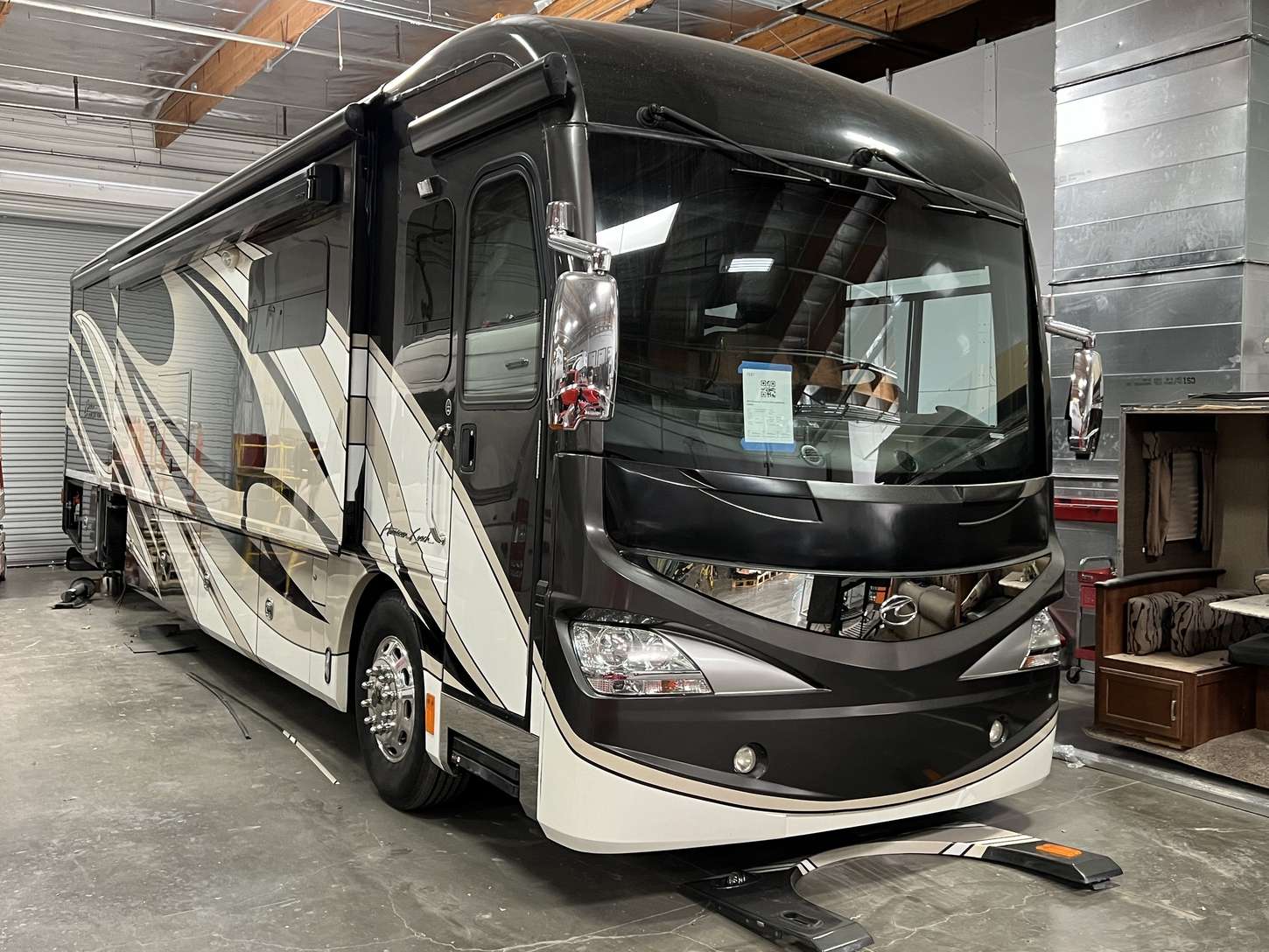
Luxury coach repair asks a shop to do two things at once: restore structure correctly, and restore a finish that a buyer will inspect at arm's length in Southern California sun. Owners in Westminster and across Orange County usually come to us after a shop told them a graphic could be blended in the middle of a panel. It cannot. This page explains how these coaches are actually refinished, what the parts reality is, and why staging the work protects the value.
Multi Stage Paint Has No Invisible Stopping Point
A high end coach finish is not one color. It is a base, then several tape and spray graphic layers in sequence, then clear over the whole thing, and often a pearl or metallic in one of those layers that shifts with viewing angle. Each layer has a hard edge somewhere, and those edges are the design. You cannot fade one out in the middle of a panel and expect it to disappear.
That is why refinish scope on these coaches is set by the graphic layout, not by the size of the damage. A repair that ends inside a swoosh will show, so the work carries to a natural break: a body line, a bay door edge, a cap seam, or in some layouts the end of the coach. Owners who understand that up front make better decisions than owners who find out after the first coat.
We spray out test cards and compare them outdoors before committing, because a fifteen year old coach has faded in ways the original paint code does not describe. Matching the code is easy. Matching the coach is the actual job.
- Photograph and measure the full graphic layout before masking
- Spray out and compare test cards in daylight, not under booth light
- Set the repair boundary at a body break, never mid graphic
- Rebuild layers in the original sequence, not a simplified version
- Cut and buff the clear after cure so the repair matches gloss, not just color
Full Body Refinish as a Planned Program
On a 43 to 45 foot coach, full body paint is a multi week program, not a job you squeeze between others. It runs strip and prep, removal of every light, rail, door and trim piece, body and surface correction, sealer, base, graphic layers, clear, then cure, cut and buff, then reassembly with fresh seals at every penetration.
Realistic labor is 150 to 300 hours of body and paint at $210 per hour, plus materials that run into five figures on a layered design. Shop time is typically five to nine weeks. Anyone quoting a full body luxury coach repaint in two weeks is either not removing the hardware or not clearing over the graphics.
This is also the natural moment to change the design. Reproducing a twenty year old layout costs the same as spraying a new one, and a lot of owners take the opportunity to modernize rather than recreate a dated scheme.
Stone, Tile and Hardwood That Crack When the Body Moves
Luxury coaches carry real tile, real stone and real hardwood, and those materials have no tolerance for structural movement. A cracked grout line running across a hallway is almost never a flooring problem. It is the floor structure telling you something moved, usually a leveling fault, a frame issue or a soft spot from a slide seal leak.
So we chase the cause before we touch the finish. Replacing tile over a moving floor is money set on fire. Once the structure is correct, the floor repair itself is careful work: matching a discontinued tile usually means sourcing from the same production family or lifting material from a closet to patch the visible run.
Solid surface and stone countertops crack the same way, often at a sink cutout where the section is narrowest. We repair those where the material allows and replace where the crack has broken through, and we always look at what moved underneath first.
Hydraulic Slides and Leveling on a Heavy Body
Larger coaches often use hydraulic slide rooms rather than electric racks, and hydraulics fail differently. Instead of grinding and stalling, they drift, creep out at a corner, or leave the room sitting slightly proud on one side. Behind that you usually find a cylinder seal, a solenoid, or air trapped in the circuit after a pump service.
The trap here is that a hydraulic room that sits crooked will chew its seals and let water into the floor, and by the time you see a stain the floor edge has been wet for months. So a slow drift is worth chasing immediately even though it seems cosmetic.
Leveling systems on these coaches are also load bearing. Leaving a coach parked out of level for months puts a twist in the body that shows up later as a bond failure in a sidewall or a slide that binds. That is one of the more expensive maintenance mistakes we see on high value units.
- A drifting room usually means a cylinder seal or solenoid
- Check for air in the circuit after any pump or fluid service
- Inspect wiper and bulb seals whenever a room sits out of square
- Meter the slide floor edge for moisture before it stains
- Do not store a coach out of level for extended periods
Long Lead Parts and What They Do to a Schedule
Parts on these coaches are low volume by definition. A model specific bay door, a curved side window, a molded cap section or a piece of interior trim can be a made to order item with a lead time measured in months. The 35 percent markup on parts over $100 is the smaller issue. The calendar is the real one.
Our approach is to identify long lead items in the first teardown and order them immediately, which is what the 50 percent deposit on repairs above $2,000 pays for. Then we sequence the rest of the job around the arrival dates so the coach is not sitting in a bay waiting on a single window.
Where a part is genuinely unavailable, we fabricate. Doors, trim, cap sections and interior panels are all things our floor can build and finish to match. That is often the difference between repairing a high value coach and watching it get written off over a discontinued part.
Staged Repair Protects Resale More Than Speed Does
The instinct after damage on a valuable coach is to get it fixed fast. On these units that instinct costs money. A rushed structural repair under a beautiful paint job is a defect that a buyer's inspector will find, and it prices the coach as damaged regardless of how the surface looks.
We work these in documented stages: structure and measurement, then seal and water integrity, then substrate and surface preparation, then finish, then interior. Each stage gets photographs and a sign off before the next begins. When you sell the coach, that file is the difference between a discount and a clean sale.
A worked example on a common job: a side impact through two bay doors and a lower sidewall on a coach with layered graphics, no chassis involvement. Typically 90 to 140 hours of body and paint at $210 for $18,900 to $29,400, plus $8,000 to $22,000 in doors, panel, hardware and refinish materials, plus tax on parts and materials at 7.75 percent.
Questions
Frequently asked questions
Why can you not just blend the paint where the damage is?
Because a luxury coach finish is layered. There is a base, several graphic layers sprayed in sequence with hard edges, and clear over all of it. A blend works on a solid color because there is only one layer to fade out. Inside a graphic there is nothing to fade into, so the repair boundary will read as a line no matter how skilled the sprayer is. The honest answer is that the refinish has to carry to a natural break in the design, which might be a body line, a bay door edge or the end of the coach. We show you where that break falls before you authorize anything.
How much does a full body repaint on a luxury coach cost?
On a 43 to 45 foot coach with layered graphics, realistic labor is 150 to 300 hours at $210 per hour, which is $31,500 to $63,000 before materials, and materials on a multi layer design commonly run into five figures on their own. Shop time is five to nine weeks. That covers full disassembly of lights, rails, doors and trim, surface correction, base, graphic layers, clear, cure, cut and buff, and reassembly with fresh seals at every penetration. A quote materially below that either is not removing hardware or is not clearing over the graphics, and both show within two years.
The tile in my hallway cracked. Can you just replace the tile?
We can, but we should not until we know why it cracked. Tile and stone have almost no tolerance for movement, so a crack running across a floor is usually the structure reporting a problem: a leveling fault that left the coach twisted, a soft floor section from a slide seal leak, or a frame issue. Replacing the tile over a floor that is still moving means doing it again next season. We inspect and meter the floor structure first, correct what moved, then repair the finish. Matching a discontinued tile often means sourcing from the same production family or borrowing material from a closet.
My slide room drifts out slightly on one side. Is that urgent?
Yes, more urgent than it looks. A hydraulic room that sits out of square wears its wiper and bulb seals unevenly, and once those seals stop sealing, water gets into the slide floor edge every time it rains with the room out. By the time a stain appears on the interior, that floor edge has usually been wet for months. The drift itself is normally a cylinder seal, a solenoid or air trapped in the circuit after a fluid service, and it is a comparatively small repair at the $260 mechanical rate. The floor it protects is not a small repair.
A part for my coach is discontinued. What now?
We fabricate. Bay doors, trim, cap sections, interior panels and a lot of hardware are all things our floor can build and finish to match the surrounding surface, including matching a graphic across a fabricated door. That capability is often the difference between repairing a high value coach and having it written off over a single unavailable part. Fabrication takes longer than ordering, so we identify these items during the first teardown and start on them immediately rather than waiting to confirm that a supplier really is out. The 50 percent deposit on repairs over $2,000 is what funds that immediate start.
How long will my coach be here for a major repair?
A contained panel and graphic repair is typically three to five weeks. A side impact through bay doors and a sidewall is six to ten weeks. A full body refinish is five to nine weeks on its own. Structural work with long lead components can run three to five months, and most of that is calendar rather than labor. We stage the work and document each phase, and where the coach is drivable between stages we will hand it back rather than storing it here. We would rather give you a real date than an optimistic one you plan a trip around.
Will a repair hurt my resale value?
A documented repair helps. An undocumented one hurts. Buyers at this level bring inspectors, and an inspector will find a rushed structural repair under a beautiful finish every time. What protects value is a file: measurements before and after, photographs of each layer during teardown, part numbers, the labor operations performed, and a clear record of the sequence. We work these jobs in stages with a sign off at each phase specifically so that file exists at the end. When you sell, that record is what keeps the conversation about the coach instead of about the damage.
Do you work on the chassis side of a luxury coach as well?
Yes. Most of these coaches are diesel pushers underneath, so air suspension, air brakes, leveling, cooling package and generator work are routine here at the $260 per hour mechanical rate. Diagnostic time is $285 per hour and is credited against a repair you authorize. That matters on a luxury unit because chassis faults are frequently the cause of the finish problems people call about: a leveling system that leaves the body twisted will crack a stone floor and delaminate a sidewall long before anyone suspects the suspension.
How the work runs
Our six step repair process
The same sequence on every vehicle, whether it is a single coach or a fleet of box trucks.
- 01
Assessment and documentation
We put the vehicle on the floor, pull panels where we need to see behind them, and photograph everything. Hidden damage found now is damage that does not become a supplement argument later.
- 02
Written estimate
You get a line by line estimate with parts, labor hours, materials, and the posted rate applied to each. Nothing is bundled into a single number you cannot check.
- 03
Carrier coordination
If a claim is involved we deal with the adjuster directly, submit the documentation, and handle supplements when teardown reveals more than the first inspection showed.
- 04
Authorization and scheduling
Once the scope is approved we confirm the deposit, order parts, and give you a realistic slot. Special order parts drive the timeline more often than labor does.
- 05
Repair
Structural first, then body, then paint, then systems and interior. The sequence is not negotiable because each stage has to be right before the next one covers it up.
- 06
Quality check and delivery
Multi point inspection, systems tested under load, paint inspected under corrected lighting, and a walkthrough with you before the vehicle leaves.
Keep reading
Related pages
Related vehicles
Services we perform
Talk to a repair specialist today
Tell us what happened and we will tell you what the repair actually involves, what it costs, and how long it takes. We work directly with every major carrier and serve Westminster owners and fleets from our 35,000 square foot facility.
Posted labor rates are published on our prices page. Diagnostic and systems assessment fees are credited against an authorized repair.