Campers and Trailers
Fifth Wheel Repair From the Pin Box Back
In short
Fifth wheel repair runs from about $1,000 for seal and panel work to past $50,000 for structural rebuilds on a large multi slide unit. The raised forward deck that rides over the truck bed is what makes these different: it concentrates load at the pin box and it puts a bedroom floor directly under a roof that owners never inspect.
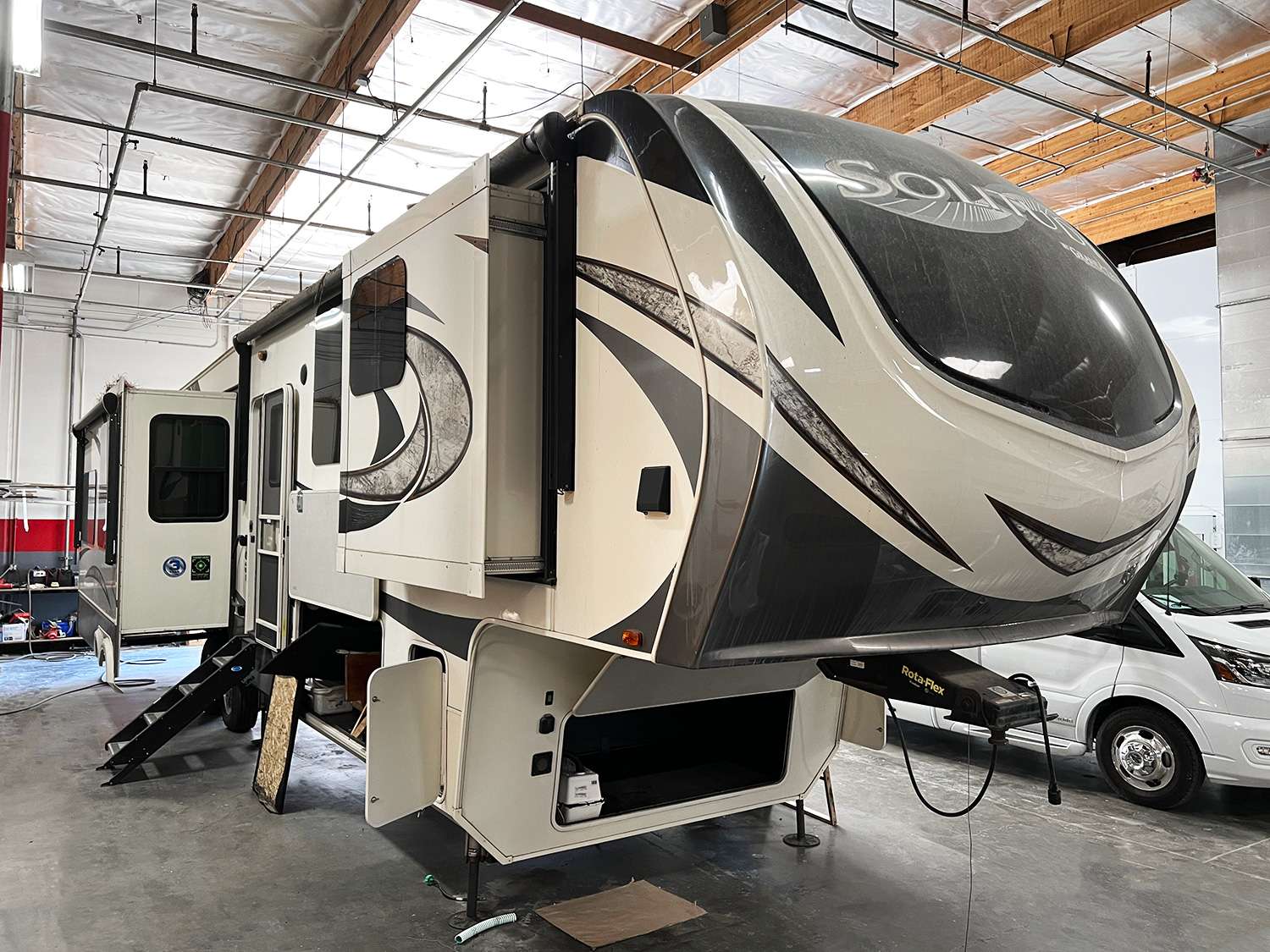
Fifth wheel repair is the heaviest work in the towable category, and Westminster owners bring us more of it every year as units get longer and taller. The raised nose changes the load path completely: the pin box carries the hitch weight into a frame that then has to support a full bedroom overhead, and the tall flat sidewalls behave like sails on a windy tow. Both facts show up in the damage we see.
Pin Box and Kingpin Damage
The pin box is the single most loaded component on the trailer. It transfers hitch weight and every acceleration and braking force into the front of the frame through a handful of bolted or welded connections. When something goes wrong at the hitch, that is where the damage concentrates, and it is frequently invisible from a walkaround.
What we look for is elongated bolt holes, cracked welds where the pin box mounts to the frame, a kingpin that measures out of spec, and any twist in the box itself. A trailer that has been hitched with the box at the wrong height for years shows wear in a distinctive pattern, and that is worth catching before it becomes a crack.
Repairs range from replacing a pin box, which is a bolt on job on many units, to rebuilding the frame structure it mounts to. The second is real structural work: measure, straighten, plate the stressed joints, and verify the box sits square to the frame afterward. Skipping the measurement step is how a trailer ends up towing crooked forever.
- Check bolt holes at the pin box mount for elongation
- Inspect every weld where the box ties into the frame
- Measure kingpin height and confirm it matches the tow setup
- Look for twist between the box and the frame rails
- Verify the front frame section is square before refitting
The Upper Deck Is Where the Water Goes
The bedroom over the truck bed is the most water damaged area on almost every used fifth wheel we take in. It has a roof, a front cap, a large forward facing wall, several windows, and usually an air conditioner or vent, and it sits at the front of the trailer taking wind driven rain at highway speed. Every one of those is a seam with a service life.
Water that enters up there does not stay up there. It runs down inside the front cap and along the upper deck floor, soaking the decking under the mattress and eventually reaching the step down into the main living area. Owners find it when the floor at the step feels soft, which is usually years after it started.
Repair scope depends on how far it traveled. A caught early front cap seam job is $1,500 to $4,000. Once the upper deck floor and framing are soft, expect $7,000 to $22,000, because the bed platform, the flooring and often a section of the front wall have to come out to get to it.
Tall Sidewalls, Crosswind and the Front Cap Seam
A modern fifth wheel can present a wall thirteen feet tall and thirty five feet long to a crosswind. That load has to go somewhere, and it goes into the seams: where the sidewall meets the front cap, where it meets the roof, and where it meets the floor. Over years of towing, those joints work, and working joints break sealant.
This is why sidewall delamination on a fifth wheel so often starts at the front corner rather than in the middle of the wall. The corner sees the most movement, and once the bond releases there, the failure runs back along the wall in the direction of travel.
Catching it early makes a large difference in cost. A localized front corner delamination treated with vacuum injection is typically $2,000 to $5,000. The same failure allowed to run twelve feet down the wall becomes a section replacement at $12,000 to $28,000 with paint.
Slide Rooms on a Unit That Flexes
Fifth wheels carry more slide rooms than any other towable, and the openings for those rooms are cut into walls that are already working hard. When the trailer flexes, the openings move, and a slide mechanism designed for a square opening starts to bind.
That is why we check the opening and floor for square before condemning a slide motor or a rail. On plenty of the units we see, the mechanism is fine and the structure is the problem, and replacing the mechanism would have been an expensive way to learn that.
Seals are the other half of the story. Wiper and bulb seals on a slide room have a service life, and a hardened seal admits water at the floor edge every time it rains with the room out. Seal replacement is inexpensive compared to the floor repair it prevents, and on a fifth wheel that floor edge is often directly above the frame where you cannot see the damage developing.
- Check opening and floor for square before pricing a mechanism
- Inspect wiper and bulb seals for hardening and permanent set
- Meter the slide floor edge for moisture at each corner
- Confirm the room sits flush against the seal when retracted
- Look for wear marks that show the room running out of alignment
Landing Gear, Leveling and the Front Drop
Landing gear failure is one of the more dramatic things that happens to a fifth wheel, and it damages far more than the legs. A front drop puts the full nose weight onto whatever it lands on, which loads the pin box, the front frame section and the front cap all at once.
After any drop we measure the frame before touching the body, because the visible cap damage is usually the least important part. We check the front rails for set, the pin box mount for cracked welds, and the floor structure at the step down for displacement.
Electric landing gear failures themselves are usually a motor, a gearbox, a switch or a corroded ground rather than the legs. That work is at the $260 mechanical rate and is worth doing on schedule, because the failure mode is expensive and the maintenance is not.
What a Fifth Wheel Repair Costs
Body and paint labor is $210 per hour, mechanical is $260, diagnostic is $285 credited against an authorized repair, and a systems assessment is $150 and also credited. Parts carry 100 percent markup at or under $100 and 35 percent over $100, plus 7.75 percent California tax on parts and materials.
A worked example on a common job: hitch strike damage to the lower front cap with no frame involvement. That is typically 16 to 26 hours of body and paint at $210 for $3,360 to $5,460, plus $700 to $2,400 in cap section, trim and refinish materials. Add frame straightening and the mechanical hours push it well past $10,000.
Anything above $2,000 carries a 50 percent deposit so material orders go in on approval day rather than a week later. On fifth wheels the long lead items are typically front caps, curved sidewall skin and model specific windows.
- Front cap seam reseal, roughly $1,500 to $4,000
- Hitch strike on the lower cap, roughly $4,000 to $8,000
- Upper deck floor and framing rebuild, roughly $7,000 to $22,000
- Front corner delamination injection, roughly $2,000 to $5,000
- Sidewall section replacement with paint, roughly $12,000 to $28,000
Questions
Frequently asked questions
The floor at the step up to my bedroom feels soft. What does that mean?
It usually means water has been entering the upper deck for a long time. The bedroom over the truck bed has a roof, a front cap, a large forward wall and several openings, all of which take wind driven rain at highway speed. Water entering there runs down inside the cap and along the upper deck floor, soaking the decking under the mattress before it reaches the step where you finally feel it. By that point the wet area is typically two to three times larger than what shows. We meter the whole deck before quoting, because the repair scope is set by how far it traveled.
How much does fifth wheel repair cost?
The working range is $1,000 to past $50,000. A front cap seam reseal is $1,500 to $4,000. Hitch strike damage to the lower cap without frame involvement is typically $4,000 to $8,000. Front corner delamination caught early and treated with injection is $2,000 to $5,000. An upper deck floor and framing rebuild is $7,000 to $22,000. Sidewall section replacement with paint runs $12,000 to $28,000, and structural work on a large multi slide unit can pass $50,000. Body labor is $210 per hour and jobs over $2,000 take a 50 percent deposit.
My landing gear collapsed. Is the frame damaged?
Assume it is until measurement says otherwise. A front drop puts the entire nose weight onto whatever it landed on, and that load goes straight into the pin box, the front frame rails and the front cap at the same time. The cap damage is what you see and it is usually the least important part. We measure the frame diagonals, check the pin box mount for cracked welds and elongated holes, and look at the floor structure at the step down for displacement before any body work is quoted. Repairing the cap on a frame that has taken a set means the seams reopen within a season.
Why does my slide room bind on one side?
Most of the time the mechanism is reporting a structural problem rather than having one. Slide rails and racks are built to run in a square opening. A fifth wheel with tall sidewalls flexes, and if the wall has softened from delamination or the floor has swelled from a hardened slide seal, the opening is no longer square and the room binds. We check the opening and floor for square, inspect the seals, and look at the room edges for swelling before pricing a mechanism. If the structure is the cause, a new motor buys a few months and then you are back with a bigger bill.
Can you replace a pin box, or does the whole frame need work?
On many units the pin box is a bolt on component and replacement is straightforward. What decides it is the condition of what it mounts to. We check the bolt holes for elongation, every weld where the box ties into the frame, the kingpin dimension, and whether there is twist between the box and the rails. If the mounting structure is sound, a replacement box goes on and the job is modest. If the front frame section has taken a set, that comes first: measure, straighten, plate the stressed joints, then fit the box and verify it sits square. Doing it the other way around wastes the box.
Is delamination on the front corner serious?
Yes, and it is the most common place for it to start on a fifth wheel. The front corner takes the most movement because a tall sidewall in a crosswind loads the joint where the wall meets the front cap. Once the bond releases there, the failure runs back along the wall in the direction of travel and it accelerates in Southern California heat. Caught while it is still localized, vacuum injection restores the bond for roughly $2,000 to $5,000. Allowed to run twelve feet down the wall, it becomes a section replacement with paint at $12,000 to $28,000. Metering it early is worth the visit.
How long will my fifth wheel be in the shop?
Seal and panel work is typically three to eight business days. A front cap section with paint is two to four weeks. An upper deck floor and framing rebuild is three to six weeks depending on how much framing comes out. Frame straightening after a landing gear collapse adds a week or two, and structural work with a molded front cap on order can run eight weeks or more. Parts drive the calendar more than labor does. If the unit is towable and a part is far out, we document, order, and hand it back until the material arrives.
Do you work on the running gear as well as the body?
Yes, at the $260 per hour mechanical rate. Fifth wheels carry heavy axles, electric brakes, springs and shackles that see real load, and a unit that pulls to one side or wears a tire pattern is usually reporting an axle alignment or shackle problem rather than a tire problem. We inspect running gear as a system: bearings and seals, brake magnets, shoes and drums, springs, shackles and bushings, and axle alignment relative to the kingpin. Landing gear motors, gearboxes and leveling systems are also mechanical work, and they are worth servicing on schedule rather than after a failure.
How the work runs
Our six step repair process
The same sequence on every vehicle, whether it is a single coach or a fleet of box trucks.
- 01
Assessment and documentation
We put the vehicle on the floor, pull panels where we need to see behind them, and photograph everything. Hidden damage found now is damage that does not become a supplement argument later.
- 02
Written estimate
You get a line by line estimate with parts, labor hours, materials, and the posted rate applied to each. Nothing is bundled into a single number you cannot check.
- 03
Carrier coordination
If a claim is involved we deal with the adjuster directly, submit the documentation, and handle supplements when teardown reveals more than the first inspection showed.
- 04
Authorization and scheduling
Once the scope is approved we confirm the deposit, order parts, and give you a realistic slot. Special order parts drive the timeline more often than labor does.
- 05
Repair
Structural first, then body, then paint, then systems and interior. The sequence is not negotiable because each stage has to be right before the next one covers it up.
- 06
Quality check and delivery
Multi point inspection, systems tested under load, paint inspected under corrected lighting, and a walkthrough with you before the vehicle leaves.
Keep reading
Related pages
Related vehicles
Services we perform
Talk to a repair specialist today
Tell us what happened and we will tell you what the repair actually involves, what it costs, and how long it takes. We work directly with every major carrier and serve Westminster owners and fleets from our 35,000 square foot facility.
Posted labor rates are published on our prices page. Diagnostic and systems assessment fees are credited against an authorized repair.