Public Sector and Partners
City Fleet Repair Contractor Capability for Public Fleets
In short
A city fleet repair contractor has to satisfy procurement before it ever touches a vehicle. Purchase orders, itemized documentation, and invoices that survive an audit matter as much as the repair itself. We work with public agencies serving Westminster and the surrounding Orange County area across police, public works, parks, and utility vehicles from one 35,000 square foot facility.
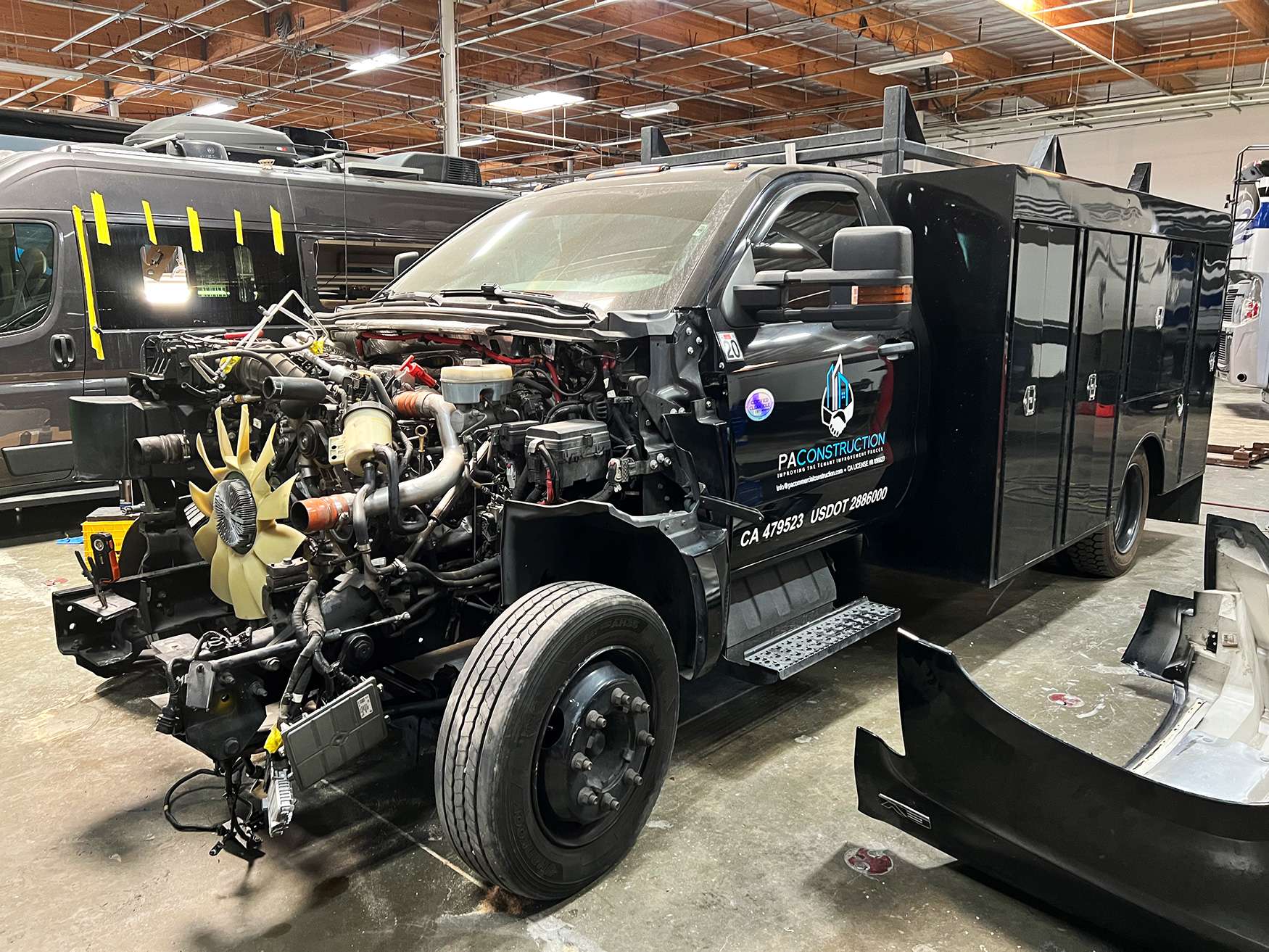
Working as a city fleet repair contractor means the paperwork is part of the job. Public agencies operate on purchase orders, defined budget cycles, and documentation standards a private customer never encounters, and a shop that cannot work inside that structure creates problems for the fleet supervisor rather than solving them. We handle municipal vehicle repair for agencies serving Westminster and the wider Orange County area, across every department a city fleet contains.
Purchase Orders and How We Invoice
Municipal repair work does not start with a handshake and a promise to sort out the paperwork later. It starts with an authorization document, and the invoice at the end has to reference that document correctly or it sits in accounts payable for a month while somebody tries to match it. We structure intake around that reality rather than treating it as an administrative inconvenience imposed on the real work.
Every job references the purchase order or authorization number you provide, carries the vehicle identifier your system already uses rather than one we invented for convenience, and separates labor, parts, and any approved supplement into distinct lines. Supplements never get folded quietly into an original scope, because that is precisely the pattern that generates an audit question two years later when nobody remembers the job.
If your agency requires quotes before a purchase order can be issued, we produce them in a format your procurement staff can process directly without rewriting. If your threshold rules require multiple quotes above a certain dollar amount, tell us the threshold and we will scope accordingly rather than handing you a document that fails your own internal review and has to come back.
- Purchase order or authorization number referenced on every document
- Agency vehicle identifiers used rather than shop numbering
- Labor, parts, and supplements shown as separate line items
- Quotes produced in a format procurement can process directly
- Supplements approved in writing before any work proceeds
Documentation Your Procurement Staff Can File
Public agencies get audited, and that is not a criticism of anybody. It is simply how public money works, and it means a fleet supervisor needs a paper record that stands entirely on its own years later, when nobody involved in the original repair still holds the same position or possibly still works there at all. The file has to answer questions entirely on its own, without anybody available to explain what happened or why a line was approved.
Our repair files include dated photographs, written damage descriptions, teardown findings where applicable, an itemized scope tying each operation to a specific damage point, parts documentation, and a final invoice that reconciles line by line to the authorized scope. That is considerably more paper than a private customer wants to receive, and it is precisely what a public agency needs to have on file.
We also retain repair history organized by vehicle identifier, which matters a great deal when a supervisor is building a replacement request. A documented pattern of repeat repairs on a single unit is a far stronger argument in front of a council or a finance committee than an assertion that the vehicle has become unreliable and everyone should take your word for it.
Budget Cycles and Timing the Work
Municipal budgets have hard boundaries that do not bend for a repair schedule. Funds encumbered in one fiscal period do not casually roll into the next, and a repair that slips past the end of a cycle can create a genuine problem for the department that authorized it. Private shops rarely think about this at all. Public fleet supervisors think about it constantly and plan their year around it.
We plan around your cycle rather than discovering it late. If work needs to be authorized, completed, and invoiced within a defined window, tell us the deadline at the beginning and we will give you an honest answer about whether the scope realistically fits. Where parts lead times threaten the boundary, we identify that before the purchase order is issued rather than after the funds are already committed and unusable elsewhere.
End of cycle also tends to be when deferred work finally gets funded, which produces a predictable seasonal rush. We can absorb batched intake in those periods, but capacity is finite and shared. A conversation in advance is considerably more productive than arriving with eight vehicles in the last two weeks of a fiscal year and needing all of them invoiced before it closes.
Police and Public Safety Vehicles
Patrol vehicles accumulate damage in ways ordinary municipal fleets do not. Curb strikes and pursuit related contact. Push bumper and pursuit equipment damage. Prisoner partition and rear compartment wear from constant use. Underneath all of it sits the duty cycle of a vehicle that runs multiple shifts a day, every day, with no meaningful rest period in which anything can be addressed quietly.
Repairs on these units have to account for the mounted equipment as a first consideration rather than an afterthought. Light bars, radio and computer installations, weapon mounts, partitions, and the wiring supporting all of it interact directly with body structure. A repair that disturbs any of them without reinstalling correctly creates an officer safety problem rather than a cosmetic complaint from a supervisor.
Downtime is a genuine operational issue for a patrol fleet rather than an inconvenience to be absorbed. Departments running at capacity have limited spare units and no ability to simply park a vehicle for three weeks. We prioritize function so the unit returns to rotation, and we schedule cosmetic completion separately whenever that is the faster path back to a full shift roster.
- Push bumper, pursuit equipment, and mounting structure repair
- Light bar, antenna, and equipment mount reinstallation
- Partition, rear compartment, and interior component repair
- Body and structural repair after contact and curb damage
- Refinishing that matches agency markings and identification
Public Works and Utility Trucks
Public works fleets look a great deal like construction fleets and they fail in the same ways for the same reasons. Dump bodies crack at hinge points under repeated load. Service bodies corrode at compartment floors where moisture sits. Equipment mounts loosen and elongate over years of vibration. Trucks operating on unpaved surfaces and hauling abrasive material wear their coatings far faster than road use alone would ever suggest.
We repair dump bodies, flatbeds, utility bodies, aerial and bucket truck structures, sweeper and maintenance equipment bodies, and the mounting systems tying equipment into the chassis. Structural repair at mounting points is routine work here, because the load a public works truck actually carries in service rarely matches what the original mounting design anticipated when the body was specified years ago.
Because these vehicles frequently support scheduled seasonal operations, we time repairs against the operational calendar rather than only against parts availability. Street maintenance programs, storm preparation, and community event support all have windows where a specific unit absolutely has to be available, and those windows are usually known months in advance if anybody asks. Give us those dates at intake and we will schedule against them rather than putting a unit in a bay the week you need it most.
Parks, Recreation, and Community Vehicles
Parks fleets are the mixed bag of any municipal operation. Pickups, small utility vehicles, compact dump trucks, trailers, equipment haulers, and passenger vans for community programs all sit under one department with a budget considerably smaller than public safety and a need for availability that is just as real to the people depending on it. Availability in a parks fleet usually means a community program runs or it does not, and that is felt by residents rather than by a dispatcher.
Damage here tends toward the accumulated rather than the dramatic, which is exactly why it goes unaddressed. Trailer coupling and frame wear. Tailgate and bed damage from repeated loading of equipment. Corrosion driven by irrigation water and turf chemicals. Body damage from operating in tight park access areas never designed for a truck. Individually minor, collectively expensive if ignored for several seasons.
For departments working with tight budgets, we prioritize honestly rather than comprehensively. Not every item on a parks vehicle needs correcting, and we will tell you which repairs protect the asset and which are cosmetic preferences you can decline without consequence. That distinction is worth more to a supervisor defending a budget line than a complete estimate covering everything we found.
- Trailer frame, coupling, and lighting repair
- Bed, tailgate, and cargo area damage from repeated loading
- Corrosion repair from irrigation and turf chemical exposure
- Passenger van body and interior repair for community programs
- Prioritized scoping that separates asset protection from cosmetics
Water, Sewer, and Utility Equipment
Water and sewer fleets carry some of the harshest duty in any municipal operation. Vacuum and jetter trucks, valve and hydrant service units, and heavy utility bodies work in constantly corrosive environments while carrying equipment that concentrates significant load into a small number of specific frame locations that were never inspected after installation. These are also the units least likely to be pulled from service for anything short of a failure, which gives small problems years to become large ones.
Corrosion is the dominant failure mode on these units by a wide margin. Constant water contact, chemical exposure, and material carryback attack coatings first and then the substrate underneath. We repair by removing corrosion back to sound metal and replacing failed sections rather than coating over compromised areas, because a cosmetic repair on a corroded utility body fails on a schedule anyone could predict.
Equipment mounting integrity matters here as much as it does on a crane truck. Tank, pump, reel, and hose mounts all transfer load into the chassis, and cracked mounts on a heavy utility unit are a safety issue rather than a maintenance note. Call (949) 799-3387 or email info@ocrvcenter.com to discuss agency intake and documentation requirements. We will structure the file around what your procurement and finance staff actually need to see rather than a generic format.
Questions
Frequently asked questions
Do you accept purchase orders from public agencies?
Yes, and we structure intake around the authorization document rather than treating it as paperwork to sort out later. Every job references the purchase order or authorization number you provide, uses your agency vehicle identifiers rather than shop numbering, and separates labor, parts, and approved supplements into distinct invoice lines. If your agency requires quotes before a purchase order can be issued, we produce them in a format your procurement staff can process directly. Tell us your threshold rules at the start and we will scope to fit them rather than making you rework documents.
What documentation do you provide for an audit trail?
Dated photographs, written damage descriptions, teardown findings where applicable, an itemized scope tying each repair operation to a specific damage point, parts documentation, and a final invoice that reconciles line by line to the authorized scope. That is more documentation than a private customer wants and roughly what a public agency actually needs, because the file has to stand on its own years later when the people involved have moved on. We also retain repair history by vehicle identifier, which supports replacement requests with evidence rather than assertion.
Can you complete and invoice work inside a fiscal year boundary?
Often, but we need the deadline at the start rather than at the end. Municipal funds encumbered in one period do not casually roll forward, so a repair that slips past a cycle boundary creates a genuine problem for the authorizing department. Tell us the date and we will give you an honest answer about whether the scope fits, including where the risk sits. Parts lead times are almost always the threat, and we identify those before the purchase order is issued rather than after the funds are committed.
Which municipal departments do you handle vehicles for?
The full range a city fleet contains. Police and public safety vehicles including patrol units with mounted equipment, public works trucks with dump, utility, and aerial bodies, parks and recreation vehicles and trailers, community program passenger vans, and water and sewer utility equipment. Running all of them through one 35,000 square foot facility gives a fleet supervisor a single accountable vendor and one consistent documentation format across departments, which is considerably easier to manage than reconciling several vendors with different invoice conventions.
How do you handle equipment mounted on patrol vehicles?
Carefully, and as part of the repair rather than an afterthought. Light bars, antennas, radio and computer installations, weapon mounts, partitions, and the wiring supporting all of it interact with body structure, and a repair that disturbs them without correct reinstallation creates an officer safety problem rather than a cosmetic one. We document configuration before removal and reinstall to that configuration. Where a component requires a specialty installer to be done correctly, we say so instead of doing an adequate job on something that should not be adequate.
Do you charge for assessments on municipal vehicles?
Yes, and the fee is credited against the repair when the work is authorized. For an agency this structure is straightforward to document, because the assessment appears as a line that either folds into an approved repair or stands alone as a diagnostic you paid for and can use. On declined work you retain a documented condition assessment that supports a deferral or replacement decision. That is often exactly what a supervisor needs when justifying a capital request rather than another round of repair spending.
Can you handle several agency vehicles at once?
Yes, with staged release so the department is not fully down at any point. Units needing long lead parts start first, quicker work fills the gaps, and vehicles return on a rolling calendar you receive at authorization. Each unit carries its own file, scope, and invoice referencing its own authorization, while you get a consolidated view for planning. End of cycle batches are common in municipal work and we can absorb them, but capacity is finite, so a conversation in advance beats eight vehicles arriving in the last two weeks of a fiscal year.
How does an agency get set up with your shop?
Call (949) 799-3387 or email info@ocrvcenter.com with your department mix, vehicle types, and your procurement requirements including purchase order format, quote thresholds, and invoicing conventions. We will structure intake to match rather than asking your staff to adapt to ours. Our facility has operated since 2015, is licensed by the California Bureau of Automotive Repair under ARD00288521, and holds EPA identification CAL000367879. We describe capability here, and any working relationship follows your agency's own procurement process.
Keep reading
Related pages
Others we work with
Services we perform
Talk to a repair specialist today
Tell us what happened and we will tell you what the repair actually involves, what it costs, and how long it takes. We work directly with every major carrier and serve Westminster owners and fleets from our 35,000 square foot facility.
Posted labor rates are published on our prices page. Diagnostic and systems assessment fees are credited against an authorized repair.