Vehicles We Repair
Mobile Business Vehicle Repair Orange County Operators Trust
In short
Mobile business vehicle repair is two repairs in one: the vehicle side and the built workplace inside it. Work runs from about $1,500 for panel and utility repairs to past $80,000 for major reconstruction of an equipped unit. For these owners the schedule matters as much as the number, because every day down is revenue that does not come back.
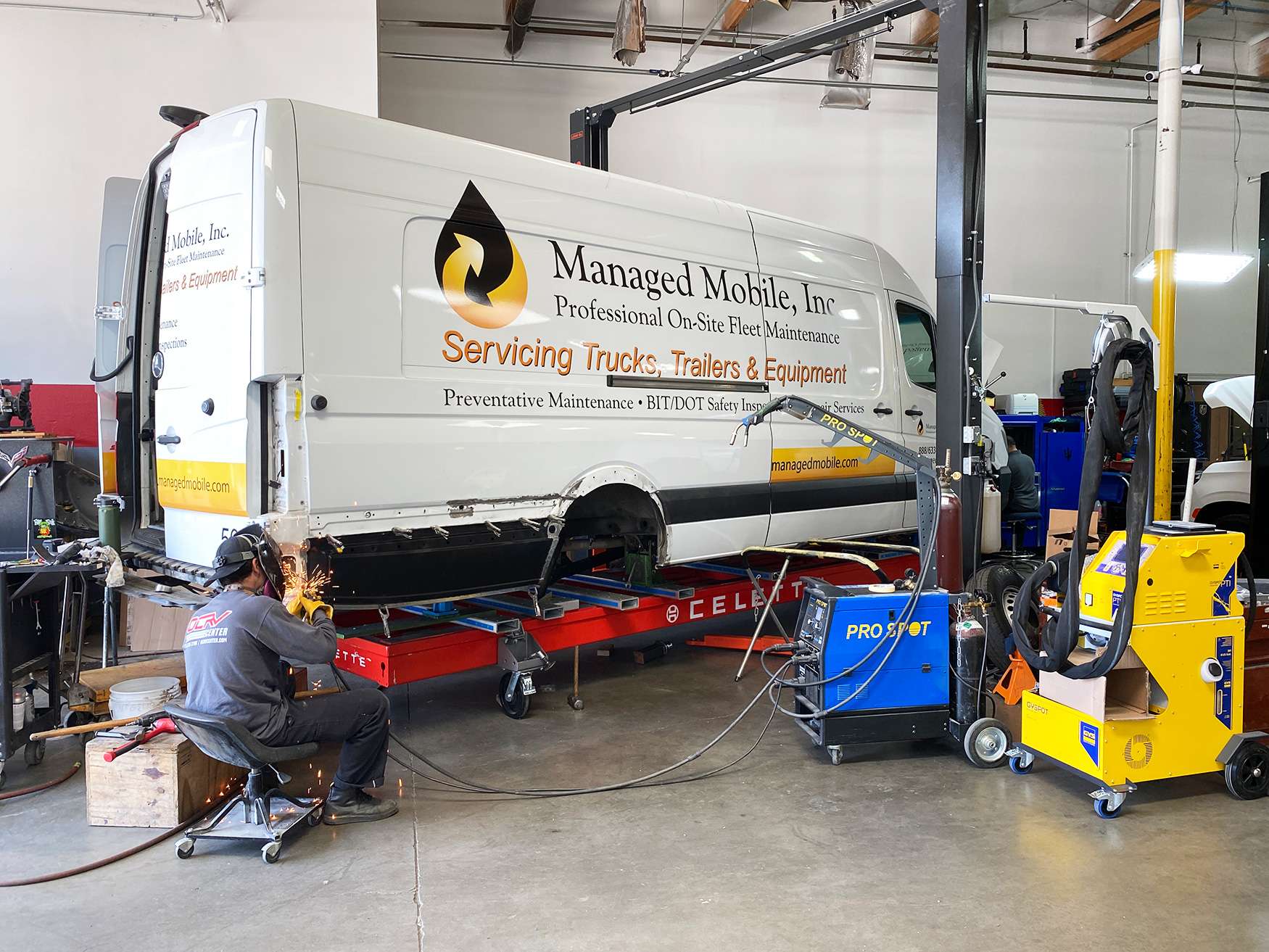
Mobile business vehicle repair Orange County operators need starts with a different question than any other job on this floor: when do you have to be working again. Westminster food truck, clinic and grooming operators lose income for every day a unit sits, so we scope around bookings rather than around bay availability. This page covers the double repair, the utilities, undocumented builds, and how re inspection considerations fit into the plan.
Every Job Here Is Two Repairs
On a mobile business vehicle there is the vehicle, which is body, chassis and drivetrain, and there is the workplace, which is the built interior, the utilities and the surfaces you work on. A collision damages both, and a repair that addresses only one hands you a truck you cannot legally or practically operate.
That is the thing most owners have already run into before they call us. A body shop fixed the panel and left an interior that no longer passes a look. Or an upfitter rebuilt the interior on a body that was never straightened, so the door still does not close.
We scope both halves on one document, with the vehicle side and the workplace side as separate sections so you can see what you are paying for and, where budget is tight, decide what happens now and what happens later.
- Vehicle side: body, structure, chassis, drivetrain, doors, glass
- Workplace side: interior surfaces, cabinetry, utilities, equipment mounting
- One scope document, two clearly separated sections
- Phased options where the budget cannot cover both at once
- A completion date built around your bookings
An Upfitted Interior Makes Body Work Harder
Body repair needs access to the back of a panel. On an equipped unit, the back of that panel has stainless sheet, cabinetry, a water line, a gas line, a wiring run or a piece of installed equipment on it. All of it has to come out and go back.
So the labor on a mobile business unit is genuinely higher than the same damage on an empty van, and it is higher in a predictable way. We put the removal and reinstallation hours in the original estimate rather than issuing them as a supplement, because they are foreseeable.
It also affects sequence. Utilities get isolated and capped before disassembly, equipment is removed and stored safely, surfaces come out in the order they went in, and everything is photographed so the rebuild matches what was there rather than approximating it.
Undocumented Builds and What We Find
Most mobile business vehicles were built by an upfitter or by the owner, and very few come with an as built drawing. That means we do not know where the propane line runs, which circuit feeds what, or whether the cabinetry is fastened to structure until we look.
So a survey is the first line on most of these jobs. We trace circuits, locate tanks and plumbing runs, identify what is fastened to structure versus skin, and photograph everything before disassembly. That survey is real labor and it is in the estimate honestly.
What owners get from it, beyond a correct repair, is documentation of their own vehicle that they have never had. On a unit you depend on for income, knowing where your gas line and your electrical runs actually are is worth having on its own.
Generators, Shore Power and Water Systems
The utilities are what make the vehicle a workplace, and they fail in predictable ways. Generators suffer from fuel sitting, from compartments that trap heat and from mounting that vibrates loose. Shore power inlets take physical damage and corrode. Water pumps and tanks fail at fittings, and tank mounting works loose from the weight moving on rough roads.
None of that is exotic. It is normal equipment maintenance that gets deferred because the unit is working and stopping costs money. The pattern we see is a small utility fault ignored until it takes the vehicle out of service on a booked day.
Utility work bills at the $260 mechanical rate, with diagnostic at $285 credited against an authorized repair. Where we are working inside a unit anyway for body reasons, addressing deferred utility items in the same visit costs far less than a separate one.
- Generator mounting, ventilation and fuel system condition
- Shore power inlet, cord and distribution condition
- Water pump, fittings and tank mounting under load
- Waste tank, drain routing and valve condition
- Propane or fuel line routing, protection and support
Re Inspection After a Structural or Interior Change
Anything that changes the interior surfaces, the plumbing, the gas train or the electrical typically means the operator has to have the unit looked at again by whichever authority permits them. We are not the authority and we do not speak for them, so we do not make claims about what will or will not be accepted.
What we do is build to surfaces and details that will pass a look, and document exactly what we changed. Sealed, cleanable surfaces with coved joints where the original had them. Utilities routed, supported and protected properly. A written record of what was replaced and how.
Owners tell us that record is what makes the re inspection straightforward rather than a negotiation. Bring your permitting requirements into the conversation at scoping and we will build to them rather than around them.
Scheduling Around Your Bookings
The number that matters most on these jobs is the date. A five thousand dollar repair that takes four weeks can cost an operator more in lost bookings than a nine thousand dollar repair that takes eight days.
So we build the schedule first. We scope, identify long lead items, order against the deposit, and take the vehicle when the material is on the shelf. On larger jobs we stage the work into phases that leave the unit operable between them wherever that is possible.
Rates are posted: body and paint at $210 per hour, mechanical at $260, diagnostic at $285 credited against an authorized repair, parts at 100 percent markup at or under $100 and 35 percent over, plus 7.75 percent California tax on parts and materials. Authorized repairs above $2,000 carry a 50 percent deposit.
- Tell us your booking calendar before we quote a date
- We order long lead parts before the vehicle comes in
- Larger jobs staged so the unit works between phases
- Deferred utility items bundled into the same visit
- Realistic dates in writing rather than optimistic ones
In this category
Types we work on
Food Truck
Food truck repair runs from about $1,500 for panel and utility work to past $50,000 for structural rebuilds with a full interior....
Read moreMobile Medical Unit
Mobile medical unit repair runs from about $2,500 for jack and door work to past $80,000 for structural repairs on a large expanda...
Read moreMobile Pet Grooming Van
Mobile pet grooming van repair runs from about $1,500 for plumbing and panel work to past $30,000 for a full floor and structural...
Read moreQuestions
Frequently asked questions
How fast can you get my unit back to work?
It depends on the damage, but the schedule is something we design rather than report. Panel and utility repairs are typically five to ten business days. Body repair requiring interior removal and reinstallation is two to four weeks. Structural work with equipment out is four to eight weeks. What shortens all of those is scoping early and ordering long lead parts before the vehicle comes in, so the unit is not sitting in a bay waiting on a part. Tell us your booking calendar at scoping and we will build the plan around it rather than around our bay availability.
Why does body work cost more on an equipped vehicle?
Because proper body repair needs access to the back of the panel, and on your unit the back of that panel has stainless sheet, cabinetry, a water line, a gas line, a wiring run or installed equipment against it. All of it comes out and goes back, with utilities isolated and capped first and everything photographed so the rebuild matches what was there. Those hours are predictable, so we put them in the original estimate rather than issuing them later as a supplement. Expect the interior removal and reinstallation to add meaningfully to what the same dent would cost on an empty van.
Do I need to be re inspected after the repair?
Usually, if the work changed interior surfaces, plumbing, the gas train or the electrical, and that determination belongs to whichever authority permits your operation rather than to us. We do not speak for them and we will not tell you what they will accept. What we do is build to sealed, cleanable surfaces with the joint details the original had, route and support utilities properly, and give you a written record of exactly what was replaced and how. Owners tell us that record is what makes re inspection straightforward. Bring your permitting requirements to scoping and we will build to them.
My unit was built by an upfitter and I have no drawings. Is that a problem?
It is normal, and it is why a survey is the first line on most of these jobs. Without documentation we do not know where the propane line runs, which circuit feeds what, or whether the cabinetry is fastened to structure until we look. So we trace circuits, locate tanks and plumbing runs, identify what is fastened to structure versus skin, and photograph everything before disassembly. That is real labor and it is in the estimate honestly. What you keep afterward is documentation of your own vehicle that you have never had, which is worth something on its own.
Can you service the generator and water system too?
Yes, at the $260 per hour mechanical rate with diagnostic at $285 credited against an authorized repair. Generators fail from fuel sitting, from compartments that trap heat and from mounting that vibrates loose. Shore power inlets take physical damage and corrode. Water pumps and tanks fail at fittings, and tank mounting works loose from weight moving on rough roads. If we are already inside your unit for body reasons, addressing deferred utility items in the same visit costs a fraction of a separate one, and we will list them as optional lines rather than doing them without asking.
How much does mobile business vehicle repair cost?
The range is about $1,500 to past $80,000. Panel and utility repairs are at the low end. Body repair requiring interior removal and reinstallation typically runs $6,000 to $16,000. Structural work with equipment removed and interior surfaces rebuilt is $18,000 to $45,000. Major reconstruction of a fully equipped unit can pass $80,000. Body and paint labor is $210 per hour, mechanical is $260, parts carry 100 percent markup at or under $100 and 35 percent over, and authorized repairs above $2,000 carry a 50 percent deposit.
Can the work be done in phases so I keep operating?
Often yes, and on these units it is usually the right plan. We split the job so the phases that take the vehicle out of service are as short as possible and grouped together, with anything that can be done while you are still working scheduled separately. A common pattern is to do the assessment and order parts while you keep operating, then take the unit for a single continuous block when the material is on the shelf. Whether a damaged unit is fit to operate in the interim depends on your own permitting situation, and that call is yours.
Do you work with insurance on a business vehicle?
Yes, and we document heavily on these because the interior is the part that gets underestimated. A photo estimate cannot show that a wall panel has a gas line and a stainless surface behind it, so first numbers on equipped units are commonly low. We photograph every layer at teardown, record what was behind each panel, and submit findings with substantiation attached. We do not predict what a carrier will approve or what a payout will be. What we control is the quality of the file: measurements, part numbers, labor operations, and photographs of each stage.
How the work runs
Our six step repair process
The same sequence on every vehicle, whether it is a single coach or a fleet of box trucks.
- 01
Assessment and documentation
We put the vehicle on the floor, pull panels where we need to see behind them, and photograph everything. Hidden damage found now is damage that does not become a supplement argument later.
- 02
Written estimate
You get a line by line estimate with parts, labor hours, materials, and the posted rate applied to each. Nothing is bundled into a single number you cannot check.
- 03
Carrier coordination
If a claim is involved we deal with the adjuster directly, submit the documentation, and handle supplements when teardown reveals more than the first inspection showed.
- 04
Authorization and scheduling
Once the scope is approved we confirm the deposit, order parts, and give you a realistic slot. Special order parts drive the timeline more often than labor does.
- 05
Repair
Structural first, then body, then paint, then systems and interior. The sequence is not negotiable because each stage has to be right before the next one covers it up.
- 06
Quality check and delivery
Multi point inspection, systems tested under load, paint inspected under corrected lighting, and a walkthrough with you before the vehicle leaves.
Keep reading
Related pages
Related vehicles
Services we perform
Talk to a repair specialist today
Tell us what happened and we will tell you what the repair actually involves, what it costs, and how long it takes. We work directly with every major carrier and serve Westminster owners and fleets from our 35,000 square foot facility.
Posted labor rates are published on our prices page. Diagnostic and systems assessment fees are credited against an authorized repair.