Paint and Refinishing
RV Ceramic Coating: What It Does and What It Costs
In short
RV ceramic coating runs $1,200 to $6,000 or more, and the majority of that number is surface preparation rather than the coating itself. A coating is a thin siloxane layer that cures onto the clear coat or gelcoat, making the surface hydrophobic, easier to wash, and more resistant to ultraviolet and chemical attack. Owners in Westminster should expect two to five years of real service life depending on storage and wash habits.
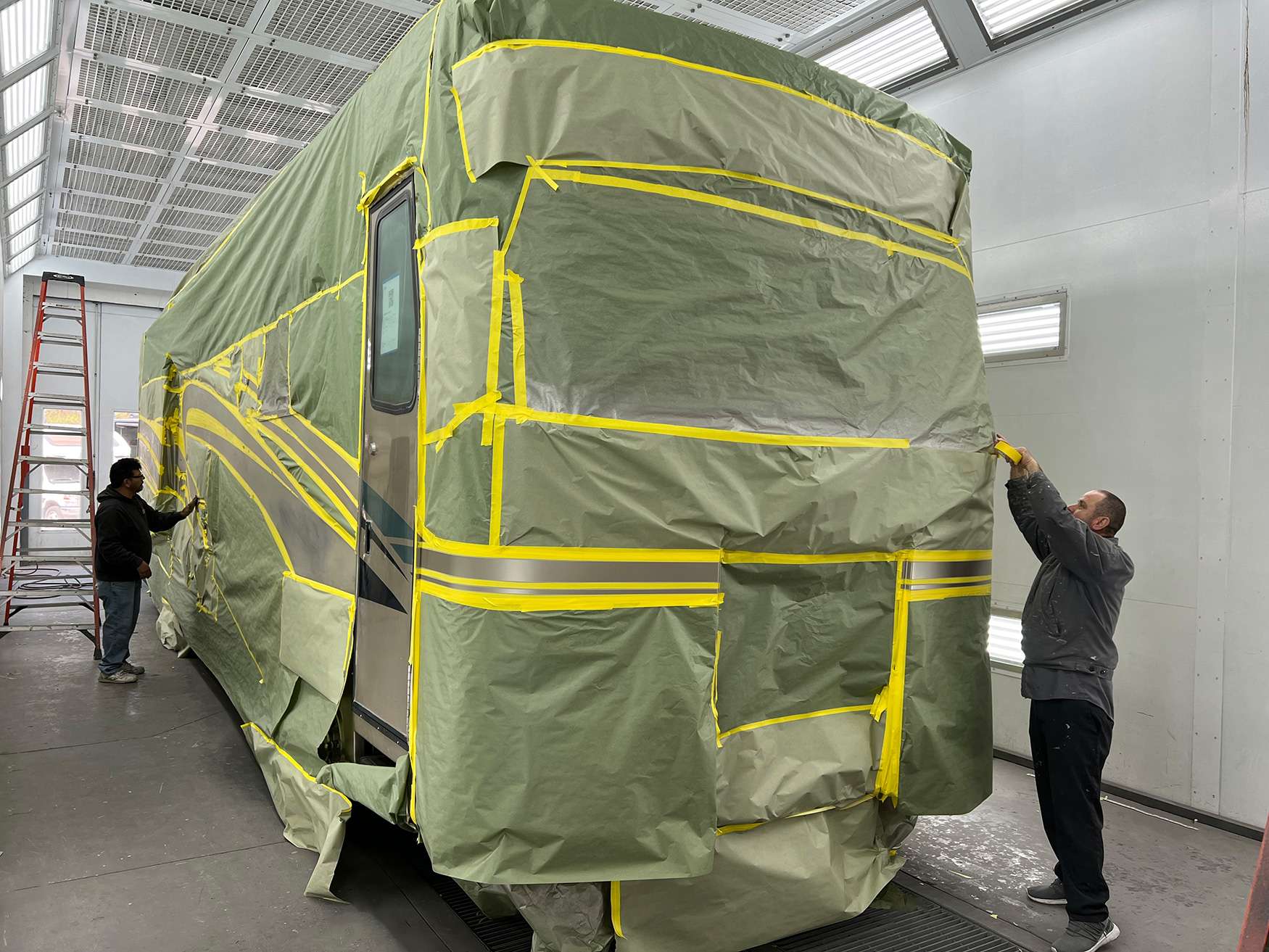
An RV ceramic coating is a liquid silica polymer that cures into a thin, hard, semi-permanent siloxane layer chemically bonded to the surface underneath it. It is not a wax and it is not a sealant, both of which sit on top and wash away. The coating becomes part of the surface until it is abraded off. For Westminster owners dealing with constant sun and hard water, that difference shows up mostly in how much easier the coach is to keep clean.
What a Ceramic Coating Is Chemically
The active chemistry in most quality coatings is a silica or silicon dioxide precursor suspended in a solvent carrier. When it is applied and the carrier flashes off, the remaining molecules cross-link with each other and bond to the substrate, forming a continuous siloxane network. That network is measured in single-digit microns of thickness, which is thinner than a sheet of paper by a wide margin, and it is far harder and more chemically stable than the clear coat under it.
Some products add other components. Silicon carbide and titanium dioxide appear in various formulations to modify hardness or ultraviolet behavior. Graphene coatings substitute a carbon structure into the matrix with claims about heat dissipation and water behavior. In practice, application discipline and surface preparation influence the outcome far more than which premium product is chosen, and any shop suggesting otherwise is selling a label.
Because it is a cross-linked network rather than a film sitting on top, a coating cannot be washed off, dissolved by normal detergent, or wiped away. It is removed the same way clear coat defects are removed: with an abrasive. That permanence is the point, and it is also why what you put under it matters so much. A wax you regret is gone in three washes. A coating applied over a surface you should have corrected first is a decision you live with until someone polishes it back off, which is billable time you already spent once.
Realistic Benefits and Honest Limits
The benefit owners notice first is water behavior. A coated surface has very high contact angle, so water beads tightly and sheets off rather than spreading and drying in place. On a coach that lives in Southern California, that means fewer hard water spots and much less mineral etching, because the water leaves before it evaporates and deposits calcium on hot fiberglass.
The second benefit is wash effort. Road film, bug residue, and general grime bond to the coating rather than to the paint, and the coating releases them easily. A wash that used to require scrubbing becomes a rinse, a gentle soap pass, and another rinse. Less scrubbing means fewer new swirl marks, which is a real long term benefit for the finish underneath.
The third is chemical and ultraviolet resistance. The siloxane layer is more stable against acidic bird droppings, sap, and industrial fallout than clear coat is, and it slows ultraviolet degradation of the surface beneath. Slows, not stops. A coated coach parked in full sun for eight years will still show fading, just less of it than an uncoated one. What it will not do is take an impact. A coating is measured in microns, so a stone off a tire chips it exactly the way it chips bare clear coat, and no coating replaces routine washing.
- Does: cause water to bead and sheet off, reducing mineral spotting
- Does: make routine washing faster and less abrasive
- Does: resist acidic contamination such as droppings and sap
- Does: slow ultraviolet degradation of the surface beneath
- Does not: prevent rock chips, road debris damage, or scratches
- Does not: eliminate washing, only make it easier and less frequent
- Does not: repair or hide existing swirls and oxidation
Preparation Is Most of the Cost
On a typical coating project, 70 to 85 percent of the invoice is what happens before the coating bottle is opened. The surface has to be chemically decontaminated, mechanically decontaminated with clay, corrected to remove defects, and then stripped of every trace of polishing oil. The coating application itself on a 36 foot coach is roughly four to eight hours. The preparation can be thirty.
That ratio is why coating quotes vary so widely between shops and why a low number should raise questions. A $1,200 coating on a large coach means very little correction happened, which is acceptable on a nearly new unit and misleading on a twelve year old one. Our estimates itemize the correction hours at $95 per hour separately from the coating hours so you can see exactly what you are buying.
The final step before application is a panel prep wipe with a dedicated solvent that removes polishing oils and any silicone residue. Coatings bond to bare clear coat or bare gelcoat. Anything in between is a weak point, and weak points show up two months later as patches where water stops beading while the rest of the coach still does.
Coating Corrected Paint Versus Coating Gelcoat
Painted surfaces with intact clear coat are the ideal substrate. The clear is smooth, chemically stable, and the coating bonds evenly across it. After a proper correction, a coated painted coach has the deepest gloss and the longest service life, commonly four to five years on a unit that is stored covered and washed properly. The prep on a well kept painted coach is also the shortest, because a light one-step correction is usually all that is needed before the panel prep wipe and application.
Gelcoat is a different animal. It is more porous than clear coat, it oxidizes faster, and a badly weathered gelcoat surface will absorb coating unevenly. It has to be cut back to sound material first, which usually means a heavier compounding stage and sometimes wet sanding. Once the chalked layer is gone, gelcoat takes a coating well and benefits enormously, because the coating slows the oxidation cycle that was destroying it.
Mixed surfaces are common on RVs and we treat them as separate jobs on one vehicle. A coach might have a painted front cap, gelcoat sidewalls, an unpainted aluminum rub rail, and acrylic windows. Each gets the preparation appropriate to it, and we use surface-specific products where the chemistry calls for it rather than coating everything with one bottle. That is why a coating estimate on a mixed surface coach is broken into sections on the paperwork, with the hours for each surface type listed separately so you can see where the labor is going.
- Painted clear coat: ideal substrate, longest realistic service life
- Gelcoat: needs heavier correction first, then benefits substantially
- Chalked gelcoat must be cut to sound material or the bond fails
- Mixed surface coaches are prepared and coated section by section
- Acrylic windows and trim take different products than body panels
Cure Time and the No-Wash Window
A coating is not finished when it is applied. It flashes within minutes, sets up over the following hours, and continues cross-linking for days. Most products reach handling hardness in 12 to 24 hours and full chemical cure somewhere between seven and fourteen days. During that window the layer is still developing its resistance, and exposing it to detergent, rain, or sprinklers can leave permanent marks in the surface.
Practically, that means the coach stays inside our facility overnight after application, sometimes for two nights depending on the product and humidity. When it leaves, we ask you to keep it dry and out of sprinkler range for at least seven days, and to avoid washing it for the same period. If it gets wet, rinse with clean water only and let it air dry rather than towel drying it.
This is the part owners most often disregard, and the failure mode is specific: water spots etched into the curing coating that cannot be washed off and require polishing the coating away to fix. Building the cure window into your travel schedule is the difference between a coating that performs as expected and one that needs redone. If you have a trip leaving in five days, tell the estimator before you book, and we will either move the application date or find a window that works around it.
Maintenance Wash Chemistry and Service Life
The coating changes how you should wash the vehicle. Use a pH neutral soap, roughly pH 6 to 8, with no wax or gloss additive in it, because those additives sit on top of the coating and mask the water behavior you paid for. Avoid strong alkaline truck wash detergents entirely, since a high pH degrades the siloxane layer over repeated exposure and shortens its life considerably.
Wash with a two-bucket method and a clean microfiber wash media, rinse thoroughly, and either blow dry or use a clean waffle weave towel. Because contamination releases easily from a coated surface, there is no reason to scrub. Two or three times a year, a dedicated coating maintenance topper can be applied to refresh the surface behavior, and that is a short detail visit rather than a reapplication.
Realistic service life on an RV in Southern California is two to five years. The low end applies to a coach stored outdoors in full sun and washed at truck washes. The high end applies to a covered coach washed properly with neutral soap. When it starts to fade, the symptom is water beading less tightly and dirt sticking more. At that point a light polish and recoat restores it, and that is a smaller job than the original.
- Use pH neutral soap with no wax or gloss additives
- Avoid high alkaline truck wash detergents entirely
- Two-bucket wash and clean microfiber media prevent new marring
- A maintenance topper two or three times a year extends performance
- Two to five years of service life depending on storage and wash habits
- Declining water beading is the signal that a recoat is due
Questions
Frequently asked questions
Will a ceramic coating stop rock chips?
No. A coating is a few microns thick and hard in a chemical sense, not in an impact sense. A stone off a truck tire at speed will chip a coated surface exactly as it chips an uncoated one. If impact protection is what you want, that is paint protection film, which is a thick urethane layer applied to leading edges and high impact zones. Some owners do both: film on the front cap and lower forward panels, coating over everything else. That combination addresses two genuinely different problems.
Why does a coating cost so much more on an RV than on a car?
Surface area and preparation. A 38 foot coach has roughly five to six times the exterior surface of a sedan, and much of it is twelve feet up, requiring lifts and repositioning. Preparation scales with that area: decontamination, clay treatment, correction, and panel prep all take hours proportional to square footage. Correction is billed at $95 per hour and typically accounts for most of the invoice. The coating product itself is a small line item. Expect $1,200 on a small trailer in good condition and $6,000 or more on a large coach needing full correction.
Do I still have to wash my RV after it is coated?
Yes, and this is the most common misunderstanding. A coating makes washing dramatically easier and less frequent, but dirt still lands on the surface and organic contamination such as bird droppings and tree sap still needs removing before it sits. What changes is effort: contamination releases with a gentle soap pass instead of scrubbing, and water sheets off so you get far less spotting. Left unwashed for months, a coated coach will look dirty and the accumulated contamination will shorten the coating life.
How long before I can wash or drive in the rain?
Plan on the coach staying at our facility overnight after application, and sometimes two nights depending on the product and humidity. After it goes home, keep it dry and away from sprinklers for at least seven days and do not wash it for that period. Full cross-linking takes seven to fourteen days. If it does get wet during that window, rinse it with clean water and let it air dry rather than towel drying. Water allowed to evaporate on a curing coating can etch permanently.
Can you coat over my existing wax or sealant?
No, and we will remove whatever is there before starting. Coatings bond to bare clear coat or bare gelcoat. Wax, sealant, and especially silicone-containing dressings act as a barrier and produce patchy adhesion, which shows up weeks later as areas where water no longer beads while the rest of the surface still does. Stripping that residue is part of the preparation stage: a chemical decontamination wash, clay treatment, correction, then a dedicated panel prep solvent wipe immediately before application.
Can a coating be applied over vinyl graphics or a wrap?
Yes, with the right product. Coatings formulated for film substrates have different flexibility and will not craze when the vinyl expands and contracts with temperature. Applied correctly, a coating on a wrap makes it easier to clean, slows ultraviolet fading of the printed inks, and extends the usable life of the film. Do not apply a standard paint coating over film, and do not apply any coating over a wrap that is already lifting or bubbling, because the coating will lock that failure in place.
How do I know when the coating needs redone?
Water behavior is the indicator. When you rinse the coach and water spreads into flat sheets instead of pulling into tight beads, the surface layer is worn. You will also notice dirt starting to stick and washing taking more effort than it did. That typically happens somewhere between year two and year five depending on storage and wash chemistry. Reapplication is easier than the first time: a light polish to clean the surface, a panel prep wipe, and a new coat, usually at a fraction of the original cost.
Is a coating worth it on an older coach with oxidized gelcoat?
Often yes, but only after real correction. Coating over chalked gelcoat locks the oxidation in and produces a patchy bond that fails early. The correct sequence is cutting the chalked layer back to sound gelcoat, refining the surface, then coating. That correction is the expensive part and it is billed at $95 per hour, so an older coach costs more overall. The payoff is that the coating slows the oxidation cycle that was destroying the gelcoat, which on a weathered unit is genuinely worth the investment.
Standard on every job
What is included
These are not upgrades. They are how the work is run on every vehicle that comes through the building.
Full teardown where it is needed
We do not estimate through a closed panel. If the damage path runs behind trim or skin, we open it and document what is actually there.
Written, itemized scope
Parts, labor hours, and materials listed separately against the posted rate, so every line is something you can question.
Direct carrier communication
We talk to the adjuster so you are not relaying technical detail between two parties who both expect you to already understand it.
Supplement handling
When teardown finds more than the original inspection, we document and submit the supplement rather than absorbing it into a vague overage.
Correct repair sequence
Structural before cosmetic, every time. A straight body over a bent frame is a repair that fails its second life.
Systems tested under load
Electrical, plumbing, generator, and climate systems are run and verified before delivery, not just reconnected and assumed good.
Photo documentation throughout
Before, during, and after. Useful for your records, and decisive if a claim is ever revisited.
Delivery walkthrough
We go over what was done, what was replaced, and what to watch, in person, with the vehicle in front of you.
How the work runs
Our six step repair process
The same sequence on every vehicle, whether it is a single coach or a fleet of box trucks.
- 01
Assessment and documentation
We put the vehicle on the floor, pull panels where we need to see behind them, and photograph everything. Hidden damage found now is damage that does not become a supplement argument later.
- 02
Written estimate
You get a line by line estimate with parts, labor hours, materials, and the posted rate applied to each. Nothing is bundled into a single number you cannot check.
- 03
Carrier coordination
If a claim is involved we deal with the adjuster directly, submit the documentation, and handle supplements when teardown reveals more than the first inspection showed.
- 04
Authorization and scheduling
Once the scope is approved we confirm the deposit, order parts, and give you a realistic slot. Special order parts drive the timeline more often than labor does.
- 05
Repair
Structural first, then body, then paint, then systems and interior. The sequence is not negotiable because each stage has to be right before the next one covers it up.
- 06
Quality check and delivery
Multi point inspection, systems tested under load, paint inspected under corrected lighting, and a walkthrough with you before the vehicle leaves.
Keep reading
Related pages
Related services
Vehicles we repair
Talk to a repair specialist today
Tell us what happened and we will tell you what the repair actually involves, what it costs, and how long it takes. We work directly with every major carrier and serve Westminster owners and fleets from our 35,000 square foot facility.
Posted labor rates are published on our prices page. Diagnostic and systems assessment fees are credited against an authorized repair.