Detailing and Inspection
RV Damage Estimate in Westminster CA and What It Costs
In short
An RV damage estimate in Westminster CA starts with a $150 systems assessment or a one hour in depth diagnostic at $285, and both amounts are credited against an authorized repair. If hidden damage has to be uncovered, teardown is quoted before it starts and billed at the applicable labor rate. You receive a written line item estimate with parts, labor hours, posted rates, and photographs that an insurance adjuster will work from.
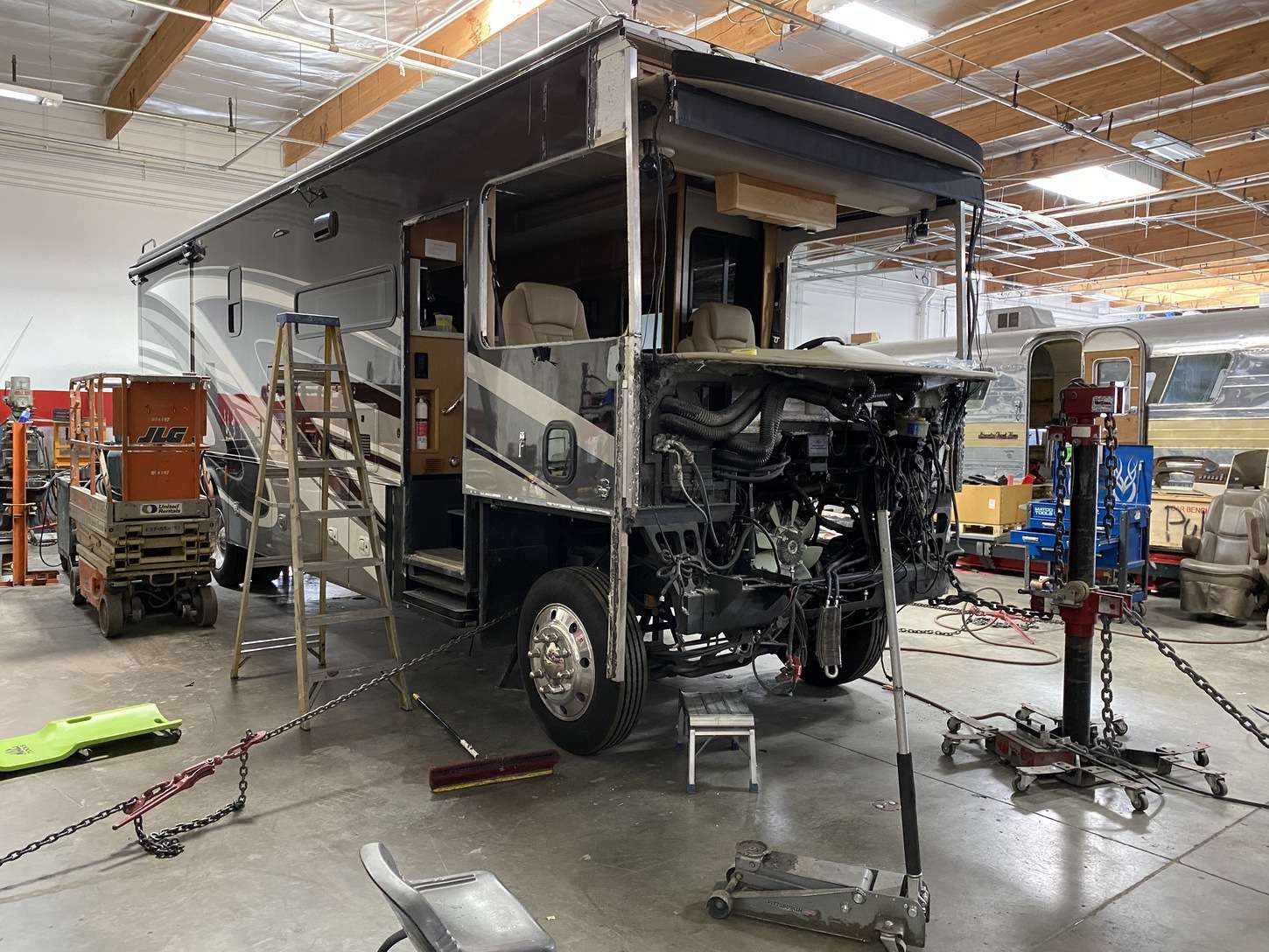
An RV damage estimate in Westminster CA costs money at our shop, and we would rather explain why than pretend otherwise. A real estimate takes a technician's hour, a bay, a lift, and usually the removal of trim and panels to see what is behind the visible damage. What you get for it is a document with line items, hours, rates, and photographs. What a phone call gets you is a number somebody made up.
What the Assessment Costs and How the Credit Works
There are two entry points. The RV systems assessment is $150 and is a structured survey of the unit and the damage: condition of the affected area, what systems are involved, what is visibly compromised, and what needs to be opened to know more. The in depth diagnostic is one hour at $285 and is used when a fault has to be traced rather than looked at, such as an intermittent electrical problem or a slide that binds without an obvious cause.
Both amounts are credited against an authorized repair. If you bring the coach in, pay $150 for the assessment, and then authorize the repair it identifies, that $150 comes off the invoice. The same applies to the diagnostic hour. You are not paying twice for the same technician time. The credit applies once per visit against the repair that follows from it, and it shows up as a line on the final invoice so you can see it rather than take it on faith.
Teardown is separate and is always quoted before it begins. If seeing the full extent of collision or water damage requires removing a sidewall panel, dropping a section of ceiling, or pulling a slide room, we tell you what that will cost and get your authorization first. Teardown on a significant job can run several hundred to well over a thousand dollars in labor, which is the top end of the range on this page.
- RV systems assessment: $150, credited against an authorized repair
- In depth diagnostic: one hour at $285, credited against an authorized repair
- Teardown labor: quoted in advance, billed at the applicable posted rate
- Body and paint labor $210 per hour, mechanical labor $260 per hour
- Parts markup 100 percent at or under $100, 35 percent above $100
- Deposit of 50 percent on any authorized work above $2,000
Why a Real Estimate Costs Money
An estimate is not a glance and a guess. It is a technician's hour, a bay that could be producing revenue, and often a lift. On a collision job it means pulling trim, fender skirts, and interior panels to see whether the impact stopped at the skin or carried into the structure behind it. On a water job it means running a moisture meter across the shell in a grid and photographing the readings. That work has a cost, and the cost lands on somebody either way.
A shop that hands out estimates without charging is paying for that time out of the repairs it books. That money does not appear from nowhere. It gets recovered in the labor rate, in the hours written on the ticket, or in a supplement after the coach is already apart and you are no longer in a position to leave. We would rather charge for the hour honestly and credit it back when you authorize the work.
There is a second reason, and it matters more than the first. Charging for the assessment means the technician can take the time to do it properly. He can pull a trim panel, put the coach on a lift, run a meter across the wall in a grid, and write up what he actually found. Nobody is rushing a walkaround to get to the next unbilled quote, and nobody is writing an optimistic number to win a job he has not really looked at.
Why a Number Over the Phone Is Worthless
Every week somebody calls and asks what it costs to fix a dented rear cap or a leak over the bunk. There is no honest answer to that question without seeing the coach. A dented rear cap on a fiberglass unit could be a $1,400 repair or a $9,000 repair depending on whether the impact cracked the laminate, whether the structure behind it moved, whether the cap is still available from the manufacturer, and whether the paint is a straightforward single stage or a three stage graphic that has to be blended across two panels.
A shop that gives you a firm number on the phone is doing one of two things. It is guessing, in which case the number is meaningless, or it is quoting low to get the coach onto the property, in which case the number will grow once your unit is apart. Neither of those helps you plan a budget. By the time it grows, your coach is in pieces in somebody else's bay and you have very little leverage left in the conversation.
What we will do on the phone is give you the rate structure, tell you honestly what comparable jobs have run, describe what usually drives a job toward the high end of a range, and explain exactly what the assessment costs and how it credits back. That is real information you can plan around and check against another shop. A total invented for a coach nobody has looked at is not information, and it will not survive contact with the unit on the floor.
- The same visible dent can hide anything from cosmetic damage to frame movement
- Panel and cap availability on discontinued models changes the number entirely
- Paint complexity, single stage versus multi stage graphics, moves the labor hours
- Water damage extent is invisible until the shell is mapped and opened
- Insurance involvement changes the documentation the estimate has to support
What You Receive for the Money
The deliverable is a written estimate, not a verbal number. It lists every operation with the labor hours assigned to it, the posted rate applied to those hours, every part with its price, sales tax at 7.75 percent on parts and materials, and a total. Labor is not taxed in California, and you will see that reflected on the document rather than buried.
Photographs come with it. We document the damage as found, anything uncovered during teardown, and the condition of the adjacent areas that were not part of the loss. That photo set is what an insurance adjuster works from, and it is what protects you if an adjuster later disputes the scope of the repair. It also protects you with us, because a documented starting condition means nobody argues six weeks later about what was already there when the coach arrived.
You also get a repair plan in plain language: what we would do, in what order, roughly how long the unit will be with us, and which items are structural versus cosmetic. If part of the damage can reasonably wait a season, we say so on the document instead of quietly writing it onto the ticket. Owners working to a budget make far better decisions when they can see which line items are keeping water out of the coach and which ones only affect how it looks.
- Line item operations with assigned labor hours and the posted rate
- Itemized parts pricing with the markup rule applied transparently
- Sales tax shown at 7.75 percent on parts and materials only
- Photo documentation of found damage and anything revealed by teardown
- A written repair sequence with a realistic time in the shop
- Clear separation of structural necessity from cosmetic preference
Estimates That Have to Satisfy an Insurance Adjuster
When a claim is involved, the estimate has to survive review by somebody who has never seen your coach and never will. That means operations written in recognizable terms with defensible hours, parts sourced and priced with documentation attached, and photographs that prove each line item. A sloppy estimate gets cut, and the cut lands on you as an out of pocket difference at delivery. Writing it correctly the first time is considerably faster than arguing about it three weeks later.
Supplements are normal on RV collision work and you should expect them. Almost nothing on an RV shows its full extent until it is opened, and an adjuster who has approved an initial scope will generally approve a documented supplement when the photographs support it. Our job is to document as we go so the supplement is a formality rather than an argument.
We work under California Bureau of Automotive Repair license ARD00288521. That license carries obligations we take seriously: a written estimate before work begins, your authorization before any additional work is performed, and an itemized invoice at the end showing parts, labor, and rates. If the job is going to exceed the estimate, you hear about it before it happens rather than at pickup. That last point is the one owners care about most, and it is a legal obligation, not a courtesy.
Booking an Assessment and What to Bring
Bring the unit, not photographs. We understand why owners want to send pictures first, and pictures are useful context, but they cannot show moisture inside a wall, movement in a frame, or whether a crack in a cap has traveled into the laminate behind the gelcoat. Schedule a slot, drop the coach, and give us the bay time to do the job properly. Send the photos ahead if you like, because they do help us schedule the right bay and the right technician.
If insurance is involved, bring the claim number, the adjuster's contact information, and the policy declarations page if you have it. If the damage happened on the road, bring whatever documentation exists from the incident. If you have service history on the unit, bring that too, because a prior repair in the same area changes how we read what we are looking at.
Assessments are usually same day or next day depending on bay availability. The written estimate follows in one to three business days, faster on a simple job and longer on a large collision or water loss where every part has to be priced and availability confirmed with suppliers. If you are working against an insurance deadline or a storage lot deadline, tell us when you book and we will tell you honestly whether we can meet it rather than promise and miss.
- Year, make, model, and length of the unit when you call to schedule
- Insurance claim number and adjuster contact if a claim is open
- Any prior repair invoices for the affected area
- A description of when and how the damage occurred
- Whether the unit is drivable or needs to be towed in
Questions
Frequently asked questions
Why do you charge for an estimate when other shops do not?
Because a real estimate consumes real resources: a technician's hour, a bay, a lift, and usually the removal of trim and panels to see behind the visible damage. Somebody pays for that time either way. A shop that does not bill it recovers it inside the repairs it books, through the labor rate, the hours written on the ticket, or a supplement raised after your coach is already apart. We would rather charge $150 for the systems assessment, credit it against an authorized repair, and give the technician the time to do the job properly. It also means the estimate you receive is a document, not a guess.
Is the assessment fee applied to the repair bill?
Yes. The $150 systems assessment and the $285 in depth diagnostic hour are both credited against an authorized repair. If you pay $150 for the assessment, we write the estimate, and you authorize the work, the $150 comes off the final invoice. The same applies to the diagnostic hour. Teardown labor is handled differently because it is actual disassembly work that has to happen regardless, so it is quoted in advance and billed at the applicable rate, though on most jobs that teardown time becomes part of the repair operation itself rather than an extra line.
Can you just tell me roughly what my repair will cost over the phone?
We can tell you our rate structure and what comparable jobs have run, and we will. What we will not do is invent a total for a unit we have not seen. The same visible dent on a rear cap can be a $1,400 job or a $9,000 job depending on whether the laminate cracked, whether the structure behind it moved, whether the cap is still available from the manufacturer, and how complex the paint is. A shop that gives you a firm number sight unseen is either guessing or quoting low to get your coach onto their property, and that number will move once the unit is apart.
What is the difference between the $150 assessment and the $285 diagnostic?
The $150 systems assessment is a structured survey. A technician evaluates the damage and the systems around it, determines what is involved, and identifies what needs to be opened for a complete picture. It answers what is wrong and what will it take to find out the rest. The $285 in depth diagnostic is one hour of focused fault tracing with meters, wiring diagrams, and testing, used when the problem will not reveal itself by inspection, such as an intermittent electrical fault, a parasitic draw, or a slide that binds without a visible cause. Both are credited against an authorized repair.
How long does it take to get the written estimate?
The assessment itself is usually same day or next day depending on bay availability, and the written estimate follows within one to three business days. A straightforward job such as a single panel or a known component moves at the fast end. A large collision or a water loss takes longer because every part has to be sourced and priced with current availability confirmed, and on discontinued models that means calls to suppliers and sometimes a decision about fabricating a component instead. If a claim is involved, we build the documentation package at the same time, which adds a little time up front and saves a great deal later.
Will my insurance company accept your estimate?
It is written to be accepted. Operations are described in terms an adjuster recognizes, hours are defensible, parts are documented with sourcing and pricing, and every line is supported by photographs. Adjusters cut estimates that are vague, and the cut becomes your out of pocket cost. Expect supplements on RV collision work as a normal part of the process, because almost nothing on an RV shows its full extent until it is opened. We photograph as we go specifically so that a supplement is supported by evidence rather than argued over. We also communicate directly with your adjuster if you want us to.
What if I get the estimate and decide not to do the repair?
That is entirely your right and it happens often, particularly when the repair cost approaches the value of an older unit. You keep the written estimate and the photographs, and you can use both to shop the job, to support an insurance claim, or to decide to sell the unit as is with full disclosure. The assessment fee is simply the price of finding out, and finding out is what you paid for. Nothing about the assessment obligates you to authorize work here. What you cannot do is have the fee credited without an authorized repair, since the credit exists to offset work you actually book.
What does the BAR license mean for me as a customer?
Our shop operates under California Bureau of Automotive Repair license ARD00288521, and that license carries specific obligations. You get a written estimate before any work begins. Nothing beyond that estimate happens without your authorization, so if we open a wall and find rot nobody expected, we stop and call you rather than continuing and adding it to the bill. At the end you receive an itemized invoice showing parts, labor, and rates. If you ever believe a licensed shop has not met those obligations, the Bureau has a complaint process, and that oversight exists for your benefit.
Standard on every job
What is included
These are not upgrades. They are how the work is run on every vehicle that comes through the building.
Full teardown where it is needed
We do not estimate through a closed panel. If the damage path runs behind trim or skin, we open it and document what is actually there.
Written, itemized scope
Parts, labor hours, and materials listed separately against the posted rate, so every line is something you can question.
Direct carrier communication
We talk to the adjuster so you are not relaying technical detail between two parties who both expect you to already understand it.
Supplement handling
When teardown finds more than the original inspection, we document and submit the supplement rather than absorbing it into a vague overage.
Correct repair sequence
Structural before cosmetic, every time. A straight body over a bent frame is a repair that fails its second life.
Systems tested under load
Electrical, plumbing, generator, and climate systems are run and verified before delivery, not just reconnected and assumed good.
Photo documentation throughout
Before, during, and after. Useful for your records, and decisive if a claim is ever revisited.
Delivery walkthrough
We go over what was done, what was replaced, and what to watch, in person, with the vehicle in front of you.
How the work runs
Our six step repair process
The same sequence on every vehicle, whether it is a single coach or a fleet of box trucks.
- 01
Assessment and documentation
We put the vehicle on the floor, pull panels where we need to see behind them, and photograph everything. Hidden damage found now is damage that does not become a supplement argument later.
- 02
Written estimate
You get a line by line estimate with parts, labor hours, materials, and the posted rate applied to each. Nothing is bundled into a single number you cannot check.
- 03
Carrier coordination
If a claim is involved we deal with the adjuster directly, submit the documentation, and handle supplements when teardown reveals more than the first inspection showed.
- 04
Authorization and scheduling
Once the scope is approved we confirm the deposit, order parts, and give you a realistic slot. Special order parts drive the timeline more often than labor does.
- 05
Repair
Structural first, then body, then paint, then systems and interior. The sequence is not negotiable because each stage has to be right before the next one covers it up.
- 06
Quality check and delivery
Multi point inspection, systems tested under load, paint inspected under corrected lighting, and a walkthrough with you before the vehicle leaves.
Keep reading
Related pages
Related services
Vehicles we repair
Talk to a repair specialist today
Tell us what happened and we will tell you what the repair actually involves, what it costs, and how long it takes. We work directly with every major carrier and serve Westminster owners and fleets from our 35,000 square foot facility.
Posted labor rates are published on our prices page. Diagnostic and systems assessment fees are credited against an authorized repair.