Services
RV Body Shop Westminster CA: Panels, Dents, and Glass
In short
Panel and dent work on an RV depends entirely on what the wall is built from, with typical repairs running $600 to $4,000 for dents and $3,000 to $18,000 for panel replacement. Our Westminster shop works on aluminum skinned trailers, laminated fiberglass walls, and filon.
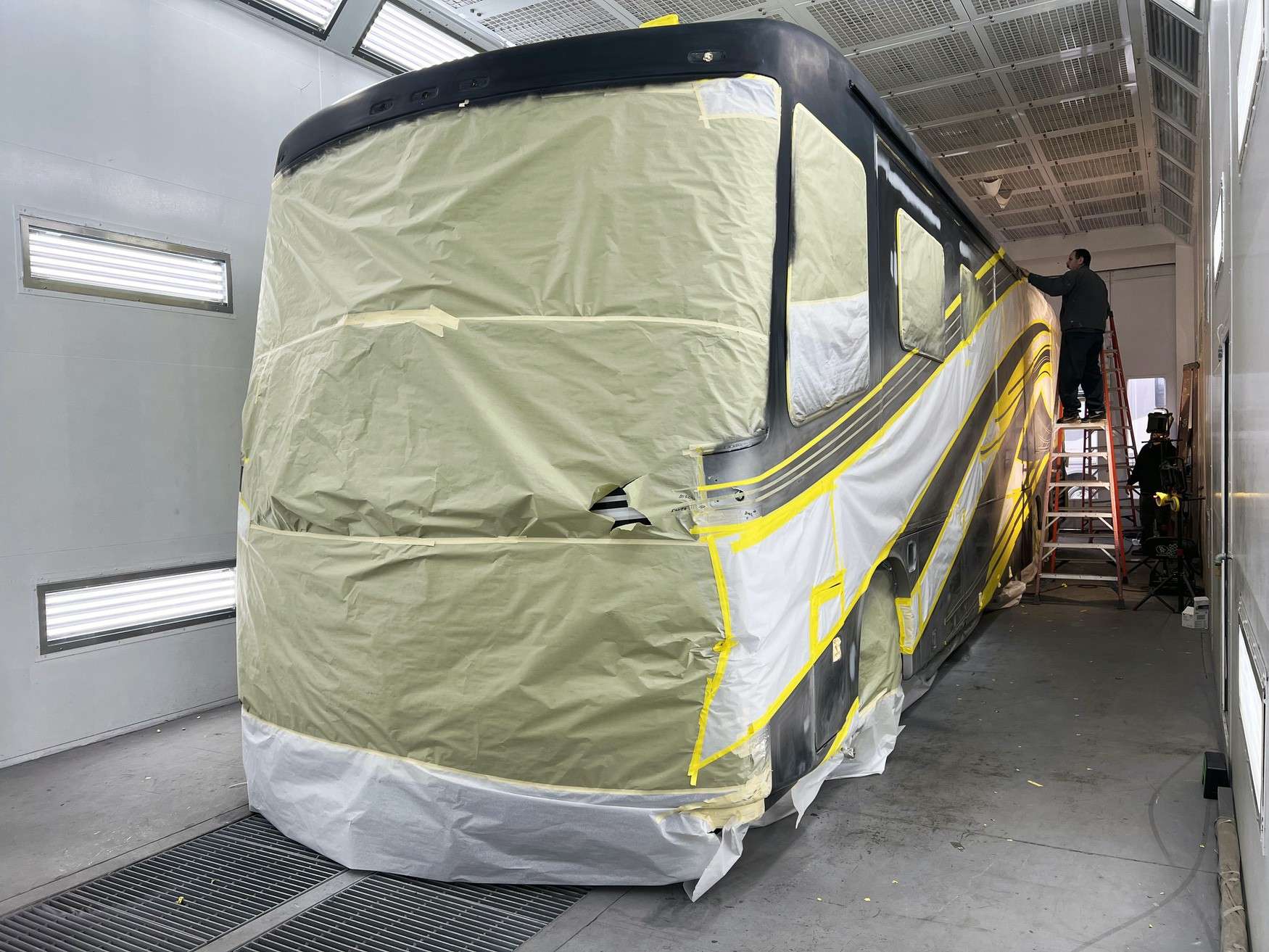
An RV body shop Westminster CA owners can bring anything to has to work in three different construction systems, because a dent in an aluminum skinned trailer and a dent in a laminated fiberglass sidewall are not the same repair at all. We handle dents, panel sections, full panel replacement, bumpers, and window and glass work on coaches, trailers, vans, and commercial trucks, and we sort the cosmetic problems from the water intrusion problems before quoting anything.
Three Wall Systems and Why They Repair Differently
Stick and tin trailers use a wood or aluminum stud frame with flat or corrugated aluminum sheet fastened over it. The skin is thin, typically in the range of twenty five to thirty two thousandths of an inch, and it is a covering rather than a structural element. Laminated walls press a fiberglass or filon skin to luan, foam, and framing with adhesive, and the bond itself carries load. Molded fiberglass caps and one piece shells are a third category.
On stick and tin, the aluminum is repairable or replaceable and the real question is what the wood behind it looks like. On a laminated wall, damage that breaks the bond is structural even when the skin looks fine, and the repair involves the whole sandwich. On molded fiberglass, you are doing composite work with resin and cloth, or replacing a cap that may or may not still be produced.
We identify which system you have before writing anything, usually by reading the fastener pattern, the seam construction, and the way the wall sounds when tapped. Two coaches that look similar in a parking lot can be built completely differently, and the estimate difference between them on the same size damage can be several thousand dollars. If you know your build type before you call, the phone conversation gets far more useful.
Dent Repair Limits on Thin Aluminum Skin
Aluminum RV skin is thin, work hardens quickly, and does not have the memory that automotive steel does. A shallow, smooth dent with no crease can often be worked out with careful pushing, stud pulling on a dedicated aluminum system, and a light skim to fair the surface. A sharp crease is different. Aluminum stretches at the crease line and will not shrink back, so pulling it flat leaves a wavy panel that shows in every reflection.
Corrugated skin is harder still. The ribs stiffen the panel, so damage tends to concentrate at a rib and flatten it permanently. Once a corrugation is flattened, restoring the profile without replacing the section is rarely worth the labor. On those units we usually recommend cutting the damaged sheet at a seam and replacing the section, which produces a cleaner result and often costs less than fighting the dent.
Filler thickness is the honest limit. A skim to fair a worked panel is fine. Building a quarter inch of filler over a stretched dent produces a repair that cracks, telegraphs, and eventually falls off a flexing wall. We set that boundary at the estimate stage rather than discovering it after the panel is primed, and we will tell you when replacement is the better value.
- Smooth shallow dents without creases are usually workable
- Sharp creases stretch the aluminum and will not return to flat
- Flattened corrugations generally need a section replacement
- Filler used to fair a panel, never to fill a stretched dent
- Damage over framing may have bent the stud behind the skin
Riveted, Screwed, and Bonded Panels
How a panel is attached decides how it comes off and how much surrounding work the job requires. Older aluminum trailers are riveted, often with thousands of rivets, and each one gets drilled out and replaced. Many units are screwed through the skin into framing, with butyl tape or sealant behind the fastener line. Laminated walls are bonded, meaning the panel is glued to the substrate and there is no fastener to remove at all.
Riveted work is slow but predictable. Screwed panels come off quicker, but the fastener holes are a leak path, so every one gets resealed on reassembly rather than reused as found. Bonded panels are the most labor intensive, because separating the skin from the luan without destroying either takes patience, and relaminating requires clamping or vacuum pressure across the whole panel while the adhesive cures.
That last point drives the schedule on laminated work. You cannot rush an adhesive cure, and the panel has to stay under even pressure the entire time. A shop without the room to lay a coach up properly ends up with a bond that looks fine and lets go two summers later. Our floor space exists partly so laminated panels can sit under pressure without blocking everything else.
Seam Work, Butyl Tape, and Keeping Water Out
Every panel edge, molding, window flange, and fastener line on an RV is a potential leak. The factory seals most of them with butyl tape behind the component and a lap sealant over the top. Butyl stays flexible for years and then hardens, shrinks, and pulls away from one surface. Lap sealant cracks under ultraviolet exposure. Neither failure is dramatic, and neither is visible until water turns up somewhere unrelated.
Proper reseal work means removing the component, scraping the old butyl completely off both surfaces, cleaning with a solvent that does not attack the substrate, laying new butyl at the correct thickness, reinstalling with even fastener torque, and topping with the right sealant for the material. Smearing new sealant over old hardened butyl is the most common shortcut in the industry and it buys about one season.
We reseal anything we disturb as a matter of course, and we inspect the seams around the repair area whether or not they were part of the original complaint. If a window flange three feet from your dent has hard, shrunken butyl, telling you now costs a fraction of what the delaminated wall will cost in three years. A tube of butyl and an hour of labor is the cheapest repair in this building.
- Old butyl scraped fully off both surfaces, not covered over
- Correct butyl thickness for the gap, applied continuously
- Even fastener torque so the tape compresses uniformly
- Self leveling sealant on horizontal surfaces, non sag on vertical
- Surrounding seams inspected while the area is already open
Sourcing Discontinued Panels and the Fabrication Fallback
RV builders do not maintain parts catalogs the way automakers do. A floor plan may have run two model years, and the sidewall graphic changed midway through the first one. Molded front and rear caps are the worst case, because the tooling gets retired and there is no supply left anywhere. We check the manufacturer, aftermarket suppliers, salvage inventory, and specialty fabricators before telling you a part does not exist.
When it truly does not, we build it. Flat and corrugated aluminum is available in sheet, filon and fiberglass panel stock come in standard widths, and aluminum extrusion for trim and rails can be sourced or bent. Compound curves are the hard part. A molded cap with complex curvature can be reproduced with a plug and a mold, or reshaped and rebuilt from the damaged original using composite layup, depending on how much of the original survived.
Fabrication is real labor and it prices accordingly at $210 per hour, but it is often the only path and sometimes it beats waiting three months on a maybe. We lay out both options with honest time and cost figures: what a sourced part would cost including lead time, versus what fabricating it costs starting this week. Most owners choose based on the calendar rather than the price.
Window Frames, Corrosion, and Reseal Work
RV windows are usually aluminum framed, either clamp ring style on older units or flange mounted and screwed through the sidewall on newer ones. The aluminum frame sits against a wall that gets damp, and dissimilar metal contact plus trapped moisture produces galvanic corrosion at the frame edge. You see it as white powder, pitting, and eventually a frame that will not seal because the mating surface is no longer flat.
Glass itself is the easy part. Fixed panes are usually set in a rubber gasket or bonded with urethane, and both are straightforward to replace. Insulated dual pane units fail differently, fogging between the panes once the perimeter seal lets go, and those get sent out to have the glass unit rebuilt or replaced rather than repaired in place. Sourcing is the real variable. Some units ship in a week and some sit on back order for months.
A leaking window is more urgent than it looks. Water running down inside the wall from a failed window flange is the single most common cause of the delamination we repair. If your window is fogged, stained at the corners, or has a soft wall below it, deal with it this season. The reseal is a few hundred to a couple thousand dollars. The delaminated wall that follows is not.
- Frame removed and corrosion cleaned back to sound aluminum
- Mating surface flattened so new butyl compresses evenly
- New butyl tape and new fasteners rather than reusing pitted ones
- Interior trim ring reset and interior wall checked for moisture
- Dual pane units with fogging sent out for glass replacement
Cosmetic Damage Versus Water Intrusion Damage
We sort every body job into two categories at intake, because they carry completely different urgency. Cosmetic damage is a dent, a scuff, a scratch, or a faded panel that does not breach the weather barrier. It looks bad, it affects resale, and it can wait for your budget. Water intrusion damage is anything that breaks the seal between outside and inside, and it cannot wait, because the clock starts running the day it happens.
The tricky part is that they look alike. A dent that dimpled the skin over a screw line may have broken the sealant under the fastener with no visible crack at all. A scratch that went through gelcoat into the fiberglass skin is a wick straight into the luan. That is why we tap around damage and take moisture readings even on a job the owner described as purely cosmetic.
If you can only afford one repair this year, fix the one letting water in. A $900 reseal now is a better use of money than a $900 dent repair, because the reseal prevents a five figure delamination job while the dent does not get worse sitting there. We tell you plainly which of your items belong in which bucket, and we sequence the work that way.
- Cosmetic: dents, scuffs, scratches in paint, faded or chalky panels
- Critical: cracked seams, punctured skin, failed window or door seals
- Critical: any damage over a fastener line or at a panel transition
- Moisture readings taken even on damage described as cosmetic
- Weather barrier items sequenced first when the budget is tight
In this category
Services we perform
Dent Removal
Most dent work at our Westminster shop lands between $500 and $3,500, with a shallow ding in one aluminum sheet at the low end and...
Read morePanel Replacement
RV panel work at our Westminster shop generally runs $1,200 to $9,000 or more, driven mostly by how much trim has to come off and...
Read moreBumper Repair and Replacement
Bumper work at our Westminster facility typically runs $600 to $4,500 or more. A rusted four inch square tube rear bumper on a tra...
Read moreWindow and Glass Replacement
Glass work at our Westminster shop runs from about $500 to $7,500 or more, because an RV carries three unrelated kinds of glass. A...
Read moreQuestions
Frequently asked questions
Can a dent in the aluminum side of my trailer be pulled out?
Sometimes. A shallow, smooth dent with no sharp crease can usually be worked back with careful pushing, aluminum stud pulling, and a thin skim to fair the surface. Once there is a crease, the aluminum has stretched, and stretched aluminum does not shrink back. Pulling it flat leaves waves that show in every reflection, and burying it in filler produces a repair that cracks off a flexing wall. If a corrugation has been flattened, replacing that sheet section is almost always the better looking result and often the cheaper one as well.
The panel I need is discontinued. What are my options?
Three, generally. First we search: manufacturer, aftermarket suppliers, salvage inventory, and specialty fabricators, because parts turn up more often than owners expect. Second, we repair the original instead of replacing it, which works well on fiberglass caps and molded pieces using composite layup and reshaping. Third, we fabricate. Flat and corrugated aluminum, filon, and fiberglass panel stock are all available in sheet, and trim extrusion can be sourced or bent. Fabrication bills at $210 per hour and is often faster than waiting on a part that may never ship. We price both paths and let you choose.
What does panel replacement cost?
Panel work generally runs $3,000 to $18,000, and the spread is mostly about what has to come off and what goes back on. A single aluminum sheet section on a trailer, replaced at existing seams with a paint blend, sits near the bottom. A laminated sidewall section on a motorhome with a window opening, a slide edge, full body graphics, and a repaint of the whole side sits near the top or above it. Labor is $210 per hour, materials carry 7.75 percent tax, and work above $2,000 takes a 50 percent deposit.
Is a corroded window frame actually a leak risk?
Yes, and it is one of the most common causes of the delamination we repair. The aluminum frame sits against a wall that stays damp, corrosion pits the mating surface, and once that surface is no longer flat the butyl tape cannot compress evenly against it. Water then runs down inside the wall where you never see it, soaking the luan and breaking the adhesive bond. A proper fix means pulling the window, cleaning the corrosion back to sound metal, flattening the mating surface, and setting it in fresh butyl with new fasteners.
Do I need a whole new bumper or can it be repaired?
It depends on the material and the damage. Steel rear bumpers on trailers can be straightened, reinforced, or sectioned and welded, and that is usually the cheaper path. TPO and ABS bumper covers can be plastic welded and refinished when the damage is a crack or a tear, but a cover that is shattered or has lost mounting tabs is generally replaced. Cost matters here too. Refinishing a plastic cover requires cleaning, surface activation, adhesion promoter, flex additive, and its own cure steps, so a small cover can carry as many paint hours as a much larger panel.
How do you know whether the dent damaged anything behind the skin?
We tap around the damage listening for hollow areas, take moisture readings above and below the impact, and check the interior wall in the same location for cracked paneling, popped trim, or a cabinet that no longer sits square. If any of those show up, or if the dent sits over a framing member or a fastener line, we recommend pulling the interior panel or a section of exterior skin to look. On a laminated wall this matters more than on stick and tin, because an impact can break the adhesive bond well beyond the visible dent.
Can you match the texture on a filon or fiberglass panel?
Usually. Filon comes in a few common surface textures, and we match the closest available stock to your existing wall, then paint the replacement and blend into the surrounding panels so the seam and the texture transition sit at a natural break line. Perfect texture matching across an entire wall is not always achievable on older units where the original material is no longer produced. In those cases we say so up front and often recommend refinishing the full side, which hides a texture change far better than stopping at a mid panel line.
Should I fix cosmetic damage now or wait?
Cosmetic damage can usually wait. Dents, scuffs, scratches in paint, and faded panels do not get meaningfully worse sitting in storage, and they are a budget decision rather than an urgent one. Anything that breaches the weather barrier is the opposite. Cracked seams, punctured skin, failed window or door seals, and damage over a fastener line let water into the wall, and a wall that takes water for a season turns a $900 reseal into a five figure delamination repair. If the budget only covers one item this year, spend it on the water path every time.
Keep reading
Related pages
Other service areas
Vehicles we repair
Talk to a repair specialist today
Tell us what happened and we will tell you what the repair actually involves, what it costs, and how long it takes. We work directly with every major carrier and serve Westminster owners and fleets from our 35,000 square foot facility.
Posted labor rates are published on our prices page. Diagnostic and systems assessment fees are credited against an authorized repair.