Campers and Trailers
Truck Camper Repair, Brackets to Overcab
In short
Truck camper repair runs from about $750 for seal and panel work to past $18,000 for structural rebuilds around jack brackets and the overcab. The four jack brackets carry the entire camper during loading, so bracket tear out and the sidewall damage around it is the signature job on these units.
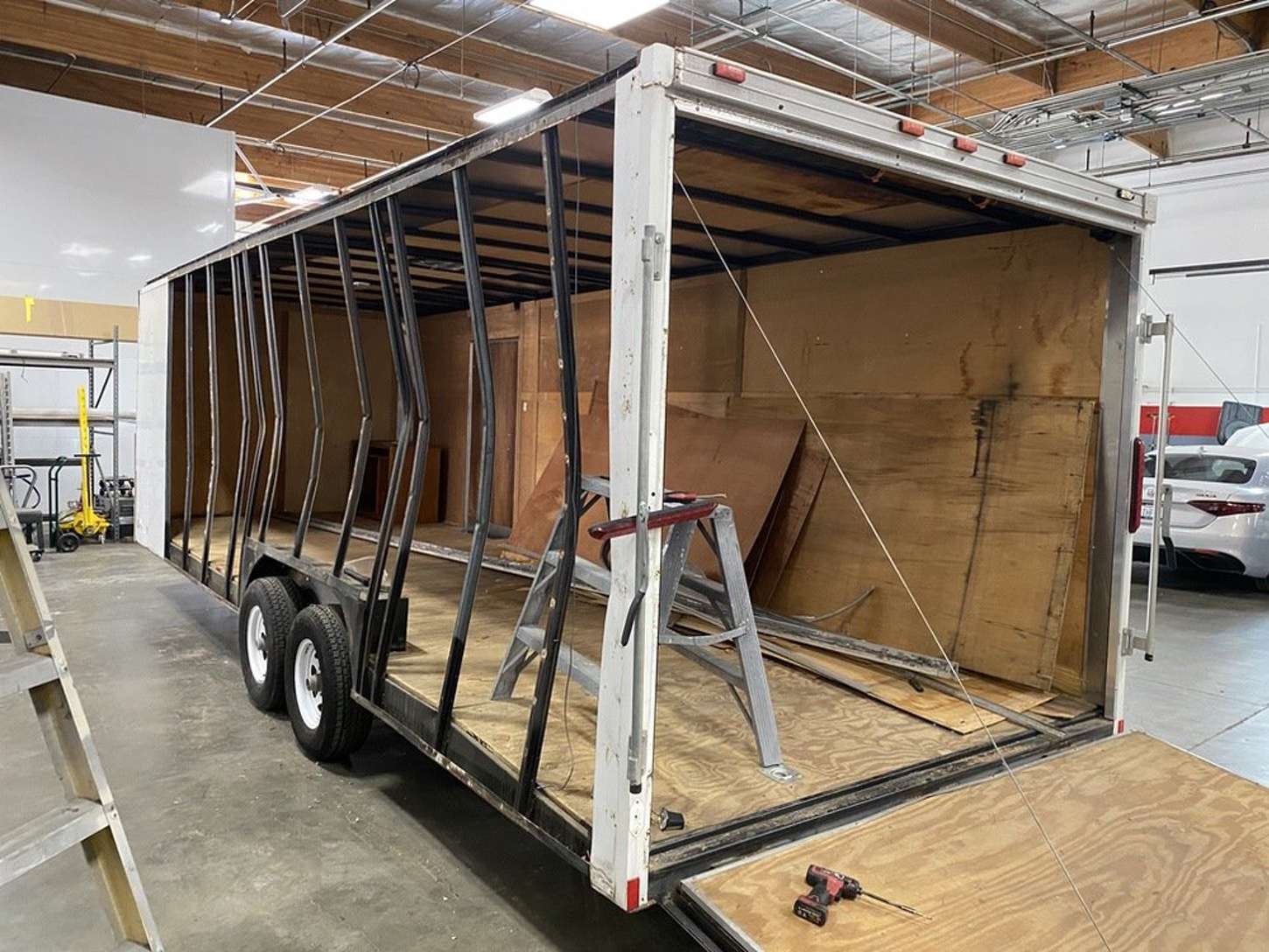
Truck camper repair is its own problem because the camper is carried, not towed, and Westminster owners find that most RV shops are set up for neither. The unit sits in a pickup bed, hangs on four jacks every time it is loaded or unloaded, and gets worked by the bed flexing underneath it on every rough road. All three of those loads land in the same places, and that is where the repairs are.
Jack Brackets Carry the Whole Camper
Four brackets, bolted or welded into the camper's own frame, hold the entire loaded weight in the air every time you unload. That is several thousand pounds hanging on eight to sixteen fasteners passing through a sidewall that also has to stay watertight. It is the most concentrated load anywhere on the unit.
Bracket tear out looks like a bracket pulling away from the wall, a crack radiating from a bolt hole, or a soft area around the mount. On a laminated wall it often shows first as a bulge in the skin near the bracket, because the bond has released before the fasteners have visibly moved.
The correct repair is not bigger bolts. We open the wall, evaluate the framing the bracket is supposed to be landing on, rebuild or add structure, and re mount with backing plate that spreads load into the frame rather than into panel. That runs roughly $2,000 to $6,500 per side depending on how much wall has to come apart.
- Inspect each bracket mount before every loading season
- Look for skin bulge near the bracket, not just cracks
- Check for elongated bolt holes and crushed spacers
- Confirm the bracket lands on framing, not on panel alone
- Re mount with backing plate that spreads load into the frame
The Overcab Nose and Its Seam
The section that extends forward over the truck cab holds the bed and takes the full force of highway air and rain. It is joined to the main box at a seam, and that seam moves every time the truck bed flexes. Water entering there runs back along the bunk decking exactly the way it does on a cab over motorhome.
The tell is a soft spot at the front corners of the sleeping platform, or a stain on the ceiling behind the nose rather than at the seam. Owners reseal the front and the leak continues because the entry was at the corner where the nose meets the sidewall.
Caught early this is a seam and seal job at $900 to $2,500. Once the nose decking has softened, the mattress platform and often the front wall panel come out, and the repair runs $3,500 to $9,000.
Wing Walls and Bed Rail Contact
The lower sides of a truck camper, the wing walls that drop down alongside the truck bed rails, take abuse from two directions. They rub against the bed rails when the truck twists on uneven ground, and they get loaded by the tie down straps pulling the camper down into the bed.
What we find is scuffed and cracked skin at the contact points, delaminated panel where the rubbing has worked the bond, and tie down anchor points that have begun to pull. All three are worth catching early because they are surface repairs at that stage and structural repairs later.
The other item here is the bed liner or padding between the camper floor and the truck bed. When that compresses or shifts, the camper rides directly on the bed ribs, and point loading a camper floor on a steel rib is how floors crack.
Tie Downs, Turnbuckles and Loading Practice
Tie down systems pull the camper down into the bed with real force, and the anchor points on the camper side pass that force into the lower sidewall. Overtightened turnbuckles are one of the most common causes of lower wall damage we see, particularly on units with spring loaded turnbuckles that owners crank down as hard as they can.
The other practice issue is loading on uneven ground. Jacking a camper up on a slope loads the brackets sideways instead of vertically, which is exactly the direction they are weakest. Most bracket failures we repair happened during loading, not driving.
None of this is a criticism of owners. It is not obvious from the outside that a bracket is a highly loaded structural mount rather than a bolt on accessory, and nobody hands you that information with the camper.
- Load and unload on level ground whenever possible
- Do not overtighten turnbuckles, snug is the target
- Inspect anchor points on the camper side each season
- Keep bed padding intact so the floor is not point loaded
- Raise and lower jacks evenly rather than one corner at a time
Weight, Center of Gravity and What Repairs Add
A truck camper repair adds material, and on this unit type that matters more than anywhere else. Adding structure at the brackets, replacing decking with heavier material, or laminating a thicker panel all add weight high and forward, which affects how the loaded truck handles.
So we repair to restore strength without piling on mass where it does not help. Backing plate at a bracket adds a few pounds and a large amount of capacity. Replacing a soft nose deck with a heavier plywood than the original adds weight in the worst possible place for very little benefit.
A worked example: single side jack bracket tear out with laminated wall damage, no framing rot beyond the immediate area, typically 12 to 22 hours of body labor at $210 for $2,520 to $4,620, plus $500 to $1,600 in framing, panel, backing plate, fasteners and refinish materials.
Questions
Frequently asked questions
My jack bracket is pulling away from the wall. Can you just bolt it back on?
No, and doing that is how a camper ends up on the ground. The bracket is supposed to transfer several thousand pounds into the camper's frame, and if it is pulling away, either the framing it lands on has failed or the original mounting relied on panel rather than structure. The correct repair opens the wall, evaluates and rebuilds the framing, and re mounts with a backing plate that spreads the load into the frame. Bigger fasteners into the same compromised material just move the failure a few inches. Expect roughly $2,000 to $6,500 per side depending on how much wall comes apart.
How much does truck camper repair cost?
The range runs about $750 to past $18,000. Seal and small panel work is at the low end. An overcab seam reseal caught early is $900 to $2,500. Once the nose decking has softened, that repair is $3,500 to $9,000. Jack bracket tear out with wall repair is $2,000 to $6,500 per side. Wing wall delamination and skin repair is $1,500 to $4,500. A full structural rebuild involving multiple brackets, the nose and floor framing reaches $18,000. Body labor is $210 per hour, and repairs over $2,000 carry a 50 percent deposit.
Where do truck campers leak?
The overcab nose seam first, then the roof penetrations, then the wing wall to floor joint. The nose takes the full force of highway air and rain and its seam moves every time the truck bed flexes underneath. Water entering there runs back along the bunk decking and shows up as a soft spot at the front corners of the sleeping platform, or a ceiling stain well behind the actual entry. The classic mistake is resealing the front face when the entry is at the corner where the nose meets the sidewall. We water test from the bottom up so the repair goes where the water is actually getting in.
Why is the skin scuffed along the bottom of my camper?
That is the wing wall rubbing against the truck bed rails as the truck twists on uneven ground. It is normal contact and it becomes a problem when the rubbing works the bond between the skin and the substrate, which shows up as a soft or bulged area rather than just a scuff. Catch it at the scuff stage and it is a surface repair. Catch it after the bond has released and it is a delamination repair. The related item is the padding between the camper floor and the bed: when that compresses, the camper rides on the bed ribs and the floor gets point loaded.
Am I overtightening my tie downs?
Quite possibly, and it is one of the most common causes of lower sidewall damage we repair. The tie down system is meant to keep the camper seated in the bed, not to compress it. Spring loaded turnbuckles in particular invite people to crank them down hard, and that force passes straight into the anchor points on the camper's lower wall. Snug is the target. The other practice worth changing is loading and unloading on level ground, because jacking on a slope loads the brackets sideways, which is the direction they are weakest, and most bracket failures we see happened during loading.
Will a repair make my camper heavier?
A little, and on a truck camper that matters more than on any other unit because the weight sits high and forward over the truck's rear axle. We repair to restore strength without adding mass where it does not help. A backing plate at a jack bracket adds a few pounds and a lot of capacity, which is a good trade. Replacing a soft nose deck with plywood heavier than the original adds weight in the worst possible place for very little gain, so we match original thickness unless there is a structural reason not to. If a repair does change the weight meaningfully, we tell you.
Can you work on the camper while it is off the truck?
Yes, and for most structural work that is how it has to happen. We can take the camper on its own jacks and support it properly on stands for the duration of the repair, which also means you keep your truck. If the camper's jacks or brackets are the thing that failed, we support it independently rather than trusting the hardware we are about to repair. Bring the truck when you drop it off so we can unload it here, and we will load it back on and check the fit, the padding and the tie down anchor alignment before you leave.
How long does a truck camper repair take?
Seal and small panel work is two to five business days. An overcab seam repair caught early is about a week. Nose decking replacement with the sleeping platform out is two to three weeks. Single side jack bracket repair with wall reconstruction is one to two weeks. A structural rebuild involving multiple brackets, the nose and floor framing is three to six weeks. Parts on older campers are frequently discontinued, in which case we fabricate the panel or bracket rather than waiting on a supplier, and that is usually faster than chasing an obsolete part number.
How the work runs
Our six step repair process
The same sequence on every vehicle, whether it is a single coach or a fleet of box trucks.
- 01
Assessment and documentation
We put the vehicle on the floor, pull panels where we need to see behind them, and photograph everything. Hidden damage found now is damage that does not become a supplement argument later.
- 02
Written estimate
You get a line by line estimate with parts, labor hours, materials, and the posted rate applied to each. Nothing is bundled into a single number you cannot check.
- 03
Carrier coordination
If a claim is involved we deal with the adjuster directly, submit the documentation, and handle supplements when teardown reveals more than the first inspection showed.
- 04
Authorization and scheduling
Once the scope is approved we confirm the deposit, order parts, and give you a realistic slot. Special order parts drive the timeline more often than labor does.
- 05
Repair
Structural first, then body, then paint, then systems and interior. The sequence is not negotiable because each stage has to be right before the next one covers it up.
- 06
Quality check and delivery
Multi point inspection, systems tested under load, paint inspected under corrected lighting, and a walkthrough with you before the vehicle leaves.
Keep reading
Related pages
Related vehicles
Services we perform
Talk to a repair specialist today
Tell us what happened and we will tell you what the repair actually involves, what it costs, and how long it takes. We work directly with every major carrier and serve Westminster owners and fleets from our 35,000 square foot facility.
Posted labor rates are published on our prices page. Diagnostic and systems assessment fees are credited against an authorized repair.