Services
RV Detailing in Orange County for Westminster Owners
In short
RV detailing at our shop is billed at $95 an hour, and a full exterior correction on a 34 foot coach usually lands between 12 and 30 hours depending on how far the gelcoat has gone. Inspections are billed separately, either a $150 systems assessment or a one hour in depth diagnostic at $285, and both are credited against an authorized repair. Most Westminster owners book this work before a sale, before long term storage, or after a hard season of sun.
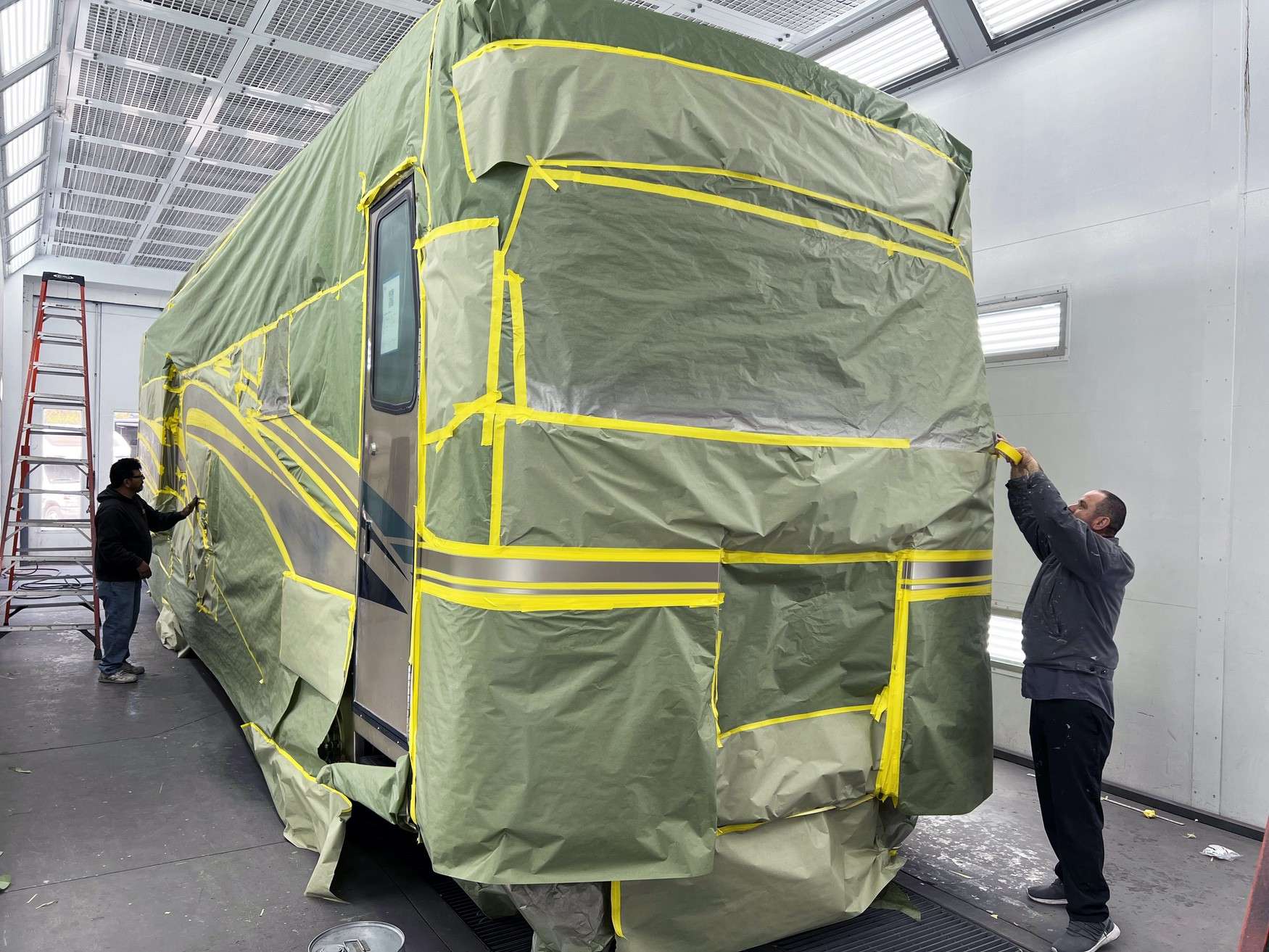
RV detailing Orange County owners book at our shop is not a car wash with a taller ladder. A 34 foot coach carries roughly ten times the painted and gelcoated surface of a sedan, most of it over your head and all of it cooking in Southern California sun. We work at $95 an hour on detail labor and we tell you before we start whether a sidewall will polish back or whether it has gone too far.
What Detailing Actually Does to a Coach
On a car, detailing is mostly cosmetic. On an RV it is closer to preventive maintenance. The gelcoat and clearcoat on a coach are the only thing standing between ultraviolet light and the fiberglass laminate underneath, and once that surface layer chalks through, water starts wicking into the substrate at every seam and fastener. Cleaning and protecting the shell is cheap. Rebuilding a delaminated sidewall is not, and the two are directly connected.
A full exterior on a 34 foot Class A means washing, decontaminating, correcting, and sealing somewhere near 900 square feet of surface, plus the roof, plus wheels, wheel wells, storage bay doors, and the awning fabric. That is why the hour count runs where it does. A light maintenance detail on a well kept coach might be six to ten hours. A neglected unit that has sat outside for four seasons can absorb thirty.
We work top down and we do the roof first, because everything that comes off the roof runs down the sides. Skipping that order is how a shop ends up polishing the same panel twice and billing you for both passes. It also means the roof gets real attention on every job instead of being treated as an add on, which matters, because the roof is where the expensive problems on an RV start. If a sealant bead is opening up, we would rather find it during a wash than during a rain.
- Wash and chemical decontamination of the full shell
- Roof cleaning and sealant condition check while we are up there
- Compound and polish stages sized to how deep the oxidation runs
- Sealant or coating applied to a clean, corrected surface
- Bay doors, wheels, wheel wells, and awning fabric
- Interior deep clean if you want the coach done inside and out
Oxidation, Chalk and the Limits of Polishing
That white powder that comes off on your hand is not dirt. It is the resin binder in the gelcoat breaking down under ultraviolet exposure and releasing pigment. Wiping it off makes the coach look better for an afternoon. Correcting it means abrading away the dead layer with a compound until you reach sound material, then refining the finish so it holds a shine instead of grabbing dirt.
There is a hard limit to that process. Gelcoat on a production coach is thin, often twelve to twenty thousandths of an inch, and thinner on curved corners where it was sprayed light. If oxidation has eaten most of the way through, cutting further exposes the laminate and you have made the problem worse. We check with a gauge on painted panels and by feel and experience on gelcoat before we commit to a cut stage.
When a panel is past correction, the honest answer is paint, not polish. We will tell you that before you pay for thirty hours of buffing that buys you six months of shine. Refinishing a single sidewall is a different budget conversation and it belongs on the paint side of the shop, not the detail side. Owners do not always want to hear it, and we say it anyway, because detail hours spent on a panel that needs refinishing is money you do not get back.
Black Streaks Point at a Sealant Problem
Every owner knows the vertical black streaks running down from the roof edge, the awning rail, and the window frames. They are the residue of the roof membrane and the sealants above them washing down in rain. Removing them is straightforward chemistry and a few hours of labor. Understanding why they came back in six weeks is the part that saves money.
Heavy streaking under one specific window or one section of drip rail usually means the sealant bead above it has opened up. Water that is running down the outside of your coach is water that found a path, and the same path is available to run inward at the next seam. When we clean streaks, we look at what is directly above them and we tell you what we found.
- Streaks concentrated at one window frame instead of spread evenly
- Chalky white sealant that has pulled away from the substrate at the edges
- Cracked lap sealant around a vent, antenna base, or roof rack foot
- Awning rail sealant that has separated from the sidewall
- Interior staining on the ceiling panel below the streaked area
Roof Cleaning Without Wrecking the Membrane
An EPDM rubber roof is the single easiest surface on an RV to destroy with the wrong product. Petroleum based cleaners, citrus degreasers, and pressure washing at close range all attack the membrane, and a membrane that has been stripped of its plasticizers chalks off in sheets for the rest of its life. We clean rubber roofs with a mild alkaline detergent and a medium bristle brush, rinse thoroughly, and stay off the sealant beads with anything aggressive.
TPO and fiberglass roofs tolerate more, but they have their own rules. A fiberglass cap can be compounded and polished like a sidewall. TPO can be cleaned harder than EPDM but still does not want solvent. Knowing which one you own before you buy a bottle of cleaner at the parts counter is worth the two minutes it takes to look.
While we are up there we photograph the condition of every penetration: the vents, the antenna base, the air conditioner gaskets, the skylight, and the seams along both roof edges. That photo set is often the first time an owner sees what the top of their own coach actually looks like, and it is frequently the most useful thing that comes out of a detail. Sealant with three good years left looks very different from sealant that is cracking, and you should not have to take our word for which one you own.
Interior Deep Cleaning and Odor Work
Interior work is billed on the same $95 hour. A deep clean on a coach that has been camped in hard means headliner and wall panels, cabinet interiors, the range hood filter, window tracks, blind slats, upholstery extraction, and the areas most people never reach: under the dinette, behind the toilet flange, and the underside of the slide floor when the room is retracted.
Odor is a different problem from dirt. Persistent smells in an RV almost always trace to one of four sources, and none of them are fixed by an air freshener. We find the source first, then clean. If the odor is coming from a saturated subfloor or a leaking tank flange, that is a repair, not a detail, and we will say so on the estimate rather than charging you for hours of scrubbing that will not solve it.
- Holding tank vent or a dry toilet seal letting sewer gas into the cabin
- Water soaked subfloor or wall insulation from an old leak
- Refrigerator drip tray, condensate line, or a failing absorption unit
- Rodent activity in the basement bays or behind an appliance
- Mildew in upholstery foam from a coach closed up wet
Coatings and Wax in Southern California Sun
A carnauba wax on a coach that lives outside in this climate is doing well to last three months. A synthetic polymer sealant will hold six to nine. A properly applied ceramic coating on corrected gelcoat is realistically two to four years, and that spread depends almost entirely on whether the coach is covered, garaged, or sitting in an open storage lot.
Coatings are not magic and they are not a substitute for correction. A coating locks in whatever surface it goes over, so applying one on top of oxidation just gives you a shiny, sealed layer of dead gelcoat. The prep is the expensive part and the coating itself is a fraction of the total. Anyone quoting a coating cheap is skipping the prep.
For an owner who stores a coach uncovered and takes it out four weekends a year, a polymer sealant reapplied annually is usually the better spend. The surface stays protected, the cost stays predictable, and you are not paying for correction hours on a coach that spends most of its life parked. For a full time coach, or one that runs hard every month, the coating math works out, because you are buying years of protection instead of months and the prep only has to happen once.
- Carnauba wax, roughly 3 months of real protection outdoors here
- Polymer sealant, roughly 6 to 9 months
- Ceramic coating on corrected surface, roughly 2 to 4 years
- Coverage matters more than product: a cover doubles most of these numbers
- Prep labor is the majority of any coating job cost
Inspections and How the Assessment Is Billed
Inspection work is priced separately from detailing because it is a different kind of labor. A systems assessment is $150 and covers a structured walk of the coach: roof and sealants, shell moisture check, slide operation, the three electrical systems, appliance function, plumbing, and running gear condition. It is credited against an authorized repair, so if you bring the coach in for an assessment and then approve the work it finds, the $150 comes off the invoice.
When a symptom needs real chasing, that is diagnostic labor at $285 an hour, also credited against an authorized repair. Chasing a parasitic draw or an intermittent slide fault is not a walk around. It is a technician with meters and a wiring diagram spending an hour proving what is actually wrong instead of guessing at parts. That hour routinely saves several hundred dollars in components nobody needed to buy, which is the whole argument for paying for it.
A pre purchase inspection for a buyer is a longer and more formal version of the same discipline, and it produces a written report with photographs attached to every finding. That report is what a buyer takes back to a seller when the roof sealant is at the end of its life and the asking price does not reflect it. It is priced separately from the shop side services because it is an independent product, and it is the one piece of paper that reliably changes a price conversation.
- Systems assessment, $150, credited against an authorized repair
- In depth diagnostic, one hour at $285, credited against an authorized repair
- Written line item findings with photographs, not a verbal summary
- Moisture mapping of the shell rather than a look at the visible stains
- Clear separation of what needs doing now and what can wait a season
Scheduling, Turnaround and Realistic Budgets
A maintenance detail on a mid size trailer is usually a one day job. A full correction and coating on a 40 foot diesel pusher is a week in the bay, because compound and polish stages take the hours they take and a coating needs cure time before the coach goes back out in dust. We schedule by the length and condition of the unit, not by a flat package.
Budget honestly. At $95 an hour, a ten hour maintenance detail is under a thousand dollars. A thirty hour correction with a coating on a large coach is a several thousand dollar job, and there is a 50 percent deposit on any work above $2,000. Sales tax runs 7.75 percent on the products and materials we use. Labor is not taxed in California.
In this category
Services we perform
Pre Purchase Inspection
An RV pre purchase inspection at our shop runs $400 to $1,200 depending on the size and complexity of the unit, and takes half a d...
Read moreDamage Assessment and Estimate
An RV damage estimate in Westminster CA starts with a $150 systems assessment or a one hour in depth diagnostic at $285, and both...
Read moreQuestions
Frequently asked questions
How much does it cost to detail a 34 foot motorhome?
Detail labor is $95 an hour, so the answer depends entirely on hours. A well maintained 34 foot coach that gets washed regularly and was last polished a year ago is usually a ten to fourteen hour job, so roughly $950 to $1,300 plus materials and tax on those materials. The same coach after four years sitting uncovered, with heavy chalking on both sidewalls and the roof cap, can take twenty five to thirty five hours because every panel needs a cut stage before it will hold a polish. We walk the coach and give you an hour estimate before anything starts.
Can heavy oxidation be polished out or does the coach need paint?
It depends on how much sound gelcoat is left underneath. Gelcoat on a production coach is thin to begin with and thinner on corners and curves. If the chalking is surface level, a compound stage followed by a polish will bring it back and a sealant or coating will hold it. If the oxidation has run deep enough that cutting exposes the laminate weave or leaves the panel translucent in spots, polishing is the wrong tool and you are buying a temporary result. At that point refinishing the panel is the honest answer. We check before committing to an aggressive cut and we tell you which side of that line your coach is on.
Why do the black streaks keep coming back after every wash?
Because they are not dirt, they are residue running off the roof and the sealants above them. Every rain or heavy dew carries oxidized membrane material and degrading sealant down the sidewall, and it deposits wherever the water slows down, which is under drip rails, window frames, and the awning rail. Washing removes the deposit but does nothing about the source. If the streaking is even across the whole coach, that is normal roof runoff and a good sealant on the sidewall will slow it. If it is concentrated under one window or one section of rail, the sealant above that spot has failed and needs attention before water finds its way inward.
Is it safe to pressure wash an RV roof?
Not at close range, and not at all on a rubber membrane. High pressure will lift the edges of lap sealant beads, drive water under flashing, and on EPDM it strips the surface and accelerates chalking permanently. We clean rubber roofs with a mild detergent, a medium bristle brush, and a normal garden hose rinse. Fiberglass caps tolerate more and can even be compounded and polished. TPO sits in between. If you are cleaning your own roof, the biggest risk is not the membrane itself, it is what a pressure wand does to twelve year old sealant around your vents and antenna bases.
How long does a ceramic coating last on an RV in this climate?
On corrected gelcoat, realistically two to four years in Southern California. The variable that moves that number most is not the product, it is storage. A coach kept under a cover or indoors will sit at the top of that range. A coach parked in an open lot with the roof and the driver side taking full sun all day will sit at the bottom. A coating also has to go over a corrected surface to be worth doing, because it locks in whatever is underneath. Most of the cost of a coating job is the correction labor, not the coating itself, which is why a cheap coating quote usually means skipped prep.
What is the difference between the $150 assessment and the $285 diagnostic?
The $150 systems assessment is a structured survey of the whole coach. A technician walks the roof and sealants, checks the shell for moisture, cycles the slides, verifies the three electrical systems, runs the appliances, checks plumbing and running gear, and writes up what he found. It answers the question what shape is this coach in. The $285 diagnostic is one hour of focused fault finding on a specific problem, with meters, diagrams, and testing, and it answers the question why is this one thing broken. Both are credited against an authorized repair, so they come off the invoice when you approve the work they identify.
Should I detail my RV before selling it?
Yes, and the return is usually well above what you spend. A buyer walking up to a chalky sidewall with black streaks and a dirty roof assumes the mechanical systems were maintained the same way, and that assumption comes straight off the price. A corrected, sealed coach with a clean roof and a fresh interior reads as a coach that was cared for. It also lets a buyer see the actual condition of the surface instead of guessing. One thing to be clear about: detailing does not hide a problem from an inspector who is worth hiring, and it should not be used to try.
Do you clean the interior as well, and what does that include?
Yes, at the same $95 an hour. Interior work covers the ceiling and wall panels, cabinet interiors, window tracks and blind slats, upholstery extraction on cloth and conditioning on vinyl or leather, the range hood filter, and the spots most owners never get to, including under the dinette base and the underside of the slide floor when the room is in. If there is a persistent odor, we find the source before we start scrubbing. Odors that come from a soaked subfloor, a tank vent problem, or rodent activity are repairs, and cleaning around them just delays the real fix.
Keep reading
Related pages
Other service areas
Vehicles we repair
Talk to a repair specialist today
Tell us what happened and we will tell you what the repair actually involves, what it costs, and how long it takes. We work directly with every major carrier and serve Westminster owners and fleets from our 35,000 square foot facility.
Posted labor rates are published on our prices page. Diagnostic and systems assessment fees are credited against an authorized repair.