Claim Situations
Food Truck Insurance Claim Repair in Westminster
In short
A food truck insurance claim is different from a standard vehicle claim because the vehicle is the business, so the buildout, the installed equipment, and the time out of service all carry weight the sheet metal does not. Coverage for the buildout usually depends on how equipment was declared, and returning to service typically requires health department and fire re-inspection after the repair. Owners in Westminster should confirm the re-inspection path before the repair is finished, not after.
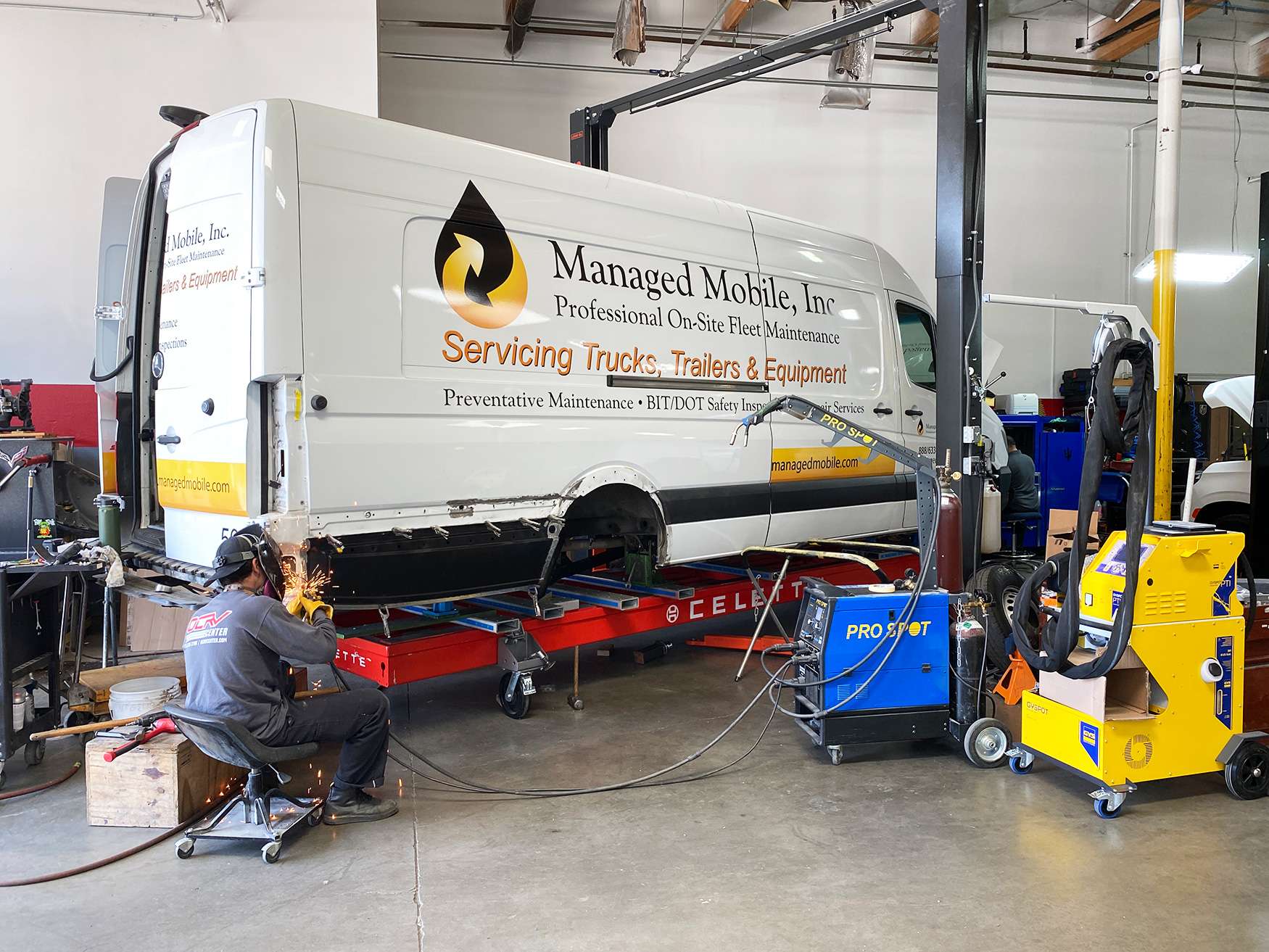
A food truck insurance claim has one feature that changes everything about how it should be handled: the vehicle is the revenue. A damaged personal vehicle is an inconvenience. A damaged mobile kitchen, mobile clinic, grooming van, or service unit is a closed business, and every day of repair is a day of lost income. That reality should shape the claim from the first phone call, and it usually does not. This page covers what to do differently.
Why These Claims Are Not Standard Vehicle Claims
Three things separate a mobile business vehicle from any other unit on a repair schedule. The first is that the buildout is often worth more than the vehicle. A used step van may be a modest asset while the kitchen inside it, meaning hood and suppression system, cooking equipment, refrigeration, water and waste tanks, generator, and electrical distribution, represents the bulk of what was invested.
The second is that downtime has a direct, measurable cost. Not inconvenience, revenue. Every day the unit is out of service is a day of no sales, and for an operator running a single vehicle it is the entire business. The third is regulatory. A personal vehicle goes back on the road when it is repaired. A mobile food unit goes back into service when a health authority says it can, and that is a separate process with its own timeline.
The same is true in different forms for mobile medical, grooming, and other regulated operations. An adjuster handling a mobile business claim may treat it as a commercial vehicle file, which addresses the first item incompletely and the other two not at all. Raising all three explicitly at first notice is the operator's job, and it is worth doing on the first call.
Is My Food Truck Buildout Covered?
Generally yes, but the amount paid depends almost entirely on how the equipment was declared when the policy was written. A commercial auto policy covering the vehicle may include permanently attached equipment only up to a stated limit, and that limit is frequently far below the cost of a full kitchen buildout. The structures that address this properly vary. Some operators carry a declared value or scheduled equipment endorsement listing the buildout.
Some carry inland marine or equipment coverage alongside the auto policy. Some carry a business owners policy that addresses the equipment separately. Which one you have determines what a loss actually pays, and the time to find out is now. What makes any of it payable in practice is documentation. Invoices from the upfitter or fabricator showing what was built and what it cost.
Equipment purchase receipts with model and serial numbers. Photographs of the completed buildout from every angle, taken before any loss. Certification documents for the hood suppression system and any inspected equipment. An appraisal for high value custom work. Store all of it somewhere other than inside the truck. The fire or theft that makes you need the documentation is the same event that destroys documentation kept in the vehicle. That is not a hypothetical, it is the most common way operators lose their proof.
- Upfitter and fabricator invoices for the buildout
- Equipment receipts with model and serial numbers
- Photographs of the completed buildout from every angle
- Hood suppression system certification records
- Generator, tank, and electrical system documentation
- Appraisal for high value custom fabrication
- A complete copy stored outside the vehicle
Equipment, Systems, and What Gets Missed
A mobile business vehicle carries systems a general estimator will not think to look for, and the misses are consistent enough to list. In a mobile kitchen: the hood and exhaust system, the fire suppression system and its certification status, cooking equipment, refrigeration and cold storage units, fresh and waste water tanks and their plumbing, the water heater, the generator and its mounting, propane systems and their regulators, the electrical distribution panel and shore power inlet, serving windows and their hardware, and interior finishes that have to meet sanitary surface requirements.
In other mobile operations the list changes but the principle holds. Mobile clinics carry medical equipment, refrigeration for supplies, and often power systems with strict reliability requirements. Grooming vans carry tubs, water systems, dryers, and specialized electrical. Mobile detailing and service units carry pressure systems, tanks, generators, and tool storage. Mobile retail carries display and point of sale infrastructure. Two things get missed most often. Damage from an impact transmitted through equipment mounts, where the equipment looks fine but the mount and the surrounding structure are compromised. And the sanitary surface requirement: an interior repaired with materials that do not meet the applicable standard will fail re-inspection, which means the repair has to be done twice.
- Hood, exhaust, and fire suppression systems with certification
- Cooking, refrigeration, and specialized operational equipment
- Fresh and waste tanks, plumbing, and water heating
- Generator, propane, and electrical distribution
- Serving windows, doors, and access hardware
- Equipment mounts and the structure behind them
- Interior finishes meeting sanitary or regulatory surface requirements
Downtime, Lost Income, and What a Policy Covers
This is where operators are most often disappointed, and the disappointment is almost always about which policy they bought rather than how a claim was handled. A commercial auto policy generally covers physical damage to the vehicle. It does not cover the income you did not earn while it was being repaired. Business interruption coverage addresses lost income, and it is a separate coverage, usually part of a business owners policy or a commercial package.
It typically has a waiting period before benefits begin, a limit, and a defined period of restoration. Some commercial auto policies include a modest loss of use or downtime provision, which is not the same thing and is usually much smaller. If you carry business interruption coverage, notify that carrier at the same time you report the physical damage, because the two claims run separately and the interruption claim has its own documentation requirements.
You will typically need financial records establishing normal revenue: tax returns, profit and loss statements, point of sale records, and event or booking schedules showing what you were committed to. If you do not carry it, find out what it would cost. For a single unit operator whose entire income depends on one vehicle, it is frequently the most important coverage on the policy, and it is regularly the one that was skipped.
What Happens to My Permits While the Truck Is Down?
Permits and licenses are tied to a specific vehicle and often to a specific configuration, and they do not pause because the vehicle is in a shop. Renewal dates continue, and a permit that lapses during a long repair has to be reinstated rather than resumed, which is a different and slower process. Contact the issuing authorities early. Ask what happens to the permit during an extended out of service period, whether any notification is required, and what the reinstatement process looks like if it lapses. Some authorities have provisions for this and some do not, and finding out in week one is far better than in week twelve.
Also confirm whether the repair itself changes anything that requires notification. If a serving window is relocated, if equipment is replaced with a different model, or if the interior layout changes even slightly, the permitted configuration may no longer match the vehicle. That is a solvable problem when it is identified during planning and an expensive one when it is discovered at re-inspection.
- Health authority permit status during extended downtime
- Fire department permit and suppression certification dates
- Business license and vendor permit renewal timing
- Event and commissary agreements affected by the outage
- Notification requirements for a change in configuration
- Reinstatement process if a permit lapses
Re-Inspection and Getting Back Into Service
A repaired mobile food unit is not back in business when it leaves the shop. It is back in business when the health authority and, where applicable, the fire authority clear it. Those inspections have their own scheduling queues, and they are the last thing anyone thinks about and frequently the longest single wait at the end of a claim.
Plan the re-inspection during the repair, not after it. Identify which authorities have to sign off, what they inspect, what documentation they require, and how long scheduling typically takes. If the fire suppression system was involved in the loss or was discharged, it requires recertification by a licensed service provider, and that certificate is usually a prerequisite for the health inspection rather than a parallel task.
Build the repair to the standard the inspection applies. Sanitary surfaces, seam sealing, hand washing station configuration, water and waste tank capacity ratios, and equipment clearances are all inspected against a written standard. Repairing an interior with materials that look correct but do not meet that standard means failing the inspection and doing the work again, which costs weeks. We coordinate this into the repair schedule so the certification work and the inspection appointments are sequenced against the completion date rather than discovered after it.
Handling the Claim So the Business Reopens Sooner
Four decisions do most of the work. Report immediately and state on the first call that the vehicle is a business asset generating revenue, that downtime has a direct cost, and that regulatory re-approval will be required. Adjusters prioritize differently when they know that, and it establishes context for everything that follows. Second, document the buildout and equipment thoroughly at the outset rather than letting the estimate be written around the vehicle. An estimate that captures a damaged step van and misses the hood system, the suppression certification, and the sanitary interior requirement will be revised three times.
Third, ask about phased return to service. Sometimes a unit can be restored to operating condition with cosmetic work deferred to a later window, which gets the business earning again weeks sooner. This is rarely offered and frequently possible. Fourth, run the regulatory track in parallel with the repair track rather than sequentially. The certifications and inspections that gate your reopening can mostly be scheduled while the work is still underway. com, and OCRV Center handles the carrier documentation alongside the repair so the operator can spend their attention on the business rather than the file.
- Business impact stated explicitly at first notice
- Buildout and equipment documented before the estimate is written
- Phased return to service discussed as an option
- Regulatory certifications scheduled in parallel with repair
- Business interruption claim opened separately and early
- Permit status confirmed with issuing authorities in week one
Questions
Frequently asked questions
Does insurance cover the kitchen equipment in my food truck?
Usually, but how much it pays depends entirely on how the equipment was declared when the policy was written. A commercial auto policy covering the vehicle often includes permanently attached equipment only up to a stated limit, and that limit is frequently well below the cost of a full kitchen buildout. Operators who are properly covered typically carry a declared value or scheduled equipment endorsement listing the buildout, or separate inland marine or equipment coverage, or a business owners policy addressing the equipment on its own. Find out which structure you have before a loss. What makes any of it payable is documentation: upfitter invoices, equipment receipts with model and serial numbers, photographs of the completed buildout, and suppression system certification records, all stored somewhere other than inside the truck.
Will insurance pay for lost income while my food truck is repaired?
Not under a commercial auto policy, which covers physical damage to the vehicle and not the revenue you did not earn. Lost income is addressed by business interruption coverage, which is a separate coverage usually found in a business owners policy or a commercial package. It typically has a waiting period before benefits begin, a limit, and a defined period of restoration. Some commercial auto policies include a small loss of use or downtime provision, which is a much narrower benefit. If you carry business interruption coverage, notify that carrier at the same time you report the physical damage, because the claims run separately and the interruption claim needs financial documentation: tax returns, profit and loss statements, point of sale records, and booking schedules establishing normal revenue.
How long is a food truck out of service after an accident?
Longer than the repair alone, and the gap surprises operators. The physical repair follows the same drivers as any commercial vehicle claim: adjuster inspection, teardown, supplement approval, and parts availability. On top of that sit two things specific to mobile business units. Custom fabrication, because a buildout is not assembled from catalog parts and replacement components often have to be built. And regulatory re-approval, because the unit cannot return to service until the health authority and, where applicable, the fire authority clear it, and those inspections have their own scheduling queues. The way to compress the total is to run the regulatory track in parallel with the repair rather than starting it after the vehicle is finished.
Do I need a health inspection after my food truck is repaired?
In nearly all cases yes, and it should be planned during the repair rather than after it. A repaired mobile food unit returns to service when the health authority clears it, not when it leaves the shop, and if the fire suppression system was involved in the loss or discharged, it requires recertification by a licensed service provider first, which is usually a prerequisite for the health inspection rather than a parallel task. The repair itself has to be built to the inspected standard: sanitary surfaces, seam sealing, hand washing configuration, water and waste tank ratios, and equipment clearances are all measured against written requirements. An interior repaired with materials that look correct but do not meet the standard will fail, and the work gets done twice.
What happens to my permits while the truck is being repaired?
They keep running on their own calendar. Permits and licenses are tied to a specific vehicle and often to a specific configuration, and they do not pause during a repair, so renewal dates arrive whether the unit is operating or not. A permit that lapses during a long repair usually has to be reinstated rather than resumed, and reinstatement is a slower process. Contact the issuing authorities in the first week of the claim, ask what happens during an extended out of service period, whether notification is required, and what reinstatement involves. Also confirm whether the repair changes the permitted configuration: a relocated serving window, a different equipment model, or an altered layout may require notification, and that is far cheaper to handle during planning than at re-inspection.
My mobile business vehicle is my only source of income. What should I do first?
Report immediately and say so explicitly on the first call. State that the vehicle is a revenue generating business asset, that downtime has a direct measurable cost, and that regulatory re-approval will be required before it can return to service. That context changes how a file is prioritized and it establishes the framing for everything afterward. Then open your business interruption claim separately if you carry that coverage, because it runs on its own track with its own documentation. Then document the buildout and installed equipment thoroughly before the estimate is written, so the scope captures the systems rather than just the vehicle. Finally, ask whether a phased return to service is possible, restoring operating capability first with cosmetic work deferred.
Can you repair the buildout, or only the vehicle body?
Both, and separating them is usually a mistake. On a mobile business vehicle the buildout and the body are structurally connected, and an impact transmits through equipment mounts into the surrounding structure even where the equipment itself looks undamaged. Our 35,000 square foot facility handles collision and structural repair on the vehicle alongside the interior and equipment work: cabinetry and sanitary surfaces, serving windows and hardware, water and waste tanks and plumbing, electrical distribution and shore power, generator mounting, and equipment reinstallation. Work requiring a licensed specialist, such as fire suppression recertification or certain gas fitting, is coordinated through the appropriate provider and documented in the same file so the whole repair reconciles for the carrier.
How do I document my buildout for insurance before something happens?
Assemble the file now and store a copy outside the vehicle, because the fire or theft that makes you need it is the same event that destroys anything kept inside. Collect upfitter and fabricator invoices showing what was built and what it cost, equipment purchase receipts with model and serial numbers, and certification records for the hood suppression system and any inspected equipment. Photograph the completed buildout comprehensively from every angle, including behind and beneath equipment, and update those photographs whenever the configuration changes. For high value custom fabrication, get a written appraisal. Then take the whole package to your agent and confirm the policy actually reflects the value, because most base commercial auto policies cover attached equipment only to a modest stated limit.
Keep reading
Related pages
More on insurance
Services we perform
Talk to a repair specialist today
Tell us what happened and we will tell you what the repair actually involves, what it costs, and how long it takes. We work directly with every major carrier and serve Westminster owners and fleets from our 35,000 square foot facility.
Posted labor rates are published on our prices page. Diagnostic and systems assessment fees are credited against an authorized repair.