Mechanical and Systems
RV Furnace Repair and Heating System Service
In short
Most RV furnace faults in Westminster coaches are a blocked exhaust, a sail switch that will not close, or a tired blower motor, not a dead furnace. Typical repairs run $350 to $2,500 or more, with a complete furnace replacement sitting at the top of that range. Mechanical labor is $260 per hour and diagnostic time is $285 per hour, credited against an authorized repair.
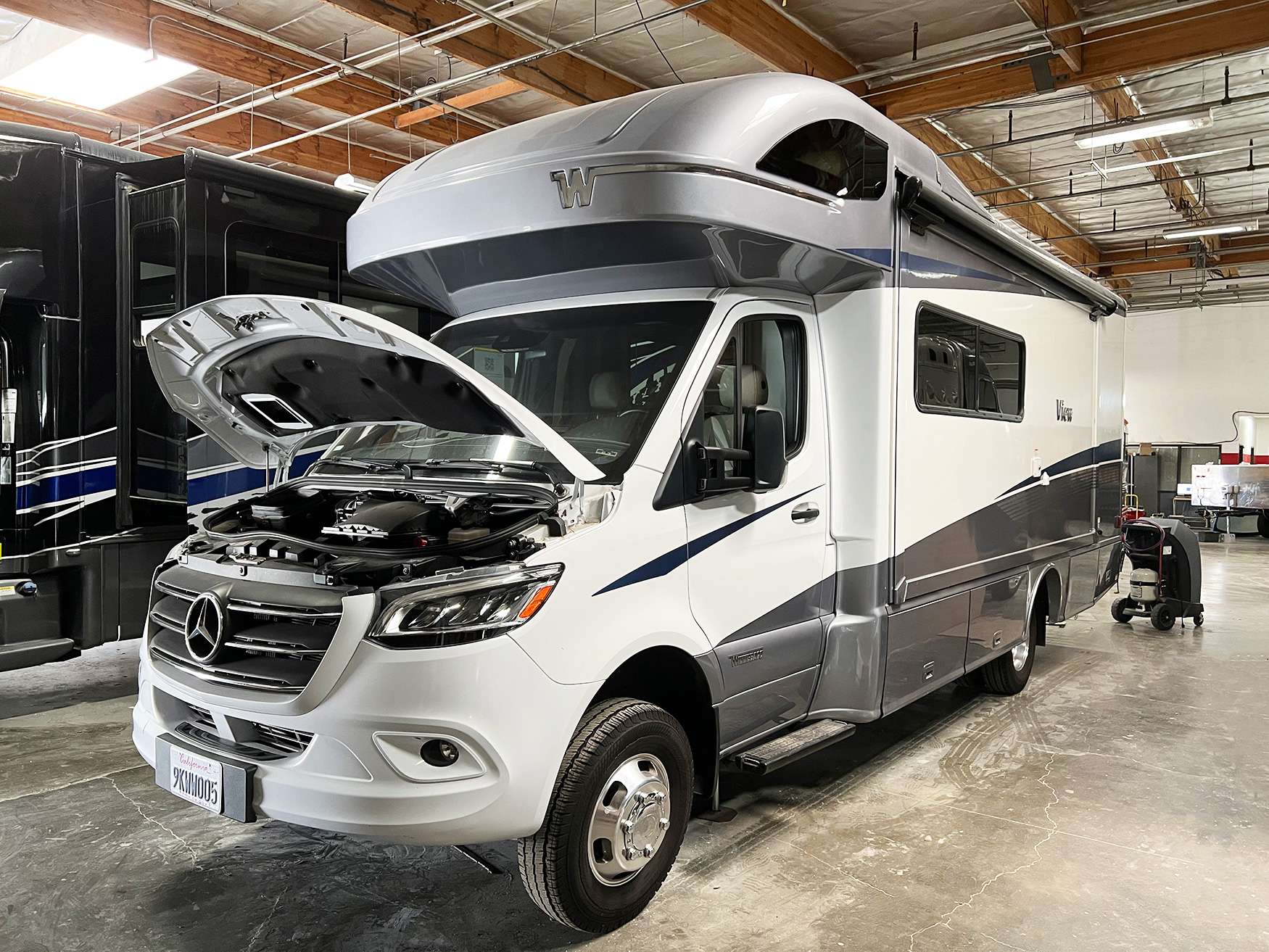
RV furnace repair almost always starts at the sail switch, the limit switch, or the igniter board, because a forced air LP furnace refuses to light for safety reasons long before it ever fails outright. The blower has to move enough air to close the sail switch, the exhaust has to be clear, and LP pressure has to hold under load. We read the lockout, verify each condition in order, and repair the one that actually failed.
How a Forced Air LP Furnace Actually Runs
A standard RV furnace is a sealed combustion box with a single motor driving two wheels. One wheel pushes combustion air through the burner and out the exhaust. The other pushes room air across the outside of that box and into the ducting. The two air streams never touch, which is the entire safety design. Call for heat at the thermostat and the board powers the blower first, waits for airflow to prove itself, then opens the gas valve and sparks the igniter. Every step has to happen in order or the board refuses to continue.
The sail switch is a light metal flap inside the blower housing. When airflow is strong enough it swings and closes a contact, telling the board the blower is really moving air rather than just spinning. A dirty wheel, a weak motor, a low battery, or a partly blocked duct can all leave the sail switch open. When that happens the blower runs and runs and the furnace never lights, which is the most common complaint we hear.
The limit switch sits on the heat exchanger and opens if the box gets too hot, usually because return air is restricted or a duct came loose. The igniter board handles timing, spark, and lockout. The blower motor itself has sleeve bearings that dry out after years of dust, and a motor that has slowed even slightly will fail to close the sail switch on a cold morning while running fine in a warm shop, which is exactly why we test cold.
- Sail switch proves combustion airflow before the gas valve opens
- Limit switch opens on high heat exchanger temperature
- Igniter board controls timing, spark, and lockout
- Blower motor bearings dry out and slow the wheel
- Gas valve solenoid needs full voltage to pull in
- Thermostat and low voltage wiring faults mimic furnace failure
Reading a Lockout Instead of Guessing at It
When a furnace fails to light it does not simply quit. The board goes into lockout after a set number of tries, and most boards then tell you why with a blink pattern on a small light, either on the board itself or on a diagnostic terminal. Counting those blinks against the manufacturer chart is the difference between a one hour diagnosis and an afternoon of parts swapping. We open the access panel, read the pattern, and write it down before touching anything.
A lockout after the blower runs but before any spark points at the sail switch circuit. A lockout with spark but no flame points at gas delivery, the valve solenoid, or LP pressure. A lockout after the flame lights and then drops out points at the flame sense circuit, usually a dirty sensor rod or a bad ground at the burner. A lockout that happens only after ten or fifteen minutes of good heat points at the limit switch and therefore at airflow.
Most boards clear by cycling the thermostat off and back on, or by pulling the twelve volt supply for thirty seconds. Clearing the lockout is not a repair. If the furnace lights after a reset and fails again the next cold morning, the underlying condition is still there and the board is doing exactly what it was designed to do. We treat a repeat lockout as evidence, not as a nuisance.
Exhaust and Intake Obstructions We Find Every Season
The furnace breathes through a pair of concentric tubes at the sidewall vent. The inner tube carries exhaust out, the outer tube draws combustion air in. Both are open to the world through a plastic or metal cover, and both are perfect real estate for insects. Mud dauber wasps build tube shaped mud nests inside them during storage, and a single nest will choke the exhaust enough that the furnace lights, runs briefly, overheats, and drops out on the limit switch. Owners read that as an intermittent furnace when it is really a blocked pipe.
We pull the vent cover and inspect both passages with a light and a mirror, then clear anything we find mechanically rather than blowing it deeper into the tube. Nests, spider webbing, leaf litter, and rodent bedding all show up. So does soot, which is a different problem, because soot means the burner is not getting the right air to gas ratio and something upstream needs correcting before the furnace goes back into service.
Physical damage matters too. A bent exhaust tube from a low overhang, a vent cover that has gone brittle in the Southern California sun and cracked away, or a sidewall vent partly blocked by an aftermarket awning bracket will all restrict flow. Once the passages are clear we run the furnace through several full cycles and watch that it holds heat without dropping out, because a marginal restriction only shows itself under sustained load.
- Mud dauber nests inside the exhaust or intake tube
- Cracked or missing sidewall vent cover
- Soot deposits pointing to an air to gas ratio problem
- Rodent bedding and spider webbing after storage
- Vent partly shadowed by aftermarket brackets or covers
- Bent or crushed tubing from a low clearance strike
Ducting That Heats the Basement Instead of the Coach
Flexible furnace ducting is held to the furnace plenum and to each floor register with clamps, foil tape, or in too many cases a single staple and optimism. Over years of road vibration and cabinet flex, a duct works its way loose and drops off behind a base cabinet or in a storage bay. The furnace then runs perfectly, burns LP, draws battery, and dumps most of its heat into the basement compartment while the coach stays cold and the thermostat never satisfies.
The tell is a furnace that runs almost continuously in mild weather, a floor register with weak airflow while another blows hard, and an unusually warm storage bay. We find these by putting the furnace in a heat cycle and following the airflow with an anemometer at each register, then opening the cabinets and bays along the run. Reattaching a duct is inexpensive. Finding it takes the time, and that is what the diagnostic hour pays for.
We also see crushed ducting where a slide mechanism or a rearranged cabinet has pinched the run flat, registers that were closed for a summer and never reopened, and returns blocked by stored gear. Restricted return air is what drives the limit switch open, so a duct problem and an overheating problem are frequently the same problem. We correct the routing, clamp and tape every joint properly, and verify balanced airflow at each register before the coach leaves.
LP Pressure, Regulators, and the Other Ways Coaches Make Heat
A furnace that sparks but will not sustain a flame is often a fuel delivery issue, not an ignition issue. We test LP with a manometer at a test port and look for the regulator to hold roughly eleven inches of water column with the furnace calling and other appliances cycling. A regulator that has aged, been contaminated by oily residue, or been frozen once will hold static pressure and then collapse under load, which is exactly the symptom of a furnace that lights and drops out.
The same test finds a two stage regulator stuck on an empty bottle, a failed automatic changeover, a pigtail hose with an internal restriction, and an underfilled tank in cold weather where vapor draw exceeds what the liquid can supply. We also perform a timed pressure drop test on the whole LP system to confirm there is no leak before we sign off on any gas appliance work. That test is not optional in our shop.
Not every coach heats with a forced air LP furnace. Hydronic systems circulate heated glycol through a boiler and small fan coil units in each zone, usually with both a diesel burner and an electric element, and they fail at the burner nozzle, the circulation pump, or the zone thermostats rather than at a sail switch. Diesel fired air heaters are common in vans and use a glow pin, a fuel dosing pump, and a scheduled soot cleaning that most owners have never had done.
Electric space heat has a place as a supplement. A ceramic heater on shore power carries the coach on a mild evening without burning LP or draining the battery, and many coaches have an electric element built into a hydronic system or a heat pump function in a rooftop unit. What electric heat will not do is keep up below roughly forty degrees outside or protect plumbing in a basement bay, which is what the furnace duct run is actually there for.
- Manometer test of LP pressure under live appliance load
- Timed pressure drop test on the full LP system
- Regulator and automatic changeover function check
- Pigtail hoses and tank valves inspected for restriction
- Hydronic boiler burner, pump, and zone thermostat checks
- Diesel air heater glow pin and soot service
Carbon Monoxide Testing and What the Furnace Costs You Overnight
Every coach with a combustion appliance needs a working carbon monoxide detector, and detectors have an expiration date printed on the back, typically five to seven years from manufacture. An expired detector is not a detector. We check the date, press the test button to confirm the horn and circuit work, and confirm the unit is mounted where it will actually see air movement rather than tucked behind a curtain. If your coach uses a combination LP and carbon monoxide alarm, both sensor elements age together.
The test button only proves the horn and the battery. It does not prove the sensing element still responds to gas. That is why the expiration date matters more than the beep. If the detector is past date, replace it, and replace it before the first cold trip rather than after. We also inspect the furnace heat exchanger and the sealed combustion path for any evidence of a breach, because that is the failure that puts exhaust into the living space.
The other thing owners underestimate is battery draw. A furnace blower pulls roughly six to nine amps at twelve volts while it runs. On a cold night the furnace might run twenty minutes out of every hour, which works out to somewhere around twenty five to forty amp hours by morning. A single group 24 lead acid battery has usable capacity in that same neighborhood, which is why boondockers wake up to a dead battery and a furnace that clicks but will not spin the blower.
That is also why a low battery masquerades as a furnace fault. Below about eleven volts the blower slows enough to leave the sail switch open and the gas valve solenoid may not pull in fully. We always verify supply voltage at the furnace under load before we condemn a board or a switch, because replacing a good board on a coach with a tired battery bank helps nobody.
What Furnace and Heating Repair Costs at Our Shop
Mechanical labor is $260 per hour. Diagnostic labor is $285 per hour and is credited against an authorized repair, so the hour spent reading the lockout and tracing the fault comes off the bill once you approve the work. Parts carry 100 percent markup at or under $100 and 35 percent markup over $100. California sales tax of 7.75 percent applies to parts and materials only. Any authorized job above $2,000 takes a 50 percent deposit before parts are ordered.
Bottom of the range. A furnace that runs the blower and never lights, diagnosed to a sail switch that no longer closes. Labor is 1.0 hour at $260. The sail switch is a $46 part, doubled to $92. Tax on that is $7.13. The invoice is $359.13, and the $285 diagnostic you paid up front credits against it, leaving $74.13 due at pickup. Clearing a mud dauber nest from the exhaust tube lands in the same neighborhood.
Middle of the range. An igniter board that has lost its spark output on a coach that otherwise tests clean. Labor is 1.5 hours at $260, which is $390. The board is a $242 part at 35 percent, which is $326.70. Tax is $25.32 and the invoice is $742.02. Most single component furnace repairs live between $350 and $900 once the diagnosis is honest.
Top of the range. A complete furnace replacement on a coach with a corroded heat exchanger, plus a new thermostat, a replacement LP regulator, and reattached ducting. Labor is 4.0 hours at $260, which is $1,040. Parts are the furnace at $685 marked to $924.75, the thermostat at $118 marked to $159.30, the regulator at $88 doubled to $176, and duct collar and flexible duct at $64 doubled to $128. Parts total $1,388.05, tax is $107.57, and the invoice is $2,535.62 with a $1,267.81 deposit. What pushes a job there is a furnace boxed into cabinetry that has to come apart or water damage at the sidewall vent.
- Mechanical labor $260 per hour, diagnostic $285 per hour credited
- Parts markup 100 percent at or under $100, 35 percent over $100
- Sales tax 7.75 percent on parts and materials, labor is not taxed
- 50 percent deposit on authorized work above $2,000
- Timed LP pressure drop test performed on any gas appliance job
Questions
Frequently asked questions
Why does my RV furnace blower run but never light?
That pattern points at the sail switch circuit almost every time. The board will not open the gas valve until it has proof that combustion air is moving, and the sail switch is what provides that proof. A slow blower motor with dry bearings, a dust caked wheel, a partly blocked exhaust or intake tube, or a battery below about eleven volts will all leave the switch open. Less often the switch itself has failed or its wiring has corroded. We test the blower amperage, measure supply voltage under load, inspect both vent tubes, and only then replace the switch if it is genuinely the failed part.
What is a sail switch and why does it shut my furnace down?
It is a thin metal flap inside the blower housing wired to a normally open contact. When the blower moves enough air the flap swings and closes the contact, telling the control board it is safe to open the gas valve. It is a safety interlock, not a nuisance part. If the switch could not close and the board lit the burner anyway, you would have combustion without adequate airflow, which is how heat exchangers crack and exhaust ends up somewhere it should not be. When a sail switch stops the furnace, it is usually reporting a real airflow problem that needs correcting.
My furnace lights, runs a few minutes, then shuts off. What is wrong?
Lighting and then dropping out after a short run is the signature of the limit switch opening on high temperature, which means the heat exchanger is getting hotter than it should. The usual causes are a restricted exhaust tube, often a mud dauber nest, a duct that has come loose so heat is not being carried away, a blocked return path, or closed floor registers. Less often the limit switch itself has drifted out of calibration. We clear and inspect the vent passages, check every duct joint and register, run several full heat cycles, and confirm it holds temperature under sustained load before returning the coach.
How much does it cost to replace an RV furnace?
A complete forced air furnace replacement typically runs $1,800 to $2,500 or more depending on how the furnace is boxed into the cabinetry and what else needs attention while it is out. Our worked example, a furnace plus a new thermostat, a replacement LP regulator, and reattached ducting, comes to $2,535.62. That is 4.0 hours of labor at $260 per hour, $1,388.05 in marked up parts, and $107.57 in tax on those parts. Work above $2,000 requires a 50 percent deposit. A single failed component such as a sail switch or an igniter board is far less, usually $350 to $900.
Why is my storage bay warm while the coach stays cold?
A duct has almost certainly come off. Flexible furnace ducting is clamped or taped to the plenum and to each floor register, and road vibration works those joints loose over the years. When a duct drops off behind a cabinet or in a basement bay, the furnace runs, burns LP, and drains the battery while heating a compartment instead of the living space. The thermostat never satisfies so it runs even longer. We put the furnace in a heat cycle, measure airflow at each register, and trace the run through the cabinets and bays until we find the disconnect.
How much battery does the furnace use overnight?
The blower draws roughly six to nine amps at twelve volts whenever it runs. On a cold night with the furnace cycling about twenty minutes per hour, that is somewhere near twenty five to forty amp hours by morning. A single group 24 lead acid battery only has usable capacity in that same range before it is discharged too deeply, which is why owners who camp without hookups wake up to a furnace that clicks and will not spin. Below about eleven volts the blower also slows enough to leave the sail switch open, so a weak battery presents itself as a furnace fault.
Can I just use an electric space heater instead of the furnace?
As a supplement on shore power, yes, and it is a reasonable way to save LP on a mild evening. As a replacement, no. A portable electric heater warms the air in the living space but does not push heat into the basement bays and underbelly where the fresh water tank and plumbing runs live. That duct run is a large part of what keeps lines from splitting in a cold snap. Electric heat also loses ground below roughly forty degrees outside, and it consumes shore power you may need for other loads. Keep the furnace serviced and use electric heat alongside it.
How often should I test the carbon monoxide detector?
Press the test button monthly, and check the printed expiration date on the back at least once a year. Detectors are built with a sensing element that degrades whether or not it has ever seen gas, and most are rated for five to seven years from the date of manufacture. The test button only confirms the horn and the power supply, not that the sensor still responds. Replace an expired unit before the first cold trip rather than after. If you have a combination LP and carbon monoxide alarm, both sensing elements age on the same clock and the whole unit gets replaced together.
Standard on every job
What is included
These are not upgrades. They are how the work is run on every vehicle that comes through the building.
Full teardown where it is needed
We do not estimate through a closed panel. If the damage path runs behind trim or skin, we open it and document what is actually there.
Written, itemized scope
Parts, labor hours, and materials listed separately against the posted rate, so every line is something you can question.
Direct carrier communication
We talk to the adjuster so you are not relaying technical detail between two parties who both expect you to already understand it.
Supplement handling
When teardown finds more than the original inspection, we document and submit the supplement rather than absorbing it into a vague overage.
Correct repair sequence
Structural before cosmetic, every time. A straight body over a bent frame is a repair that fails its second life.
Systems tested under load
Electrical, plumbing, generator, and climate systems are run and verified before delivery, not just reconnected and assumed good.
Photo documentation throughout
Before, during, and after. Useful for your records, and decisive if a claim is ever revisited.
Delivery walkthrough
We go over what was done, what was replaced, and what to watch, in person, with the vehicle in front of you.
How the work runs
Our six step repair process
The same sequence on every vehicle, whether it is a single coach or a fleet of box trucks.
- 01
Assessment and documentation
We put the vehicle on the floor, pull panels where we need to see behind them, and photograph everything. Hidden damage found now is damage that does not become a supplement argument later.
- 02
Written estimate
You get a line by line estimate with parts, labor hours, materials, and the posted rate applied to each. Nothing is bundled into a single number you cannot check.
- 03
Carrier coordination
If a claim is involved we deal with the adjuster directly, submit the documentation, and handle supplements when teardown reveals more than the first inspection showed.
- 04
Authorization and scheduling
Once the scope is approved we confirm the deposit, order parts, and give you a realistic slot. Special order parts drive the timeline more often than labor does.
- 05
Repair
Structural first, then body, then paint, then systems and interior. The sequence is not negotiable because each stage has to be right before the next one covers it up.
- 06
Quality check and delivery
Multi point inspection, systems tested under load, paint inspected under corrected lighting, and a walkthrough with you before the vehicle leaves.
Keep reading
Related pages
Related services
Vehicles we repair
Talk to a repair specialist today
Tell us what happened and we will tell you what the repair actually involves, what it costs, and how long it takes. We work directly with every major carrier and serve Westminster owners and fleets from our 35,000 square foot facility.
Posted labor rates are published on our prices page. Diagnostic and systems assessment fees are credited against an authorized repair.