RVs and Motorhomes
Class A Motorhome Repair, Cap to Chassis
In short
Class A motorhome repair runs from about $2,000 for a bay door and seal job to past $150,000 for a structural rebuild with full body paint. The flat front cap, the laminated sidewalls and the slide room openings are where the money goes. Body and paint labor is $210 per hour and a real number requires opening the damaged area.
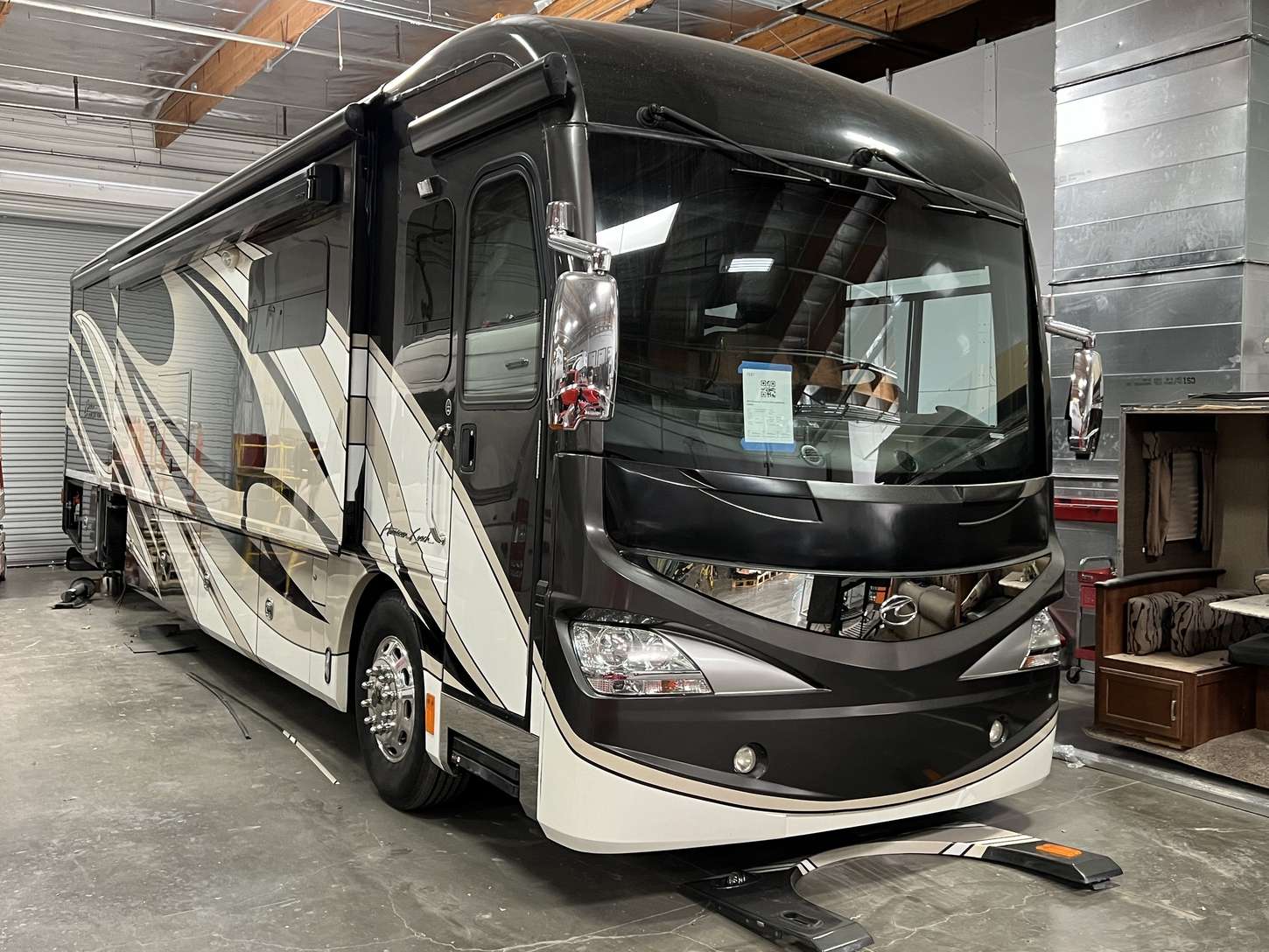
Class A motorhome repair is the deepest end of RV body work, and it is most of what fills our bays on any given week, including a steady stream from Westminster. The flat front, bus style body means the whole nose is one bonded fiberglass structure, the sidewalls are laminated panels carrying real load, and the slide openings are the weakest line in the wall. Nothing about that repairs like a car.
The Front Cap Is a Structure, Not a Bumper
On a Class A the front cap is a single molded fiberglass shell that ties the roof, both sidewalls and the floor together across the nose. It carries the windshield opening, the headlight and marker housings, and usually the front air conditioning ducting. When something hits it, the damage does not stay where the impact was. It travels up the corner radius toward the roof seam and back along the sidewall bond line.
That is why we start a front hit by checking the windshield opening for square rather than by looking at the crack. If the opening has moved, a new cap is going in, because a windshield set into a distorted opening will leak or crack again within a season. If the opening is true, a sectional repair is usually the right call and it costs a fraction of a cap replacement.
Cap replacement on a current production coach means ordering a molded shell, transferring or replacing every mounted component, bonding and mechanically fastening it, then fairing and refinishing the entire nose. Budget 60 to 110 hours of body and paint time plus the cap itself. Where the coach builder is gone, we section and laminate the damaged area instead and rebuild the surface by hand.
- Check the windshield opening for square before pricing anything
- Follow the crack up the corner radius to the roof seam
- Confirm whether the cap carries structural roof load on that model
- Inspect the bond line where the cap meets each sidewall
- Pull the headlight housings to see the backside of the laminate
Windshields, One Piece and Two Piece
Older Class A coaches commonly use a two piece windshield with a center divider bar. Newer coaches often use a single curved pane. The two are very different problems. A two piece unit is easier to source, easier to handle and cheaper to replace, but the divider bar seal is a chronic leak point that quietly wets the dash and the cap laminate underneath.
A one piece windshield is a heavy, expensive, specialized pane that has to be set into a true opening on a fresh bed of urethane. Setting one into a body that has taken a hit without first confirming the opening is flat is how a shop creates a stress crack that shows up three weeks later. We measure the opening in five places before glass goes anywhere near it.
Delamination Along a Long Sidewall
A Class A sidewall can be 40 feet of laminated panel with only a handful of framing members inside it. When the skin releases from the foam and framing, the wall stops behaving like a beam. On a long coach this shows up as a shimmer or wave in the reflection down the side, usually starting near a window corner, a slide opening or the bottom edge above the bay doors.
The two repair paths are injection or section replacement. Injection means drilling a controlled pattern, drawing vacuum, and pushing structural adhesive back into the void so the skin bonds to the core again. It works well when the core is dry and intact and runs roughly $1,500 to $6,000 depending on area. Section replacement means cutting the skin back to sound bond, rebuilding framing where needed, laminating new panel, then fairing and painting.
The decision hinges on moisture. Wet foam does not bond, so injecting a wet wall wastes your money and buys a few months. We meter the wall first, and if it reads wet, we open it. It is a harder conversation and it is the right one.
Slide Rooms, Racks and the Opening They Live In
Most slide problems that arrive as a mechanical complaint are really a structural complaint. A rack and pinion or Schwintek slide is designed to run in an opening that stays square. Let a sidewall soften from delamination or let a collision tweak the wall, and the room binds, the motors draw harder, and eventually a rail or a gear gives up.
So when a slide grinds or stalls, we check the opening and the floor for square before condemning the mechanism. Sometimes the fix is the wall, and the slide runs correctly again once the opening is restored. Sometimes the mechanism really is worn out, and then it is a parts and adjustment job at the $260 mechanical rate.
Slide seals are the other half. A wiper and bulb seal set that has gone hard will let water into the floor edge every time it rains while the room is out. Replacing seals is inexpensive compared to replacing the floor they were supposed to protect.
- Bind or stall usually points at the opening, not the motor
- Check floor and wall for square before ordering a mechanism
- Inspect wiper and bulb seals for hardening and set
- Look at the slide floor edge for swelling and delamination
- Verify the room sits flush top and bottom when retracted
Basement Bays and Compartment Doors
The bay structure under a Class A does more than hold your chairs. On many coaches the compartment framing ties into the floor structure and helps resist twist. A side swipe that crushes a bay door frame can therefore be a structural repair even though it looks cosmetic, and a door that will not latch square is often the first symptom.
Compartment doors themselves are a common parts headache. Painted, radiused, model specific doors from a builder who no longer exists mean fabrication. We build the door, hang it on new hardware, and refinish it to match the surrounding panel, which on a coach with graphics means matching the graphic across the door as well.
Full Body Paint Versus a Spot Blend
The single most common estimate surprise on a Class A is paint scope. On a solid color coach, we blend into the adjacent panels and you never see the repair. On a coach with layered multi stage graphics running the length of the body, there is no invisible stopping point in the middle of a swoosh, so the repair has to carry to a natural break, and sometimes that break is the far end of the coach.
Full body paint on a 38 to 45 foot coach is a serious operation: strip and prep, mask and reassemble, base, graphic layers, clear, then cut and buff. Figure 120 to 250 hours of body and paint labor at $210 per hour before materials, and four to seven weeks in the shop. It is also the point where a lot of owners choose to change the design rather than reproduce a twenty year old one.
A worked example on the more common end: a scraped and cracked rear corner on a solid color gas coach, no water intrusion, runs 24 to 34 hours at $210 for roughly $5,000 to $7,100 in labor, plus $1,600 to $3,200 in cap section material, trim and refinish materials, plus 7.75 percent tax on the parts and materials.
Questions
Frequently asked questions
What does Class A motorhome repair usually cost?
Working range is $2,000 to past $150,000. A bay door, a seal job and a small blend sits near the bottom. A rear corner with cap sectioning and paint typically lands between $6,000 and $12,000. A front cap replacement with a windshield and refinish commonly runs $18,000 to $45,000 depending on the coach and the graphics. Structural rebuilds with water damage through the framing and full body paint are where six figures happens. Body and paint labor is $210 per hour, mechanical is $260, parts carry 100 percent markup at or under $100 and 35 percent above that, and repairs over $2,000 take a 50 percent deposit.
Can a cracked front cap be repaired instead of replaced?
Often yes. Fiberglass is very repairable when the substrate behind it is sound and the opening geometry has not moved. We grind the crack out to a taper, lay in structural glass on the backside where we can reach it, rebuild the front surface, fair it and refinish. That path is usually a third to a half the cost of a cap replacement. Replacement becomes the right call when the windshield opening is out of square, when the crack runs into the roof seam, or when the laminate has separated over a large area. We measure the opening first and make that call before writing the estimate.
My slide room grinds when it comes out. Is the motor bad?
Maybe, but the motor is the last thing we suspect. A slide mechanism is built to run in a square opening. If the sidewall has softened from delamination, if the floor has swelled from a seal leak, or if the coach took a hit that moved the opening, the room binds and the motor is simply reporting the problem. We check the opening and floor for square, inspect the seals, and look at the room edges for swelling before we price a mechanism. If the structure is the cause, replacing the motor buys you a few months and then you are back. Mechanism work bills at $260 per hour.
Why is paint on a Class A so expensive?
Surface area and layers. A 40 foot coach has several times the paintable surface of a car, it is tall enough to need scaffolding and a booth that can take it, and modern coach graphics are multi stage: base, several tape and spray graphic layers, then clear over everything. There is no invisible place to stop in the middle of a graphic, so a repair often has to carry to a body break rather than a panel edge. Full body work on a long coach is commonly 120 to 250 hours at $210 per hour plus materials, and four to seven weeks of shop time.
Do you fix delamination, or do I have to replace the wall?
We fix it when the core is dry. The least invasive path is vacuum injection: a controlled drill pattern, vacuum drawn through the void, structural adhesive pushed back in, then the surface faired and refinished. That runs roughly $1,500 to $6,000 depending on area and works well on a dry wall. If the meter says the foam and framing are wet, injection is a waste, because adhesive will not bond to wet material. Then we cut the skin back to sound bond, replace whatever framing has gone soft, laminate new panel and refinish. We take moisture readings before quoting, not after.
How long does a Class A repair take?
Panel and paint work is usually one to three weeks. Cap sectioning with refinish is two to five weeks. A front cap replacement with a one piece windshield is typically four to eight weeks, and most of that is waiting on the cap. Full body paint is four to seven weeks. Water intrusion jobs are the least predictable because the scope grows as framing comes out. If a part is many weeks out and your coach is drivable, we document, order and hand it back so it is not sitting in our yard. The 50 percent deposit on jobs over $2,000 is what lets us order on approval day.
Will my insurance cover the delamination behind the impact?
We do not predict coverage decisions, and any shop that does is guessing with your money. What we can do is document. On a claim job we photograph every layer as it comes off, take moisture readings with the meter in the frame, record part numbers and write the labor operations against the damage found. If the delamination is continuous with the impact, that evidence is what makes the case. If the wall was already delaminated from an old roof seam leak before the collision, the file will show that too. Either way you get a clear picture rather than an argument.
Can you work on a coach that is 40 feet or longer?
Yes. Length and height are the practical limit for most shops, which is why a lot of Class A owners get turned away twice before they find us. Our floor is 35,000 sq ft with bay length and door height sized for full length coaches, including paint capacity for a full body job rather than panel only work. We handle roughly 75 vehicles a month across every category. If your coach is drivable and the parts for it are weeks out, we will schedule the teardown and the repair as separate visits so you are not storing it here.
How the work runs
Our six step repair process
The same sequence on every vehicle, whether it is a single coach or a fleet of box trucks.
- 01
Assessment and documentation
We put the vehicle on the floor, pull panels where we need to see behind them, and photograph everything. Hidden damage found now is damage that does not become a supplement argument later.
- 02
Written estimate
You get a line by line estimate with parts, labor hours, materials, and the posted rate applied to each. Nothing is bundled into a single number you cannot check.
- 03
Carrier coordination
If a claim is involved we deal with the adjuster directly, submit the documentation, and handle supplements when teardown reveals more than the first inspection showed.
- 04
Authorization and scheduling
Once the scope is approved we confirm the deposit, order parts, and give you a realistic slot. Special order parts drive the timeline more often than labor does.
- 05
Repair
Structural first, then body, then paint, then systems and interior. The sequence is not negotiable because each stage has to be right before the next one covers it up.
- 06
Quality check and delivery
Multi point inspection, systems tested under load, paint inspected under corrected lighting, and a walkthrough with you before the vehicle leaves.
Keep reading
Related pages
Related vehicles
Services we perform
Talk to a repair specialist today
Tell us what happened and we will tell you what the repair actually involves, what it costs, and how long it takes. We work directly with every major carrier and serve Westminster owners and fleets from our 35,000 square foot facility.
Posted labor rates are published on our prices page. Diagnostic and systems assessment fees are credited against an authorized repair.