Interior Remodeling
RV Upholstery Repair, Recovering, and Cushion Rebuilds
In short
RV upholstery repair runs $600 to $8,500 or more, depending on whether you are recovering two dinette cushions or rebuilding a full theater seat set in leather. Most jobs take 7 to 20 business days in the shop. The biggest cost driver is not the fabric, it is the labor to strip, pattern, sew, and refit every piece.
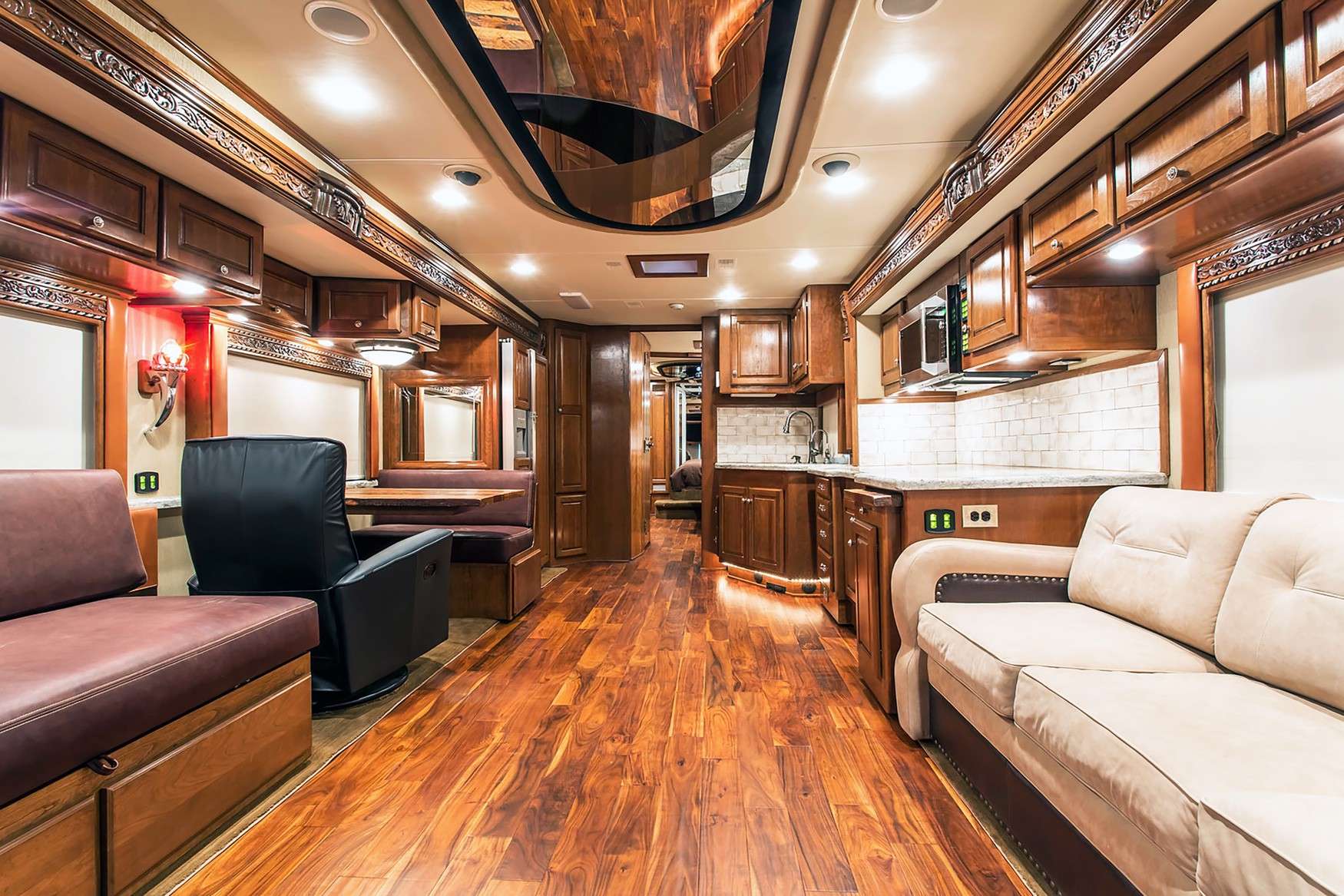
RV upholstery repair covers everything from a split seam on a jackknife sofa to a full interior in marine grade vinyl, and Westminster owners usually call us when the foam has quit rather than when the fabric tears. Cushions carry weight every day they are used, and factory foam is chosen to hit a price. We rebuild the inside of a seat as well as the outside, because new fabric over collapsed foam still feels wrong.
Which Seats You Actually Have
Before we quote anything we need to know what is bolted to your floor. A dinette is the simplest: two bench bottoms and two backs, usually loose cushions in zippered covers over plywood platforms. A jackknife sofa is a folding steel frame with a one piece back and seat, and the cover has to allow the fold without bunching. Theater seating is a manufactured recliner unit with powered or manual mechanisms inside. Captain chairs are seat frames on a pedestal or a swivel base.
Those four types carry very different labor. Dinette cushions can often be recovered with clean pattern work and a straightforward sew. A jackknife cover has to be built so the hinge line still closes, which means test fitting more than once. Theater seats come apart in panels held by hidden clips and staples, and each panel is patterned separately, so a two seat unit can be twenty or more individual pieces. Captain chairs add belts, trim panels, and mounting hardware.
We also ask how the seat gets used. A dinette that doubles as a bed needs firmer foam and a cover that tolerates being sat on at the edge every day. A theater seat used two weeks a year is a different specification than one an owner lives in full time. Telling us that up front changes the foam we order, and it changes how the seat feels three seasons from now when the novelty has worn off.
- Dinette bottoms and backs, usually loose cushions over plywood platforms
- Jackknife sofa on a folding frame that must still close cleanly
- Theater seats with powered or manual recline mechanisms inside
- Captain chairs on pedestals, often with belts and trim panels
- Bed conversion seating that needs a firmer foam specification
Foam Density and Why Factory Cushions Collapse
Foam is sold by density and by firmness, and they are not the same number. Density is weight per cubic foot and it tells you how long the foam will last. Firmness, usually listed as ILD, tells you how it feels when you sit down. A lot of factory RV cushions use foam around 1.2 to 1.5 pounds per cubic foot, which feels acceptable on the dealer lot and gives up its shape after two or three seasons of regular use.
When we rebuild a cushion we generally move to 1.8 pound foam or higher for seating, and for a dinette bench that doubles as a bed we go higher still or build a layered core with a firmer base and a softer top. Adding a wrap of bonded polyester over the foam gives the cover a full look and keeps the corners from going hollow. That wrap costs very little and it is the difference between a cushion that stays crisp and one that looks tired in a year.
Foam is also why a recover alone can disappoint. If we sew a clean new cover and drop it over the original core, you get a seat that photographs well and still bottoms out under you. We will quote the cover alone when that is what you want, and we will tell you plainly when we think the core needs to go. On most coaches older than about six years, the foam is the actual repair and the fabric is just the finish.
Vinyl, Cloth, or Leather in a Vehicle Interior
Marine grade vinyl is the default for good reasons. It is UV stabilized, it resists mildew, it wipes clean, and it handles the humidity swings of a closed coach sitting in the sun. It is what we recommend for dinettes, for anything near a galley, and for any seat that sees wet swimsuits or dogs. The trade is breathability. Vinyl feels warm against your legs on a hot afternoon, and low grade vinyl gets tacky as it ages.
Cloth breathes and feels better to sit on, and modern performance fabrics with a solution dyed acrylic base hold color remarkably well. Cloth absorbs spills and odors, though, and it is hard to bring back after a mildew event. Leather looks and feels excellent on a theater seat or a captain chair, but it wants conditioning, it does not like being closed up hot for months, and it costs more in both material and labor because it patterns differently than a fabric that stretches.
Fabric selection in a vehicle is not only a matter of taste. Interior materials in a motorhome are expected to meet flammability standards written for vehicle interiors, which is a different test than what a residential sofa fabric passes. We select goods that carry the appropriate rating for vehicle use, and we will decline to install a residential upholstery fabric with no rating, because that is the wrong material in a space where people sleep.
- Marine grade vinyl for galley seating, wet exposure, and easy cleaning
- Solution dyed performance cloth when comfort and breathability matter most
- Leather or leather match on theater seats and captain chairs
- Materials selected to carry a flammability rating suitable for vehicle interiors
- Contrast welting and stitching chosen at the sample stage, not at final fitting
Sun Fade, Seam Failure, and Hardware
Almost every coach we see has faded unevenly. Whichever side sits toward the sun on your pad takes the hit, so the curbside cushions go a shade lighter than the street side, and the piece nearest a window goes first. That matters when an owner wants only one cushion recovered. New material next to eight year old material will not match even when it is the identical part number, and we will show you that in daylight before you spend money on it.
Seams and zippers fail before fabric does. Thread degrades in UV, so a cover can be sound everywhere except along the top seam that faced the window for a decade. Zippers on RV cushions are often a lightweight coil that gives up after a few hundred cycles. Welting, the cord sewn into the seam, is what holds a cushion edge crisp, and when the welt breaks down the corners go round and the whole cover starts to shift when you sit.
Several of these are small repairs worth doing on their own. Restitching a failed seam with UV stable thread, replacing a zipper, or replacing welting on two edges can be a few hours of bench work rather than a full recover. We would rather do the small version now and see you again in four years than sell you a full interior you did not need yet.
Recovering a Seat Versus Replacing the Whole Unit
There is a point where recovering stops making sense. If a theater seat mechanism is worn, if frame welds are cracked, or if a jackknife hinge has elongated its holes, you are putting new material on a structure that is already failing. Replacement units are available for most common seating, and on a badly worn theater set the delivered price of a new unit can land close to what a full recover costs in labor alone.
Recovering wins when the frame and mechanism are sound and you care about fit, color, or keeping the original dimensions. RV seating is often sized to a specific slide out or a specific aisle width, and a replacement unit that is two inches deeper can change how the slide closes. It also wins when you want a material better than what the aftermarket offers, or when you are matching new seating to existing cabinetry and window treatments.
We give you both numbers when it is close. That means the recover estimate with the foam specification written out, and the replacement estimate including removal, floor and mounting modifications, and any trim work needed to make a different footprint look factory. Owners usually decide quickly once the two sit side by side, and neither answer is wrong. It is your money and your coach, and you should be choosing with both numbers in front of you.
- A sound frame and a smooth mechanism favor recovering
- Cracked welds or worn recline hardware favor replacement
- Slide out clearance often rules out a deeper replacement unit
- Custom color and material matching favors recovering
- Delivered cost of a new unit can rival the labor of a full recover
Cost Math on a Four Piece Dinette
Take a common job: a four piece dinette recovered in marine grade vinyl with new 1.8 pound foam, a polyester wrap, new zippers, and welted edges. Patterning, cutting, sewing, foam fabrication, and fitting run about 16 hours. Body and paint labor bills at $210 per hour, so labor is $3,360. That number surprises owners until they watch someone pattern a bench back that is not square in any direction, which describes almost every RV cushion ever built.
Parts: 12 yards of marine grade vinyl at $42 per yard is $504, and since the line is over $100 the markup is 35 percent, so $680.40. Two sheets of high density foam at $135 each is $270, marked up 35 percent to $364.50. Thread, zippers, welt cord, and adhesive total $85, and parts at or under $100 carry 100 percent markup, so $170. Parts come to $1,214.90, and sales tax at 7.75 percent on parts and materials adds $94.15.
The ticket is $4,669.05, and since it is over $2,000 we take a 50 percent deposit of $2,334.53 to order material. A smaller job looks very different. Recovering a single jackknife sofa cushion might be 5 hours at $210 for $1,050, with 5 yards of vinyl at $42 marked up to $283.50, one foam sheet at $135 marked up to $182.25, and $45 of notions marked up to $90. Parts of $555.75 plus $43.07 in tax lands that at $1,648.82.
What pushes a job toward the top of the range: leather instead of vinyl, theater seats with many separate panels, powered mechanisms that have to come out and go back in, contrast stitching, and matching an existing pattern across a slide out. What keeps it at the bottom: a simple dinette, one material, sound foam that can be reused, and bringing the coach in during a slower stretch of the year when the sewing bench is not stacked.
Questions
Frequently asked questions
Can you recover my cushions and keep the old foam?
We can, and sometimes it is the right call. If the coach is newer, the foam still springs back when you press it, and the cushion holds its shape at the corners, reusing the core saves real money. On most coaches past about six years the foam has taken a set, and a new cover over it feels the same as before, only shinier. We check by removing a cover and compressing the core by hand. If it does not recover its height, we recommend new foam and describe how the cushion will feel with each choice before you spend anything.
How long does an RV upholstery job take?
Plan on 7 to 20 business days in the shop. Material lead time drives a lot of it, since a specific vinyl or performance cloth is often a special order and can take a week or more to arrive. Once the material is here, a dinette set is a few days of pattern work, sewing, and fitting. Theater seats take longer, because each unit comes apart into many separate panels and every one gets patterned individually. We usually schedule the coach to arrive after material lands, so you are not parked here waiting on a delivery truck.
Will a new cushion match the ones I am not replacing?
Almost certainly not exactly, even with identical material. Sun exposure fades everything in a coach, and the curbside pieces and the cushion nearest a window fade fastest. New goods against faded goods reads as a mismatch in daylight even when it looks fine under interior lights. We hold a sample against your existing cushions and let you see it before you commit. Owners who care about a uniform look generally do the whole set at once. Owners replacing one damaged piece in a bedroom or a rarely used seat often accept the difference and move on.
Is marine grade vinyl worth it over standard vinyl?
For a coach, yes. Marine grade goods are built for sun and humidity, with UV stabilizers, a mildew resistant backing, and a topcoat that stands up to repeated cleaning. Standard indoor vinyl in a closed coach parked in Southern California sun will get brittle at the seams and start cracking within a few seasons. The material cost difference across a dinette is often under a hundred dollars, and the labor to recover is identical either way. Paying that labor again in four years to save a small amount on material is a poor trade.
Can I supply my own fabric?
Yes, with two conditions. First, it needs to carry a flammability rating appropriate for a vehicle interior. Residential upholstery goods often do not, and we will not install unrated material in a space where people sleep. Second, we need enough yardage, and that number is larger than most owners expect once pattern repeat and directional nap are accounted for. Bring the material to us before you buy it if you can, or send us the specification sheet. We will confirm the rating and give you the yardage. Labor is quoted the same either way.
Our dinette is also the bed. What foam should we use?
Go firmer and go layered. A cushion that serves as a mattress needs a higher density base so it does not bottom out under a hip, with a softer top layer so it is not punishing to sleep on. We typically build a 2.0 pound or better base with a softer topper and a polyester wrap, and we sew the covers with a zipper long enough that the core can be swapped later without new covers. Tell us who sleeps there and how often, because a weekend guest bed and a full time sleeping surface are different specifications.
Is it cheaper to buy new theater seats than to recover mine?
Often, yes. A theater seat comes apart into many separate upholstered panels, and patterning and sewing each one adds up fast, so a full recover on a two seat unit can approach the delivered cost of a new unit. Recovering wins when your frame and mechanism are sound and the replacement units available do not fit your slide out depth or aisle width, or when you want a material and color the aftermarket does not offer. We price both when it is close, including removal and any floor or mounting work a different footprint would need.
What does it cost to fix just a torn seam or a broken zipper?
Small repairs are billed by the hour and they are worth doing. Restitching a failed seam with UV stable thread is often one to two hours. Replacing a zipper on a cushion cover runs one to three hours depending on how the cover was built. Replacing welting along two edges is usually two to four hours. At the body and paint rate of $210 per hour, plus a small amount of notions with markup and sales tax, most single cushion repairs land between roughly $250 and $900. That beats replacing an interior you do not need yet.
Standard on every job
What is included
These are not upgrades. They are how the work is run on every vehicle that comes through the building.
Full teardown where it is needed
We do not estimate through a closed panel. If the damage path runs behind trim or skin, we open it and document what is actually there.
Written, itemized scope
Parts, labor hours, and materials listed separately against the posted rate, so every line is something you can question.
Direct carrier communication
We talk to the adjuster so you are not relaying technical detail between two parties who both expect you to already understand it.
Supplement handling
When teardown finds more than the original inspection, we document and submit the supplement rather than absorbing it into a vague overage.
Correct repair sequence
Structural before cosmetic, every time. A straight body over a bent frame is a repair that fails its second life.
Systems tested under load
Electrical, plumbing, generator, and climate systems are run and verified before delivery, not just reconnected and assumed good.
Photo documentation throughout
Before, during, and after. Useful for your records, and decisive if a claim is ever revisited.
Delivery walkthrough
We go over what was done, what was replaced, and what to watch, in person, with the vehicle in front of you.
How the work runs
Our six step repair process
The same sequence on every vehicle, whether it is a single coach or a fleet of box trucks.
- 01
Assessment and documentation
We put the vehicle on the floor, pull panels where we need to see behind them, and photograph everything. Hidden damage found now is damage that does not become a supplement argument later.
- 02
Written estimate
You get a line by line estimate with parts, labor hours, materials, and the posted rate applied to each. Nothing is bundled into a single number you cannot check.
- 03
Carrier coordination
If a claim is involved we deal with the adjuster directly, submit the documentation, and handle supplements when teardown reveals more than the first inspection showed.
- 04
Authorization and scheduling
Once the scope is approved we confirm the deposit, order parts, and give you a realistic slot. Special order parts drive the timeline more often than labor does.
- 05
Repair
Structural first, then body, then paint, then systems and interior. The sequence is not negotiable because each stage has to be right before the next one covers it up.
- 06
Quality check and delivery
Multi point inspection, systems tested under load, paint inspected under corrected lighting, and a walkthrough with you before the vehicle leaves.
Keep reading
Related pages
Related services
Vehicles we repair
Talk to a repair specialist today
Tell us what happened and we will tell you what the repair actually involves, what it costs, and how long it takes. We work directly with every major carrier and serve Westminster owners and fleets from our 35,000 square foot facility.
Posted labor rates are published on our prices page. Diagnostic and systems assessment fees are credited against an authorized repair.