Vans
Electric Delivery Van Repair Done Safely
In short
Electric delivery van repair changes the order of operations before anyone touches a panel. The high voltage pack usually sits under the floor, so it has to be isolated and the vehicle placed in a documented service state before cutting, welding or lifting. Work runs from about $1,500 for panel repair to past $35,000 for structural collision jobs.
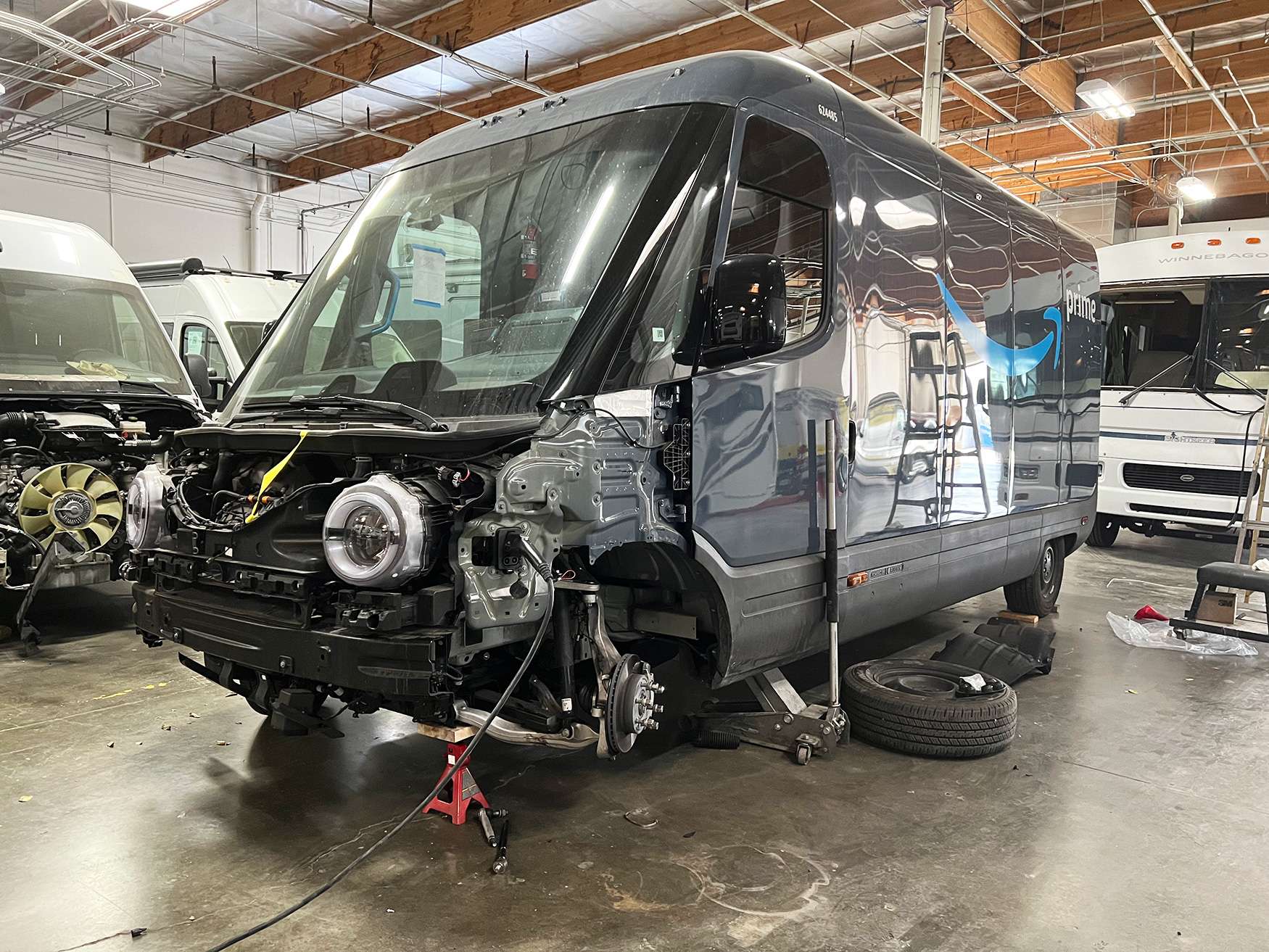
Electric delivery van repair is ordinary body work wrapped around one very serious constraint, and Westminster operators running these units need a shop that respects it. The traction pack normally lives under the floor, which changes where you can lift, where you can weld, how much heat a panel can see, and what has to be documented before a technician picks up a tool. Everything on this page follows from that.
Isolation Comes Before Any Tool Comes Out
On a battery electric van, the first operation is not disassembly. It is placing the vehicle into a documented service state: following the manufacturer's published high voltage isolation procedure, confirming the system is de energized, and recording that it was done and by whom. Nothing on the body happens before that is complete.
We require the service documentation for the platform before we start. If an operator cannot provide access to the manufacturer's procedure for their vehicle, we will say so rather than improvise, because guessing at a disconnect sequence on a traction pack is not a risk anyone should take with a technician.
We do not hold any manufacturer authorization and we do not claim one. What we do is follow the published procedure for the platform, document each step, and hand that record back to the operator with the repair file.
- Obtain the manufacturer's published isolation procedure first
- Place the vehicle in a documented de energized service state
- Record who performed the isolation and when
- Keep the vehicle tagged for the duration of the repair
- Return the isolation and re energization record with the file
Lift Points and Jacking Move When the Pack Is Underneath
A traction pack occupying the underfloor changes the lift and jack points, and the factory points on the equivalent diesel van are frequently wrong on the electric version. Lifting on the wrong location can load the pack enclosure or its mounts, and pack enclosure damage is a very expensive thing to cause during a routine repair.
So we look up the points for the specific platform rather than assuming, and we use the manufacturer's specified support locations for the full duration the vehicle is off the ground. On a long repair that means the support plan is part of the job planning, not an afterthought.
The same care applies to anything that clamps to the vehicle for measurement or pulling. Structural repair equipment anchors to specific locations, and on an electric platform some of the usual anchor points are now pack structure.
Heat, Welding and Where a Panel Repair Has to Stop
Heat is the other constraint. Welding, cutting and even aggressive panel work near an under floor pack introduces temperature and sparks in a place they do not belong. Manufacturers publish exclusion zones around the pack for exactly this reason, and repairs that would ordinarily be a straightforward weld may need a different approach on this platform.
In practice that means more panel replacement at joints away from the pack, more mechanical fastening and adhesive bonding where the manufacturer allows it, and careful sequencing so that any hot work happens while the vehicle is in the correct state and the pack is protected.
The same logic applies to refinishing. Bake cycles that are routine on a conventional van can exceed what is appropriate for a vehicle with a traction pack installed, so we use low temperature curing products and extended flash times rather than turning the booth up.
- Respect published exclusion zones around the pack
- Prefer joints away from the pack when sectioning is required
- Use adhesive and mechanical fastening where the platform allows
- Cure with low temperature products rather than high bake cycles
- Protect the pack enclosure physically during any hot work
Pack Enclosure Integrity After an Underbody Strike
Curbs, debris, speed bumps taken hard and road hazards all strike the underbody, and on these vans the underbody is the pack enclosure. A scrape that would be cosmetic on a conventional van is a sealing question here, because the enclosure keeps water and contamination out of the pack.
After any underbody event we inspect the enclosure and its mounting for deformation, damaged fasteners, compromised sealing surfaces and any breach of the case. We document what we find with photographs, and where there is any indication the enclosure has been compromised, that goes to the operator and the platform's own service channel rather than getting patched.
We are deliberately conservative here. An enclosure that looks acceptable but has a disturbed seal is a problem that shows up months later as a fault, and nobody wants that traced back to a body repair.
Charge Ports, Cables and the Fleet Realities
Charge port damage is one of the most frequent electric specific repairs on a delivery fleet. Ports get hit by cables dragged across them, doors get broken off, latches fail, and the surrounding panel takes damage from a driver connecting in a hurry. The port assembly and its door are usually available parts and the repair is straightforward, but the mounting has to be right or the door will not seal against weather.
Charging cables and their handling are the other item. A damaged cable is a depot issue rather than a body shop issue, but we see the consequences: the port that took the force when the cable was dropped or driven over.
A worked example on the most common job: a side panel repair with refinish on a delivery unit, no structural involvement and no pack proximity work, typically 12 to 20 hours of body and paint at $210 for $2,520 to $4,200, plus $500 to $1,700 in panel and refinish materials, plus the isolation and documentation time.
Questions
Frequently asked questions
Can you safely work on a battery electric van?
Yes, with a documented process and the manufacturer's published procedure in hand. The first operation on any of these vehicles is placing it into a documented de energized service state following that procedure, recording who did it and when, and tagging the vehicle for the duration. Nothing on the body happens before that is complete. We do not hold or claim any manufacturer authorization. What we do is follow the published procedure for the platform, document each step, and return that record with the repair file so the operator has it. If we cannot get access to the procedure for a given platform, we will tell you rather than improvise.
Does the battery pack change how you repair the body?
Significantly. The pack usually occupies the underfloor, which changes lift and jack points, restricts where heat and welding are acceptable, and adds exclusion zones published by the manufacturer. In practice that means more panel replacement at joints away from the pack, more adhesive bonding and mechanical fastening where the platform allows it, and careful sequencing of any hot work. It also changes refinishing: bake cycles that are routine on a conventional van can exceed what is appropriate with a pack installed, so we use low temperature curing products and longer flash times rather than turning up the booth.
My van scraped hard on a curb. Do I need the pack checked?
Yes, because on these vans the underbody is the pack enclosure. A scrape that would be purely cosmetic on a conventional van is a sealing question here, since the enclosure is what keeps water and contamination out. We inspect the enclosure and its mounting for deformation, damaged fasteners, compromised sealing surfaces and any breach, and we document what we find with photographs. Where there is any indication the enclosure has been compromised, that goes to you and to the platform's service channel rather than getting patched here. We stay deliberately conservative on this, because a disturbed seal turns into a fault months later.
How much does electric delivery van repair cost?
The range is about $1,500 to past $35,000. A side panel repair with refinish, no structural involvement and no pack proximity work, is typically $3,000 to $6,000. Charge port and door replacement with surrounding panel repair runs $1,200 to $3,500. Structural repair requiring measurement, careful sequencing around the pack and low temperature refinishing is $8,000 to $22,000. Serious collision work can pass $35,000. Body and paint labor is $210 per hour, mechanical is $260, and isolation and documentation time is billed as part of the job rather than hidden.
Why does the charge port keep getting damaged?
Usually because of how cables are handled at the depot rather than anything wrong with the vehicle. Ports get struck by cables dragged across them, doors get broken off at the hinge, latches fail from repeated hard closing, and the surrounding panel takes damage from a driver connecting in a hurry at the end of a shift. The port assembly and door are generally available parts and the repair is straightforward. What matters is that the mounting goes back correctly, because a door that does not seal against weather turns a small repair into a corrosion problem at the connector over the following year.
Will paint work damage the battery?
Not if the shop adjusts for it, which is why we do. A conventional refinish cycle can run the booth at temperatures and durations that are inappropriate for a vehicle with a traction pack installed. We use low temperature curing products with extended flash times, which achieves the same finish quality without exposing the pack to a high bake. Where a manufacturer specifies a maximum temperature for the vehicle, we work to it. A shop that runs your electric van through the same bake cycle as a diesel one is taking a risk with your asset that you will not find out about until later.
What documentation do we get back?
The isolation record showing who de energized the vehicle and when, the re energization record, photographs of the underbody and pack enclosure condition at intake and at completion, the measurement records if the repair was structural, the parts used, and the labor operations performed. For a fleet operator that file matters, because it establishes the state of the vehicle when it left us. We put it together as a matter of course on these vehicles rather than as an extra, and we will format it to whatever your maintenance system needs if you tell us up front.
How long will an electric van be down?
A panel and refinish job is typically six to twelve business days, slightly longer than the equivalent conventional van because of isolation, documentation and low temperature curing. Charge port work is two to four days. Structural repair with measurement and careful sequencing around the pack is three to six weeks. If the pack enclosure needs assessment through the platform's own service channel, that timeline is outside our control and we will tell you as soon as we know. For fleets we schedule intake around parts availability so the van keeps working until we are actually ready for it.
How the work runs
Our six step repair process
The same sequence on every vehicle, whether it is a single coach or a fleet of box trucks.
- 01
Assessment and documentation
We put the vehicle on the floor, pull panels where we need to see behind them, and photograph everything. Hidden damage found now is damage that does not become a supplement argument later.
- 02
Written estimate
You get a line by line estimate with parts, labor hours, materials, and the posted rate applied to each. Nothing is bundled into a single number you cannot check.
- 03
Carrier coordination
If a claim is involved we deal with the adjuster directly, submit the documentation, and handle supplements when teardown reveals more than the first inspection showed.
- 04
Authorization and scheduling
Once the scope is approved we confirm the deposit, order parts, and give you a realistic slot. Special order parts drive the timeline more often than labor does.
- 05
Repair
Structural first, then body, then paint, then systems and interior. The sequence is not negotiable because each stage has to be right before the next one covers it up.
- 06
Quality check and delivery
Multi point inspection, systems tested under load, paint inspected under corrected lighting, and a walkthrough with you before the vehicle leaves.
Keep reading
Related pages
Related vehicles
Services we perform
Talk to a repair specialist today
Tell us what happened and we will tell you what the repair actually involves, what it costs, and how long it takes. We work directly with every major carrier and serve Westminster owners and fleets from our 35,000 square foot facility.
Posted labor rates are published on our prices page. Diagnostic and systems assessment fees are credited against an authorized repair.