Buses and Municipal Fleet
Transit Bus Repair for Revenue Service Fleets
In short
Transit bus repair runs from about $2,500 for panel and fascia work to past $60,000 for structural repairs to a low floor body. Parts lead times on these units are long enough that a staged plan is usually the only way to avoid a bus sitting out of service for eight weeks waiting on a single fascia module.
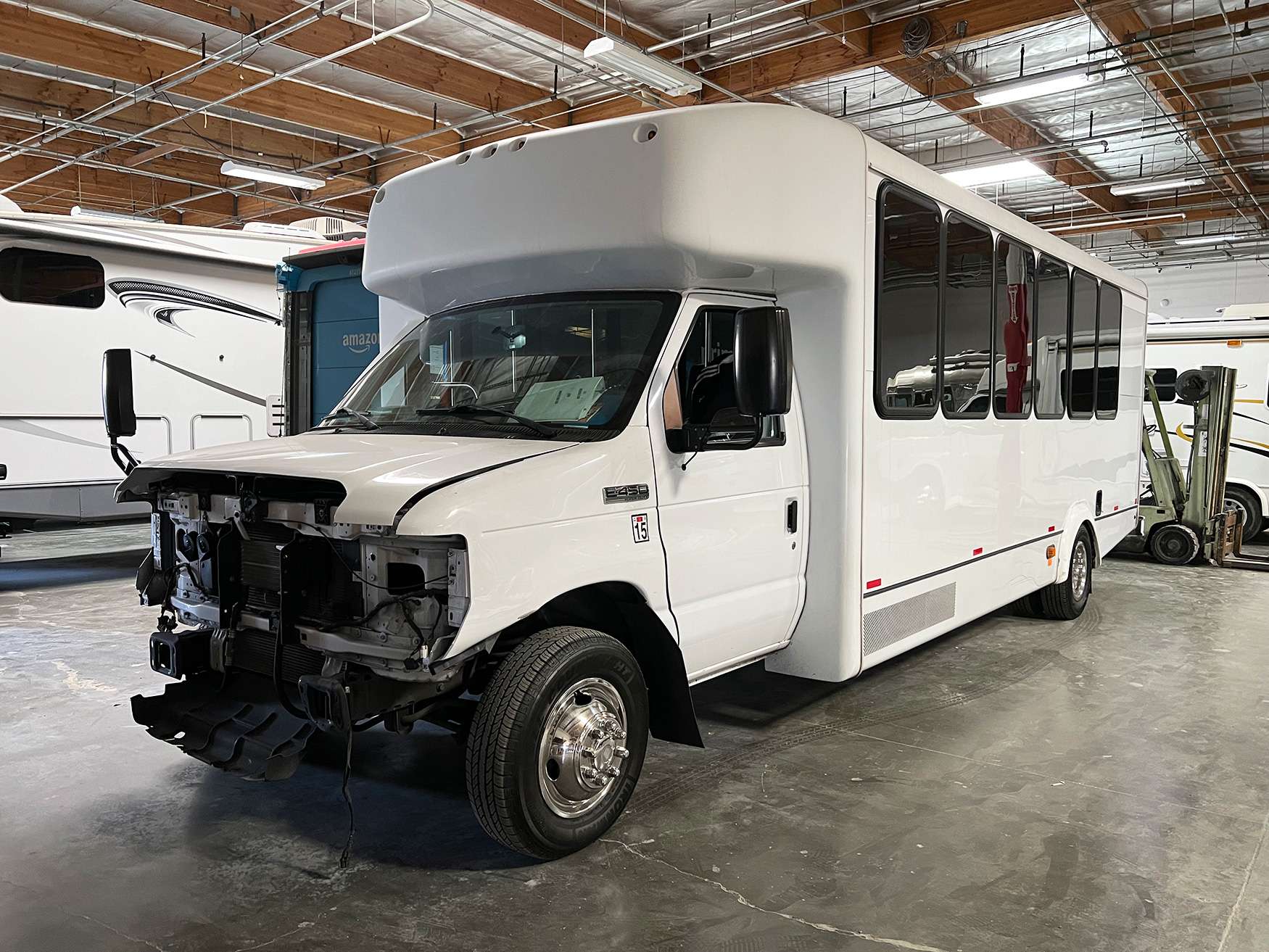
Transit bus repair is planning work as much as body work, and Westminster area agencies running daily revenue service feel that immediately. These are heavy duty low floor units with composite panels over a steel cage, modular fascias, ramp openings and a lot of mounted equipment. A single fascia module can be a long lead item, so the schedule has to be built before the bus comes in, not after.
Composite Panels Over a Steel Cage
A heavy duty transit bus is a welded steel cage with composite and fiberglass panels attached to it. That construction is durable and it changes how damage is assessed, because a panel can be badly broken while the cage behind it is untouched, and the cage can be deformed while the panel looks acceptable.
So the assessment goes past the panel every time. We remove damaged panels to inspect the cage members behind them, check for cracked welds at the joints, and measure where the damage was severe enough to suggest the structure moved.
Composite panel repair is genuinely viable on these units, and on a bus with a discontinued panel it is often the only path. We repair to sound substrate, rebuild the surface and refinish, which for a localized break is a fraction of the cost of a replacement module even when one is available.
- Remove damaged panels to inspect the cage behind them
- Check welded joints for cracking after any significant impact
- Measure where damage suggests the cage moved
- Consider composite repair before assuming a module replacement
- Document cage condition photographically before closing anything up
Front and Rear Fascia Modules
Modern transit buses use large molded fascia modules at each end, carrying lighting, destination signage, cameras and sometimes the bike rack mounting. They are expensive, they are model specific, and they are among the longest lead items on the vehicle.
That single fact drives the schedule on most front and rear collision jobs. A bus with a broken fascia can be perfectly serviceable in every other respect while it waits eight weeks for a module, which is why we scope and order first and bring the bus in second whenever the damage allows it.
Where a module is unavailable or the lead time is unacceptable, composite repair is frequently the answer. Molded fascias take structural repair well when the mounting points are intact, and rebuilding one on our floor is often faster than waiting for a replacement.
Low Floor Structure and the Ramp Opening
The low floor design that makes these buses accessible also puts structure in an unusual place. The floor is close to the road, the ramp opening is a large cut in the side structure, and the area around that opening carries loads from the ramp cycling under passenger weight repeatedly.
Damage here is structural by definition. Curb strikes at the low floor, ramp openings that have distorted, and ramp mounting that has loosened all need the structure assessed rather than the visible panel repaired.
The kneeling suspension interacts with all of it. A bus that kneels onto a distorted structure loads it in a way the design did not intend, so a kneeling fault and a ramp fault frequently show up together and share a root cause. We look at both when either one is reported.
Equipment That Has to Come Off and Go Back On
Fascia and panel work on a transit bus means removing a lot of mounted equipment: destination signs, cameras, lighting, bike racks, sensors and their wiring. Putting it back correctly, aimed correctly and documented correctly is a real part of the job and it belongs in the estimate rather than in a surprise.
We photograph and record positions before removal, label wiring, and reinstall to the recorded configuration. Cameras in particular have to go back to the same aim, because a camera that has moved changes the coverage an agency is relying on.
Bike rack mounting is worth its own mention. The rack mounts into the fascia and the structure behind it, takes repeated loading, and is a common source of cracked mounting after a front impact even when the rack itself survived.
- Photograph and record equipment positions before removal
- Label wiring rather than trusting memory or color
- Reinstall cameras to the recorded aim, not approximately
- Inspect bike rack mounting structure after any front impact
- Verify destination sign and lighting function before release
Agency Livery and Decal Reproduction
Transit livery is usually a designed scheme with specific colors, placements and regulatory markings, applied across a fleet that the public sees every day. Reproducing it after a panel or fascia replacement is exacting work and it is not optional.
We photograph and measure the full layout before disassembly, recording distances from body lines, panel joints and openings. Color goes through the same process as every other fleet: spray out, compare in daylight against the actual bus, and set the blend boundary by eye rather than by paint code.
Where a scheme includes wrapped sections rather than paint, we scope that separately so an agency can use its own wrap vendor if it prefers, or have us coordinate it. Either way it appears as a line on the scope document rather than an assumption.
Staging Work When a Bus Cannot Sit for Eight Weeks
Agencies run to a spare ratio, and a transit bus out of service for two months is a real operational cost. The way we handle long lead parts is to split the job: assess and document, order the long lead components, return the bus to service if it is safe and legal to operate in that condition, then bring it back when the parts land.
That approach only works if the assessment happens early, which is why we push agencies to scope damaged units immediately rather than parking them until a budget cycle opens. The parts clock starts when the order is placed, not when the bus arrives.
A worked example: front fascia module replacement with lighting and camera removal and reinstallation, livery reproduction and no cage involvement, typically 34 to 52 hours of body and paint at $210 for $7,140 to $10,920, plus $6,000 to $18,000 in fascia module, lighting, hardware, decal and refinish materials.
- Assess immediately, even if repair is deferred to a later cycle
- Order long lead modules against the deposit right away
- Return the bus to service between phases where that is appropriate
- Consider composite repair when a module lead time is unacceptable
- Sequence multiple units to protect the spare ratio
Questions
Frequently asked questions
Why do transit bus parts take so long?
Because the major components are model specific and low volume. Front and rear fascia modules in particular are large molded assemblies carrying lighting, signage, cameras and sometimes bike rack mounting, and they are built to order rather than stocked in depth. Eight weeks is not unusual. That is why we push agencies to scope damaged units immediately, even if the repair is deferred to a later budget cycle: the parts clock starts when the order is placed, not when the bus arrives. Where a lead time is unacceptable, composite repair of the existing module is frequently faster and considerably cheaper.
How much does transit bus repair cost?
The range is about $2,500 to past $60,000. Composite panel repair with refinish and livery reproduction is typically $4,000 to $9,000. Front fascia module replacement with lighting and camera reinstallation and livery work runs $14,000 to $30,000. Ramp opening and low floor structural repair is $12,000 to $32,000. Major collision work involving cage repair, both fascias and full livery can pass $60,000. Body and paint labor is $210 per hour, mechanical is $260, and authorized repairs above $2,000 carry a 50 percent deposit.
Can a broken fascia be repaired instead of replaced?
Frequently yes, and on these buses it is worth asking every time given the lead times and cost. Molded fascias take structural repair well when the mounting points and the general geometry are intact: we repair back to sound substrate, rebuild the surface, and refinish with the livery reproduced. For a localized break that is a fraction of the cost of a replacement module and it is usually much faster. Replacement becomes the right call when the mounting points have torn, when the module no longer holds its shape, or when the damage spans multiple sections of the assembly.
Our bus has a kneeling fault and a ramp fault at the same time. Related?
Very often, yes, and it usually points at the structure around the ramp opening. The low floor design puts a large cut in the side structure and the area around it carries loads from the ramp cycling under passenger weight repeatedly. A curb strike or an impact at the low floor can distort that area. A bus that then kneels onto distorted structure loads it in a way the design did not intend, so the two faults share a root cause. We assess the structure whenever either symptom is reported rather than treating them as separate mechanical complaints.
What happens to our cameras and destination signs during the repair?
They come off, and coming back correctly is part of the job we scope and charge for rather than treating as incidental. We photograph and record equipment positions before removal, label wiring rather than relying on color or memory, and reinstall to the recorded configuration. Cameras in particular go back to the recorded aim, because a camera that has shifted changes the coverage your agency is relying on, and that is not something anyone should discover from an incident review. We verify sign and lighting function before the bus is released.
Can you reproduce our livery exactly?
Yes. We photograph and measure the full layout before disassembly, recording distances from body lines, panel joints and openings so everything returns to its exact position rather than approximately. Color goes through spray out and daylight comparison against the actual bus rather than trusting the paint code, since a fleet is rarely all the same age. Where your scheme uses wrapped sections rather than paint, we scope that as a separate line so you can use your own wrap vendor if you prefer, or have us coordinate it. Your formulas and layouts stay on file.
Can the bus stay in service while we wait for parts?
Often yes, and that is the point of staging. We assess and document, order the long lead components, and where the bus is safe and legal to operate in its damaged condition, it goes back into service until the parts land. Then it comes in for the repair itself. That turns an eight week outage into a two week one. Whether a unit is fit to operate in its current condition is your determination as the agency, made with our documentation and your own inspection process, and we will give you the detail you need to make it.
How do you handle several buses after a yard incident?
We sequence them around your spare ratio rather than taking them all at once. Units come in as previous ones leave, and we keep color formulas, livery layouts and equipment configurations on file so each subsequent bus takes less shop time. Scope documents are written per unit so each can be authorized on its own purchase order. Our floor is 35,000 sq ft and we run roughly 75 vehicles a month, so holding several large units at once is possible when a situation genuinely calls for it, but for most agencies protecting the spare ratio is the better plan.
How the work runs
Our six step repair process
The same sequence on every vehicle, whether it is a single coach or a fleet of box trucks.
- 01
Assessment and documentation
We put the vehicle on the floor, pull panels where we need to see behind them, and photograph everything. Hidden damage found now is damage that does not become a supplement argument later.
- 02
Written estimate
You get a line by line estimate with parts, labor hours, materials, and the posted rate applied to each. Nothing is bundled into a single number you cannot check.
- 03
Carrier coordination
If a claim is involved we deal with the adjuster directly, submit the documentation, and handle supplements when teardown reveals more than the first inspection showed.
- 04
Authorization and scheduling
Once the scope is approved we confirm the deposit, order parts, and give you a realistic slot. Special order parts drive the timeline more often than labor does.
- 05
Repair
Structural first, then body, then paint, then systems and interior. The sequence is not negotiable because each stage has to be right before the next one covers it up.
- 06
Quality check and delivery
Multi point inspection, systems tested under load, paint inspected under corrected lighting, and a walkthrough with you before the vehicle leaves.
Keep reading
Related pages
Related vehicles
Services we perform
Talk to a repair specialist today
Tell us what happened and we will tell you what the repair actually involves, what it costs, and how long it takes. We work directly with every major carrier and serve Westminster owners and fleets from our 35,000 square foot facility.
Posted labor rates are published on our prices page. Diagnostic and systems assessment fees are credited against an authorized repair.