Detailing and Inspection
RV Pre Purchase Inspection for Westminster Buyers
In short
An RV pre purchase inspection at our shop runs $400 to $1,200 depending on the size and complexity of the unit, and takes half a day to a full day with the written report following within two business days. It covers roof and sealants, moisture mapping of the shell, slide operation, all three electrical systems, LP leak down, appliance function, plumbing pressure, and running gear. Westminster buyers use the report to walk away from a bad coach or to renegotiate a price with documented findings.
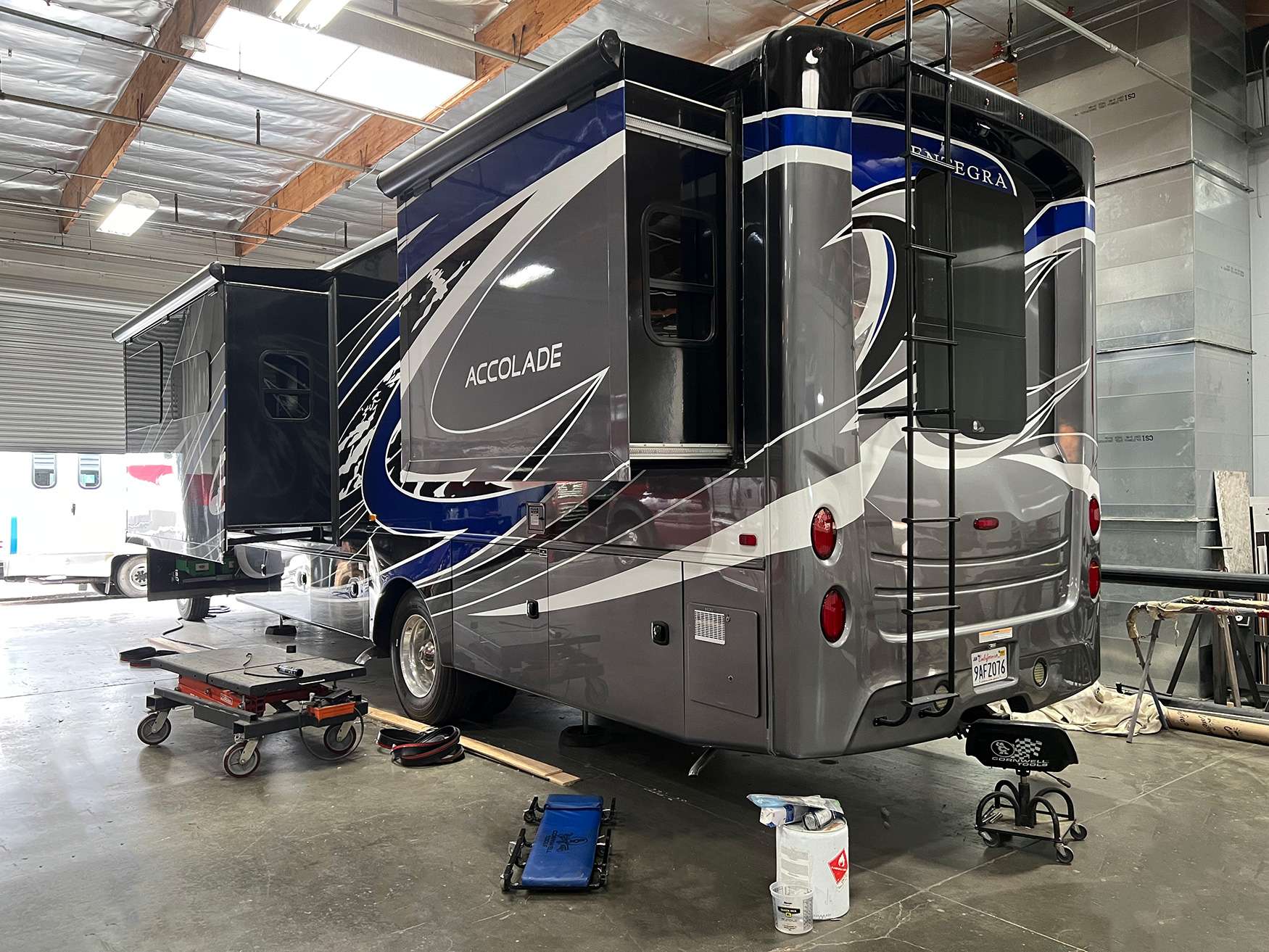
An RV pre purchase inspection is the cheapest insurance in this hobby, and skipping it is the most expensive shortcut buyers in Westminster take. A used coach hides its history well. A soft floor under a slide, a roof with two years left, and a refrigerator on its way out all look fine at a walkthrough on a sunny afternoon. We put the unit on a bay floor, go through it in a fixed order, and hand you a written report.
What Gets Checked and in What Order
We work in a fixed sequence because the order matters. Roof and sealants come first, since almost every expensive problem in an RV starts as water and almost every water path starts above your head. From there we work down the shell with a moisture meter, then inside to the systems, then underneath to the running gear. Doing it in that order means that when we find a stain on a ceiling panel, we already know what is directly above it.
Nothing on the list gets skipped because the seller says it works. We run the appliances, we cycle the slides, we pressurize the water system, and we leak down the propane. A statement that everything worked last season is not a data point, it is a hope. Sellers are usually not lying to you either. They simply have not run the furnace since March, and the mud dauber nest in the exhaust tube arrived in April while the coach sat.
The inspection is a condition report, not an appraisal. We tell you what shape the coach is in, what is working, what is failing, and roughly what it will cost to put right using our posted labor rates. What the unit is worth to you after that is your call, and it depends on things we cannot put a number on: how badly you want that floor plan, how long you intend to keep it, and what else is sitting on the market this month.
- Roof membrane condition, every penetration, and the age of the sealant beads
- Moisture mapping across sidewalls, front and rear caps, and the floor
- Slide rooms cycled in and out, seals and mechanism inspected under load
- Chassis 12 volt, house 12 volt, and 120 volt shore systems tested separately
- LP leak down test, regulator pressure, and every appliance run through a cycle
- Fresh and waste plumbing pressurized, tanks and valves checked for leaks
- Tires read by DOT date code, brakes, bearings, springs, and frame condition
Moisture Mapping Is the Part That Earns the Fee
A meter reading taken in a grid across the walls and floor will find water that is not visible yet. Elevated moisture behind a bathroom wall, under a window frame, or along the bottom two feet of a sidewall tells you an active leak exists even when the panel looks clean. That single finding is often worth ten times the inspection fee, because a wall rebuild on a coach starts in the thousands and a floor rebuild starts higher.
We map rather than spot check. A stain on the ceiling tells you where water arrived, not where it entered, and a coach can have a dry looking interior with a soaked laminate core behind the panel. Mapping the whole shell shows the shape and extent of the wet area, and the shape usually points straight back at the entry point. That is the difference between a finding you can act on and a vague note about possible moisture that helps nobody.
When we find elevated readings, we say so plainly and we show you the numbers by location. We do not soften a finding to keep a deal alive. You are paying us to tell you the truth about somebody else's coach, and we have no stake in whether you buy it. If the readings are borderline, we say that too, because borderline is useful information and an overstated alarm costs you a unit you would have been happy owning.
What an Inspection Cannot Tell You
No inspection predicts the future. We can tell you a refrigerator is cooling correctly today and that it is a fourteen year old absorption unit, which means it is well past the middle of its service life. We cannot tell you which month it will quit. We can tell you the roof sealant was redone recently and looks sound, but we cannot see under a fresh bead that was applied over a bad one last week.
We also do not disassemble a coach we do not own. Panels stay on, floors stay down, and appliances stay in place. If a reading or a symptom suggests something behind a wall, we report it as a finding that warrants teardown, and the buyer and seller decide between them who pays for that next step. That conversation is often exactly where a deal gets renegotiated, and having the finding in writing with a photograph is what makes it possible.
Road testing a motorhome is limited to what the current owner authorizes and insures, which on a private sale is usually a short drive at most. On a towable we check running gear on the ground and on jack stands rather than by towing it, which tells us a great deal about bearings, brakes, springs, and tire condition but will not reveal a sway problem that only appears loaded and moving. We tell you plainly what we were and were not able to test.
- We do not remove interior panels, flooring, or appliances during an inspection
- We do not certify a unit or issue any statement about future condition
- We do not perform emissions or smog testing on a motorized chassis
- We do not appraise the unit or tell you what it is worth on the market
- We do not negotiate with the seller on your behalf
The Report You Actually Receive
The deliverable is a written, line item report with photographs attached to the findings, delivered within two business days. Each item is categorized by whether it needs attention now, needs attention within a season, or is a note for the file. Where a repair is involved, we put an estimated cost range next to it using our posted labor rates so you can add the numbers up yourself.
That format exists because of how buyers use it. A report that says the coach has some water issues is useless in a price conversation. A report that says elevated moisture across a four foot section of the driver side wall at the window frame, with photos and meter readings, and an estimated $3,000 to $6,500 to open and repair, is a number a seller has to answer to.
- Line item findings grouped by system, not a paragraph of narrative
- Photographs tied to each finding, including roof and undercarriage
- Moisture meter readings recorded by location
- Priority rating on every item: now, this season, or note only
- Estimated repair cost ranges based on our posted labor rates
Using the Findings to Renegotiate
Most buyers who commission an inspection do not walk away. They go back to the seller with a document. A private seller who genuinely did not know the rear cap was holding moisture will usually meet you somewhere, and a dealer with a lot payment to make will often absorb a repair to keep the deal moving. Either way, the conversation changes when you have photographs and readings instead of a feeling.
The other outcome is that the report clears the coach, and that is worth paying for too. Knowing the roof was resealed two years ago, the moisture map is clean, and all three electrical systems check out lets you buy with your eyes open. It also gives you a documented baseline for the years you own the unit, which is useful the first time something goes wrong and you are trying to work out whether it is new. A clean report is not a wasted fee.
Cost, Scheduling and How to Set It Up
Pricing runs $400 to $1,200. A single axle travel trailer under 24 feet sits at the bottom. A 40 foot diesel pusher with three slides, a generator, an inverter bank, hydraulic leveling, and two roof units sits at the top, because there is simply more to test and more hours in the bay. We quote the number before you commit, based on the unit you describe.
The unit has to come to us. We inspect on our floor with a lift available, not in a seller's driveway, because half of what we check requires getting underneath and on top of the coach safely. Coordinate with the seller for a window of time and let us know the length, type, and year when you book so we can schedule the right bay and quote accurately.
Timing matters in a private sale. Get the inspection scheduled while your deposit terms still let you walk away, not after you have signed and wired the balance. Sellers are generally willing to hold a unit a few days for a serious buyer, and a seller who will not allow an inspection window has told you something worth knowing for the price of asking. If the unit is at a dealer the same logic applies, and most dealers will release a coach for an inspection if you ask before you commit.
Questions
Frequently asked questions
How much does an RV pre purchase inspection cost?
It runs $400 to $1,200 and the spread is driven by size and complexity, not by how thorough we are. A small single axle travel trailer with one slide, no generator, and a simple 12 volt system sits near the bottom of the range because there is less to test. A 40 foot motorhome with three slides, a diesel generator, an inverter and battery bank, hydraulic leveling jacks, two rooftop air conditioners, and a residential refrigerator sits near the top because each of those systems takes real time to verify. We give you the exact number when you tell us the year, length, and type of the unit.
How long does the inspection take and when do I get the report?
Plan on half a day for a small towable and a full day for a large motorhome. That is time in the bay with the unit, not elapsed calendar time, and it includes getting on the roof, getting underneath, cycling every slide, running every appliance, and mapping the shell for moisture. The written report with photographs follows within two business days. We do give you a verbal summary of anything serious the same day, because if the floor is soft under the slide you should not have to wait forty eight hours to hear it.
Can you inspect the RV at the seller's house?
No, the unit needs to come to our floor. A meaningful inspection requires getting underneath the coach safely with a lift, getting on the roof with proper access, running the water system with a real supply, and putting a load on the electrical system. A driveway inspection means checking the things that are easy to reach and guessing at the rest, which is exactly the kind of report that gives buyers false confidence. Most sellers who are confident in their unit have no problem bringing it in, and a seller who refuses has told you something useful for the price of asking.
What is the single most common serious problem you find?
Water intrusion, by a wide margin, and usually in a coach the seller honestly believes is dry. The common pattern is elevated moisture in the lower sidewall or in the floor at a slide opening, with no visible stain inside yet. Sealant on an RV roof and around every window and rail has a service life of roughly five to ten years depending on exposure, and a great many used coaches on the market are past that and have never been resealed. Second most common is an absorption refrigerator at the end of its life, which is a two to four thousand dollar item most buyers do not budget for.
Will the inspection tell me if the roof needs to be replaced?
It will tell you the condition of the membrane, the state of every sealant bead and penetration, whether the substrate feels sound when walked, and whether there is elevated moisture in the ceiling or upper walls. That is usually enough to separate a roof that needs resealing from a roof that needs replacing. What it will not do is see through an intact membrane to inspect the decking underneath. If the walk test finds soft spots or the meter finds moisture up high, we report that the decking is suspect and that opening the roof is the only way to know the extent.
Is the inspection fee credited if I have you do the repairs?
The pre purchase inspection is priced as its own product and is billed as such, because the whole point is that it is independent of any repair work. What is credited against an authorized repair is the $150 systems assessment and the $285 in depth diagnostic hour, which are the shop side services for owners of coaches we are already working on. If you buy the unit and bring it back to us for the repairs the report identified, we already have the documentation and the photographs, which saves estimating time on the front end of that job.
Do you inspect fifth wheels, truck campers, and van conversions?
Yes. Every towable and motorized type we service gets the same structured sequence, adjusted for what the unit actually has. A fifth wheel adds the pin box, the king pin, and the landing gear to the running gear portion. A truck camper adds the jack system and the tie down points. A van conversion has a much smaller shell to map but usually a more involved 12 volt and solar system to verify, and the house build quality on a converted van varies enormously, so the electrical and propane portions of the inspection carry more weight there.
The seller says the RV was just serviced. Do I still need an inspection?
Yes, and a recent service record is a reason to look closer, not a reason to skip. Service invoices tell you what somebody was paid to do, not what condition the unit is in now. We regularly find fresh sealant applied over failed sealant, which looks reassuring and traps water underneath it. We also find coaches where the mechanical service was thorough and the house systems were never touched. Bring the invoices with you if the seller will share them. They give us a useful place to look, and they let us tell you whether the work described actually appears to have been done.
Standard on every job
What is included
These are not upgrades. They are how the work is run on every vehicle that comes through the building.
Full teardown where it is needed
We do not estimate through a closed panel. If the damage path runs behind trim or skin, we open it and document what is actually there.
Written, itemized scope
Parts, labor hours, and materials listed separately against the posted rate, so every line is something you can question.
Direct carrier communication
We talk to the adjuster so you are not relaying technical detail between two parties who both expect you to already understand it.
Supplement handling
When teardown finds more than the original inspection, we document and submit the supplement rather than absorbing it into a vague overage.
Correct repair sequence
Structural before cosmetic, every time. A straight body over a bent frame is a repair that fails its second life.
Systems tested under load
Electrical, plumbing, generator, and climate systems are run and verified before delivery, not just reconnected and assumed good.
Photo documentation throughout
Before, during, and after. Useful for your records, and decisive if a claim is ever revisited.
Delivery walkthrough
We go over what was done, what was replaced, and what to watch, in person, with the vehicle in front of you.
How the work runs
Our six step repair process
The same sequence on every vehicle, whether it is a single coach or a fleet of box trucks.
- 01
Assessment and documentation
We put the vehicle on the floor, pull panels where we need to see behind them, and photograph everything. Hidden damage found now is damage that does not become a supplement argument later.
- 02
Written estimate
You get a line by line estimate with parts, labor hours, materials, and the posted rate applied to each. Nothing is bundled into a single number you cannot check.
- 03
Carrier coordination
If a claim is involved we deal with the adjuster directly, submit the documentation, and handle supplements when teardown reveals more than the first inspection showed.
- 04
Authorization and scheduling
Once the scope is approved we confirm the deposit, order parts, and give you a realistic slot. Special order parts drive the timeline more often than labor does.
- 05
Repair
Structural first, then body, then paint, then systems and interior. The sequence is not negotiable because each stage has to be right before the next one covers it up.
- 06
Quality check and delivery
Multi point inspection, systems tested under load, paint inspected under corrected lighting, and a walkthrough with you before the vehicle leaves.
Keep reading
Related pages
Related services
Vehicles we repair
Talk to a repair specialist today
Tell us what happened and we will tell you what the repair actually involves, what it costs, and how long it takes. We work directly with every major carrier and serve Westminster owners and fleets from our 35,000 square foot facility.
Posted labor rates are published on our prices page. Diagnostic and systems assessment fees are credited against an authorized repair.