Collision and Structural
Major RV Collision Damage Repair and Rebuild Work
In short
Major collision work on a motorhome or trailer runs $8,000 to $150,000 or more and commonly takes three to nine months, most of it spent waiting on parts and adjuster approvals. A full front cap from a coach builder is often an 8 to 20 week lead time. Our Westminster facility stores the coach and manages the supplement cycle through the claim.
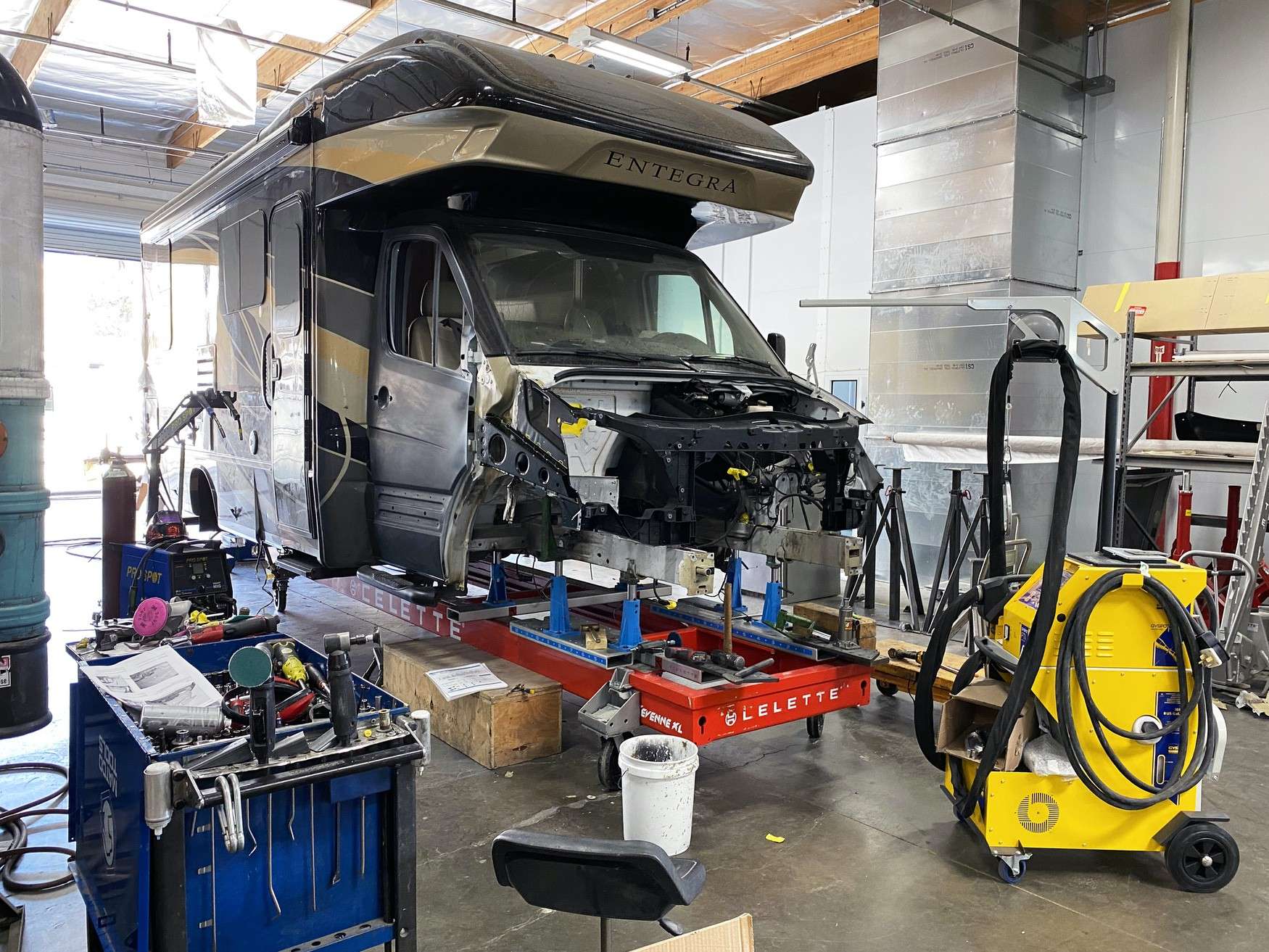
A major rv collision damage repair is not a body shop visit, it is a construction project with an insurance file attached. Rollovers, sidewall breaches, front cap destruction, and rear impacts where a towed vehicle came forward all involve structure, systems, and molded parts that are built to order. We work these jobs in our 35,000 sq ft Westminster facility because they need floor space for months, not days. Here is how the process actually runs.
What a Major Job Actually Involves
Major means the load path changed. A rollover crushes the roof structure and racks the sidewalls, so every slide opening, window opening, and door opening is out of square. A sidewall breach means framing members are broken and the laminate has separated well beyond the visible hole. Front cap destruction on a motorhome usually takes the windshield frame, the dash structure, and often the entry step and cockpit floor with it. None of that is a panel and paint job.
Rear impacts where a towed vehicle pushed forward into the coach are their own category. The hitch receiver transfers load straight into the rear frame extension, which then folds the rear cap, the bumper structure, and frequently the holding tanks and their mounts. Owners see a wrinkled rear cap and assume it is bodywork. What we usually find is a bent frame extension, torn tank straps, damaged wiring harness, and a rear wall that no longer sits flat on the floor.
Systems ride along with all of it. Twelve volt and shore power runs, propane lines, water lines, and slide mechanisms all pass through the areas that got hit. A serious job means the electrical and plumbing get traced, tested, and often replaced in the damaged zone. That work is invisible in a photo estimate and it is one of the biggest sources of supplements on a large file.
- Roof crush and racked sidewalls after a rollover
- Broken framing and separated laminate at a sidewall breach
- Windshield frame, dash structure, and cockpit floor damage
- Bent rear frame extensions from towed vehicle impacts
- Torn holding tank mounts, wiring runs, and propane lines
- Slide rooms that no longer seal or travel squarely
Teardown and the Supplement Cycle
No honest estimate exists before teardown on a job this size. What an adjuster writes from photos is a starting document, not a repair plan. We tear down to sound structure, photograph every layer, and then write a supplement with part numbers, labor operations, and hours. That supplement goes to the carrier, the carrier reviews it, and either approves, questions, or sends a field adjuster back out. Each round of that cycle takes days to weeks.
Expect two to four supplements on a large file. The first comes after initial teardown reveals structure. The second comes when parts arrive and something does not fit or arrives damaged. The third often comes from systems work that could not be seen until interior panels were out. This is normal and it is not a shop trying to inflate a number. It is the honest consequence of estimating a hidden structure through a hole in a wall.
Your role in this matters more than owners expect. Approving a supplement quickly, keeping the carrier moving, and escalating when a file sits are the levers that shorten a job. We supply the documentation, the photos, and the line item detail. We cannot make a carrier answer the phone. Files where the owner stays actively engaged consistently close months sooner than files where the owner waits quietly for a call.
Sourcing a Front Cap From the Coach Builder
A full front cap is a build to order part. Coach builders do not warehouse them, they schedule tooling runs. Realistic lead times are 8 to 20 weeks from purchase order to delivery, and on discontinued model years the answer is simply no part available. When that happens the path becomes a salvage cap from a matching coach or a hand laid reproduction, and reproduction of a full cap is hundreds of hours of layup, fairing, and finishing.
Caps ship on a pallet by common carrier and they arrive damaged more often than any other part we order. We inspect on the truck, photograph everything, and note damage on the delivery receipt before signing, because once you sign clean the claim against the carrier is difficult. A damaged cap that has to be reordered restarts the entire lead time clock, which is why that ten minute inspection matters more than it sounds.
Fitting a cap is not bolting on a part. The old cap comes off with the windshield, the roof membrane gets peeled back at the front seam, drip rails and trim come off, and the underlying framing has to be true before the new molding goes on. Then every fastener is bedded, the roof seam is rebuilt, the windshield is reset, and the cap is prepped, primed, blocked, and painted with the graphics reproduced.
- 8 to 20 week typical lead time on a factory front cap
- Discontinued model years may have no cap available at all
- Inspect and note damage on the delivery receipt before signing
- A damaged cap on arrival restarts the full lead time clock
- Roof seam, drip rail, windshield, and trim all come off for fitment
- Graphics are reproduced and reapplied after refinish
Total Loss Thresholds and How Your Policy Decides
Carriers compare repair cost plus expected supplements against the vehicle value, and the threshold is usually somewhere between 70 and 80 percent depending on the carrier and the state. This is where the difference between an actual cash value policy and an agreed value policy becomes the most important number in your file, and most owners do not know which one they have until the day they need to.
An actual cash value policy pays what the unit is worth today, depreciated, minus your deductible. On a fifteen year old coach that number can be low enough that a $40,000 repair totals a unit you consider well maintained and irreplaceable. An agreed value policy sets the payout figure when the policy is written, so the total loss math runs against that agreed number instead. Agreed value costs more annually and it is worth it on anything older or customized.
If a carrier declares a total loss and you disagree, you can dispute the valuation with comparable listings, document upgrades and recent maintenance, and in some cases retain the unit for a salvage value deduction and repair it yourself. We will supply the repair documentation either way. What we will not do is write a low estimate to keep a unit off the total loss list, because that leaves you underfunded halfway through the job.
- Total loss thresholds commonly fall between 70 and 80 percent of value
- Actual cash value pays depreciated worth minus your deductible
- Agreed value sets the payout figure when the policy is written
- Valuations can be disputed with comparable listings and upgrade records
- Retaining a totaled unit means accepting a salvage value deduction
Coordinating Chassis Work With Coach Work
On a motorhome you are dealing with two manufacturers. The chassis maker built the rails, steering, brakes, and drivetrain. The coach builder built everything above and around it. After a serious impact both sides need attention, and they do not share parts catalogs, service documentation, or repair procedures. Sequencing matters, because chassis correction has to be finished and verified before coach structure is rebuilt on top of it.
Practically that means frame and suspension work comes first, then structural rebuild, then systems, then skin, then paint, then interior reassembly, then a final alignment and road test. If anyone builds the coach body before the rails are true, the body gets built to a crooked reference and every door and slide opening ends up out of square. We have taken in units from other shops that had exactly that problem, and the correction is expensive.
Some chassis operations have to happen at a chassis service location rather than in our building, and we schedule and coordinate that transport rather than handing you a phone number. Every transfer adds days, and each one is a place where a file can stall. We track those handoffs on the job board with dates so you can see where the unit actually is at any point in the project.
Storage, Deposits, and Paying for a Long Job
A months long job occupies floor space, and that gets addressed up front rather than as a surprise at the end. Many policies include a storage allowance while a claim is active, and we submit for it when it applies. When a file goes quiet because an owner or a carrier stops responding, storage becomes the owner responsibility, so keeping the file moving is in everyone interest including yours.
Any authorized job above $2,000 takes a 50 percent deposit before parts are ordered, which on a large rebuild is a real number. That deposit funds build to order components that cannot be returned once a coach builder starts them. On insurance work we coordinate the payment structure with the carrier so the deposit lines up with the initial claim payment rather than coming entirely out of your pocket up front.
Labor bills at the posted rates, $210 per hour for body and paint, $260 per hour for mechanical, $285 per hour for diagnostic, with paint supplies at $55 per paint hour. Parts carry 100 percent markup at or under $100 and 35 percent over $100, and sales tax at 7.75 percent applies to parts and materials only. Everything appears as a line item so you and your adjuster can audit the file at any point.
Realistic Timelines for a Months Long Rebuild
Set expectations honestly at the start and the rest of the project goes better. A moderate structural job with available parts is eight to sixteen weeks. A full front cap rebuild on a motorhome is four to seven months. A rollover with roof structure, multiple sidewalls, and full systems work is six to nine months and occasionally longer. Very little of that is hands on labor time. Most of it is parts lead time and claim approval time.
Here is where the calendar actually goes on a typical large file. Two to four weeks for teardown and the first supplement. Two to six weeks for carrier review and approval. Eight to twenty weeks for molded parts. Four to ten weeks for structural rebuild and systems. Three to six weeks for prep, paint, graphics, and cure. Two to four weeks for reassembly, interior finish, water testing, and road testing before delivery.
We give you a job board position and update it when something real changes, not on a schedule that produces empty status calls. If a part slips, you hear about it the day we hear about it. Anyone who promises a large RV rebuild in six weeks is either not counting parts lead time or is planning to hand the coach back with work unfinished behind the panels.
- Moderate structural work with parts on hand, 8 to 16 weeks
- Full front cap rebuild on a motorhome, 4 to 7 months
- Rollover with roof and multiple sidewalls, 6 to 9 months or longer
- Carrier review of each supplement, 2 to 6 weeks per round
- Paint, graphics, and cure, 3 to 6 weeks on a large unit
- Reassembly, water testing, and road testing, 2 to 4 weeks
Questions
Frequently asked questions
Why does a big RV repair take months instead of weeks?
Because the two longest items are not labor. Molded parts like front caps, rear caps, and full sidewall panels are built to order and commonly run 8 to 20 weeks from the coach builder. Claim approval is the other one, since each supplement round takes two to six weeks of carrier review. Actual hands on time on a large rebuild might be 400 to 900 hours, which our floor can work through steadily, but that work stops every time we are waiting on a part or an approval. Anyone quoting six weeks on a rollover is not counting those two items.
What is the difference between actual cash value and agreed value?
Actual cash value pays what your unit is worth today after depreciation, minus your deductible. Agreed value sets the payout amount when the policy is written and pays that figure regardless of depreciation. On a serious impact the difference decides whether your coach gets repaired or declared a total loss, because carriers total a unit when repair cost approaches roughly 70 to 80 percent of value. On an older or heavily upgraded coach, actual cash value can total a unit over a repair you would gladly have paid for. Check your declarations page now rather than after an accident.
Can my RV be repaired after a rollover?
Often yes, structurally, but the question is whether the carrier will fund it. A rollover racks the sidewalls, crushes roof structure, and puts every window, door, and slide opening out of square. Repairing that means squaring the structure back to reference measurements, replacing framing members, rebuilding the roof, and replacing skins, then redoing systems in the affected zones. That is real work and it is real money, frequently $60,000 and up. On a newer high value coach it is well within repairable range. On an older unit with an actual cash value policy it usually totals.
What is a supplement and why do I keep getting more of them?
A supplement is a formal addition to the original estimate covering damage that could not be seen when the estimate was written. On a large job you should expect two to four. The first follows initial teardown once structure is exposed. The second usually comes when parts arrive and something does not fit or shows shipping damage. The third often comes from wiring, plumbing, or slide mechanism damage found behind interior panels. Each one is documented with photos, part numbers, and labor operations so the carrier can verify it. Supplements are the honest consequence of estimating hidden structure through a hole.
Who pays for storage while my coach sits waiting for parts?
Most RV policies include a storage allowance while a claim is active, and we submit for it as part of the file. That coverage usually continues as long as the claim is moving. Where it gets uncomfortable is when a file stalls because an owner has not approved a supplement or a carrier has gone quiet for weeks. At that point storage can become an owner responsibility. This is the practical reason we push owners to stay engaged with their adjuster. A file that moves is a file that costs you less in every category.
Do you handle the chassis side too, or just the coach?
We handle coach structure, body, paint, and systems, and we coordinate chassis work rather than handing you a phone number. On a motorhome the chassis maker and the coach builder are separate companies with separate parts catalogs and separate repair procedures. Some chassis operations have to be performed at a chassis service location, and we schedule and manage that transport as part of the project timeline. Sequencing matters, because frame and suspension correction has to be complete and verified before we rebuild coach structure on top of it. Building a body on crooked rails puts every opening out of square.
Can I get a firm price before teardown?
No, and any shop that gives you one on a major job is either padding heavily or planning to come back for more later. What we can give you before teardown is a realistic range based on the damage pattern and your specific coach, plus a paid teardown estimate at $285 per hour of diagnostic labor that is credited against the authorized repair. After teardown you get a line item document with part numbers, operations, and hours that holds up to adjuster review. That is the first number worth planning around, and it typically arrives two to four weeks after intake.
What happens if the insurer will not approve everything you found?
It happens, and there is a process. We resubmit with better documentation, usually additional photographs, measurements, and coach builder repair procedure references. If the carrier still declines a line, they have to say why in writing, and you can request a reinspection by a field adjuster or escalate within the carrier. We will not perform work that has not been authorized, and we will not quietly skip a needed operation to fit an approved number. If a gap remains, we show you exactly what is unfunded so you can decide whether to cover it yourself.
Standard on every job
What is included
These are not upgrades. They are how the work is run on every vehicle that comes through the building.
Full teardown where it is needed
We do not estimate through a closed panel. If the damage path runs behind trim or skin, we open it and document what is actually there.
Written, itemized scope
Parts, labor hours, and materials listed separately against the posted rate, so every line is something you can question.
Direct carrier communication
We talk to the adjuster so you are not relaying technical detail between two parties who both expect you to already understand it.
Supplement handling
When teardown finds more than the original inspection, we document and submit the supplement rather than absorbing it into a vague overage.
Correct repair sequence
Structural before cosmetic, every time. A straight body over a bent frame is a repair that fails its second life.
Systems tested under load
Electrical, plumbing, generator, and climate systems are run and verified before delivery, not just reconnected and assumed good.
Photo documentation throughout
Before, during, and after. Useful for your records, and decisive if a claim is ever revisited.
Delivery walkthrough
We go over what was done, what was replaced, and what to watch, in person, with the vehicle in front of you.
How the work runs
Our six step repair process
The same sequence on every vehicle, whether it is a single coach or a fleet of box trucks.
- 01
Assessment and documentation
We put the vehicle on the floor, pull panels where we need to see behind them, and photograph everything. Hidden damage found now is damage that does not become a supplement argument later.
- 02
Written estimate
You get a line by line estimate with parts, labor hours, materials, and the posted rate applied to each. Nothing is bundled into a single number you cannot check.
- 03
Carrier coordination
If a claim is involved we deal with the adjuster directly, submit the documentation, and handle supplements when teardown reveals more than the first inspection showed.
- 04
Authorization and scheduling
Once the scope is approved we confirm the deposit, order parts, and give you a realistic slot. Special order parts drive the timeline more often than labor does.
- 05
Repair
Structural first, then body, then paint, then systems and interior. The sequence is not negotiable because each stage has to be right before the next one covers it up.
- 06
Quality check and delivery
Multi point inspection, systems tested under load, paint inspected under corrected lighting, and a walkthrough with you before the vehicle leaves.
Keep reading
Related pages
Related services
Vehicles we repair
Talk to a repair specialist today
Tell us what happened and we will tell you what the repair actually involves, what it costs, and how long it takes. We work directly with every major carrier and serve Westminster owners and fleets from our 35,000 square foot facility.
Posted labor rates are published on our prices page. Diagnostic and systems assessment fees are credited against an authorized repair.