Services
RV Interior Remodel in Orange County That Holds Up
In short
An RV interior remodel runs from roughly $2,500 for a single room refresh to $45,000 for a full rebuild, and most jobs land between $6,000 and $22,000. Cabinets, flooring, wall panels, counters and soft goods are five separate trades that have to be sequenced in the right order. Plan on 2 to 8 weeks in the shop depending on how much structure is involved.
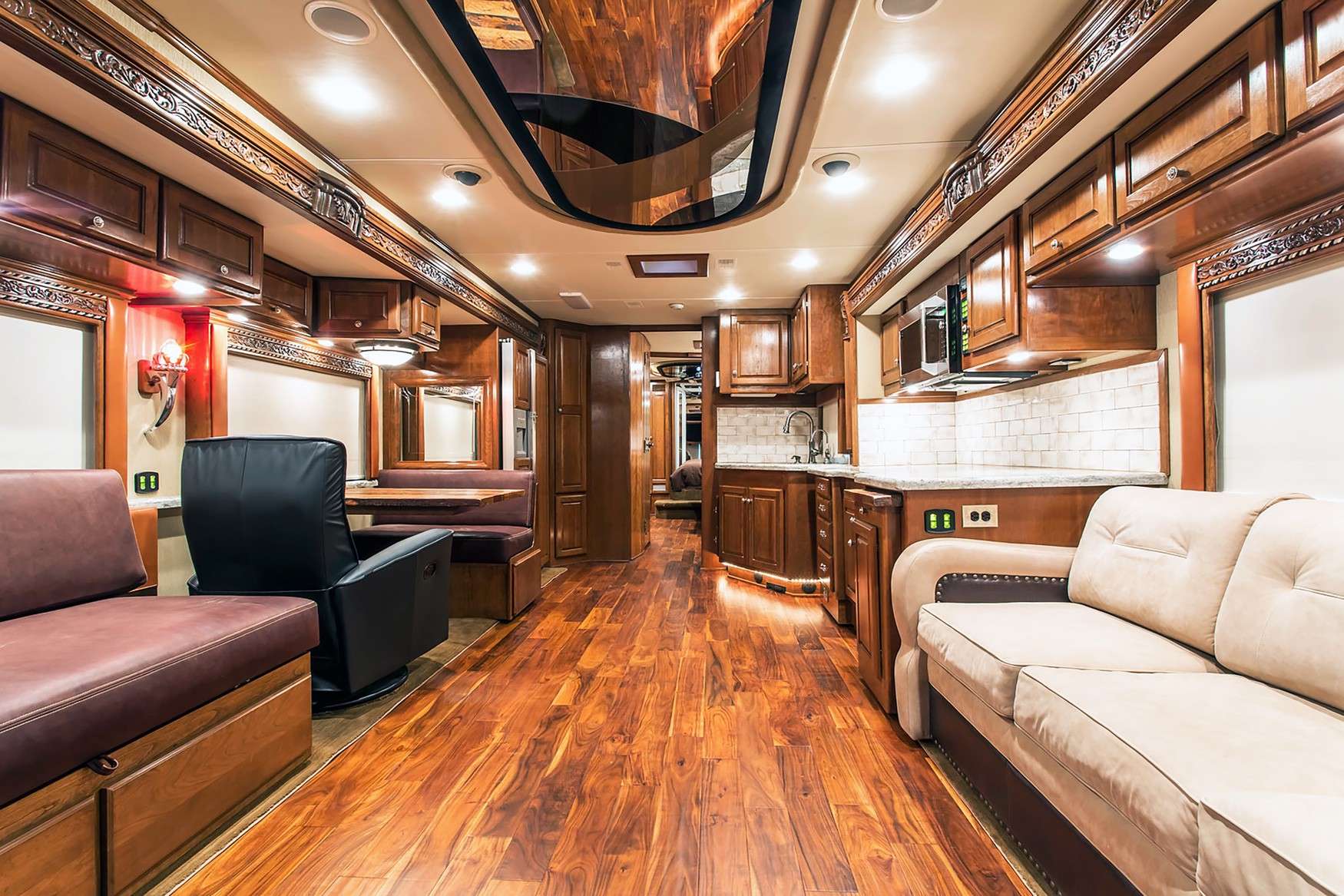
An honest rv interior remodel orange county owners can live in starts with a weight budget and a moisture check, not a color board. Our shop has been rebuilding coach interiors in Westminster since 2015, and the pattern is consistent: the coaches that turn out well are the ones where somebody looked under the floor before ordering material. We handle cabinets, flooring, wall and ceiling panels, counters and upholstery as one sequenced job.
Why RV Interiors Are Built Light
A house cabinet box is three quarter inch plywood. A coach cabinet box is usually quarter inch or eighth inch ply, sometimes vinyl wrapped particle board, stapled and glued into a face frame that carries the real load. Wall panels are typically eighth inch luan with a printed vinyl face bonded to a foam or block core. Countertops are a thin laminate skin over particle board. None of that is cheap by accident. Every pound in the box comes out of what you are allowed to carry down the road.
That single fact drives every material decision in a remodel. Solid hardwood doors, stone counters and thick engineered flooring all work in a stick built house because the floor under them is framed for it. In a coach the deck is often five eighths inch plywood laid over aluminum or steel structure on 16 inch centers, and it flexes when the chassis twists. Heavy finishes on a flexible deck crack at the seams, and heavy doors tear their hinges out of thin stiles within a single season of travel.
The answer is not to accept junk. It is to pick materials with a good strength to weight ratio: real hardwood only where it earns its mass in face frames and door rails, rigid core vinyl plank instead of stone tile, solid surface or thin quartz only where the cabinet below has been reinforced first. We spec that way on every job because we are the shop that sees the coach come back in two years.
- Cabinet boxes: eighth to quarter inch ply or vinyl wrapped particle board
- Wall and ceiling panels: eighth inch luan with a bonded vinyl print face
- Deck: five eighths inch plywood over aluminum or steel structure
- Counters: laminate over particle board, often three quarter inch total
- Fastening: staples, brads and construction adhesive far more than screws
- Face frames: solid oak, maple or alder, and almost always worth keeping
Weight Budgeting and Cargo Carrying Capacity
Cargo carrying capacity is the number on the yellow sticker inside a cabinet door or beside the entry step. It is gross vehicle weight rating minus unloaded vehicle weight, minus full fresh water, minus propane, minus passengers. On a lot of towables that number sits between 1,200 and 2,500 pounds. On a gas Class A it can be under 2,000. A remodel spends out of that same account as your clothes, tools, food, generator fuel and gear.
Here is the math that surprises people. Two hundred and ten square feet of 12mm laminate with an attached pad runs close to 2.4 pounds per square foot, or about 500 pounds. The same area in 5mm rigid core vinyl plank is around 1.5 pounds per square foot, or 315 pounds. Sheet vinyl is under 100 pounds installed. Put a laminate floor and a stone counter into a trailer with 1,400 pounds of capacity and you have spent close to half of it before a single bag goes aboard.
We weigh what comes out and estimate what goes back in, then hand you the difference in writing. If a plan runs you negative on capacity we say so before anything is ordered. On motorized coaches we also watch where the weight lands, because adding 400 pounds of counter and cabinet to one side of a slide room can push a single tire past its rating even when the total vehicle weight is still legal.
- Read the yellow capacity sticker before choosing any material
- Vinyl plank saves roughly 180 pounds against laminate on a 30 foot coach
- Solid surface counters run about half the weight of granite per square foot
- Residential furniture is often three times the weight of the coach version
- Tile floors and tile backsplash are the two most common weight mistakes
- Weigh by corner, not just by axle, on any coach with a large slide
Cosmetic Refresh Versus Structural Rebuild
There are two completely different jobs that both get called a remodel. A cosmetic refresh means the structure is sound and you are changing surfaces: new flooring, refaced or repainted cabinet doors, new panel treatment on the walls, new fabric on the dinette and the captain chairs. Nothing structural moves. That job is predictable, it can be quoted tightly, and it returns more satisfaction per dollar than anything else we do to an interior.
A structural rebuild starts the moment a moisture meter reads wet. Water gets in at a roof seam, a slide seal, a window frame or a marker light, runs down inside the wall cavity and sits in the bottom plate and the deck edge. By the time the floor feels spongy underfoot, the luan has usually delaminated, the foam core has separated from the skin, and the framing at that corner is soft enough to push a screwdriver through.
We meter every interior job before we quote it, along the wall bases, under the windows, at the slide corners and at the entry step. Our RV systems assessment is $150 and it is credited against an authorized repair. If the meter is dry we quote the refresh with confidence. If it is wet, we give you a range for opening it up and we do not commit to a final number until the panel is off and the extent is visible.
Sequencing a Full Interior Remodel
Order matters more than any single material choice. Work from the top down and the outside in, or you will pay to do parts of the job twice. Roof and seal repairs come first, because there is no sense installing a new ceiling panel under a seam that still lets water past. Then demolition, then structure and subfloor, then the floor, then walls and ceiling, then cabinets, then counters, and soft goods and trim last so later trades cannot damage them.
Flooring under the slide rooms is the sequencing decision that catches most owners off guard. The floor has to run under the slide box or you get a visible edge, a dirt trap and a trip hazard every time the room comes in. That means running the slides out, flooring the main deck, then walking the rooms in and out to finish the covered area. It adds hours to the job, and skipping it is the single most common shortcut in cheap remodel work.
We stage the shop the same way every time so the trades never step on each other. Body and paint labor is billed at $210 per hour for interior structure, panel and cabinet work. Where mechanical systems are involved, wiring behind a wall or plumbing under a floor, that portion is billed at the mechanical rate instead. Your quote breaks the hours out by trade so you can see exactly which dollars bought which work.
- Seal the envelope: roof seams, slide seals, window frames, marker lights
- Demo: furniture, dinette, bed platform, old flooring, damaged panels
- Structure: framing repair, subfloor patching, slide room decking
- Flooring: laid with slides run out, continued under the slide rooms
- Walls and ceiling: panel replacement, paint or new wall covering
- Cabinets: boxes first, then faces, then hardware and latches
- Counters, backsplash, then upholstery, trim and final detail
Living In It During the Job or Leaving It With Us
Some owners live in the coach, and we understand why. We will work around it when the scope allows. A cabinet reface, an upholstery job or a single room floor can usually be staged so the coach is livable at night. You do lose efficiency, because we tarp and untarp every day, mask surfaces twice and cannot leave tools staged overnight, and that shows up as roughly 15 to 25 percent more labor hours on the exact same scope of work.
A full remodel is a different conversation. Once the floor is out and the walls are open there is sanding dust, adhesive odor, exposed fasteners, and no functioning kitchen or bath. Subfloor repair means the coach is not sealed against weather. We do not recommend occupancy through that phase, and there are stretches where the coach is up on jacks or the slides are locked out entirely for days at a time.
The practical answer for most people is a hybrid schedule. We front load the disruptive work into one solid block while you are elsewhere, bring the coach back to livable, then finish the slower trim and soft goods on a schedule you can plan around. Tell us your housing constraint at the estimate rather than after demolition starts, because it changes how we sequence the job and how we quote the hours.
Budget Tiers and What They Actually Buy
Ranges only help if you know what puts a job at each end. The bottom of any tier is a shorter coach, sound structure, the stock layout, materials we already stock, and nothing unexpected behind the panel. The top is a 40 foot coach, wet framing, a layout change, slide rooms involved, and material that has to be ordered and waited on. The same square footage can swing by a factor of three on those variables alone.
Any authorized job above $2,000 takes a 50 percent deposit before we order material or open the coach. That is not an extra charge, it is the material and scheduling commitment, and it comes straight off the final invoice. Parts carry a 100 percent markup at or under $100 and 35 percent above $100. Sales tax of 7.75 percent applies to parts and materials only. Labor is not taxed in California, so a labor heavy job carries very little tax.
We will also tell you when to stop. If a 1998 coach needs $18,000 of interior work and the roof membrane is at the end of its service life, the honest answer is to do the roof, do the floor, and leave the cabinets alone this year. Spending an entire budget on surfaces while the envelope still lets water in is the most expensive mistake in this trade, and we see the results of it every month.
- Light refresh, roughly $2,500 to $6,000: one room of flooring or soft goods
- Mid refresh, roughly $6,000 to $14,000: floor, cabinet reface, new counters
- Full cosmetic remodel, roughly $14,000 to $28,000: all surfaces, all rooms
- Structural rebuild, add $9,000 to $30,000 depending on how far the rot ran
- Layout change, add $8,000 to $25,000 for framing, wiring and plumbing moves
- Deposit of 50 percent applies to any authorized job above $2,000
Resale Math on an Older Coach
Interior remodels do not return dollar for dollar, and anyone who tells you otherwise is selling something. On a coach worth $30,000, a $20,000 interior brings it to maybe $38,000 to $42,000 on a private sale, and less through a dealer. You recover something like 40 to 60 cents on the dollar in market value. That is not an argument against remodeling. It is an argument for being clear with yourself about why you are doing it.
The math changes shape when the work is corrective rather than cosmetic. Documented water damage repair, a new floor over a sound and inspected subfloor, and a rebuilt slide corner all move a coach out of the price bracket buyers treat as a project unit. That is worth real money, often more than the repair itself cost, because it changes the buyer pool from bargain hunters to people who simply want a usable coach.
The strongest case is the owner who plans to keep the coach five more years. Then resale is not really the question. The question is whether $16,000 of interior work is cheaper than trading into a newer unit with a $600 monthly payment, and on a well maintained chassis with a healthy drivetrain the answer is usually yes. Ask us to price the corrective work separately from the cosmetic work so you can decide with real numbers in front of you.
In this category
Services we perform
Cabinet Repair and Refacing
RV cabinet work runs from about $500 for hinge and shelf repairs to $7,500 or more for a full reface of a galley and bedroom. Refa...
Read moreFlooring Replacement
RV flooring replacement on a 30 foot coach typically runs $6,500 to $9,500 and takes 6 to 15 business days, covering roughly 210 s...
Read moreWall and Ceiling Panel Repair
RV wall and ceiling panel repair runs $500 to $5,500 or more, depending on how much soft board has to come out and whether the lea...
Read moreUpholstery Repair
RV upholstery repair runs $600 to $8,500 or more, depending on whether you are recovering two dinette cushions or rebuilding a ful...
Read moreCountertop Replacement
RV countertop replacement runs $650 to $4,000 or more, depending on material, square footage, and how many cutouts the top needs....
Read moreQuestions
Frequently asked questions
How long does a full RV interior remodel take?
A single room refresh is usually 5 to 12 business days. A full cosmetic remodel on a 30 to 34 foot coach runs 3 to 5 weeks in the shop. Add structural work and you are looking at 6 to 8 weeks, sometimes longer if framing has to be rebuilt at a slide corner. The variables that stretch a schedule are almost never the installation itself. They are material lead times on ordered counters and fabric, and what we find once the panels come off. We give you a working schedule at authorization and update it in writing the day anything changes.
Can you just put new flooring over the old floor?
Sometimes, and we usually advise against it. Laying new plank over existing sheet vinyl adds height at every transition, raises the floor under the slide rooms so the seals no longer sit right, and traps whatever moisture is already in the old material. It also hides the one thing worth looking at, which is the condition of the deck. On a coach where the existing floor is genuinely dry, flat and well bonded, an overlay can be a reasonable budget choice in a small area. On anything with a soft spot, a stain, or a slide that has ever leaked, we pull it up.
How do I know if there is water damage before I commit to a remodel?
Walk the coach barefoot and feel for soft spots along the wall bases, in front of the entry step, under the windows and at every slide corner. Press on the interior wall panels low down and see if they feel spongy or if the vinyl face is bubbling. Look for stains at the ceiling seams and around roof vents. Smell for that flat musty odor in closed cabinets. Those checks catch most of it, but not all. A meter reading through the wall base is the reliable test, and our RV systems assessment is $150, credited against an authorized repair.
Will a remodel put my coach over its weight rating?
It can, easily, and it is one of the least discussed risks in this trade. The common offenders are tile floors, stone counters, residential recliners and a residential refrigerator. We weigh or calculate what comes out and what goes back in, and we hand you the net change before you authorize material. If the plan takes you negative on cargo capacity we will offer lighter equivalents that get you most of the look at a fraction of the mass. On a coach with a large slide we also look at corner loading, because one tire can be over its rating while the total is fine.
Do you charge for an estimate on interior work?
Yes. Interior estimating is real diagnostic work, not a walk around. To quote a remodel honestly we meter the walls and floor, pull a vent or a panel edge where needed, check slide floor condition and confirm what the cabinet boxes are actually built from. Our RV systems assessment is $150 and it is credited against an authorized repair. Diagnostic labor beyond that assessment is billed at $285 per hour and is also credited. That policy exists so the estimate you get is based on what is behind the panel rather than a guess we later have to revise.
Can I supply my own cabinets, flooring or counters?
You can supply flooring, fabric and hardware, and plenty of owners do. We will tell you honestly whether the product you picked will survive a coach that flexes and sits closed at 120 degrees in summer. What we ask is that everything arrives before the shop date and that you accept the material risk, because we cannot stand behind a product we did not select or a shortage that stalls the job. Owner supplied counters and cabinet doors are harder, since fit tolerances in a coach are rarely square and we usually need to template on site.
Is it worth remodeling a coach that is twenty years old?
It depends entirely on the envelope and the drivetrain. A 2005 coach with a sound roof, a dry floor, good tires and a healthy engine is a fine platform for a $15,000 interior, and you will spend far less than a newer unit costs. The same coach with a failing membrane, delaminated sidewalls and a transmission that slips is not worth the investment, because the interior will be the nicest part of a vehicle you cannot use. We look at the envelope and the chassis first and tell you which category you are in before quoting surfaces.
What order should I do the work in if I spread it over two years?
Seal the coach first. Roof seams, slide seals, window frames and any leaking marker lights come before a dollar goes into the interior, because everything downstream depends on the coach staying dry. Second, deal with subfloor and framing repair while it is small. Third, flooring, since it is disruptive and everything else sits on top of it. Fourth, cabinets and counters. Save upholstery and trim for last, both because it is the least urgent and because it is the item most likely to be damaged by earlier work. That order also lets you stop cleanly at any stage.
Keep reading
Related pages
Other service areas
Vehicles we repair
Talk to a repair specialist today
Tell us what happened and we will tell you what the repair actually involves, what it costs, and how long it takes. We work directly with every major carrier and serve Westminster owners and fleets from our 35,000 square foot facility.
Posted labor rates are published on our prices page. Diagnostic and systems assessment fees are credited against an authorized repair.