Roof, Slides and Awnings
RV Slide Out Repair for Westminster Owners
In short
RV slide out repair runs $500 to $8,500 or more, and the mechanism decides most of that spread. Motor, controller and adjustment work usually lands between $900 and $3,000, while full mechanism replacement with floor repair under the room is what pushes a job to the top. Plan on 2 to 10 business days in the shop.
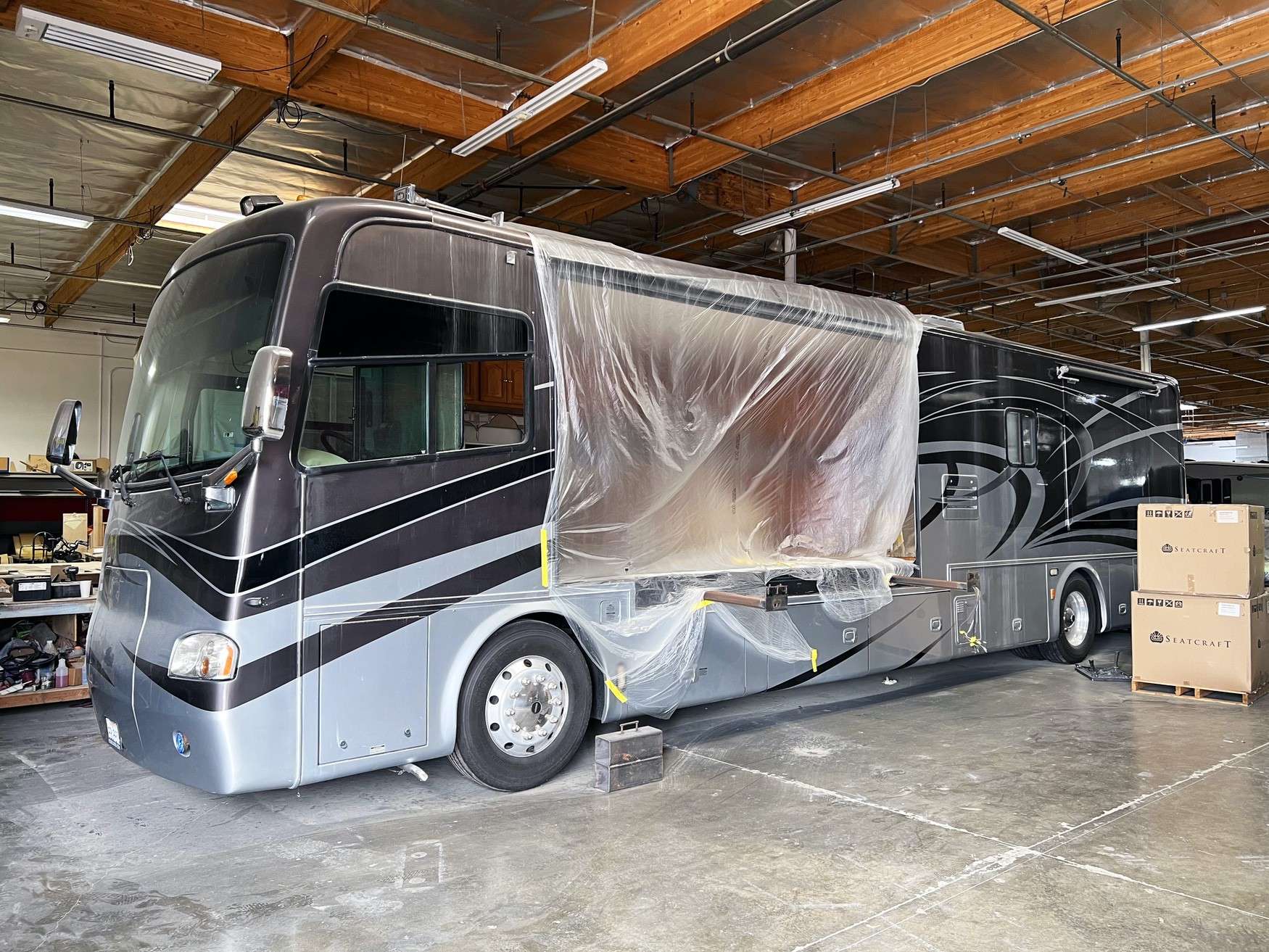
Most RV slide out repair calls we take start the same way, with a room that moves an inch, hesitates, and then stalls while the motor keeps running. That single symptom points at four or five different failure modes depending on the mechanism, and the parts bill for each one is very different. We check the drive system, the controller, the rollers and the floor before we quote anything, because a room that binds is often out of adjustment rather than actually broken.
How the Four Common Slide Mechanisms Work
Almost every slide in the North American market uses one of four drive systems. Through frame rack and pinion runs a single motor and a square shaft across the coach, turning two gears that ride on toothed racks bolted to the room. Schwintek, often called an in wall system, puts a small motor and a vertical gear rack inside each side wall. Cable driven systems pull the room in and out with steel cables and pulleys. Hydraulic systems use a pump, a valve block and one or two rams.
Knowing which one you have changes the whole conversation about money. A through frame motor is a couple of hundred dollars and a few hours of access work. A Schwintek room carries two motors, two controllers and a synchronization routine that has to be reset after any repair. Cable systems are cheap in parts and expensive in labor because the cables thread through the floor structure. Hydraulic rams are stout, but a leaking seal means dropping the ram, and contaminated fluid can take out the pump along with it.
We identify the mechanism in the first ten minutes, usually by pulling the interior fascia on one side and looking at how the room is driven. Owners are often told over the phone that their slide needs a new motor when the coach does not even use that style of drive. That is why we quote after we look, not before.
- Through frame rack and pinion: one motor, one cross shaft, two gear racks
- Schwintek in wall: two motors, two controllers, vertical racks in the side walls
- Cable driven: steel cables and pulleys, low parts cost, high labor cost
- Hydraulic: pump, valve block, one or two rams, plus fluid and hose service
- Electric over hydraulic on large fifth wheel and diesel pusher rooms
Reading the Symptoms Before You Buy Parts
Jerking or shuddering as the room moves usually means uneven drag, not a dying motor. On a rack and pinion room it points at one gear loaded harder than the other, which comes from a room that has drifted out of square. On a Schwintek room it points at one side motor working ahead of the other, which the controller will eventually fault on. Either way, replacing the motor without correcting the geometry gets you the same symptom back in a few months.
Racking is the term for a room that comes out crooked, high on one corner or low on the other. You can measure it with a tape at the top and bottom of the opening and compare. Anything more than about a quarter inch of difference side to side is worth correcting. A racked room chews seals, scrapes the flange, and puts side load on the drive gears until something gives.
Stalling partway is the most common complaint we hear. If the motor is silent, look at power and the controller. If the motor is running but the room is not moving, look at a stripped gear, a slipped cable, or a shaft coupler that has spun on the flat. If you hear a rapid clicking and nothing else, that is usually the relay or the controller cycling on an overcurrent fault.
- Jerking or shuddering: uneven drag, room out of square, worn rollers
- Racking: one corner leading the other, measure top and bottom of the opening
- Stalls halfway with motor running: stripped gear, slipped cable, spun coupler
- Rapid clicking, no movement: overcurrent fault, weak battery, bad ground
- Oil film on the ram or a puddle under the coach: hydraulic seal failure
- Grinding at the last two inches: wear pad gone, room dragging on the floor
Controllers, Limit Switches and Motor Faults
On electric rooms the controller is the part that gets blamed and the part that is least often at fault. Controllers monitor current draw and Hall effect signals from each motor, and they shut the room down when one side pulls harder than the other. That fault is real, but it is usually reporting a mechanical problem rather than causing one. We read the fault, then load test the drive by hand before we condemn any electronics.
Limit switches and magnetic sensors tell the system where the room is. A sensor that has shifted on its bracket, a magnet that has fallen off the flange, or a chafed wire in the slide harness will all produce a room that stops short or refuses to retract the last inch. These are inexpensive parts and quick to correct once found. Finding them is the labor.
Motors themselves fail in two ways. Brushes and windings wear out, which shows up as low speed and high current draw under load. Gearboxes strip, which shows up as a motor that spins fast and moves nothing. On Schwintek systems we replace motors in pairs when the coach has real hours on it, because a fresh motor on one side and a tired one on the other will fault the controller again within a season.
Rollers, Wear Pads and Floor Rot Under the Room
Nylon wear pads and rollers carry the weight of the room as it travels. They are consumable parts. When they flatten or break up, the slide floor drops and starts dragging on the main floor, which loads the drive system and tears up flooring at the same time. Replacing four wear pads is a small parts bill and a couple of hours of jacking and shimming, and it prevents a much larger repair later.
Floor rot under the slide is the failure we hate to find and find often. Water that gets past a top seal runs down the inside of the flange, soaks into the plywood or lauan sandwich at the leading edge, and rots it from the inside. The tell is a soft spot right at the threshold where the room meets the coach, or fasteners that no longer hold torque. From the outside the coach can look fine.
Once the floor is soft, no amount of mechanism work will hold an adjustment, because the drive components are bolted to material that will not carry load. We open the affected area, cut back to sound structure, replace the core and skin, then reset the mechanism. That is the work that takes a $1,500 job to $6,000 or more, and it is why we ask about past leaks during the walkaround.
- Nylon wear pads and rollers are wear items, not lifetime parts
- A dropped room drags on the flooring and loads the drive gears
- Soft spots at the threshold usually mean water got past a top seal
- Delaminated slide floors will not hold mechanism fasteners in torque
- We probe with a moisture meter before quoting any mechanism replacement
Manual Override and What to Do When It Stops Halfway
Every slide system has a way to bring the room in without power, and knowing yours before you need it is worth an hour of your time. Through frame systems usually have a hex or square drive on the motor end that accepts a drill or a hand crank once the motor is disengaged. Schwintek systems require pulling the interior trim and turning each vertical gear rack by hand or with a drive tool, one side at a time, keeping the room square as you go.
Hydraulic systems have manual release valves on the pump or valve block. Opening them lets the room be pushed in by hand, which takes two or three people on a large room. Cable systems usually have a release at the drive that lets the drum spin so the room can be pushed. In all four cases, retract slowly and watch the seals so you do not roll one under.
If a room stops halfway on the road, get it in far enough to travel and stop there. Ratchet straps across the interior opening will hold a partially retracted room for a short trip. Do not run the motor over and over trying to force it. Repeated stall current is what cooks controllers and strips gear teeth, and it turns a $700 diagnosis and adjustment into a full mechanism replacement.
What Slide Out Repair Costs at Our Shop
Slide work is billed at our body and paint rate of $210 per hour. Parts carry a markup of 100 percent at or under $100 and 35 percent above $100, and California sales tax of 7.75 percent applies to parts and materials. Labor is not taxed. Any authorized job above $2,000 takes a 50 percent deposit before we order parts, and our RV systems assessment is $150, credited against an authorized repair.
Here is a real Schwintek job. Two motors at $310 each is $620, plus 35 percent equals $837. A replacement controller at $265 plus 35 percent equals $357.75. Parts total $1,194.75, and tax on that is $92.59. Labor to pull interior fascia both sides, replace both motors and the controller, run the synchronization routine and set the room square runs about 6.5 hours, or $1,365. The job comes to $2,652.34, with a deposit of $1,326.17.
A simpler example. A through frame motor swap on a bedroom slide is roughly 3.5 hours at $210, or $735. The motor at $185 plus 35 percent is $249.75, and tax adds $19.36, for a total of $1,004.11. At the other end, a room with a rotted floor, new mechanism, new wear pads and reset flooring will run past $8,500 once structure work is in the ticket. The honest answer on some older coaches is that the room is not worth rebuilding, and we will tell you that.
- Body and paint labor: $210 per hour
- Parts markup: 100 percent at or under $100, 35 percent over $100
- Sales tax: 7.75 percent on parts and materials, labor untaxed
- Deposit: 50 percent on any authorized job above $2,000
- RV systems assessment: $150, credited against an authorized repair
- Wear pad example: four pads at $22 each doubles to $176, tax $13.64
Questions
Frequently asked questions
Why does my slide go out a few inches and then stop?
That pattern almost always means the system is seeing more resistance than it expects. On an electric room the controller watches current draw and shuts down when one side pulls harder than the other, so the room barely leaves the seal and quits. The cause is usually mechanical: a flattened wear pad, a roller that has seized, a room that has drifted out of square, or a seal that has folded under and is binding. Low battery voltage produces the same symptom because the motors draw more current when they are underfed. Check voltage at the battery first, then look for drag. Replacing the motor rarely fixes it.
Is it cheaper to fix a Schwintek slide or a rack and pinion slide?
Rack and pinion is usually cheaper. It has one motor, and the parts are simple and widely available. A motor and coupler swap plus adjustment lands around $1,000 to $1,800 on most coaches. Schwintek systems have two motors, two controllers and vertical gear racks buried in the side walls, so the parts count is higher and the labor to access them is longer. A full Schwintek refresh with both motors and a controller commonly runs $2,400 to $3,500. Schwintek rooms are also less tolerant of being out of square, so they need a proper synchronization and adjustment afterward, which is billable time either way.
Can I still drive the RV if the slide will not come in?
Not with the room out. A slide left extended will contact almost anything you pass and will destroy the room, the flange and often the sidewall. Use the manual override to bring it in as far as it will go, then secure it. If it will only come in partway, ratchet straps run across the interior opening and anchored to solid structure will hold it for a short, slow trip to a shop. Do not use the straps as a long term fix, and do not tow at speed with an unsupported room. If the room will not move at all, have the coach transported rather than driven.
How do I use the manual override on a stuck slide?
It depends on your mechanism. Through frame rack and pinion systems have a drive point at the motor, usually a hex or square end you reach after removing a small access panel, and many require disengaging the motor first. Schwintek systems need the interior trim pulled so each vertical gear rack can be driven by hand, alternating sides in small increments to keep the room square. Hydraulic systems have release valves on the pump or valve block that let the room be pushed in by hand. Cable systems have a release at the drum. Go slowly, keep the room square, and watch that the seals are not rolling under as it comes in.
My slide makes a clicking noise and does not move. What is that?
Rapid clicking is the sound of a relay or controller trying to energize and then dropping out on an overcurrent or undervoltage condition. Nine times out of ten it is either weak batteries, a bad ground at the controller, a corroded connection in the slide harness, or a room that is mechanically bound so hard the motor cannot start turning. Measure voltage at the controller while someone holds the switch. If it collapses below about ten volts, you have a power problem, not a slide problem. If voltage holds and the motor still will not turn, the drive is jammed and forcing it will strip gear teeth.
There is oil on the ground under my slide. How bad is that?
It means a hydraulic ram seal, a hose, or a fitting is leaking, and how bad depends on which. A weeping fitting is a tightening and a fluid top off. A seal that has failed at the rod means the ram comes out, gets rebuilt or replaced, and the system gets flushed and bled. The real risk is running the pump low on fluid, because that pulls air and debris through it and can take out the pump, which is the expensive part. Stop using the slide, check the reservoir, and get it looked at. A ram rebuild handled early is far cheaper than a pump and ram together.
Do you have to pull the whole room out to fix it?
Usually not. Most motor, controller, sensor and wear pad work is done with the room in place, working through interior fascia panels and from underneath. We pull the room when the floor under it needs structural repair, when a full mechanism has to come out on a cable or through frame system, or when the flange and the entire seal set are being replaced at once. Pulling a room takes lifting equipment, several technicians and floor space, and it adds roughly six to twelve hours of labor to the ticket. We tell you before we do it, because it changes the number substantially.
How long does slide out repair take once you have the parts?
Most jobs are 2 to 10 business days in the shop. A motor and adjustment on a through frame room is often in and out in two or three days. A Schwintek refresh with both motors, a controller and a synchronization routine typically holds the bay for four or five days. If the floor under the room has to be opened, cut back, recored and reskinned, add another week because adhesives and resin need cure time before we can load the structure again. Parts availability on older or discontinued mechanisms is the other variable and is the one thing we cannot compress.
Standard on every job
What is included
These are not upgrades. They are how the work is run on every vehicle that comes through the building.
Full teardown where it is needed
We do not estimate through a closed panel. If the damage path runs behind trim or skin, we open it and document what is actually there.
Written, itemized scope
Parts, labor hours, and materials listed separately against the posted rate, so every line is something you can question.
Direct carrier communication
We talk to the adjuster so you are not relaying technical detail between two parties who both expect you to already understand it.
Supplement handling
When teardown finds more than the original inspection, we document and submit the supplement rather than absorbing it into a vague overage.
Correct repair sequence
Structural before cosmetic, every time. A straight body over a bent frame is a repair that fails its second life.
Systems tested under load
Electrical, plumbing, generator, and climate systems are run and verified before delivery, not just reconnected and assumed good.
Photo documentation throughout
Before, during, and after. Useful for your records, and decisive if a claim is ever revisited.
Delivery walkthrough
We go over what was done, what was replaced, and what to watch, in person, with the vehicle in front of you.
How the work runs
Our six step repair process
The same sequence on every vehicle, whether it is a single coach or a fleet of box trucks.
- 01
Assessment and documentation
We put the vehicle on the floor, pull panels where we need to see behind them, and photograph everything. Hidden damage found now is damage that does not become a supplement argument later.
- 02
Written estimate
You get a line by line estimate with parts, labor hours, materials, and the posted rate applied to each. Nothing is bundled into a single number you cannot check.
- 03
Carrier coordination
If a claim is involved we deal with the adjuster directly, submit the documentation, and handle supplements when teardown reveals more than the first inspection showed.
- 04
Authorization and scheduling
Once the scope is approved we confirm the deposit, order parts, and give you a realistic slot. Special order parts drive the timeline more often than labor does.
- 05
Repair
Structural first, then body, then paint, then systems and interior. The sequence is not negotiable because each stage has to be right before the next one covers it up.
- 06
Quality check and delivery
Multi point inspection, systems tested under load, paint inspected under corrected lighting, and a walkthrough with you before the vehicle leaves.
Keep reading
Related pages
Related services
Vehicles we repair
Talk to a repair specialist today
Tell us what happened and we will tell you what the repair actually involves, what it costs, and how long it takes. We work directly with every major carrier and serve Westminster owners and fleets from our 35,000 square foot facility.
Posted labor rates are published on our prices page. Diagnostic and systems assessment fees are credited against an authorized repair.