Interior Remodeling
RV Cabinet Repair and Refacing for Coach Interiors
In short
RV cabinet work runs from about $500 for hinge and shelf repairs to $7,500 or more for a full reface of a galley and bedroom. Refacing keeps the sound hardwood face frames and boxes and replaces only the doors and drawer fronts, at roughly a third the cost of new cabinetry. Most jobs take 5 to 12 business days in the shop.
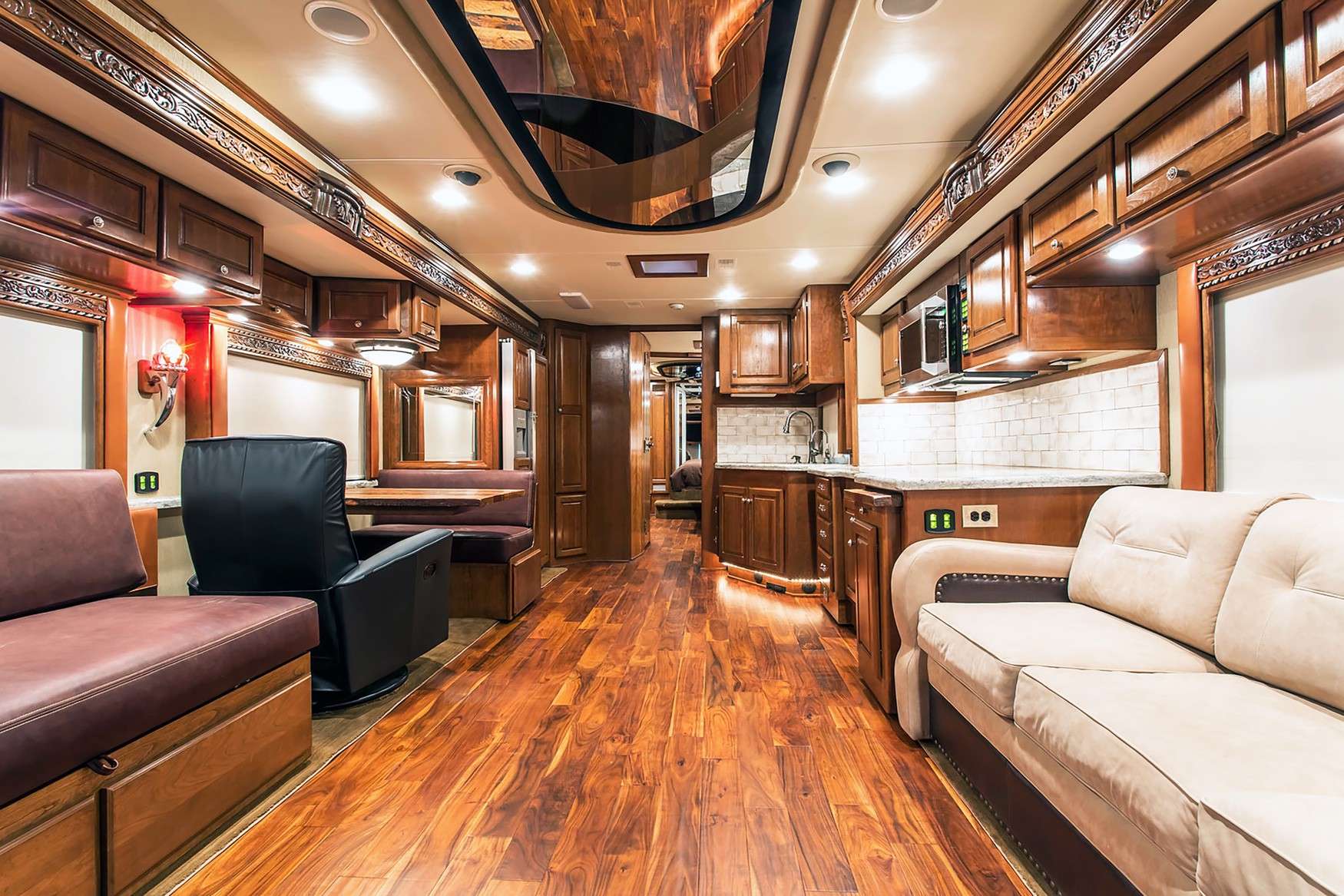
Most rv cabinet repair and refacing work starts with the same three failures: vinyl wrap lifting at a door edge, a shelf that has bowed under canned goods, and hinge screws that spun out of particle board somewhere on the road. Owners in Westminster bring us coaches where the boxes are still sound and only the faces look tired, which is the cheapest good outcome available in this trade.
What RV Cabinets Are Actually Made Of
Open a cabinet door in most coaches and look at the raw edge of the box. What you usually find is quarter inch or eighth inch plywood, sometimes hardboard, sometimes vinyl wrapped particle board on the exposed ends. The face frame is real hardwood, commonly oak, maple or alder, and that frame is doing nearly all of the structural work. Shelves are often quarter inch ply resting on dowels or stapled cleats. Doors range from solid hardwood on higher end coaches to a vinyl film wrapped over MDF on most of the rest.
Knowing which of those you have determines everything about the repair. A hardwood face frame carrying vinyl wrapped MDF doors is the most common combination we see, and it is also the best candidate for refacing, because the expensive structural part of the cabinet is already sound. A box built entirely from vinyl wrapped particle board is a different story. Once particle board takes on moisture it swells, loses fastener grip permanently, and cannot be dried back to usable condition no matter how long it sits.
We identify the construction at the estimate and put it in writing, because it changes the number substantially. Refacing a sound hardwood frame with new doors costs a fraction of what building new boxes costs. We photograph a cut edge or a drawer side and show you exactly what you are working with rather than asking you to take our word for the assessment.
- Face frames: solid oak, maple, alder or cherry, and usually still sound
- Boxes: eighth to quarter inch ply, hardboard, or vinyl wrapped particle board
- Doors: solid hardwood, hardwood frame with a ply panel, or vinyl film over MDF
- Shelves: quarter inch ply on dowels or stapled cleats, rarely edge banded
- Drawers: stapled ply boxes or plastic sided systems with a screwed on front
- Finish: a catalyzed factory sheen that ordinary primer will not bond to
Delaminating Vinyl Wrap and Sagging Shelves
Vinyl film wrapped over MDF fails predictably, and heat is the trigger. A coach closed up through a Southern California summer runs well past 120 degrees inside. The adhesive under the film softens and the wrap starts lifting at the door edges and around the routed profile first. Once air gets under it, the lifted area grows a little every hot day. You cannot glue that back with any lasting result, because the film has shrunk and no longer matches the panel it came off of.
Sagging shelves are a load and span problem, not a material defect. Quarter inch ply spanning 30 inches with canned goods on it will take a permanent bow in a single season. The fix is not simply a thicker shelf in the same opening, since that adds weight and usually will not fit the existing dado. We add a hardwood stiffener along the front edge or a center support at the back wall, which stops the sag at a fraction of the weight and often without pulling the box.
Blown out hinge screws are the third failure and by far the most common. European style cup hinges rely on two short screws biting into a bore in particle board. Road vibration works them loose, the door begins to sag, the owner tightens them, and eventually the screw strips the hole out entirely. We repair those bores with a hardwood dowel and adhesive rather than reaching for a longer screw, because a longer screw into particle board only moves the same failure a quarter inch deeper.
Repair, Reface or Replace
Repair means the boxes, frames and doors all stay and we address specific failures: rebore a hinge, stiffen a shelf, reglue a loose joint, replace a broken latch, patch a torn wrap section on a door that is otherwise fine. This is the right call when three or four things are wrong on an interior you otherwise like the look of. It is usually 3 to 10 hours of work, it keeps the coach original, and it is the least expensive path by a wide margin.
Refacing keeps the boxes and the hardwood face frames, replaces every door and drawer front, and applies matching veneer or paint to the visible frame edges. It gives you a new looking galley at roughly a third the cost of new cabinetry, and it adds almost no weight if you stay with hardwood frame doors or wrapped MDF. Refacing is the right answer when the boxes are sound but every door looks worn, which describes most coaches past their tenth year.
Full replacement is for boxes that are structurally gone: water damage in a base cabinet, particle board that has swollen at the toe kick, a layout change, or a bathroom vanity that has been wet for years. New boxes mean template work, because coach cabinets are rarely square and many sit against a curved sidewall. Expect the cost to run three to four times a reface for the same run, and expect a longer schedule because every box is built to fit one opening.
Latches, Catches and What Fails on the Road
The single most expensive cabinet failure is a latch that lets go at speed. A galley upper opens, twenty pounds of dishes come out, the door swings into its neighbor and splits a stile, and now you have a repair that started as a two dollar catch. Positive catch latches on overhead cabinets are wear items, not lifetime parts. We check every one of them on any interior job that comes through the shop, because catching that early costs almost nothing.
Magnetic catches lose grip as the strike plate wears and the magnet ages. Roller catches spread and stop holding. Push button latches on wardrobe and entertainment doors crack at the plunger. None of that is unusual and none of it is expensive to correct if it is handled during a planned job rather than discovered somewhere out on a trip. Replacing catches throughout a coach is typically 2 to 4 hours of labor plus the hardware itself.
Drawer slides are the other road failure worth naming. Coach drawers use a slide with a positive lock or a lip that has to be lifted before the drawer opens, and once that lock wears the drawer walks out on every hard stop. Full extension ball bearing slides with a locking detent are a straightforward upgrade during a reface and they solve the problem permanently. They also add weight, so we count them into the total before you authorize them.
- Positive catch latches on overhead doors are wear items, checked on every job
- Magnetic catches weaken as the strike plate wears and the magnet ages
- Push button latches crack at the plunger on wardrobe and entertainment doors
- Drawer locks wear until the drawer walks open under hard braking
- Hinge cup screws back out from vibration long before anything else fails
- Missing door bumpers let doors slam and split stiles over a few seasons
Refinishing Over Factory Sheen
Factory cabinet finish in a coach is a catalyzed conversion varnish or a precatalyzed lacquer sprayed at the plant. It is hard, it is slick, and ordinary wall primer will not bond to it. Every failed cabinet paint job we are asked to correct has the same story behind it: somebody scuffed lightly, rolled on a general purpose primer, and within a month the finish peeled off in sheets everywhere a hand or a sleeve touched it.
The process that actually works is not complicated, but no step in it can be skipped. Degrease with a solvent cleaner to lift years of cooking film and hand oil. Sand to a uniform dull scratch with 180 to 220 grit. Blow off and tack. Apply a bonding primer rated for glossy surfaces, then two thin topcoats sprayed rather than rolled, then a real cure period before doors go back on. Cure time matters more than dry time, and handling a door at four hours instead of forty eight is how print marks happen.
We spray doors and drawer fronts off the coach, laid flat, and finish the face frames in place with everything around them masked. Interior finish work is billed at the $210 per hour body and paint rate. A galley plus bedroom refinish typically runs 16 to 24 hours of labor depending on door count and how heavy the degreasing job turns out to be once we start wiping.
Cabinet Cost Math and How We Quote It
Here is a real repair job. A 28 foot trailer with four blown out hinge bores, two sagging galley shelves and one torn wrap section. Labor is 6 hours at $210 per hour, which is $1,260. Parts are twelve hinges at $14 each, a cost of $168, marked up 100 percent because each part is at or under $100, so $336. Shelf stiffener stock at $78 marks up the same way to $156. Parts total $492, sales tax at 7.75 percent adds $38.13, and the invoice lands at $1,790.13 with no deposit required.
Now a reface. A 32 foot coach, galley and bedroom, twelve doors and six drawer fronts. Labor is 18 hours at $210 per hour, which is $3,780. The doors are $145 each, a cost of $1,740, marked up 35 percent because each is over $100, so $2,349. The drawer fronts are $85 each, a cost of $510, marked up 100 percent to $1,020. Parts total $3,369 and tax at 7.75 percent adds $261.10. The invoice is $7,410.10, and a 50 percent deposit of $3,705.05 is collected at authorization and applied against it.
What moves a quote inside that range is door count first, finish choice second, and whether the boxes need work behind the faces third. A short trailer with eight doors and sound boxes sits near the bottom. A 40 foot coach with thirty openings, a painted finish that needs full degreasing and stripping, and two base cabinets with swollen particle board sits at the top or past it. We count every opening at the estimate and give you the hours line by line.
- Body and paint labor: $210 per hour, quoted in whole and half hours
- Parts at or under $100 carry a 100 percent markup
- Parts over $100 carry a 35 percent markup
- Sales tax of 7.75 percent applies to parts and materials, never to labor
- A 50 percent deposit is collected on any authorized job above $2,000
- Hinge and latch hardware is quoted per opening, not as a flat coach price
Questions
Frequently asked questions
Can you match my existing cabinet color?
Close, usually, but a perfect match to a twelve year old finish is not realistic and we will tell you that up front. Factory finishes fade with sun exposure, and the inside of a door is often a different shade than the outside of the same door. If you are replacing only a few doors we will bring the new pieces to the closest available match and place them where the eye is least likely to compare, such as a lower run. If a true uniform look matters to you, refinishing every door at once is the honest path and it is what most owners choose.
My cabinet doors have peeling vinyl. Can it be reglued?
Not with a result that lasts. Once the vinyl film lifts, it has already shrunk and heat cycled, so it no longer covers the same footprint it did when it left the plant. Gluing it down leaves ripples and it releases again the first hot week. The two real options are replacing the affected doors with new wrapped or hardwood frame doors, or stripping the film entirely and refinishing the MDF underneath. Stripping is labor heavy and only makes sense on a handful of doors. If more than a third of the doors are lifting, refacing the whole set costs less per door.
How many hours does a cabinet reface take?
For a typical 30 to 34 foot coach with fifteen to twenty openings, plan on 16 to 24 hours of shop labor spread over 5 to 12 business days. The hours cover removing doors and hardware, prepping and refinishing exposed frame edges, hanging and adjusting new doors and drawer fronts, and replacing catches and bumpers. The calendar time is longer than the labor time because doors are ordered, finish has to cure between coats, and we will not rehang a door before the finish has hardened. If your doors are in stock and the frames need no repair, the schedule compresses toward the low end.
Will refacing add weight to my coach?
Very little, if the material is chosen with that in mind. Swapping wrapped MDF doors for new wrapped MDF or hardwood frame doors with a ply panel is close to a wash, usually within twenty pounds across an entire coach. Where weight sneaks in is solid slab hardwood doors, thick glass inserts, and full extension ball bearing drawer slides, which are heavier than the stock plastic sided systems. If we are adding more than about fifty pounds we say so at the estimate, because that number comes straight out of your cargo carrying capacity.
The hinge screws keep coming loose. What actually fixes that?
The bore is the problem, not the screw. Cup hinges bite into particle board with two short screws, and once vibration has enlarged that hole, tightening it only crushes more material. A longer screw pushes the same failure a quarter inch deeper into the panel. The repair that holds is to drill the damaged bore clean, glue in a hardwood dowel or a plug of solid stock, let it cure, then redrill and remount the hinge into solid wood. That is roughly fifteen to twenty minutes per bore. On a coach with several failed hinges we do them all at once, since the setup is the same.
Is it cheaper to paint the cabinets than to replace the doors?
On labor alone, painting usually costs less, but the gap is smaller than people expect. Doing it properly means removing every door, degreasing, sanding to a uniform scratch, bonding primer, two sprayed topcoats and a real cure period. That is 16 to 24 hours on a typical coach, and the material cost is modest. New doors shift the money from labor to parts. Painting also cannot fix a door that is delaminating, warped, or swollen at the bottom edge from a leak. We usually recommend painting when the doors are sound and refacing when they are not.
Do you need my coach for the whole job or just the doors?
For a pure door replacement we can often work from measurements and a template, order the doors, and have the coach in only for the fitting and hardware work. That can cut your time in the shop to two or three days. For a refinish job we need the coach, because the face frames are attached to it and they have to be prepped and coated in place while everything around them is masked. If the job includes shelf, box or hinge bore repair, the coach stays with us for the duration.
What does a cabinet repair estimate cost?
Our RV systems assessment is $150 and it is credited against an authorized repair. For cabinet work that assessment covers opening a representative box to confirm what it is built from, counting and inspecting every opening, testing hinge bores and latches, and metering any cabinet base that sits against an exterior wall for moisture. If the inspection turns into extended diagnostic work, for instance chasing a leak behind a galley run, that time is billed at the diagnostic rate and is also credited against an authorized repair. You get the findings and the line by line hours in writing before anything is ordered.
Standard on every job
What is included
These are not upgrades. They are how the work is run on every vehicle that comes through the building.
Full teardown where it is needed
We do not estimate through a closed panel. If the damage path runs behind trim or skin, we open it and document what is actually there.
Written, itemized scope
Parts, labor hours, and materials listed separately against the posted rate, so every line is something you can question.
Direct carrier communication
We talk to the adjuster so you are not relaying technical detail between two parties who both expect you to already understand it.
Supplement handling
When teardown finds more than the original inspection, we document and submit the supplement rather than absorbing it into a vague overage.
Correct repair sequence
Structural before cosmetic, every time. A straight body over a bent frame is a repair that fails its second life.
Systems tested under load
Electrical, plumbing, generator, and climate systems are run and verified before delivery, not just reconnected and assumed good.
Photo documentation throughout
Before, during, and after. Useful for your records, and decisive if a claim is ever revisited.
Delivery walkthrough
We go over what was done, what was replaced, and what to watch, in person, with the vehicle in front of you.
How the work runs
Our six step repair process
The same sequence on every vehicle, whether it is a single coach or a fleet of box trucks.
- 01
Assessment and documentation
We put the vehicle on the floor, pull panels where we need to see behind them, and photograph everything. Hidden damage found now is damage that does not become a supplement argument later.
- 02
Written estimate
You get a line by line estimate with parts, labor hours, materials, and the posted rate applied to each. Nothing is bundled into a single number you cannot check.
- 03
Carrier coordination
If a claim is involved we deal with the adjuster directly, submit the documentation, and handle supplements when teardown reveals more than the first inspection showed.
- 04
Authorization and scheduling
Once the scope is approved we confirm the deposit, order parts, and give you a realistic slot. Special order parts drive the timeline more often than labor does.
- 05
Repair
Structural first, then body, then paint, then systems and interior. The sequence is not negotiable because each stage has to be right before the next one covers it up.
- 06
Quality check and delivery
Multi point inspection, systems tested under load, paint inspected under corrected lighting, and a walkthrough with you before the vehicle leaves.
Keep reading
Related pages
Related services
Vehicles we repair
Talk to a repair specialist today
Tell us what happened and we will tell you what the repair actually involves, what it costs, and how long it takes. We work directly with every major carrier and serve Westminster owners and fleets from our 35,000 square foot facility.
Posted labor rates are published on our prices page. Diagnostic and systems assessment fees are credited against an authorized repair.