Mobile Business Vehicles
Food Truck Repair Built Around Your Service Days
In short
Food truck repair runs from about $1,500 for panel and utility work to past $50,000 for structural rebuilds with a full interior. The complication is that a body repair which cuts a wall almost always means new interior surfaces on the inside of that wall, so the vehicle job and the kitchen job arrive together.
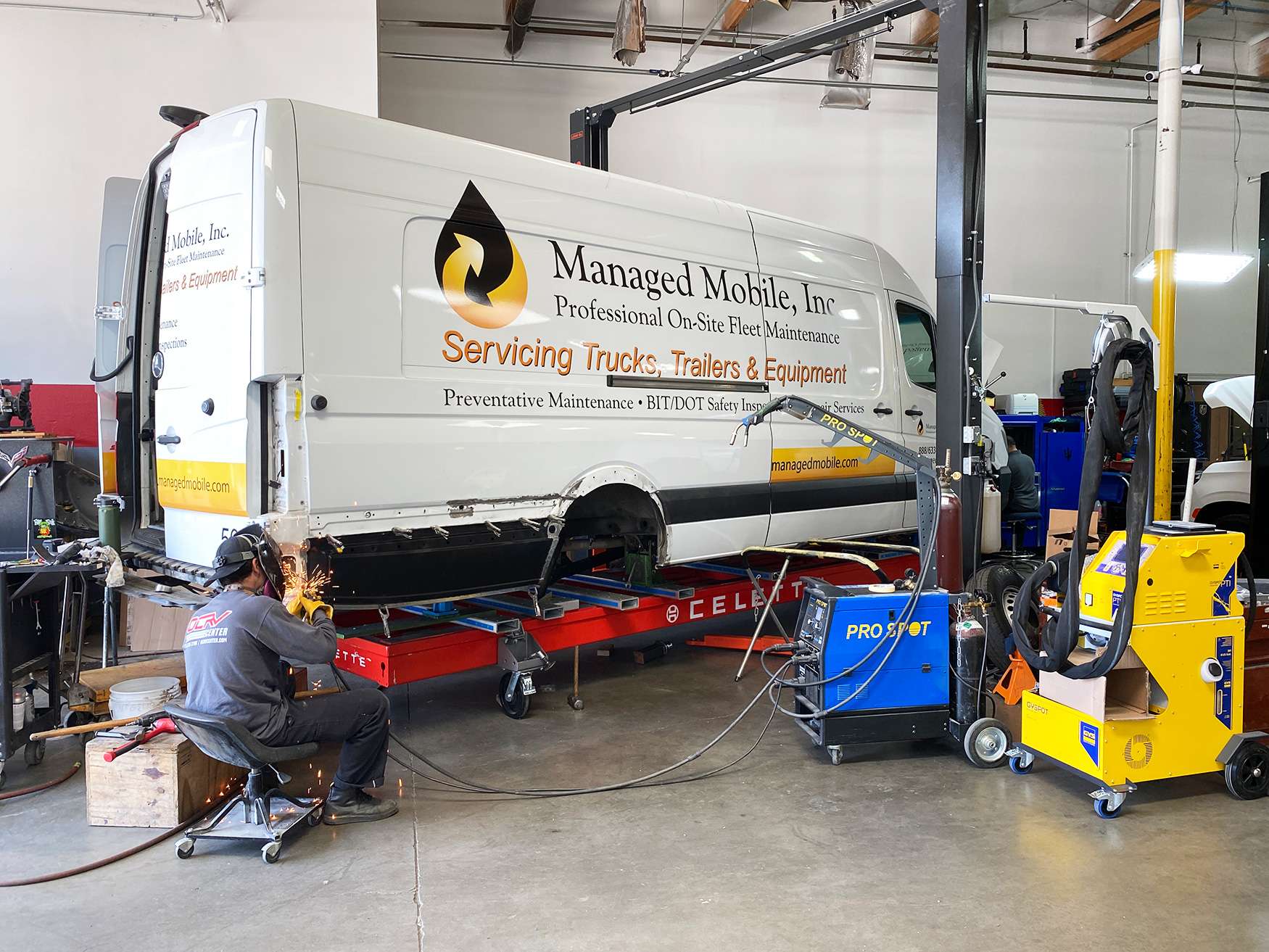
Food truck repair is the clearest example of a vehicle that is also a workplace, and Westminster operators feel it every time a unit goes down on a booked weekend. Cut a wall to repair a dent and you have opened the inside of a kitchen. This page covers stainless interiors and their seams, the serving window and its structure, hood and roof penetrations, propane and generator mounting, and tanks.
Stainless Interiors and the Seams That Matter
The interior surfaces in a food truck are there to be cleaned, and the seams are what make that possible or impossible. Panels lapped and sealed properly present a smooth surface with no place for anything to collect. Panels butted with an open joint, or sealed with something that has cracked, do the opposite.
So a repair that opens a wall has to close it back to the same standard. We replace stainless sheet with matching gauge and finish, lap and seal the joints properly, and restore coving at the wall to floor junction where the original had it.
Cutting corners here is tempting because the seam is only visible up close, and it is exactly what makes an owner fail a look afterward. We would rather add the four hours it takes to do the joint properly than hand back a truck that has to come back.
- Match stainless gauge and finish to the existing surface
- Lap and seal joints rather than butting them open
- Restore coving at wall to floor junctions
- Use sealants appropriate for a food preparation surface
- Photograph the finished seams for your own records
The Serving Window Is a Structural Opening
The serving window is a large hole cut in the side of the body, and the framing around it is carrying load that the rest of the wall shares. On a box body that means the corner posts and rails around the opening. On a van or step van it means the side structure.
Damage there is structural. A side impact near the window, a window frame that has begun to rack, or a door that no longer closes flush are all reports about the opening rather than the window hardware.
The other common finding is water. The window frame, the shelf that projects from it, and the awning or canopy above are all penetrations through the wall, and the sealing around them takes weather, movement and daily use. We meter the wall below a serving window as a matter of course on these trucks.
Hoods, Roof Penetrations and Everything Above the Line
The exhaust hood is the largest penetration in the roof and it is the one owners are least likely to inspect, because getting up there is inconvenient and the hood works whether or not the flashing is sound. Water entering there runs into the roof structure and along the top of a wall.
Everything else on the roof follows the same rule: air conditioning, vents, the fan, antennas and any rack. Each is a penetration with a sealing service life shorter than the vehicle.
When we have a roof open, we inspect all of them rather than only the one that leaked. Doing eight penetrations in one visit costs a fraction of doing one now and another in six months, and on a truck where every shop visit costs a service day, that consolidation is worth real money.
Propane, Generator and Fuel System Mounting
Propane tanks, gas lines, the generator and its fuel supply are all mounted to a vehicle that vibrates constantly. Mounting that has loosened, lines that have chafed against a bracket, and supports that have corroded are common findings and they are the ones that matter most.
We inspect routing, support spacing, protection where a line passes through structure, and the condition of every mount. Where a line was routed carelessly in the original build, which is frequent on owner built trucks, we reroute rather than reinstalling a problem.
The generator compartment is its own item. Ventilation that has been blocked by a later modification, exhaust routing that has corroded, and mounting isolators that have collapsed all shorten generator life and all get looked at while we are in there.
- Check line routing, support spacing and chafe protection
- Inspect every tank and generator mount for movement or corrosion
- Verify generator compartment ventilation has not been obstructed
- Look at exhaust routing and its isolation from combustible material
- Replace collapsed mounting isolators rather than shimming them
Water Tanks, Waste and Floor Drainage
Fresh and waste tanks carry a lot of weight that moves every time the truck does, and tank mounting is a chronic failure point. A tank that has been working against its straps for two years will eventually take the mounting structure with it.
Below that, the floor is doing hard duty. Water, cleaning chemicals and grease work at any joint in the floor covering, and once moisture gets under it the substrate softens quietly. On a truck with a wood floor over steel, that combination produces corrosion you cannot see.
A worked example: side panel repair at the serving window with stainless interior restoration and reseal, no structural involvement, typically 20 to 32 hours at $210 for $4,200 to $6,720, plus $1,200 to $3,600 in panel, stainless, sealant, hardware and refinish materials.
Questions
Frequently asked questions
If you fix a dent, does the inside of my truck get torn up?
Some of it, yes, and we scope that from the start rather than discovering it. Proper body repair needs access to the back of the panel, and on a food truck the back of that panel is a stainless interior surface with equipment, plumbing or gas lines against it. Those surfaces come out and go back, and they go back to the same standard: matching gauge and finish, joints lapped and sealed rather than butted open, coving restored where the original had it. The interior removal and restoration hours are in the original estimate because they are entirely predictable.
How much does food truck repair cost?
The range is about $1,500 to past $50,000. Utility and small panel work sits at the low end. Side panel repair at the serving window with stainless interior restoration is typically $6,000 to $11,000. Roof penetration service across the hood, air conditioning and vents in one visit is $2,000 to $5,500. Structural repair with interior surfaces rebuilt runs $18,000 to $35,000. A full rebuild after a serious incident can pass $50,000. Body labor is $210 per hour, mechanical is $260, and authorized repairs above $2,000 carry a 50 percent deposit.
Will I need to be re inspected after the work?
Probably, if the work changed interior surfaces, plumbing, the gas train or the electrical, and that call belongs to whichever authority permits your operation rather than to us. We do not speak for them and we will not tell you what they will accept. What we control is building to surfaces and details that will pass a look: matched stainless with properly lapped and sealed seams, coving restored at wall to floor junctions, utilities routed and supported correctly, and a written record of exactly what was replaced. Bring your permitting requirements to scoping and we will build to them.
Water is getting in below my serving window. Why there?
Because the serving window area is several penetrations stacked together: the window frame itself, the shelf projecting from it, the awning or canopy above, and every fastener holding all of that to the wall. All of it moves as you open and close the window and as the truck flexes, and the sealing around it has a service life shorter than the truck. We meter the wall below a serving window as a matter of course on these units, because the damage develops behind an interior surface where you cannot see it until the panel is soft.
My generator keeps failing early. Is that a mounting issue?
Often it is a compartment issue. The two things that kill generators on food trucks are heat and vibration. A compartment whose ventilation has been obstructed by a later modification runs the unit hot every service day. Mounting isolators that have collapsed transmit vibration straight into the generator and into everything connected to it. We check ventilation paths, exhaust routing and its isolation from combustible material, and the condition of every mount and isolator. Replacing collapsed isolators rather than shimming them is a small job that meaningfully extends generator life.
How long will my truck be out of service?
Utility and small panel work is three to seven business days. Roof penetration service across all openings is two to four business days. Side panel repair with stainless interior restoration is two to three weeks. Structural repair with interior rebuilt is four to seven weeks. What shortens all of it is scoping early so long lead parts are ordered before the truck comes in, and grouping deferred items into the same visit rather than making separate trips. Tell us your booking calendar at scoping and we will build the schedule around your service days.
Can you inspect everything at once so I stop making trips?
Yes, and it is the single best thing an operator can do. A $150 systems assessment, credited against the repair, covers the roof penetrations, the serving window sealing, propane and generator mounting and routing, tank mounting, the water and waste systems, floor and interior surface condition, and the body and structure. You get one document listing what needs attention now, what can wait a season, and what is fine. Then we bundle the work into one visit. On a vehicle where every shop trip costs a service day, that consolidation is usually worth more than the repair discount anyone could offer.
My tanks shift when I drive. Is that serious?
Yes. Fresh and waste tanks carry substantial weight that moves every time the truck does, and a tank working against its straps will eventually take the mounting structure with it rather than just loosening. It also stresses every fitting and line connected to it, which is how a tank mounting problem turns into a plumbing failure on a service day. The repair is straightforward: restore or improve the mounting so the load lands on structure with proper support and restraint, and address any fitting or line that has been working. Catching it while it is a mounting issue keeps it from becoming a floor repair.
How the work runs
Our six step repair process
The same sequence on every vehicle, whether it is a single coach or a fleet of box trucks.
- 01
Assessment and documentation
We put the vehicle on the floor, pull panels where we need to see behind them, and photograph everything. Hidden damage found now is damage that does not become a supplement argument later.
- 02
Written estimate
You get a line by line estimate with parts, labor hours, materials, and the posted rate applied to each. Nothing is bundled into a single number you cannot check.
- 03
Carrier coordination
If a claim is involved we deal with the adjuster directly, submit the documentation, and handle supplements when teardown reveals more than the first inspection showed.
- 04
Authorization and scheduling
Once the scope is approved we confirm the deposit, order parts, and give you a realistic slot. Special order parts drive the timeline more often than labor does.
- 05
Repair
Structural first, then body, then paint, then systems and interior. The sequence is not negotiable because each stage has to be right before the next one covers it up.
- 06
Quality check and delivery
Multi point inspection, systems tested under load, paint inspected under corrected lighting, and a walkthrough with you before the vehicle leaves.
Keep reading
Related pages
Related vehicles
Services we perform
Talk to a repair specialist today
Tell us what happened and we will tell you what the repair actually involves, what it costs, and how long it takes. We work directly with every major carrier and serve Westminster owners and fleets from our 35,000 square foot facility.
Posted labor rates are published on our prices page. Diagnostic and systems assessment fees are credited against an authorized repair.