Vehicles We Repair
Commercial Truck Repair Orange County Fleets Use
In short
Commercial truck repair covers medium and heavy duty work trucks where downtime costs more than the repair. Work runs from about $1,500 for body and door repairs to past $50,000 for frame and cab structural work. On any hit, frame rail measurement comes first, because everything else is guessing until the rails are known good.
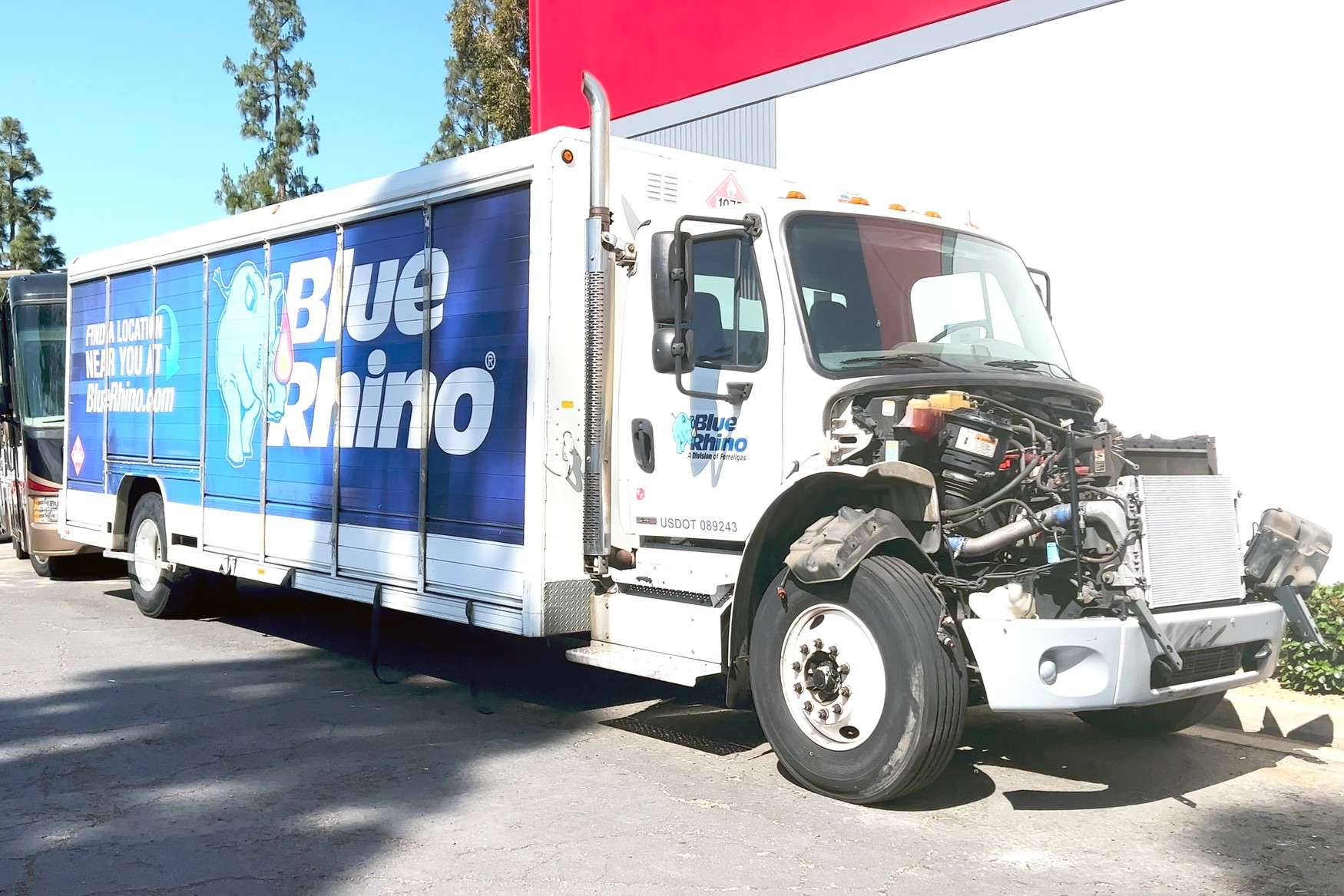
Commercial truck repair Orange County operators need is rarely just body work. Westminster fleets bring us trucks where a low speed dock hit moved a body mount, or a highway impact put a set in a frame rail that nobody measured. These are body on frame vehicles, which means the frame is the vehicle and the body is cargo equipment bolted to it. Measuring first is not a formality, it is the whole job.
Frame Rails Get Measured Before Anything Is Quoted
A commercial truck is a pair of steel rails with crossmembers, and everything else hangs on it. Suspension, steering, driveline, cab mounts and the body are all located by the frame. When a truck takes an impact, the rails either took a set or they did not, and there is no way to know by looking.
So measurement comes first on every collision job here, not after the panels are off. We measure the rails for sweep, sag, diamond and twist against published dimensions, and we check the critical points where suspension and cab mounts land. That measurement is what decides whether the job is a body repair or a structural one, and the two are wildly different numbers.
The failure mode of skipping this is specific and expensive. A truck with a rail out of tolerance eats steer tires, tracks with the rear axle offset, and stresses every body mount until the mounting holes elongate. Operators usually blame alignment for a year before anyone measures the frame.
- Measure sweep, sag, diamond and twist against published dimensions
- Check suspension and cab mount locations, not just rail straightness
- Inspect crossmember to rail connections for cracked welds or loose rivets
- Look at body mounting holes for elongation
- Re measure after any straightening operation
Cab, Body and Chassis Are Three Different Conversations
Every commercial truck estimate we write separates three things, because they have different parts sources, different labor rates and different lead times. The cab is automotive style repair with manufacturer parts. The body is equipment made by a body builder who is often a completely different company. The chassis is heavy duty mechanical work.
Owners frequently assume a truck dealer handles all three. Usually the dealer handles the chassis and the cab and sends the body somewhere else, which is how a truck ends up making two trips and sitting at two facilities. Doing all three under one roof is most of the value we offer on this category.
It also lets us sequence properly. Chassis work that requires the body off happens while the body is off for its own repair, rather than pulling the body twice. On a truck with a mounted body, that sequencing alone can take a week out of the downtime.
Bay Length and Door Height Decide What a Shop Can Take
A great many shops turn commercial trucks away for reasons that have nothing to do with skill. They cannot get the vehicle through the door, they cannot get it into a booth, or they cannot lift it. That is a facility constraint and it is why operators sometimes call four shops before finding one.
Our floor is 35,000 sq ft, sized for full length motorhomes and heavy trucks, with paint capacity that takes a full body rather than forcing panel only work outdoors. We run roughly 75 vehicles a month across every category.
The practical benefit is that we can keep a truck and its body together for the whole job. Splitting a truck between a chassis shop and a body shop adds transport, adds handoffs, and adds the risk that each facility assumes the other checked something.
Planning Downtime Instead of Reacting to It
For a working truck, the repair estimate is half the decision and the schedule is the other half. A three week repair on a truck that generates revenue daily is a different proposition than a five week one, even at the same price.
We plan around that in two ways. First, we schedule intake for when parts arrive rather than taking a truck in to sit. Second, on larger jobs we stage the work so the truck can return to service between phases where it is safe and legal to do so. A truck with a repaired cab and a body scheduled for next month is a truck that is earning.
For multi truck fleets we sequence units so an operator is never down more than one at a time, and we keep color formulas, decal measurements and body specifications on file so the second truck moves faster than the first.
- Book intake for when parts land, not before
- Stage large repairs so the truck earns between phases
- Sequence multi truck work to keep the fleet running
- Keep color and decal specifications on file for repeat work
- Give realistic dates rather than optimistic ones
Fleet Color, Decals and Numbering
Commercial paint has its own discipline. A fleet is rarely all one age, and a panel matched perfectly to the paint code can still look wrong beside a truck that has had five years of sun on it. We spray out and compare against the actual vehicle in daylight, then set the blend boundary by what the eye will see.
Decals, unit numbering and regulatory markings all have to go back where they were. We photograph and measure the layout before disassembly, including distances from body lines and door edges, so the reinstalled markings land in the same place rather than approximately there.
Where a body panel has been replaced, we plan the repair boundary around the decal layout wherever possible, because a paint edge that falls under a decal is invisible and one that falls beside it is not.
How a Commercial Estimate Differs From a Consumer One
Commercial customers want different things in an estimate, and we write them differently. Line items separated by cab, body and chassis so a maintenance manager can code them. Parts identified by number. Labor operations described rather than summarized. Photographs at teardown. A realistic completion date rather than a hopeful one.
Rates are posted and do not change by customer: body and paint at $210 per hour, mechanical at $260, diagnostic at $285 credited against an authorized repair. Parts carry 100 percent markup at or under $100 and 35 percent over $100, plus 7.75 percent California tax on parts and materials. Authorized repairs above $2,000 carry a 50 percent deposit.
A worked example: a dock impact on a truck body rear corner with no frame involvement typically runs 14 to 24 hours of body labor at $210 for $2,940 to $5,040, plus $800 to $2,800 in corner post, rail, hardware and refinish materials.
In this category
Types we work on
Box Truck
Box truck repair runs from about $1,500 for a door and rail repair to past $30,000 for structural body rebuilds. Almost everything...
Read moreSemi Truck
Semi truck collision repair runs from about $2,500 for hood and fairing work to past $50,000 for frame rail replacement with cab s...
Read moreFlatbed Truck
Flatbed truck repair runs from about $1,500 for deck board and pocket work to past $25,000 for subframe and crossmember rebuilds....
Read moreRefrigerated Truck
Refrigerated truck repair treats a puncture as a thermal breach rather than a dent. Once foam core takes on moisture it does not r...
Read moreQuestions
Frequently asked questions
Why do you measure the frame before writing an estimate?
Because on a body on frame truck the frame is the vehicle and everything else is located by it. Rails either took a set in the impact or they did not, and there is no way to tell by looking. We measure for sweep, sag, diamond and twist against published dimensions and check the points where suspension and cab mounts land. That measurement decides whether you have a body repair or a structural one, and those are very different numbers. Skipping it produces a truck that eats steer tires, tracks with the rear axle offset, and elongates its body mounting holes for years before anyone finds the cause.
How much does commercial truck repair cost?
The working range is $1,500 to past $50,000. A dock impact on a body rear corner with no frame involvement is typically $4,000 to $8,000. Cab panel and door repair with refinish runs $3,500 to $9,000. Frame straightening with suspension and alignment verification is $8,000 to $22,000. A serious collision involving cab structure, frame and body can pass $50,000. Body and paint labor is $210 per hour, mechanical is $260, diagnostic is $285 credited against an authorized repair, and repairs above $2,000 carry a 50 percent deposit.
Do you work on the body and the chassis, or just one?
Both, and that is most of the value on this category. A truck has three separate repair conversations: the cab, which is automotive style work with manufacturer parts, the body, which was built by a different company entirely, and the chassis, which is heavy duty mechanical work. Dealers commonly handle the cab and chassis and send the body elsewhere, so the truck makes two trips and sits at two facilities. Doing all three here also lets us sequence properly, so chassis work that needs the body off happens while the body is already off rather than pulling it twice.
How long will my truck be out of service?
Body panel and refinish work is typically one to two weeks. Cab structural repair with measurement is two to four weeks. Frame straightening with suspension and alignment verification is three to five weeks. Major collision work involving cab, frame and body runs six to twelve weeks and is parts driven. We book intake for when parts arrive rather than taking the truck in to sit, and on large jobs we stage the work so the truck can return to service between phases where that is safe and legal. For multi truck fleets we sequence so you are down one unit at a time.
Can you match our fleet colors and put the decals back correctly?
Yes. On color, we spray out and compare against the actual truck in daylight rather than trusting the paint code, because a fleet is rarely all one age and five years of Southern California sun moves a color further than operators expect. On decals, unit numbering and regulatory markings, we photograph and measure the layout before disassembly, including distances from body lines and door edges, so everything goes back where it was. Where possible we plan the paint boundary to fall under a decal, which hides the transition. Your formulas and layouts stay on file for the next truck.
My truck has been eating steer tires since an accident. Is that alignment?
It might be, but check the frame first. Alignment adjusts the steering geometry relative to the frame. If the frame itself has taken a set, you can align the truck perfectly and it will still track badly and wear tires, because the rear axle is offset relative to the front. We measure the rails for sweep, sag, diamond and twist before doing any alignment work, and we check the crossmember to rail connections for cracked welds and loose fasteners. Operators frequently spend a year and several sets of tires on alignment shops before anyone measures the frame.
Do you handle multiple trucks for one fleet?
Yes, and we schedule them so you are not down several at once. Trucks come in as the previous one leaves, and we keep color formulas, decal measurements and body specifications on file so each subsequent unit takes less shop time. For larger fleets we will hold recurring slots so routine damage does not wait for an opening. Estimates are written with line items separated by cab, body and chassis so a maintenance manager can code them, parts identified by number, and labor operations described rather than summarized. Tell us your reporting format up front and we will write to it.
Can your shop physically fit a heavy truck?
Yes. A lot of shops turn commercial trucks away for reasons that have nothing to do with skill: they cannot get the vehicle through the door, into a booth, or onto a lift. Our floor is 35,000 sq ft with bay length, door height and paint capacity sized for full length motorhomes and heavy trucks, and we run roughly 75 vehicles a month across all categories. The practical benefit is that the truck and its body stay together for the whole job, which avoids the transport, the handoffs and the gaps that appear when a truck is split between a chassis shop and a body shop.
How the work runs
Our six step repair process
The same sequence on every vehicle, whether it is a single coach or a fleet of box trucks.
- 01
Assessment and documentation
We put the vehicle on the floor, pull panels where we need to see behind them, and photograph everything. Hidden damage found now is damage that does not become a supplement argument later.
- 02
Written estimate
You get a line by line estimate with parts, labor hours, materials, and the posted rate applied to each. Nothing is bundled into a single number you cannot check.
- 03
Carrier coordination
If a claim is involved we deal with the adjuster directly, submit the documentation, and handle supplements when teardown reveals more than the first inspection showed.
- 04
Authorization and scheduling
Once the scope is approved we confirm the deposit, order parts, and give you a realistic slot. Special order parts drive the timeline more often than labor does.
- 05
Repair
Structural first, then body, then paint, then systems and interior. The sequence is not negotiable because each stage has to be right before the next one covers it up.
- 06
Quality check and delivery
Multi point inspection, systems tested under load, paint inspected under corrected lighting, and a walkthrough with you before the vehicle leaves.
Keep reading
Related pages
Related vehicles
Services we perform
Talk to a repair specialist today
Tell us what happened and we will tell you what the repair actually involves, what it costs, and how long it takes. We work directly with every major carrier and serve Westminster owners and fleets from our 35,000 square foot facility.
Posted labor rates are published on our prices page. Diagnostic and systems assessment fees are credited against an authorized repair.