Campers and Trailers
Toy Hauler Repair Starting at the Ramp Door
In short
Toy hauler repair runs from about $1,000 for hinge and cable work to past $40,000 for structural rebuilds of a rear wall and garage. The ramp door is the defining component: it is a door and a structural wall at the same time, and it is the most common repair we do on these units.
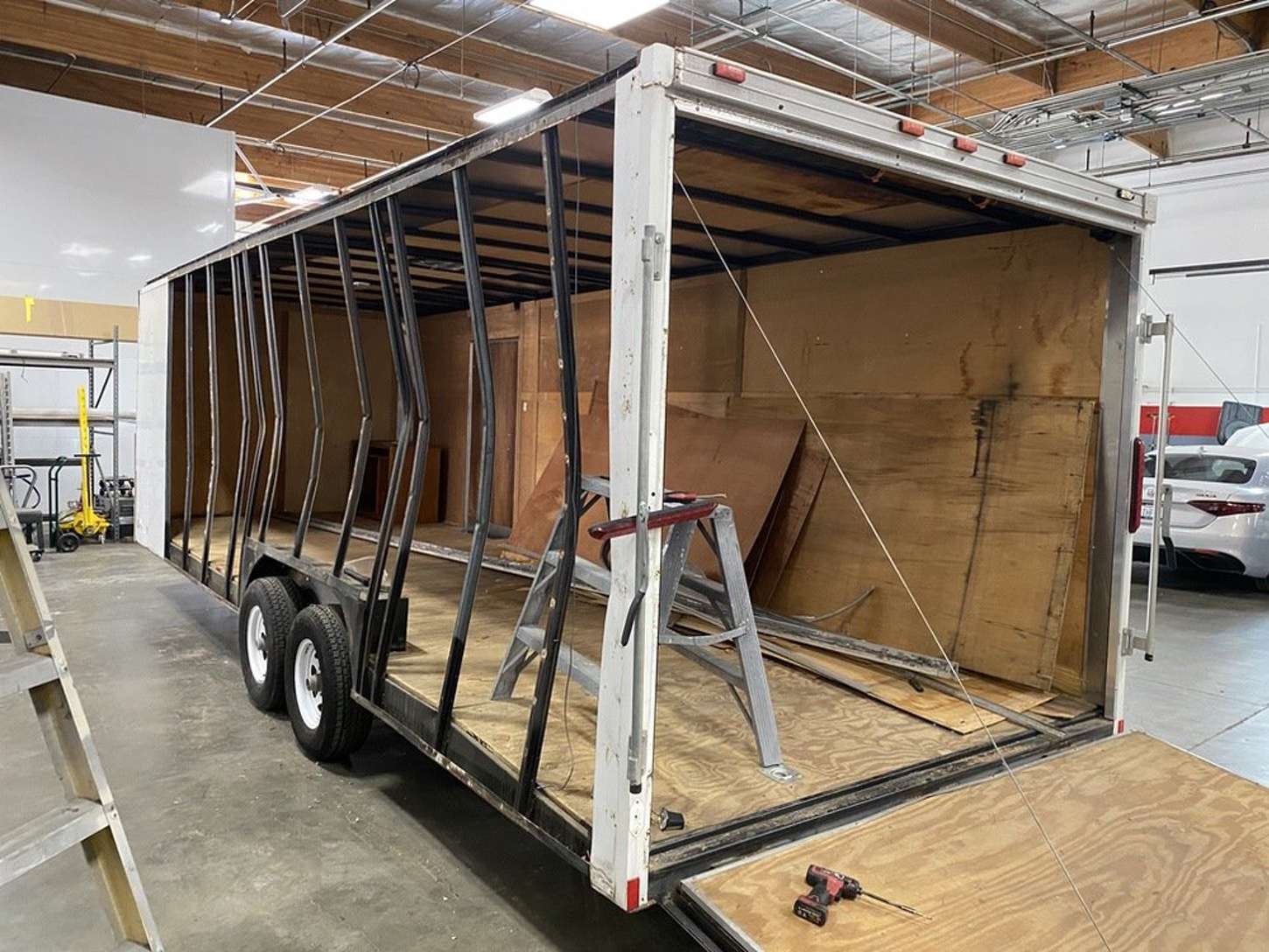
Toy hauler repair is trailer work with a loading dock attached, and Westminster owners who haul bikes, quads or a side by side bring us the same job over and over. The ramp door is both a door and a load bearing rear wall, so every time it takes a hit or a hinge tears, the trailer loses structure as well as a door. Everything else on this page follows from that one fact.
The Ramp Door Is Structure, Not Just a Door
When the ramp is closed and latched, it closes the box. The rear wall of a toy hauler is a large opening with a door filling it, and the door plus its latches are carrying part of the load that keeps the rear of the trailer square. Open the ramp and the box loses a wall, which is why loading a heavy machine with the trailer poorly supported is such a good way to tweak the structure.
The failures we see follow directly from that. Hinge tear out at the rear wall, where the hinge fasteners have pulled through laminated panel that was never meant to take that load alone. Bent ramp frames from loading at an angle. Latches that no longer engage because the opening has changed shape rather than because the latch failed.
So we assess the opening first. If the rear wall opening is out of square, a new door will not latch correctly either, and hanging one is a way to spend money learning what a measurement would have told us in an hour.
- Measure the rear opening diagonally before ordering a door
- Inspect hinge fasteners and the panel they pass through
- Check the ramp frame for twist along its length
- Look for elongated holes at the latch strikers
- Verify the trailer sits level when the ramp is used
Cables, Springs and the Lift Hardware
Most ramps use cables and a spring assist so a person can raise a heavy door alone. Those cables are steel rope running over pulleys under constant tension, and they fail progressively: a few broken strands, then a visible flat spot, then failure under load. Once one cable goes, the door twists as it falls and takes the hinge line with it.
Inspection is quick and worth doing every season. Run a rag along the cable and it will catch on broken strands before you can see them. Check the pulleys for grooving and the anchor points for elongation. Replacing a pair of cables is inexpensive maintenance and the failure it prevents is not.
Spring assist hardware also has a service life, and a spring that has lost tension makes the door heavy enough that owners start slamming it, which loads the hinge line and starts the whole cycle over.
Garage Floor Tie Downs That Pull Through
The tie down anchors in the garage floor were installed into a floor structure with a specific capacity, and the loads a strapped machine puts into them during a hard stop are much higher than the static weight suggests. What we see is anchors pulling up through the decking, taking a cone of floor material with them, and leaving a hole that then admits water from the road.
Repair means more than replacing the anchor. We open the floor around the failure, evaluate the framing underneath, and re anchor into structure with backing plate rather than into decking alone. Where several anchors have failed, that usually indicates the original layout put them between framing members, and the right fix is relocating them to land on structure.
Water damage from a pulled anchor is common and often unnoticed, because it is under a floor covering in a garage that carries dirty equipment. We meter the floor around every anchor when a unit comes in for related work.
Reinforced Rear Structure and Heavier Running Gear
Toy haulers carry more weight than a comparable travel trailer and they carry it further back. That means heavier axles, higher rated tires, stronger springs and a frame with more material at the rear. It also means that when the running gear is neglected, the consequences arrive sooner.
Tire load rating is the specific thing owners get wrong. A tire that was correct for the trailer empty is not correct with a thousand pounds of machine in the garage, and a blowout on a loaded toy hauler does serious damage to the fender, the sidewall above it and sometimes the floor.
We inspect running gear as a system at the $260 mechanical rate: bearings and seals, brake magnets and drums, springs, shackles and bushings, and axle alignment. On a heavily loaded trailer these components wear faster and the inspection interval should reflect that.
- Match tire load rating to loaded weight, not empty weight
- Inspect springs and shackles more often on a loaded unit
- Check brake performance loaded, not just at the shop
- Verify axle alignment after any hard braking event
- Watch for uneven tire wear as a first sign of a bent axle
How Garage Damage Travels Into the Living Area
A loaded garage changes how an impact propagates. On an empty trailer, a rear hit deforms the rear wall and stops. With a machine strapped in the garage, that same hit drives the load forward through the tie downs into the floor structure and often into the wall separating the garage from the living area.
So after any rear impact on a loaded unit, we inspect forward of the damage as a matter of course: the tie down anchors, the garage floor framing, and the divider wall including its door frame. Damage there is easy to miss because it does not show from outside.
A worked example: a rear impact with a bent ramp frame, torn hinge line and no forward damage typically runs 20 to 32 hours of body labor at $210 for $4,200 to $6,720, plus $1,200 to $3,800 in ramp components, hinge, hardware and refinish materials. Once the divider wall and floor framing are involved, expect $12,000 to $28,000.
Questions
Frequently asked questions
My ramp door will not latch anymore. Is it the latch?
Usually not. The ramp closes a large opening in the rear wall, and when the trailer structure moves, that opening changes shape and the latches stop lining up. Replacing latches on a distorted opening produces a door that still does not close. We measure the opening diagonally first, check the ramp frame for twist, and inspect the hinge line and its fasteners. If the opening is out of square, that comes first. If the opening is true and the ramp frame is bent, the frame is repaired or replaced. Latches are the last thing on the list, not the first.
How much does toy hauler repair cost?
The range is about $1,000 to past $40,000. Cable and spring assist replacement is at the low end. Hinge line repair with rear wall reinforcement typically runs $2,500 to $6,000. A rear impact with a bent ramp frame and torn hinge line is commonly $6,000 to $11,000. Once the damage travels forward into the garage floor framing and the divider wall, expect $12,000 to $28,000, and full structural rebuilds pass $40,000. Body and paint labor is $210 per hour, mechanical is $260, and authorized repairs above $2,000 carry a 50 percent deposit.
How often should ramp cables be replaced?
Inspect them every season and replace at the first sign of broken strands. The quickest check is to run a rag along the cable: it snags on broken strands before your eye can see them. Also look at the pulleys for grooving and the anchor points for elongated holes. Cables fail progressively, and once one lets go the door twists as it falls and takes the hinge line with it, turning an inexpensive maintenance item into a structural repair. Spring assist hardware has a service life too, and a weak spring makes the door heavy enough that people start slamming it, which loads the hinges.
A tie down anchor pulled out of my garage floor. Can you just replace it?
We can, but we should not do it that way. When an anchor pulls through, it takes a cone of decking with it, which tells us the anchor was fastened into decking rather than into framing, or that the framing under it has softened. The correct repair opens the floor around the failure, evaluates the framing, and re anchors into structure with a backing plate to spread the load. If several anchors have failed, the original layout probably placed them between framing members and the right answer is relocating them. We also meter the surrounding floor, because a pulled anchor leaves a hole that admits road water.
Do I need different tires for a loaded toy hauler?
You need tires whose load rating covers the trailer loaded, and that is where owners most often get caught. A tire adequate for the empty trailer can be well past its rating with a machine and fuel in the garage, and toy haulers carry that weight toward the rear where it loads one axle more than the other. A blowout on a loaded unit damages the fender, the sidewall above it and often the floor structure, which costs far more than the tire. Age matters as much as tread depth in Southern California, since sun degrades sidewalls long before the tread wears out.
Can damage in the garage affect the living area?
Yes, and this is the part owners do not expect. On an empty trailer a rear impact deforms the rear wall and stops. With a machine strapped down, the same impact drives load forward through the tie downs into the floor structure and often into the wall between the garage and the living area. That damage does not show from outside, so we inspect forward of any rear impact as a matter of course: anchors, garage floor framing, and the divider wall including its door frame. Finding it during the estimate rather than during reassembly is the difference between one repair and two.
Is the rear wall on a toy hauler weaker than on a normal trailer?
It is different rather than weaker. The rear wall is mostly a large opening, so the builder reinforces the structure around that opening and relies on the closed and latched ramp to help keep the box square. That works well when everything is in good order. It stops working when the hinge line tears, when the latches no longer engage, or when the trailer is loaded with the ramp down and inadequately supported. The reinforcement is also why hinge repairs on these units are structural work rather than a hardware swap: the fasteners have to land in structure with proper backing.
How long does ramp door work take?
Cable, pulley and spring assist replacement is usually one to two business days. Hinge line repair with rear wall reinforcement is one to two weeks. A bent ramp frame that has to be straightened or replaced, with refinish, is two to four weeks and depends on parts. Once the damage reaches the garage floor framing and the divider wall, expect four to eight weeks. The long lead item is nearly always the ramp assembly itself on a discontinued unit, and where one cannot be sourced we fabricate. The 50 percent deposit on work over $2,000 lets that order go in on approval day.
How the work runs
Our six step repair process
The same sequence on every vehicle, whether it is a single coach or a fleet of box trucks.
- 01
Assessment and documentation
We put the vehicle on the floor, pull panels where we need to see behind them, and photograph everything. Hidden damage found now is damage that does not become a supplement argument later.
- 02
Written estimate
You get a line by line estimate with parts, labor hours, materials, and the posted rate applied to each. Nothing is bundled into a single number you cannot check.
- 03
Carrier coordination
If a claim is involved we deal with the adjuster directly, submit the documentation, and handle supplements when teardown reveals more than the first inspection showed.
- 04
Authorization and scheduling
Once the scope is approved we confirm the deposit, order parts, and give you a realistic slot. Special order parts drive the timeline more often than labor does.
- 05
Repair
Structural first, then body, then paint, then systems and interior. The sequence is not negotiable because each stage has to be right before the next one covers it up.
- 06
Quality check and delivery
Multi point inspection, systems tested under load, paint inspected under corrected lighting, and a walkthrough with you before the vehicle leaves.
Keep reading
Related pages
Related vehicles
Services we perform
Talk to a repair specialist today
Tell us what happened and we will tell you what the repair actually involves, what it costs, and how long it takes. We work directly with every major carrier and serve Westminster owners and fleets from our 35,000 square foot facility.
Posted labor rates are published on our prices page. Diagnostic and systems assessment fees are credited against an authorized repair.