Mechanical and Systems
RV Generator Repair When the Genset Will Not Start or Will Not Carry a Load
In short
Most RV generator repair falls between $400 and $8,500, and the most common cause we see is varnished fuel sitting in a carburetor through a long storage stretch. A carburetor service with fuel filter, plugs, and an oil change typically runs about $1,300 and two days in the shop. Westminster owners who exercise the unit monthly under real load rarely see us for that particular bill.
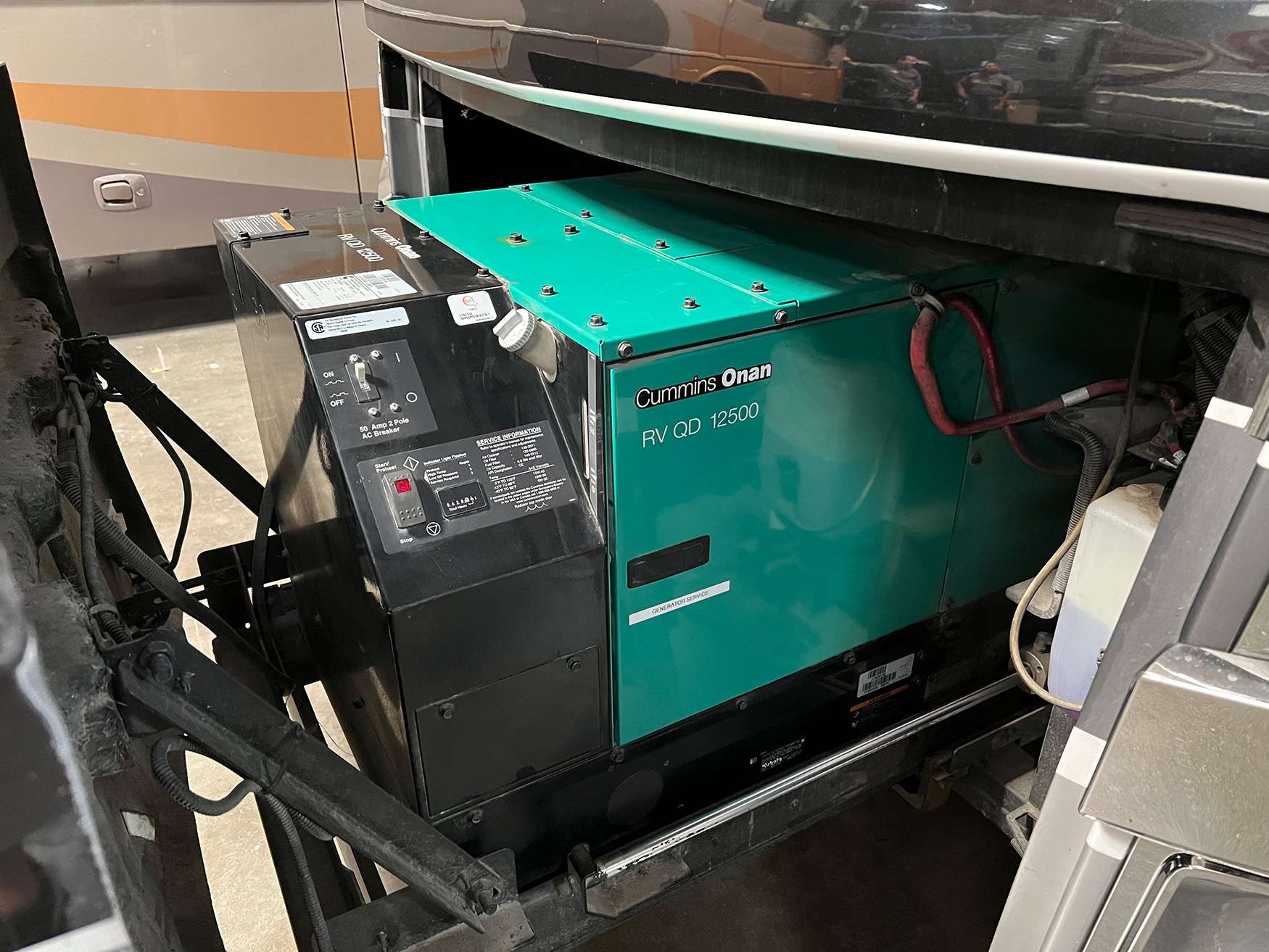
Most RV generator repair calls start the same way: the unit sat for eight months, the owner turned the key the week before a trip, and it cranks without catching. Ethanol blended gasoline turns to varnish in a carburetor bowl in as little as sixty days of heat. From there the work splits three ways, a unit that will not start, one that starts and dies, and one that runs fine but produces nothing at the outlets.
LP, Gasoline, and Diesel Gensets Are Different Animals
LP fueled gensets are the cleanest of the three to live with. Propane does not varnish, does not absorb water, and does not leave gum in a carburetor, so a unit that sits for a season usually starts. What LP costs you is output per pound of fuel and cold weather behavior, since tank pressure falls as the tank empties and as temperature drops. LP units also need a regulator in good condition; a lazy regulator shows up as surging under load, not as a fuel problem.
Gasoline gensets are the most common on motorhomes and the most common in our bays. They share a tank with the chassis engine, they draw from a dedicated pickup tube, and they suffer badly from fuel that sits. They are also the cheapest to buy and to rebuild, which is why they still dominate. Expect a carburetor to be the first suspect on any gasoline unit that has been parked more than a few months.
Diesel gensets on larger coaches are built to a heavier standard and will run three to five times the hours of a small air cooled gas unit before major work. In exchange they want clean fuel and clean air without exception. Injector and lift pump problems on a diesel genset are rarely cheap, and the water separator is the single most neglected part on the whole machine. Drain it, and most diesel fuel system trouble never happens.
Fuel Varnish and the Pickup Tube That Strands You
Ethanol blended pump gasoline is hygroscopic, meaning it pulls moisture out of the air, and it begins breaking down within thirty to sixty days in a vented bowl in summer heat. What is left behind is varnish, a hard amber glaze that plugs the main jet, the idle circuit, and the tiny emulsion holes you cannot see without magnification. That is why a unit cranks strongly, has spark, has fuel in the line, and still will not catch. The fuel is there; it cannot get through the passages.
Carburetor service is not always a rebuild. If the varnish is light we can clean the bowl, soak and blow the jets, replace the needle and seat, and put it back. If the throttle shaft is worn or the body is corroded, a replacement carburetor is the honest recommendation, because a cleaned carburetor on a worn body will surge under load and bring the coach back to us in a month.
Then there is the detail that surprises owners. On a motorhome that shares one tank, the generator fuel pickup tube is deliberately cut short so it stops drawing at roughly a quarter tank. That is not a defect. It exists so the genset cannot run the tank dry and leave you unable to drive. If your generator quits and the gauge reads a quarter, add fuel before we start diagnosing anything else, because that is the system working as designed.
- Stabilize fuel or run the carburetor dry before any storage over sixty days
- Replace the inline fuel filter at every carburetor service, not every other one
- Expect the generator to stop drawing around a quarter tank on shared tank coaches
- Surging under load after a cleaning usually means a worn throttle shaft
- Drain the diesel water separator on a schedule, not when a fault appears
No Start, Starts and Dies, or No Output
A unit that will not start at all is a three legged problem: fuel, spark, and compression, tested in that order. We confirm fuel pressure or LP supply at the carburetor, pull a plug for spark and to read how the engine has been running, then take a compression reading. Low compression on an air cooled gas genset with high hours often means a scored cylinder or stuck rings from long storage, and that is the moment the conversation shifts from repair to replacement.
Starts and dies is almost always fuel delivery or air. It runs on what is in the bowl, then quits when the bowl cannot refill. Causes we find regularly are a plugged fuel filter, a failing fuel pump, a pinched or cracked supply line drawing air, a mouse nest in the intake, or an LP regulator that cannot keep up. On units with a low oil shutdown, a low oil level or a failed pressure switch produces the same symptom and confuses a lot of people.
Runs but makes no power is an electrical fault, not an engine fault, and it is the one where diagnostic time saves real money. On brush type units we check brush length, spring pressure, and the condition of the slip rings, which glaze and pit over time. On brushless units we test the capacitor, the rotor and stator windings, and the voltage regulator or control board. We also check the obvious first, because a tripped generator breaker or a transfer switch stuck in the shore position accounts for more no output calls than any single component.
- No start: verify fuel, then spark, then compression, in that order
- Starts and dies: filter, pump, cracked supply line, intake blockage, low oil shutdown
- No output: generator breaker, transfer switch, brushes, slip rings, capacitor, control board
- Surging under load: worn throttle shaft, weak LP regulator, or partially plugged jets
- Cranks slowly: check the starting battery before condemning the starter
Exercise Intervals, Oil, and Real Load
A generator is the one appliance in an RV that fails from disuse. Run it two hours a month, and run it under load, not at idle with nothing switched on. Half of rated output is a good target, which on a 4,000 watt unit means running an air conditioner and a couple of other things. Loaded operation gets the engine hot enough to boil moisture out of the crankcase, keeps the rings sealing, and burns off the carbon that light running leaves behind on the valves and exhaust.
Oil intervals on small air cooled gasoline gensets are short, commonly one hundred hours or once a season, whichever comes first. Liquid cooled and diesel units usually go one hundred fifty hours. These engines hold very little oil, run hot, and have no filter on some models, so a schedule that looks aggressive next to a car is normal here. We change oil and filter, clean or replace the air filter, check the spark arrestor screen, and inspect the plug at every service.
Keep an hour meter reading in your notes. Hours tell us far more than years do about what a unit needs and what it is worth. A ten year old genset with 300 hours is barely broken in. A four year old unit with 3,000 hours from full timing is approaching the end of its economical life, and knowing that changes how we advise you on a large repair.
- Two hours a month at roughly half rated load, every month
- Oil and filter every 100 hours on air cooled gas, 150 on most diesel units
- Air filter and spark arrestor screen checked at every oil service
- Record hour meter readings; hours matter more than calendar age
- Stabilize the fuel any time the coach will sit more than two months
Exhaust, Carbon Monoxide, and the Sound Enclosure
Exhaust is the part of generator service nobody thinks about until it matters. The tailpipe has to exit past the outermost edge of the sidewall and point away from the coach, with no cracks, no rusted through sections, and intact flexible joints at the engine. A cracked exhaust tube inside a compartment can put carbon monoxide into the living space through a floor penetration or a slide seal within minutes, and the failure gives almost no warning you would notice while asleep.
We inspect the entire exhaust path on every generator that comes in, pressure permitting, and we replace rather than patch. We also check the carbon monoxide alarm, which has a service life of five to seven years from its date of manufacture regardless of whether the battery is good. An alarm past that date is a decoration. Replace it, and test it with the generator running before you take a trip.
The sound enclosure is more than noise control. Those foam panels direct cooling air across the engine, and when they are missing, oil soaked, rodent chewed, or left off after a previous repair, the unit runs hotter and louder and pulls its own hot exhaust air back through the intake. Missing panels routinely add six to ten decibels, which is the difference between a genset a campground tolerates and one it does not. Replacement panels are inexpensive next to a heat related failure.
Repair Cost Against Replacement Cost
A carburetor service on a gasoline genset is the most common ticket we write. Three and a half hours of mechanical labor at $260 per hour is $910. The carburetor kit at $85 doubles to $170 under our markup rule, the fuel filter at $22 becomes $44, two spark plugs at $14 each become $56, and oil with a filter at $48 becomes $96. Parts total $366, sales tax of 7.75 percent on parts adds $28.37, and the out the door number is $1,304.37 with no deposit required below $2,000.
A unit that runs but makes no power is a different bill. Diagnostic labor is $285 per hour and is credited against an authorized repair, and ninety minutes at $427.50 usually identifies whether you are looking at brushes, slip rings, a capacitor, or a control board. Brushes and a slip ring cleanup is about two hours of labor at $520 plus a $60 brush set that becomes $120, plus $9.30 in tax, for $649.30. A control board at $520 becomes $702 after markup, and with three hours of labor and tax that lands at $1,536.41.
When a genset has low compression, a scored cylinder, or a failed stator on top of a rusted fuel system, a rebuild stops making sense. A replacement 4,000 watt gasoline unit at $4,200 becomes $5,670 after the 35 percent markup applied to parts over $100. Add an exhaust kit at $351, fuel line and fittings at $180, and isolation mounts at $162, then seven hours of installation labor at $1,820 and $493.13 in tax. The total is $8,676.13, with a 50 percent deposit of $4,338.07 collected before we order.
Our rule of thumb is simple. If the estimated repair passes roughly sixty percent of the installed cost of a comparable new unit, and the old machine is past 2,500 hours, replacement is the better use of your money. Below that line, repair almost always wins, because a maintained genset will run three thousand to five thousand hours. We will show you both numbers on the estimate and let you decide with the arithmetic in front of you.
- Mechanical labor $260 per hour, diagnostic labor $285 per hour credited against approved work
- Parts markup: 100 percent at or under $100, 35 percent above $100
- Sales tax of 7.75 percent on parts and materials only; labor is not taxed
- Deposit of 50 percent on any authorized job above $2,000
- Replacement is usually the better value past 2,500 hours on a small gas unit
Questions
Frequently asked questions
My generator cranks but will not start after storage. What is it?
Nine times out of ten it is the carburetor. Ethanol blended gasoline breaks down in thirty to sixty days in summer heat and leaves a hard varnish glaze in the main jet, the idle circuit, and the emulsion passages. The engine has spark, it has fuel in the line, and none of that fuel can get through the passages into the venturi. We pull the carburetor, inspect the throttle shaft for wear, and either clean and rebuild it or replace it if the body is corroded. Expect a fuel filter, plugs, and an oil change in the same visit, since the unit is apart and those items are almost always overdue.
Why does my generator quit when the tank still shows a quarter?
Because it is supposed to. On a motorhome where the generator shares the chassis fuel tank, the generator pickup tube is cut short on purpose so it stops drawing at roughly a quarter tank. That design keeps the genset from emptying the tank and leaving you unable to drive the coach to a station. It is not a fault, and no repair will change it without defeating the safety intent. If your generator shuts down and the gauge reads near a quarter, add fuel first. If it still will not run with half a tank in it, then we start looking at the fuel pump, filter, and carburetor.
How often should I run my RV generator?
Two hours a month, under load. Idling it with nothing switched on does more harm than good, because the engine never reaches operating temperature, moisture stays in the crankcase, and carbon builds on the valves. Aim for roughly half of rated output, which on a 4,000 watt unit means running an air conditioner plus a few smaller loads. Monthly loaded operation keeps the fuel in the bowl fresh, keeps the rings seated, keeps the brushes and slip rings clean on brush type units, and exercises the automatic voltage regulation. It is the single cheapest thing an owner can do to avoid a four figure repair bill later.
The generator runs but nothing works inside. What is wrong?
Start with the two cheapest possibilities. Check the breaker on the generator itself, which is usually on the end panel and trips on overload, then check whether the automatic transfer switch actually moved over from the shore position. Those two account for a large share of the no output calls we take. If both are fine, the fault is in the generating end rather than the engine, and we test in this order: brush length and spring pressure, slip ring surface condition, the capacitor on brushless units, then rotor and stator winding resistance, then the voltage regulator or control board. Diagnostic labor is $285 per hour and is credited against the repair if you approve it.
Can I run my generator while we sleep?
We do not recommend it, and here is the honest reason. Carbon monoxide from a generator is odorless, and the failure modes that let it into a coach are quiet ones: a hairline crack in an exhaust tube inside a compartment, a rusted flexible joint at the engine, a failed floor grommet, or wind pushing exhaust back along the sidewall into an open window. Your carbon monoxide alarm is the only thing standing between that and a very bad night, and those alarms expire five to seven years after manufacture whether or not the battery is good. Check the date on yours. If you must run overnight, make sure the exhaust exits well past the sidewall and the alarm is current.
How much is a carburetor rebuild on an RV generator?
A representative gasoline genset carburetor service comes to $1,304.37. That is three and a half hours of mechanical labor at $260 per hour, which is $910, plus parts: a carburetor kit at $85 that becomes $170 under the 100 percent markup on items at or under $100, a fuel filter at $22 that becomes $44, two spark plugs that become $56, and oil with a filter at $48 that becomes $96. Parts total $366 and sales tax of 7.75 percent on parts adds $28.37. Labor is not taxed in California. If the carburetor body is corroded or the throttle shaft is worn, a replacement unit instead of a kit adds roughly $200 to $400.
When is it smarter to replace the generator than repair it?
We use two numbers. The first is hours on the meter; past about 2,500 hours a small air cooled gasoline unit is near the end of its economical life. The second is the repair estimate against the installed cost of a comparable new unit. When the repair passes roughly sixty percent of that installed cost, replacement is the better money, because you are buying a new service life rather than extending a tired one. A full replacement with exhaust, fuel line, isolation mounts, and seven hours of installation labor runs in the neighborhood of $8,676 for a 4,000 watt gasoline unit. We put both numbers on the estimate so the choice is arithmetic, not persuasion.
Do you work on LP generators and diesel units?
Yes, all three fuel types. LP units rarely have fuel varnish problems, so their faults tend to be regulator pressure, ignition, and the generating end rather than the carburetor. Diesel gensets on larger coaches need clean fuel above everything else, and the water separator is the most neglected component on the machine; injector and lift pump work on those is real money, so we push maintenance hard. Gasoline units are the bulk of what comes through the bays and the ones most affected by long storage. Whichever you have, bring the hour meter reading and a rough history of how often it has been run, because that shapes the estimate more than the fuel type does.
Standard on every job
What is included
These are not upgrades. They are how the work is run on every vehicle that comes through the building.
Full teardown where it is needed
We do not estimate through a closed panel. If the damage path runs behind trim or skin, we open it and document what is actually there.
Written, itemized scope
Parts, labor hours, and materials listed separately against the posted rate, so every line is something you can question.
Direct carrier communication
We talk to the adjuster so you are not relaying technical detail between two parties who both expect you to already understand it.
Supplement handling
When teardown finds more than the original inspection, we document and submit the supplement rather than absorbing it into a vague overage.
Correct repair sequence
Structural before cosmetic, every time. A straight body over a bent frame is a repair that fails its second life.
Systems tested under load
Electrical, plumbing, generator, and climate systems are run and verified before delivery, not just reconnected and assumed good.
Photo documentation throughout
Before, during, and after. Useful for your records, and decisive if a claim is ever revisited.
Delivery walkthrough
We go over what was done, what was replaced, and what to watch, in person, with the vehicle in front of you.
How the work runs
Our six step repair process
The same sequence on every vehicle, whether it is a single coach or a fleet of box trucks.
- 01
Assessment and documentation
We put the vehicle on the floor, pull panels where we need to see behind them, and photograph everything. Hidden damage found now is damage that does not become a supplement argument later.
- 02
Written estimate
You get a line by line estimate with parts, labor hours, materials, and the posted rate applied to each. Nothing is bundled into a single number you cannot check.
- 03
Carrier coordination
If a claim is involved we deal with the adjuster directly, submit the documentation, and handle supplements when teardown reveals more than the first inspection showed.
- 04
Authorization and scheduling
Once the scope is approved we confirm the deposit, order parts, and give you a realistic slot. Special order parts drive the timeline more often than labor does.
- 05
Repair
Structural first, then body, then paint, then systems and interior. The sequence is not negotiable because each stage has to be right before the next one covers it up.
- 06
Quality check and delivery
Multi point inspection, systems tested under load, paint inspected under corrected lighting, and a walkthrough with you before the vehicle leaves.
Keep reading
Related pages
Related services
Vehicles we repair
Talk to a repair specialist today
Tell us what happened and we will tell you what the repair actually involves, what it costs, and how long it takes. We work directly with every major carrier and serve Westminster owners and fleets from our 35,000 square foot facility.
Posted labor rates are published on our prices page. Diagnostic and systems assessment fees are credited against an authorized repair.