Our process
How a Repair Runs From Intake to Delivery
In short
Assessment and documentation, written estimate, carrier coordination, authorization and scheduling, repair in a fixed sequence, then quality control and a walkthrough. The same order on every vehicle, whether it is one coach or a group of fleet trucks.
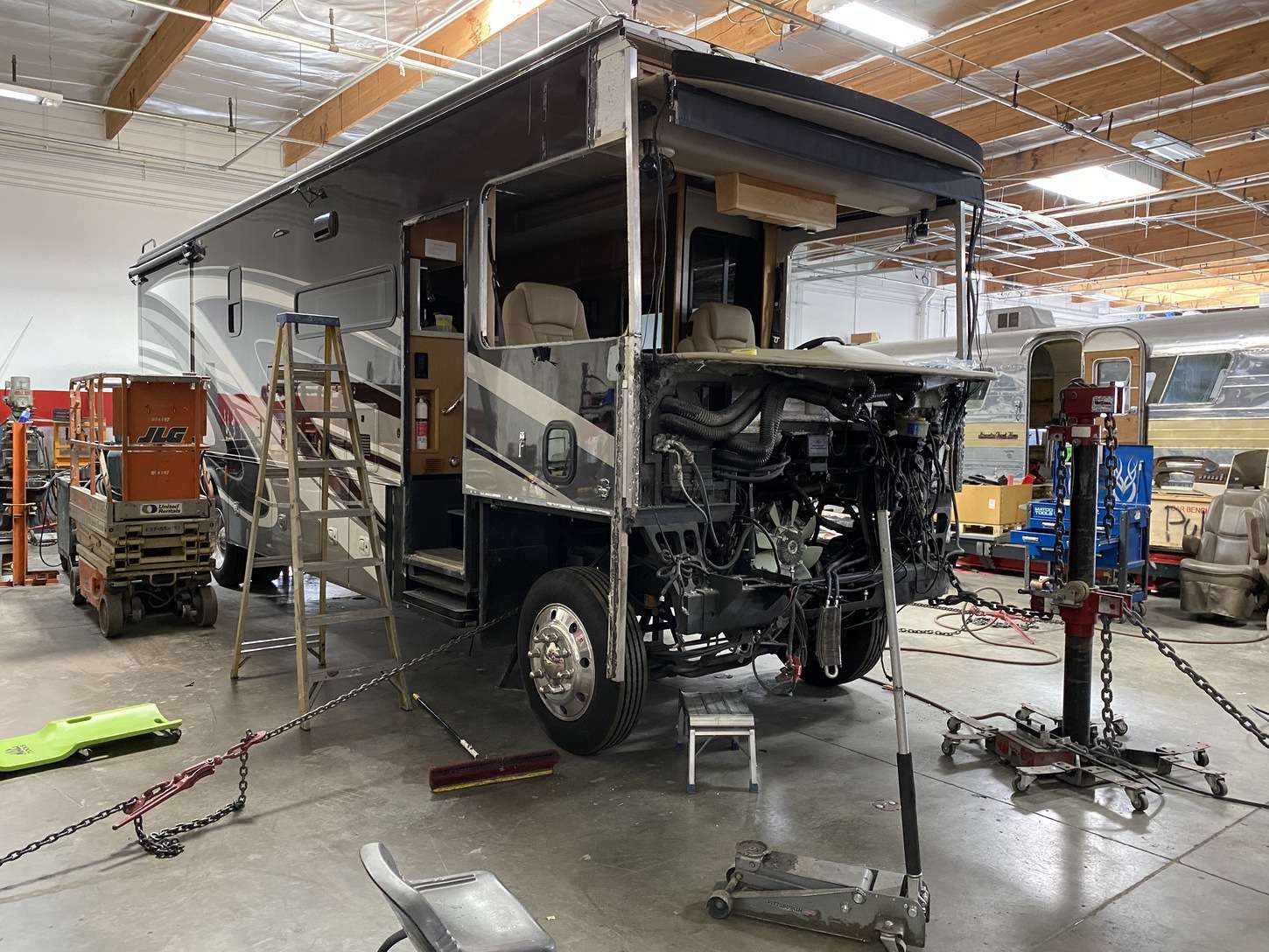
The process below is not a marketing diagram. It is the order the work physically has to happen in, and the reason it is written down is that every stage seals in the one before it. What follows the summary is the detail owners actually ask about: what we do at intake, why teardown changes the number, how a supplement works, and what gets checked before anything leaves the property.
How the work runs
Our six step repair process
The same sequence on every vehicle, whether it is a single coach or a fleet of box trucks.
- 01
Assessment and documentation
We put the vehicle on the floor, pull panels where we need to see behind them, and photograph everything. Hidden damage found now is damage that does not become a supplement argument later.
- 02
Written estimate
You get a line by line estimate with parts, labor hours, materials, and the posted rate applied to each. Nothing is bundled into a single number you cannot check.
- 03
Carrier coordination
If a claim is involved we deal with the adjuster directly, submit the documentation, and handle supplements when teardown reveals more than the first inspection showed.
- 04
Authorization and scheduling
Once the scope is approved we confirm the deposit, order parts, and give you a realistic slot. Special order parts drive the timeline more often than labor does.
- 05
Repair
Structural first, then body, then paint, then systems and interior. The sequence is not negotiable because each stage has to be right before the next one covers it up.
- 06
Quality check and delivery
Multi point inspection, systems tested under load, paint inspected under corrected lighting, and a walkthrough with you before the vehicle leaves.
Step one in detail
Intake, and why the vehicle comes inside first
An assessment performed in the parking lot is a description of what a surface looks like. On a bonded vehicle that is close to useless, because the panel is the structure and the structure is glue. So the unit comes onto the floor. Trim, moldings, and panels come off wherever we need to see behind them. Interior surfaces get opened where a reading suggests water has traveled. If the impact pattern suggests the chassis moved, the vehicle goes on the rack and gets measured before anyone writes a number.
Moisture mapping happens on every water related intake and on most collision intakes too, because a hard impact opens seams that were previously sealed. A meter reading is recorded with its location, so the wet area can be drawn rather than guessed at. This is the single most valuable twenty minutes in the whole process. The wet region is nearly always larger than the stain that prompted the call, and finding that before the estimate is written is the difference between an accurate scope and an argument in week three.
Everything is photographed as it happens, in stages. Wide shots establishing where the damage sits on the vehicle, then closer shots of each area, then shots taken as each layer comes off. Those images do two jobs. They become the evidence in the carrier file, and they become the record we can show you later when you ask why a line reads the way it does. An assessment fee covers this work, and it is credited against an authorized repair.
Step two in detail
The written estimate, line by line
The estimate you receive lists each part with its number and its expected lead time, each labor operation with its hours and the applicable posted rate, materials calculated per paint hour and per body hour rather than dropped in as a lump sum, sublet where any applies, and tax shown separately because in California labor is not taxed and parts and materials are. If a deposit applies, the schedule is on the estimate too rather than introduced later.
Under the labor lines there is written reasoning. Not a code, a sentence: why the operation is required, what it accomplishes, and why it takes the hours listed. This is partly for you and largely for the adjuster, who has to justify the authorization to someone else. On a vehicle type that is unfamiliar to most claims staff, an explanation attached to each line converts a file that gets questioned into a file that gets approved.
Where we expect teardown to expose more, the estimate says so explicitly and gives the probable range with the reason attached. Owners sometimes read that as hedging. It is the opposite of hedging. It is telling you the difficult part of the story on day one, while the vehicle is still on the trailer and you still have every option available, rather than at the point where the interior is out and you have none.
Steps three and four in detail
Carrier coordination, authorization, and scheduling
If a claim is involved we deal with the adjuster directly. That means submitting the documentation package, reconciling our estimate against the carrier estimate line by line where they differ, and handling the negotiation over specific operations rather than over totals. Insurance billed work may be invoiced at a carrier negotiated labor rate that differs from our posted retail rates, which is a normal arrangement and usually works in the owner's favor because the negotiated rate is what the carrier pays without argument.
Once scope is approved, we confirm the deposit, order parts, and give you a realistic slot. The deposit schedule is published: 50 percent at authorization on work above $2,000, and an additional 25 percent when parts arrive on work above $10,000. Special order parts require a full non refundable deposit at the time we place the order, because those components are frequently non returnable once they are cut, drilled, or built against a specific unit.
Scheduling is built around parts arrival, not around the calendar. Pulling a vehicle into a bay before its critical part exists occupies a working space and accomplishes nothing, so a unit waiting on a long lead component sits in staging until the part is close. That is why we ask about your use of the vehicle at intake. If you have a trip, a season, or a fleet rotation to work around, that changes what we order first and occasionally changes the repair approach entirely.
Step five in detail
Repair, and how supplements are handled once it starts
Work runs structural first, then body and laminate, then refinishing, then systems and interior reinstallation. Structural correction is a measurement exercise: anchor, establish reference points, apply controlled force, and verify the numbers returned to specification rather than stopping when it looks right. Body and laminate work rebuilds the layers so the assembly carries load again, which is a different job from making a surface flat. Refinishing follows color development and spray out against the actual adjacent panels, not against the paint code.
When something is found mid repair that was not in the approved scope, work on that area stops. The finding is photographed with the surrounding context, a supplement is written with the reasoning attached, and it goes to you and to the adjuster where a claim applies. Nothing extra is performed until it is approved. That is both the legal position under California repair rules and the only workable one, because a shop that performs first and explains later ends up with an invoice nobody will pay.
You are welcome on the floor during business hours to see the vehicle in whatever state it is in. Owners who look at their own torn down coach with a technician standing next to it make better decisions than owners who only ever see paperwork, particularly on the judgment calls: repair or replace a section, restore or upgrade an interior, address a secondary issue now while the wall is already open or defer it.
Step six in detail
What final quality control actually checks
The foreman signs this inspection, and the estimator who owns the file runs a second pass against the paperwork.
| Area | What is verified |
|---|---|
| Structure | Measurement points re verified against specification and the printout added to the file |
| Fit and gaps | Every reassembled panel, door, hatch, and compartment checked for even gap and correct closure |
| Finish | Gloss, texture, and color checked against adjacent panels under corrected lighting and in daylight |
| Sealing | Water test on anything that touched a seam, a seal, a roof penetration, or a slide perimeter |
| Electrical | Shore and battery power, converter and inverter, lighting circuits, and any circuit disturbed by the repair |
| Plumbing and tanks | Pressure held, fixtures run, no weeping at joints that were opened or disturbed |
| Appliances and climate | Refrigeration, water heater, furnace, and roof air operated under load rather than switched on |
| Slide rooms | Full extension and retraction cycles, seal compression checked around the entire perimeter |
| Chassis | Road check where brakes, suspension, steering, or driveline were part of the repair |
| File audit | Every authorized line confirmed performed, every supplement reconciled, deferred items written down |
The two passes catch different failures. The workmanship pass finds a gap that is uneven, a texture that does not match, a seal that is not compressing, a circuit that works cold and drops under load. The file pass finds the other kind: an authorized operation that was never performed, a supplement that was approved but not reconciled, an item on the original loss report that quietly disappeared during a busy week. Neither pass finds the other's problems, which is why both exist.
Water testing gets its own emphasis because it is the check most commonly skipped elsewhere and the one whose failure is most expensive. Anything that touched a seam, a seal, a roof penetration, or a slide perimeter gets tested before the vehicle is released, not after the first storm. A leak found in our bay costs an afternoon. The same leak found in your driveway costs a wall.
Delivery
The walkthrough, the invoice, and what happens afterward
Delivery is a conversation, not a key handover. We walk the vehicle with you and show you the repaired areas, what teardown exposed that was not on the original estimate, how any replaced component operates differently from the one it replaced, and where the boundaries of the refinished area sit so you know what you are looking at in different light. If a system was rebuilt or upgraded, you operate it yourself with a technician standing there rather than reading about it afterward.
The invoice uses the same line structure as the estimate so the two can be compared directly. Parts are identified as new, used, rebuilt, or reconditioned, as California requires. Supplements appear as their own lines with their approval dates. The final balance is due at pickup, and no vehicle leaves the property until it is paid in full, which is a policy we apply uniformly rather than case by case.
After that, watch the vehicle. On water repairs the first significant rain is the real test, and on structural work the thing to notice is how it tracks and how the doors and compartments close after a few hundred miles. If something is not right, call and bring it back. A concern raised in the first month is a straightforward conversation. The same concern raised much later is harder for both of us to reconstruct, and neither of us benefits from that.
Questions
Frequently asked questions
What actually happens when I first bring the vehicle in
We take the vehicle onto the floor rather than assessing it in the parking lot. An estimator walks the damage with you, then the unit is positioned so panels and trim can come off where we need to see behind them. Moisture readings are taken on anything near a seam or a seal. If the impact suggests structural involvement, the chassis goes on the rack for measurement before any figure is written. Everything gets photographed at each stage. Then you get a written line by line estimate with parts, hours, materials, and the posted rate applied. That process is why an assessment has a fee and why the fee is credited against an authorized repair.
Why can you not just quote me from photographs
We can give you a useful read from photographs, and we encourage you to send them. What we cannot give you is a firm number, because on a laminated vehicle the visible damage and the actual damage are routinely different sizes. An outer skin bonded to a core bonded to an inner panel transmits impact energy along the bond line instead of crumpling in place, so a scuff you can cover with your hand can sit over half a meter of separated laminate. A number invented from a photograph is the number you will remember, and every honest correction after that will feel like a shop moving the goalposts.
How does teardown change the scope of a repair
Teardown is where the real estimate gets written. Removing the damaged skin exposes the core, the framework, and whatever water has been doing behind them, and the answer is frequently that the wet or crushed area extends past the visible boundary. It also reveals previous repairs, which on used vehicles is extremely common and is often the reason the current damage propagated the way it did. We stop at that point, photograph what is there, and write a supplement with the reasoning attached before continuing. Nothing additional gets performed until you, and the carrier where one is involved, have approved it.
What is a supplement and who pays for it
A supplement is a written addition to the approved scope covering work that could not be identified before disassembly. On a covered claim it goes to the adjuster with the supporting photographs and the reason the work is required, and if approved, the carrier pays it under the same claim. On customer pay work it comes to you for authorization before anything is performed. California repair regulations require your consent before a shop exceeds the estimated amount, and our practice is to make that consent an informed one by showing you the images rather than describing them. Supplements are normal on this type of vehicle. A repair with none is the exception.
Why does the repair have to run in a fixed order
Because every stage covers up the one before it. Structural correction has to be complete before body work, or the panels are fitted to geometry that is still wrong. Body and laminate work has to be finished before refinishing, because paint seals everything underneath. Systems and interior go back after paint, since a wiring run or a wall panel installed early has to be removed again. If a mistake is left in place, the next operation buries it, and it reappears either at final inspection or months later as a leak, a crack, or a door that no longer closes evenly.
What drives the timeline more, labor or parts
Parts, in most cases, and it is not close. Labor is largely predictable once the scope is settled. Parts are not. Recreational vehicle components are frequently discontinued, produced in small runs, back ordered for months, or manufacturer ordered against a specific unit and therefore non returnable. A front cap or a graphics kit can be the entire critical path on a job whose labor content is three weeks. This is why our estimates carry real supplier lead times against part numbers instead of generic promises, and why fabrication in house sometimes turns a season long wait into an afternoon.
What is checked before the vehicle is released
The foreman signs a final inspection covering structure, fit and gaps, finish under corrected lighting, water testing on anything that touched a seam or a seal, electrical circuits, plumbing under pressure, appliances and climate systems operated under load, slide rooms cycled fully with seal compression checked around the perimeter, and a road check where chassis components were involved. There is a second pass against the file rather than the vehicle: every authorized line confirmed performed, every supplement reconciled, and anything deliberately deferred written down so you know it was a decision rather than an omission.
What happens at the delivery walkthrough
We walk the vehicle with you before it leaves. You see what was repaired and how, what teardown exposed that was not on the original estimate, and how anything new operates. You get the itemized invoice with the same line structure as the estimate, so the two can be laid side by side. We tell you what to watch over the following weeks, particularly on water repairs where the first significant rain is the real test. Final balance is due at pickup. If something is not right, we would much rather hear about it in the first month than read about it later, and bringing it back is the fastest path to fixing it.
Talk to a repair specialist today
Tell us what happened and we will tell you what the repair actually involves, what it costs, and how long it takes. We work directly with every major carrier and serve Westminster owners and fleets from our 35,000 square foot facility.
Posted labor rates are published on our prices page. Diagnostic and systems assessment fees are credited against an authorized repair.