Commercial Trucks
Flatbed Truck Repair Where the Deck Is the Product
In short
Flatbed truck repair runs from about $1,500 for deck board and pocket work to past $25,000 for subframe and crossmember rebuilds. The deck is the product on these trucks, and most of what kills a deck is corrosion underneath where nobody inspects rather than damage on top where everybody does.
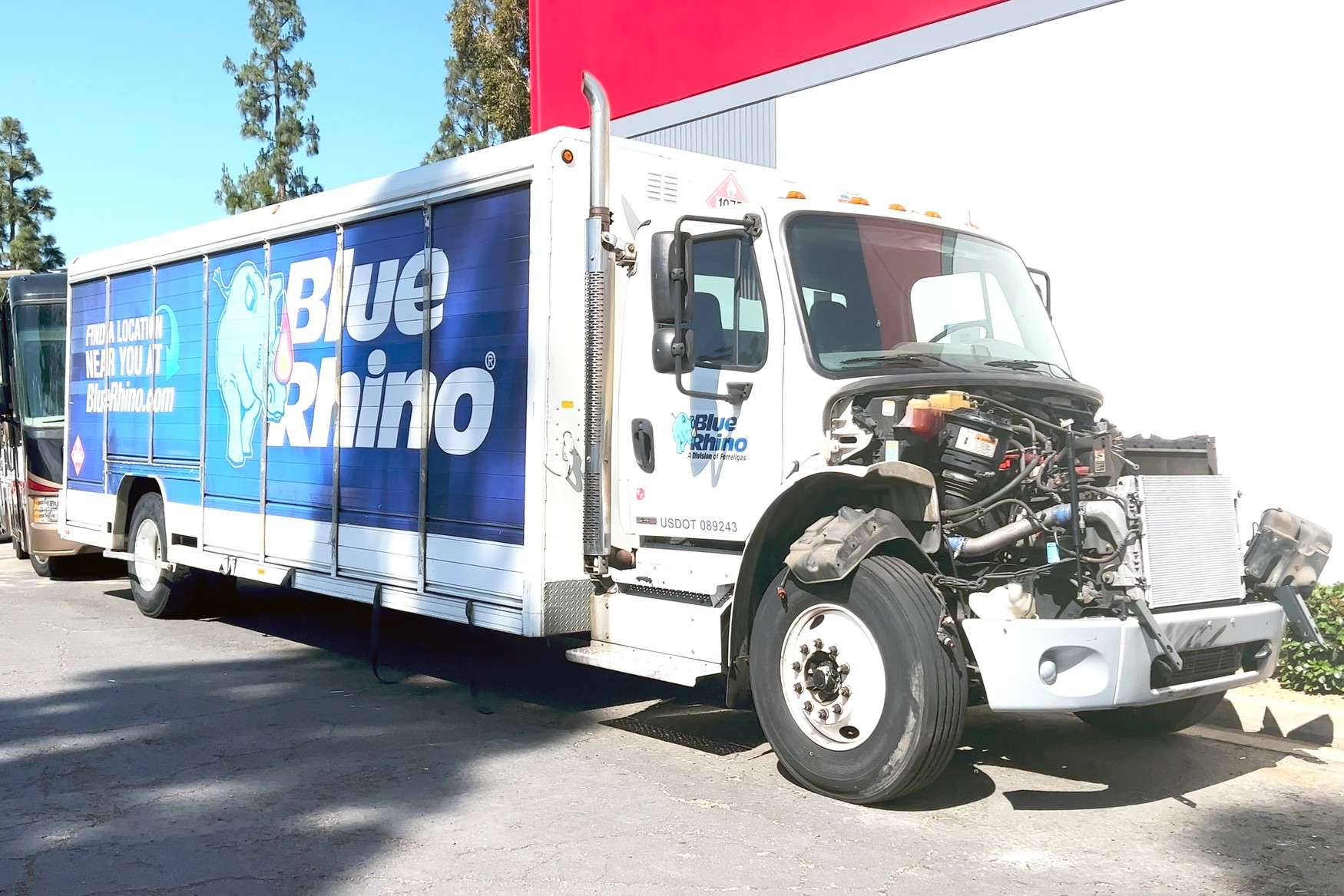
Flatbed truck repair is mostly a conversation about what is under the deck. Westminster operators bring us trucks with a couple of split boards and find that the crossmembers beneath have been rusting for years under a layer of dirt and chain wear. This page covers deck boards and plate, the subframe underneath, stake pockets and rub rails, headache racks, and the load rating conversation that has to follow a structural repair.
Deck Boards, Steel Plate and What Each One Tells You
Wood decks split, cup and check with sun and load, and they are meant to be replaced. That is the design. A split board is maintenance, not damage, and replacing boards on schedule is far cheaper than letting a broken board load its neighbors and the crossmember beneath it.
What matters is the pattern. Boards failing in one area repeatedly means the crossmember support under that area has moved or corroded, and no amount of new lumber fixes a support problem. We pull boards in the affected area and look underneath before quoting a deck job.
Steel plate decks fail differently: they dish between crossmembers, they crack at welds, and they trap water anywhere the drainage was compromised. A dished plate deck usually means the crossmember spacing is no longer doing its job, either from corrosion or from an overload event.
- Replace boards on a pattern rather than one at a time
- Investigate any area where boards fail repeatedly
- Look for dishing between crossmembers on plate decks
- Check plate deck welds for cracking at the crossmembers
- Verify drainage paths are still open after any repair
The Subframe Nobody Looks At
Underneath the deck is a set of crossmembers tying the two long members together, and that assembly is what actually carries the load. It sits directly in the path of road spray, it collects dirt and moisture in every corner, and it has fasteners and welds that have been working since the truck was new.
Corrosion here is the number one structural finding on used flatbeds. It concentrates where the crossmember meets the long member, where a fastener passes through, and anywhere a bracket creates a pocket that holds water. It progresses invisibly under a deck that looks acceptable from above.
The repair is not glamorous: remove the deck in the affected area, cut out the corroded material, replace it with new section, re weld to proper procedure, treat and coat, then re deck. On a truck with a decade of Southern California coastal air behind it, expect to find more than the estimate assumed, which is why we open before we finalize a number.
Stake Pockets, Rub Rails and Chain Damage
Stake pockets and rub rails take the entire securement load, and they take it in shock. Chains, binders and straps pull against them with a great deal of force, and every one of those pulls works the weld or the fastener holding the pocket to the rail.
The typical finding is a pocket that has begun to tear out of the rail, a rail deformed inward where a binder has been cranked against it repeatedly, and elongated holes anywhere a bolted pocket is used. All of them are load path failures and none of them are cosmetic.
Repair means replacing the pocket and repairing the rail it mounts to, with the weld run properly rather than tacked. On trucks where the same two pockets keep failing, the honest answer is often that the securement practice is loading them beyond design and adding pockets is the better fix than repeatedly replacing the same two.
- Inspect every pocket weld and fastener at service intervals
- Look for inward deformation of the rail at frequently used points
- Check for elongated holes on bolted pocket designs
- Consider adding pockets where the same points keep failing
- Repair the rail as well as the pocket, not just the pocket
Headache Racks, Toolboxes and Side Kits
A headache rack is a safety component, and its mounting is what makes it one. A rack bolted to the deck rather than to structure will not stop a shifting load, and the mounting is the part we inspect first when one comes in bent.
Bent racks are usually repairable, and where the tubing has been kinked or torn at a joint, replacement of that section is straightforward fabrication work. What is not acceptable is straightening a rack and putting it back on a mount that already failed once.
Toolboxes, side kits and headboard extensions follow the same rule. Everything that attaches to the deck should be landing on structure with load spread properly, because on a flatbed there is no body to take the load if a mount fails.
Load Rating After a Structural Repair
This is the conversation that has to happen after any subframe or long member work. A repaired structure is only as good as the repair, and an operator needs to know what they have. We repair to the body manufacturer's published methods where they exist and to accepted structural practice where they do not, and we document the material, the joint design and the welding performed.
What we do not do is issue a new rating. That is not ours to give. What we hand you is a documented repair record showing exactly what was replaced, with what material, joined how, so that whoever is responsible for your equipment ratings has the information they need.
A worked example on the common job: crossmember corrosion repair across a four foot section with deck removal and replacement, typically 22 to 36 hours of labor at $210 for $4,620 to $7,560, plus $1,200 to $3,500 in steel, deck material, fasteners, coating and finish materials.
Questions
Frequently asked questions
My deck boards keep splitting in the same spot. Why?
Because the support under that spot is not doing its job anymore. Boards splitting across a deck randomly is normal wear and gets handled by replacing them on a pattern. Boards failing repeatedly in one area is a report about the crossmember beneath: it has corroded, moved, or was overloaded at some point. New lumber over a compromised support fails again on the same schedule. We pull boards in the affected area and inspect underneath before quoting a deck job, because the difference between a lumber bill and a structural bill is exactly what is under those boards.
How much does flatbed truck repair cost?
The range is about $1,500 to past $25,000. Deck board replacement on a section is at the low end. Stake pocket replacement with rail repair is typically $900 to $2,800 per location. Crossmember corrosion repair across a four foot section with deck removal and replacement runs $6,000 to $11,000. Full subframe rebuild with a new deck can reach $25,000. Headache rack repair or section replacement is $1,200 to $4,000. Body and structural labor is $210 per hour, mechanical is $260, and authorized repairs above $2,000 carry a 50 percent deposit.
How bad does rust under the deck usually get?
Worse than the top of the deck suggests, and it is the single most common structural finding on used flatbeds. The subframe sits directly in road spray, collects dirt and moisture in every corner, and has welds and fasteners that have been working since the truck was new. Corrosion concentrates where the crossmember meets the long member, at fastener penetrations, and anywhere a bracket forms a pocket that holds water. It progresses invisibly under a deck that looks fine from above. That is why we open the deck in the affected area before finalizing a number rather than quoting from a walkaround.
A stake pocket tore out. Can you just weld it back?
We can weld it, but on its own that is a repair with a short life. A pocket that tore out did so because securement loads exceeded what that joint could take, and the rail it mounts to has usually been damaged too, often deformed inward from binders being cranked against it. The proper repair replaces the pocket and repairs the rail, with the weld run properly rather than tacked. If the same two pockets keep failing on your truck, the honest answer is that your securement pattern is loading them beyond design, and adding pockets is a better investment than replacing the same two every year.
Will you re rate my truck after a structural repair?
No. Issuing equipment ratings is not ours to do and you should be cautious of a shop that offers. What we provide is a documented repair record: exactly what was replaced, what material was used, how the joints were designed and welded, and photographs of each stage. We repair to the body manufacturer's published methods where those exist and to accepted structural practice where they do not. That documentation is what whoever is responsible for your equipment ratings needs in order to make their own determination. It is also what a buyer will want to see when you sell the truck.
Can you repair a bent headache rack?
Usually yes, and where the tubing has kinked or torn at a joint we replace that section rather than trying to straighten damaged material. What we look at first is the mounting, because that is what makes a headache rack a safety component rather than a decoration. A rack bolted to the deck instead of to structure will not stop a shifting load. If the mount failed once, straightening the rack and putting it back on the same mount is not something we will do. The same rule applies to toolboxes, side kits and headboard extensions: everything lands on structure with the load spread.
Do steel plate decks fail differently from wood?
Yes. Wood splits and cups and is meant to be replaced, so failure is expected and cheap to address. Steel plate dishes between crossmembers, cracks at the welds where it attaches, and traps water anywhere the drainage was compromised by a repair or a modification. A dished plate deck is telling you the crossmember spacing is no longer supporting the plate, either from corrosion or from an overload event, so the repair is underneath rather than on top. We check the plate welds at every crossmember and verify that drainage paths are still open after any work.
How long does deck and subframe work take?
Deck board replacement on a section is one to three business days. Stake pocket and rail repair is two to four days per location. Crossmember corrosion repair across a section with deck removal and replacement is one to three weeks depending on how much steel is replaced once it is open. A full subframe rebuild with a new deck is three to six weeks. Materials are conventional steel and lumber rather than proprietary parts, so parts delays are rarely the constraint here, which makes these among the more predictable schedules we quote.
How the work runs
Our six step repair process
The same sequence on every vehicle, whether it is a single coach or a fleet of box trucks.
- 01
Assessment and documentation
We put the vehicle on the floor, pull panels where we need to see behind them, and photograph everything. Hidden damage found now is damage that does not become a supplement argument later.
- 02
Written estimate
You get a line by line estimate with parts, labor hours, materials, and the posted rate applied to each. Nothing is bundled into a single number you cannot check.
- 03
Carrier coordination
If a claim is involved we deal with the adjuster directly, submit the documentation, and handle supplements when teardown reveals more than the first inspection showed.
- 04
Authorization and scheduling
Once the scope is approved we confirm the deposit, order parts, and give you a realistic slot. Special order parts drive the timeline more often than labor does.
- 05
Repair
Structural first, then body, then paint, then systems and interior. The sequence is not negotiable because each stage has to be right before the next one covers it up.
- 06
Quality check and delivery
Multi point inspection, systems tested under load, paint inspected under corrected lighting, and a walkthrough with you before the vehicle leaves.
Keep reading
Related pages
Related vehicles
Services we perform
Talk to a repair specialist today
Tell us what happened and we will tell you what the repair actually involves, what it costs, and how long it takes. We work directly with every major carrier and serve Westminster owners and fleets from our 35,000 square foot facility.
Posted labor rates are published on our prices page. Diagnostic and systems assessment fees are credited against an authorized repair.