Vehicles We Repair
Camper and Trailer Repair Orange County Owners Count On
In short
Camper and trailer repair covers every towed or carried unit, from a folding pop up to a park model. Work runs from about $750 for a seal and panel job to past $50,000 for structural rebuilds on a large fifth wheel. The defining issue on almost every trailer we take in is water, not impact.
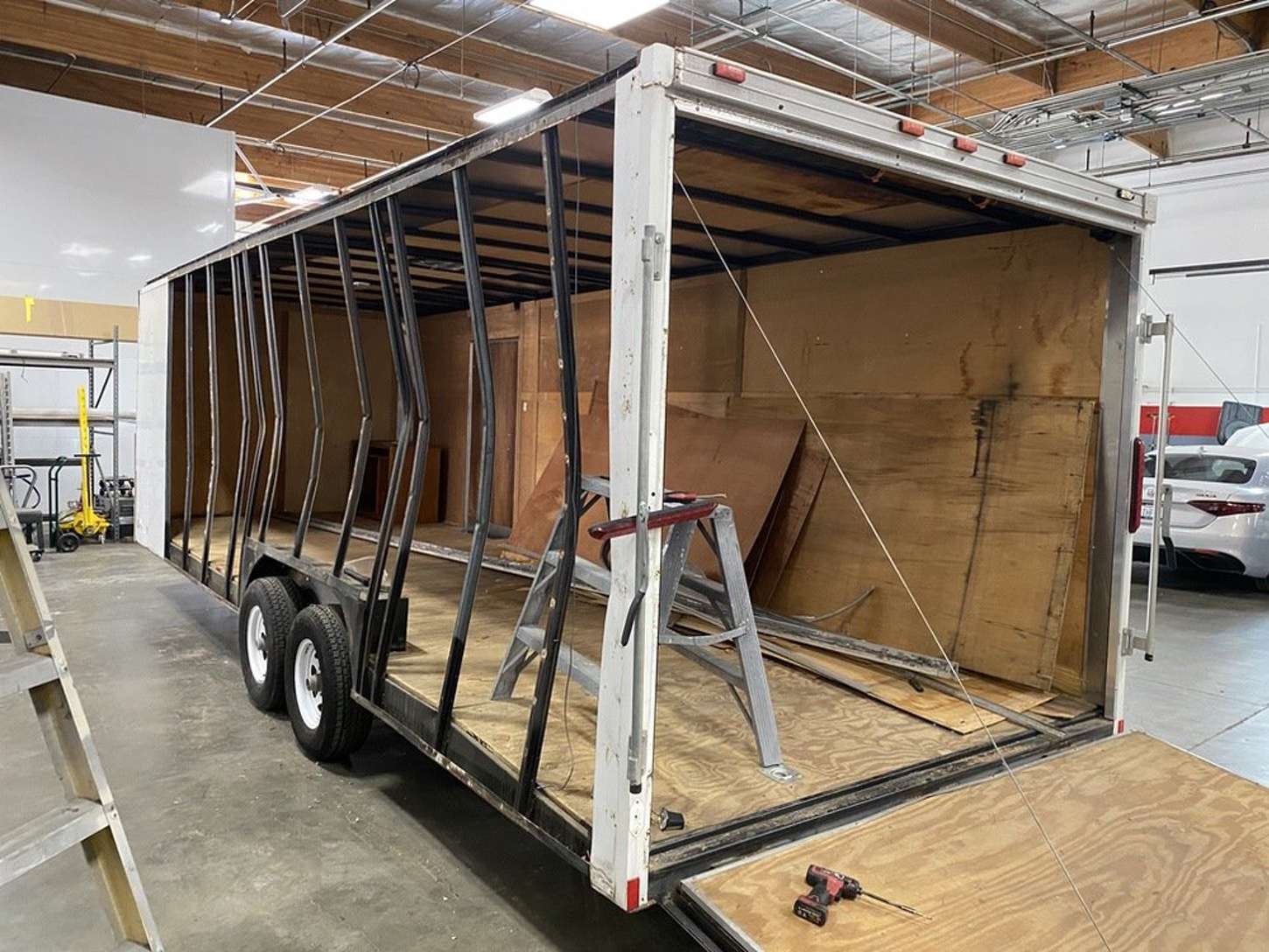
Camper and trailer repair Orange County wide has one thing in common no matter the unit: there is no engine and no factory cab to hide behind, so the trailer's own structure, sealing and running gear are the entire vehicle. Westminster owners bring us units where a fifty dollar sealant job that was deferred three years ago turned into a wall. This page covers how towables are built, why that decides the repair path, and what the work costs.
Two Ways to Build a Trailer, Two Ways to Fix One
Nearly every towable falls into one of two construction types, and knowing which you own tells you most of what a repair will look like. Stick and tin means a wood or aluminum stud frame with corrugated aluminum siding screwed over it. Laminated means fiberglass skin bonded to foam block and framing in a heated press, producing a smooth flat wall.
Stick and tin is easier and cheaper to repair. Siding comes off in panels, you can see the framing directly, you replace what is rotted and screw new siding back on. It is also less stiff, which is why these units flex and why the sealant at every seam has a shorter service life.
Laminated walls are stiffer and look better, but when the bond fails, the wall stops carrying load and the repair is far more involved. There is no way to see inside a laminated wall without opening it, so on these units the moisture meter earns its keep before anyone writes a number.
- Stick and tin: corrugated siding over a stud frame, panel by panel repair
- Laminated: bonded fiberglass over foam and framing, injection or section replacement
- Stick and tin flexes more, so seams need sealant service more often
- Laminated hides damage completely until it is structural
- Aluminum siding dents but rarely delaminates, which makes damage visible
Water Is the Real Enemy, Not Impact
Most trailers that come to us have never been in a collision. They have been slowly taken apart by water entering somewhere small: a roof seam, a vent flange, a window corner, a marker light, a screw head. Sealant is a consumable with a service life of a few years in Southern California sun, and the maintenance interval is the single most ignored thing in RV ownership.
The pattern is always the same. Water enters high, travels along a framing member, and appears low, often at the floor and often several feet from the entry. Owners chase the stain and reseal the wrong place. We do a water test and a moisture map first, so the repair goes where the entry actually is.
The economics are brutal and worth stating plainly. Resealing a roof perimeter and all penetrations is typically $600 to $1,800. Rebuilding a rear wall and floor section after three seasons of that leak is $6,000 to $20,000. The maintenance is not optional, it is just deferred.
Roof Membranes and the Sealant Interval
Most towables have a single ply rubber or TPO membrane over a decked roof, terminated at the edges with a metal rail and covered in sealant. The membrane itself usually outlives the sealant by many years. What fails first is almost always the lap sealant on the penetrations and the edge rail.
Inspection is straightforward: look at every flange, every seam, every screw head, and every rail termination for cracking, chalking or lifting. Anything that has pulled away is a water path. On a unit that has been in the sun for five years without service, expect most of it to need attention rather than a spot repair.
Full membrane replacement is a different job: strip the old membrane and all roof mounted components, evaluate and replace decking that has softened, lay new membrane, then reinstall and reseal everything that came off. On an average trailer that runs $3,500 to $9,000 depending on length and how much decking is bad.
Frames, Tongues and Low Speed Hits
Trailer frames are simple steel structures, and that simplicity is why they are repairable. What we see most often is not highway collision damage but low speed events: jackknifing into the tow vehicle, a curb strike on a corner, a sway incident that loaded the A frame sideways, or a landing gear failure that dropped the front on pavement.
The critical thing on any of these is measuring before repairing. A frame that is out of square will tow crooked, wear tires on one side, and stress the body at every seam until the sealant fails. We measure the frame diagonally and check the axle alignment relative to the coupler, then straighten and reinforce as needed.
Reinforcement matters more than replacement on most trailer frames. Adding plate at a stressed joint is often stronger, cheaper and quicker than replacing a rail section, and on a welded frame it avoids introducing a new heat affected zone in the middle of a load path.
- Measure frame diagonals and axle to coupler alignment before repair
- Check the A frame and coupler for twist after any sway event
- Inspect welds at every crossmember to rail joint
- Look for cracked or elongated shackle and hanger holes
- Reinforce with plate at stressed joints rather than replacing rail
Axles, Bearings, Brakes and the Parts Owners Skip
Trailer running gear is the least maintained system in RV ownership and the most likely to strand you. Bearings need service on an interval regardless of mileage, because grease breaks down sitting in a hot wheel hub through a Southern California summer. Electric brake magnets wear out. Springs sag and shackle bushings elongate.
A trailer that pulls to one side, wears a tire pattern, or takes noticeably longer to stop is telling you something specific. We inspect the whole running gear as a system rather than replacing the part that made noise, because a worn shackle bushing and a dragging brake produce similar complaints and different repairs.
This work bills at the $260 mechanical rate. A full running gear service on a tandem axle trailer, including bearing repack, brake inspection and adjustment, is usually a one day job and is far cheaper than a roadside bearing failure that takes a spindle with it.
Sequencing a Job When Water Has Been in a Wall for Years
When a unit arrives with long standing intrusion, the order of operations decides whether the repair lasts. We stop the water first: find and fix every entry point, and confirm with a water test before any interior work happens. Repairing a wall while the roof still leaks is money spent on a schedule to do it again.
Second, we open and dry. Soft framing comes out, sound framing gets exposed and dried and metered until it reads dry, and anything that has gone punky is replaced. This is the stage where the estimate can grow, so we photograph everything and get authorization before continuing.
Third, we rebuild and re seal, then refinish. Body and paint labor is $210 per hour, parts carry 100 percent markup at or under $100 and 35 percent over, and any authorized repair above $2,000 takes a 50 percent deposit so long lead material can be ordered on approval day.
- Stop the water and verify with a test before anything else
- Open, dry and meter the framing until it reads dry
- Photograph and authorize before scope grows
- Rebuild framing, then re skin, then re seal
- Refinish last, so no new work happens over fresh paint
In this category
Types we work on
Fifth Wheel
Fifth wheel repair runs from about $1,000 for seal and panel work to past $50,000 for structural rebuilds on a large multi slide u...
Read moreTravel Trailer
Travel trailer repair runs from about $750 for sealant and panel work to past $35,000 for a structural rebuild. Because these are...
Read moreToy Hauler
Toy hauler repair runs from about $1,000 for hinge and cable work to past $40,000 for structural rebuilds of a rear wall and garag...
Read morePop Up Camper
Pop up camper repair runs from about $500 for a cable and winch service to past $12,000 for a full roof and bunk rebuild. The lift...
Read moreTruck Camper
Truck camper repair runs from about $750 for seal and panel work to past $18,000 for structural rebuilds around jack brackets and...
Read morePark Model Trailer
Park model trailer repair runs from about $1,500 for roof and flashing work to past $30,000 for structural repairs to walls and fl...
Read moreQuestions
Frequently asked questions
How much does camper and trailer repair cost?
The range runs about $750 to past $50,000. Sealant service on a roof perimeter and all penetrations is $600 to $1,800. A single panel repair with refinish is typically $1,200 to $3,500. Roof membrane replacement is $3,500 to $9,000 depending on length and decking condition. A rear wall and floor rebuild after long term water intrusion is $6,000 to $20,000. Structural work on a large fifth wheel with multiple slides can pass $50,000. Body and paint labor is $210 per hour, mechanical is $260, and repairs over $2,000 carry a 50 percent deposit.
How often does my trailer need to be resealed?
Plan on inspecting every seam, flange, screw head and edge rail twice a year, and expect to be doing actual sealant work every two to four years in Southern California. Sun is what kills sealant here, not rain. It chalks, shrinks and cracks, and once it pulls away from either surface it is a water path even though it still looks like sealant from ten feet away. A full perimeter and penetration reseal typically runs $600 to $1,800. Compare that to $6,000 or more for a wall rebuild and the maintenance interval stops looking like an expense.
There is a stain on my interior wall. Where is the leak?
Almost never directly above the stain. Water enters high, runs along a framing member or between the skin and the insulation, and comes out wherever it finds a gap, often several feet away and usually lower. That is why owners reseal the wrong spot twice before calling us. We do a controlled water test working from the bottom of the unit upward so we can isolate the entry, then moisture map the surrounding area with a meter to find the true extent. The wet area is typically two to three times larger than the visible stain.
Is my trailer worth repairing?
Sometimes not, and we would rather tell you before a teardown than after. The math is straightforward: what does the unit sell for sound, what will the repair cost, and how much life is left in the roof, tires, axles and appliances. Lightweight trailers in particular can reach a point where a structural repair passes the value of the unit. We give you the moisture map and a real range before you commit, and if the numbers say walk away we will say so. If the unit has value to you beyond the market number, we will lay out a phased plan instead.
What is the difference between stick and tin and a laminated trailer?
Stick and tin means a wood or aluminum stud frame with corrugated aluminum siding screwed over it. Laminated means fiberglass skin bonded to foam block and framing in a heated press, giving a smooth flat wall. Stick and tin is cheaper and simpler to repair because the siding comes off in panels and you can see the framing directly. Laminated walls look better and are stiffer, but when the bond fails the wall stops carrying load and repair means either vacuum injection or cutting out and replacing a section. Damage also hides completely in a laminated wall until it is structural.
Do you service axles, brakes and bearings?
Yes, at the $260 per hour mechanical rate. Trailer running gear is the least maintained system in RV ownership and the most common cause of a trip ending on the shoulder. Bearing grease breaks down sitting in a hot hub through a Southern California summer regardless of how few miles you tow. We inspect the running gear as a system: bearings, seals, brake magnets and shoes, drums, springs, shackles and bushings, plus axle alignment relative to the coupler. A pull to one side or an odd tire wear pattern is usually a bent axle or a worn shackle rather than a tire problem.
My trailer tows crooked after a minor accident. What is wrong?
Most likely the frame is out of square or an axle has shifted. Low speed events do this constantly: a jackknife into the tow vehicle, a curb strike, a sway incident that loaded the A frame sideways, or a landing gear collapse. The visible body damage is often minor while the frame underneath has taken a set. We measure the frame diagonals and check axle alignment relative to the coupler before doing any body work, because straightening panels on a crooked frame means the seams will open again. Repair is usually straightening plus plate reinforcement at the stressed joint.
Can you replace a roof membrane, or only patch it?
Both, and the choice is usually clear once we look. If the membrane is sound and the failures are at the flanges, rails and screw heads, resealing those is the right and much cheaper answer. If the membrane itself is chalked through, torn, or the decking under it has softened, patching just buys time. Full replacement means stripping the membrane and everything mounted through the roof, replacing soft decking, laying new membrane, then reinstalling and resealing every component. Figure $3,500 to $9,000 depending on length and how much decking has to come out.
How the work runs
Our six step repair process
The same sequence on every vehicle, whether it is a single coach or a fleet of box trucks.
- 01
Assessment and documentation
We put the vehicle on the floor, pull panels where we need to see behind them, and photograph everything. Hidden damage found now is damage that does not become a supplement argument later.
- 02
Written estimate
You get a line by line estimate with parts, labor hours, materials, and the posted rate applied to each. Nothing is bundled into a single number you cannot check.
- 03
Carrier coordination
If a claim is involved we deal with the adjuster directly, submit the documentation, and handle supplements when teardown reveals more than the first inspection showed.
- 04
Authorization and scheduling
Once the scope is approved we confirm the deposit, order parts, and give you a realistic slot. Special order parts drive the timeline more often than labor does.
- 05
Repair
Structural first, then body, then paint, then systems and interior. The sequence is not negotiable because each stage has to be right before the next one covers it up.
- 06
Quality check and delivery
Multi point inspection, systems tested under load, paint inspected under corrected lighting, and a walkthrough with you before the vehicle leaves.
Keep reading
Related pages
Related vehicles
Services we perform
Talk to a repair specialist today
Tell us what happened and we will tell you what the repair actually involves, what it costs, and how long it takes. We work directly with every major carrier and serve Westminster owners and fleets from our 35,000 square foot facility.
Posted labor rates are published on our prices page. Diagnostic and systems assessment fees are credited against an authorized repair.