Our team
The Technicians and How Our Repair Floor Is Organized
In short
The floor runs on eight disciplines: estimating, structural, body and laminate, paint, systems, interior, fabrication, and final quality control. Work moves through them in a fixed sequence, and the estimator who writes your scope stays with the file to delivery.
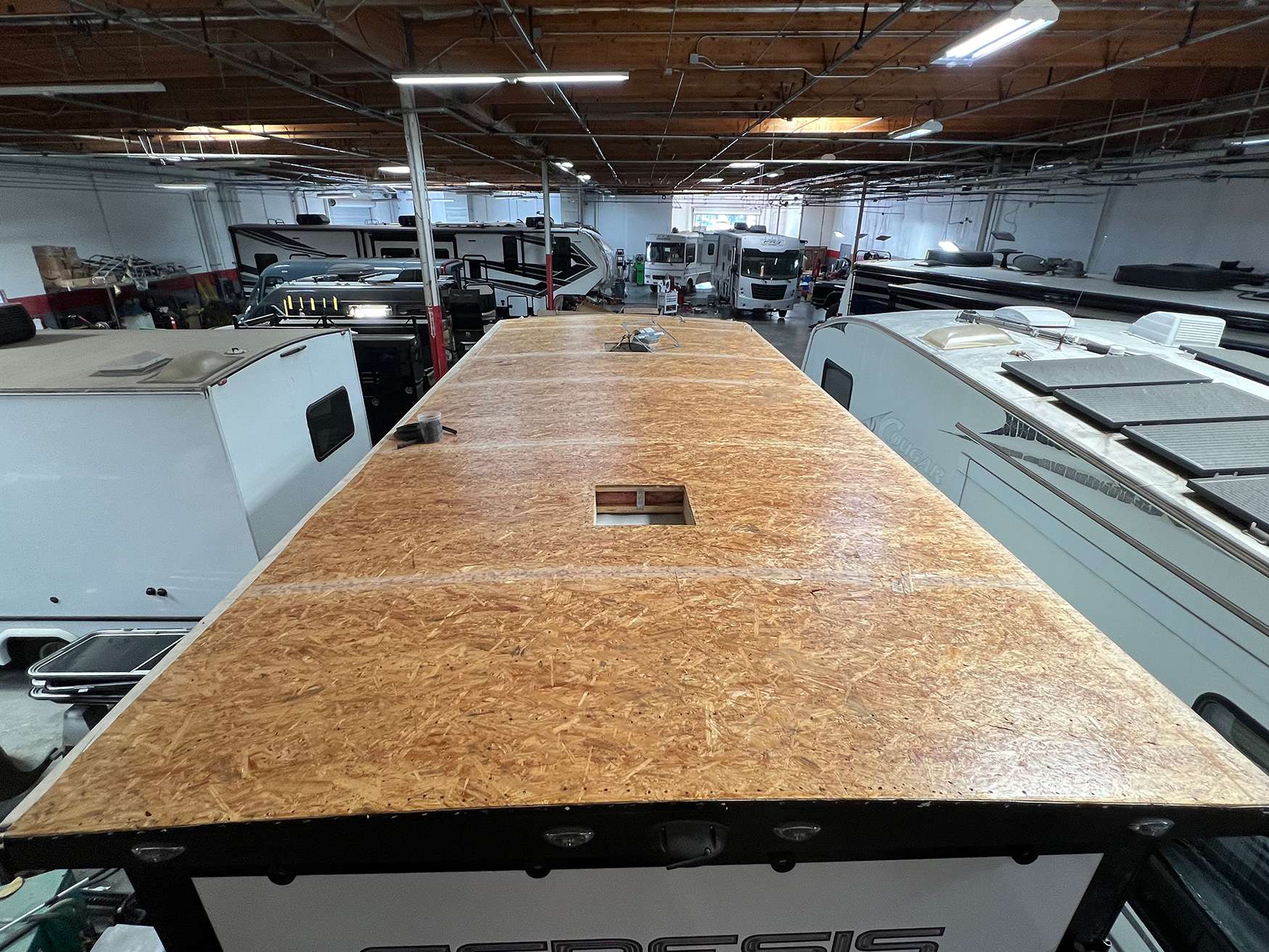
This page describes roles rather than people. We do not publish invented biographies, and we do not list credentials we cannot show you a record for. What is useful to an owner is knowing who owns which part of the repair and where one discipline hands off to the next.
Estimating
Writes the opening scope, runs the assessment, builds the carrier file, and owns the job from intake to delivery.
Structural
Rack setup, anchoring, measurement, controlled pulls, and post repair verification on chassis and frame.
Body and laminate
Panel repair and replacement, bonded sidewall and cap work, fiberglass layup, gelcoat, and substrate reconstruction.
Paint and refinishing
Prep, sealer, color development and spray out, base and clear application, graphics, and gloss correction.
Systems
Electrical, solar, inverter and converter, generator, plumbing, tanks, appliances, climate, and slide mechanisms.
Interior and trim
Flooring, wall and ceiling panels, cabinetry, countertops, upholstery, and the finish work behind a water repair.
Fabrication
Welding, structural sections, brackets, bumpers, racks, and any part that has to be made rather than ordered.
Quality control and delivery
Final inspection, systems tested under load, paint reviewed under corrected lighting, and the customer walkthrough.
Estimating
The estimator owns the file from intake to delivery
Estimating is where most repairs succeed or fail, and it is not a clerical role. The estimator decides how far to disassemble before writing, whether a chassis needs to go on the rack before anything is committed, whether moisture mapping is required, and what the probable teardown findings are on a vehicle whose damage is partly hidden by construction. Getting that judgment wrong produces an opening number that is comfortable to hear and impossible to hold.
The same person then carries the file. He writes the supplements when teardown exposes more, he talks to the adjuster, he answers your questions about why a line reads the way it does, and he is present at the delivery walkthrough. Handing a job between three advisors loses the reasoning behind every judgment call made along the way, and the customer ends up being told what the paperwork says rather than what happened.
Estimating also owns the documentation package. Staged teardown photography, moisture readings with their locations, structural measurements before and after correction, part numbers with real lead times, and written reasoning under each labor operation. That file is what an adjuster reviews, and its quality has more effect on how a claim goes than any argument made on the phone.
Structure and body
Structural, laminate, and body work are separate skills
The structural technician works in measurements. Anchoring a chassis to the rack, establishing reference points, applying force in a controlled direction, and verifying that the numbers came back to specification is a discipline of patience and arithmetic rather than force. The failure mode when it is done poorly is invisible at delivery and obvious six months later, when the unit tracks slightly off and wears tires unevenly.
The laminate and body technicians work in layers. A bonded sidewall is an outer skin, a core, an inner panel, and a framework, and repairing it means rebuilding those layers so the assembly carries load again rather than filling a hole so it looks flat. This is where a general automotive background is least transferable, and it is where we see the most damage from previous repairs done elsewhere: filler over a compromised core, a patch bonded to a substrate that was never dried out, or a cap section fitted without addressing why the original one failed.
Fabrication sits alongside both. On vehicles this age and this varied, parts are frequently discontinued, back ordered for months, or were never available separately in the first place. Being able to make a bracket, a mounting section, a bumper, or a structural piece in house is often the difference between a repair that takes three weeks and a repair that waits an entire season on a supplier.
Paint and systems
Refinishing and onboard systems, the two most misjudged disciplines
Painters on this floor spend more time on color development than on spraying. A coach has been sitting in Southern California sunlight for years, which has moved the finish away from whatever the paint code says. Matching the code produces a repair that reads as a repair from across a parking lot. The technician sprays out, checks against the actual adjacent panel under corrected lighting, adjusts, and only then decides where the blend boundaries fall. On multi stage graphics that decision is the whole job.
Systems technicians handle everything that makes a recreational vehicle a building rather than a truck: shore and battery power, inverters and converters, solar, onboard generators, fresh and waste plumbing, tanks, water heaters, furnaces, roof air, gas appliances, and the mechanisms and seals that move slide rooms in and out. Most of that work is diagnostic before it is mechanical, because the complaint the owner reports and the fault causing it are frequently in different systems entirely.
Systems work also intersects with collision more than owners expect. A hard impact moves things that are not visibly damaged. Wiring gets pinched, a plumbing run gets stressed, a slide rail shifts a quarter inch and now the seal does not compress evenly. Checking those after structural correction, not before, is the reason the sequence runs the way it does.
Sign off
Final quality control and who is accountable
Nothing leaves without a final inspection signed by the foreman. That inspection covers fit and gaps on everything reassembled, gloss and texture match under corrected lighting, structural verification numbers where a pull was performed, every affected system operated under load rather than just switched on, water testing on anything that touched a seam or a seal, and a road check where the repair involved chassis, brakes, suspension, or driveline.
The second check is against the file rather than against the vehicle. Every authorized line performed, every supplement accounted for, nothing on the original loss report quietly dropped, and any deferred item clearly identified in writing so you know it was a decision rather than an oversight. Those are different failures from workmanship failures and they need a different pass to catch.
Then you walk the vehicle with us before it is released. We show you what was done, what was found during teardown that you were not expecting, how anything new operates, and what to watch over the following weeks. Owners who see the repair explained in front of them notice problems earlier and call sooner, and a problem raised in the first month is a far easier conversation for everyone than one raised in the ninth.
Hiring
How we staff a specialty floor
There is no local pipeline of people who arrive already knowing how to repair a bonded coach sidewall. Trade programs teach automotive collision, which is a genuinely useful foundation and is not the same trade. So the floor is staffed by hiring experienced technicians into the disciplines where inexperience is expensive, and developing people in the roles where the trade is actually learned.
Disassembly is the best teacher we have. A technician who has taken hundreds of these vehicles apart knows how they are built, which is exactly the knowledge that makes a good laminate repair or an accurate estimate possible later. That is why prep and disassembly are treated as a starting point rather than a permanent station, and why they sit physically next to the body and paint work they lead into.
If you work in the trade in Orange County and this is the kind of floor you want to be on, the careers page lists the roles we hire for and what experience matters in each.
Questions
Frequently asked questions
Why does this page not list individual names and photographs
Because we will not publish a biography we cannot support with documentation on file. Shop team pages are one of the most heavily fabricated pieces of content in this industry: invented tenure, credentials nobody holds, and headshots that came from a stock library. Our lead estimator and shop foreman is named on his own author page because he reviews the technical content published here and that attribution has to be real. Beyond that, what is useful to you is not a wall of faces, it is knowing which discipline owns which part of your repair and where the handoffs happen. That is what this page describes.
Who is my point of contact once the vehicle is in the shop
The estimator who wrote your opening scope stays with the file through teardown, supplement, repair, and delivery. That is deliberate. On a large vehicle, the reasoning behind a labor line is often about something a technician found behind a panel three weeks earlier, and the person who was standing there when it was found is the person who can explain it. Rotating a customer through whoever answers the phone loses that context immediately. If your estimator is on the floor when you call, you may reach the front counter first, but the answer to anything technical comes back from the person who owns the job.
What experience matters most for this kind of work
Repetition on laminated and bonded construction, more than years in collision generally. A technician with a long automotive career still has to learn that the panel is the structure, that impact energy travels along a bond line rather than crumpling in place, and that cure behavior across three bonded materials is not the same as heat on sheet steel. The second thing that matters is comfort with diagnosis. On a coach, the customer complaint and the actual fault are frequently in different systems, and a technician who only replaces what he is pointed at will replace the wrong thing confidently.
How is work assigned across the floor
Jobs move through the disciplines in a fixed sequence rather than being handed to one technician who does all of it. Structural before body, body before paint, paint before systems reinstallation and interior, everything before final quality control. That sequence is not a preference, it is physics: each stage covers up the one before it, so a mistake left in place gets sealed under the next operation and only reappears at delivery. Running roughly 75+ vehicles a month through that sequence is what the bay layout and the staging space exist to support.
Does the same person who wrote the estimate inspect the finished vehicle
Final sign off sits with the foreman, and the estimator who owns the file is part of the delivery walkthrough. Two sets of eyes at that point is the useful arrangement. The foreman checks the work against the standard: fit, gaps, gloss, texture match, systems function under load, structural verification numbers. The estimator checks the work against the file: every line that was authorized was performed, every supplement is accounted for, and nothing on the original loss report was quietly left undone. Those are different questions and they catch different problems.
Do you train people in house or only hire experienced technicians
Both, and the balance is intentional. Experienced structural, paint, and systems technicians are hired for those disciplines because the cost of learning them on a customer's vehicle is unacceptable. Detail, prep, disassembly, and parts handling are where people start and where the trade is actually learned, because a person who has taken two hundred coaches apart understands how they are built in a way no classroom produces. Advancement here is by demonstrated work, and the shop is deliberately structured so that a prep technician spends his day next to the body and paint work he is aiming at.
Can I talk to the technician working on my vehicle
Usually yes, if he is not mid operation. There are stages where the answer is no for a practical reason: a technician inside a booth in a suit with a gun in his hand cannot stop, and a laminate repair in a cure window cannot be interrupted. Outside of those, we would rather you saw the vehicle and heard the explanation from the person holding the tools. Owners who look at their own torn down coach with a technician standing next to it ask better questions and make better decisions than owners who only ever see paperwork.
How many people work on a typical repair
More than most owners expect. A moderate collision job on a coach will pass through an estimator, a disassembly technician, a structural technician if the chassis is involved, a laminate or body technician, a prep technician, a painter, a systems technician for anything disturbed by the impact, an interior technician if the inside was opened, a detailer, and the foreman at final inspection. That is the reason the sequence and the documentation matter so much. The number of hands on a job is precisely why nothing can be left to memory.
Talk to a repair specialist today
Tell us what happened and we will tell you what the repair actually involves, what it costs, and how long it takes. We work directly with every major carrier and serve Westminster owners and fleets from our 35,000 square foot facility.
Posted labor rates are published on our prices page. Diagnostic and systems assessment fees are credited against an authorized repair.