Campers and Trailers
Travel Trailer Repair, Tongue to Rear Wall
In short
Travel trailer repair runs from about $750 for sealant and panel work to past $35,000 for a structural rebuild. Because these are the lightest built towables, a small impact often causes a large repair, and the honest conversation about whether a unit is worth fixing comes up more here than in any other category.
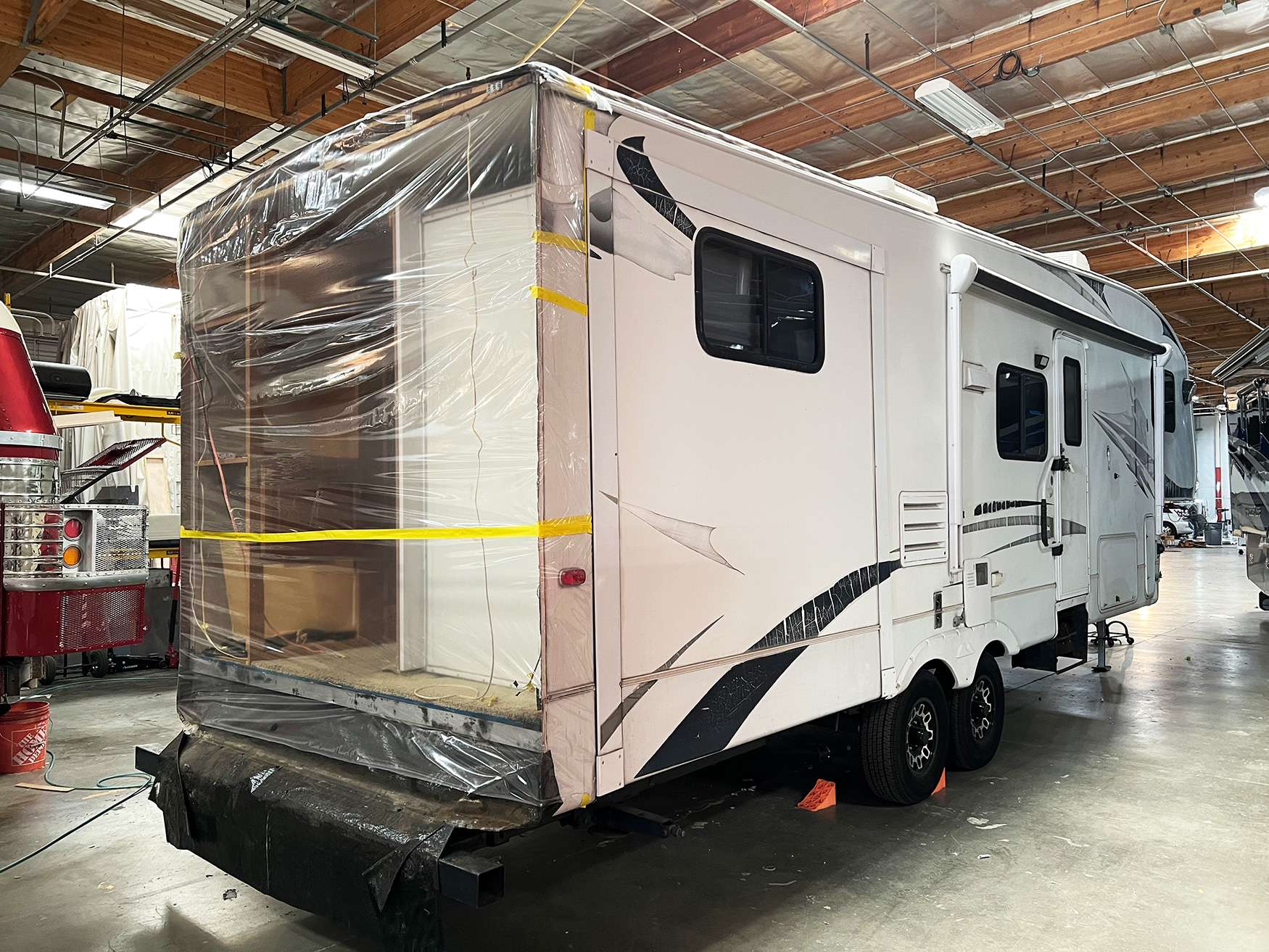
Travel trailer repair covers the bumper pull units that make up most of the towables in Westminster driveways, and they are built lighter than anything else we work on. That is the whole story: light framing, thin laminated walls and a single A frame tongue mean damage spreads further than the impact suggests. This page covers sway damage, tongue and A frame repair, wall delamination, roof seams, and the point at which the numbers stop working.
What a Sway Event Does to a Trailer
Sway is the defining failure mode of a bumper pull trailer, and the damage it leaves is often nothing like what the owner expects. The visible result might be a scuffed corner or nothing at all. The structural result is a tongue and A frame that have been loaded sideways well beyond design, and a body that has been twisted around its own frame.
What we look for after a sway incident is a coupler that no longer sits square to the frame, cracked welds at the A frame to rail joints, and a front wall where the seams have opened. That last one is the sign owners miss: a hairline gap at the front corner trim that was not there before is a structural report, not a cosmetic one.
Measuring is the first step and it is not optional. A trailer with a twisted frame will never seal properly again, and putting a beautiful front cap onto a frame that is out of square is a repair with an expiration date.
- Check coupler squareness to the frame rails
- Inspect A frame welds for cracks at every joint
- Look for newly opened seams at the front corners
- Measure frame diagonals before any body work
- Verify axle alignment relative to the coupler
Thin Walls Telegraph Small Impacts
A modern lightweight travel trailer wall can be a very thin fiberglass skin over foam block with widely spaced framing. It is remarkably stiff as an assembly and remarkably fragile once that assembly is broken. A backing incident at walking speed that would leave a dent in a truck can release the bond across several feet of wall.
So the visible damage on these units understates the repair almost every time. A palm sized crack in the skin usually sits at the center of a delaminated area two or three feet across, and the repair boundary has to reach sound bond or the new work will release at the edge.
This is also why we meter before quoting rather than pricing from photographs. On a laminated wall there is no way to know how far the bond has released without checking, and an estimate written from a photo on these units is close to a guess.
Roof Seams at the Front and Rear Terminations
On a travel trailer, the two roof seams that matter most are the front and rear terminations where the membrane turns down over the cap. They take the most movement, the most sun and, at the front, the most wind driven water at highway speed. They are also the seams owners are least likely to inspect because you have to get on the roof and lean over the edge to see them properly.
A failed front termination puts water into the top of the front wall, where it runs down inside the laminate and shows up at the floor months later. A failed rear termination does the same at the back, often around the ladder mounts or the spare tire bracket if the unit has one.
Service is straightforward and cheap compared to the alternative: strip the old sealant back to clean substrate, inspect the membrane edge and the rail fasteners, replace any that have loosened, and re bed the termination properly. On most trailers that is a few hundred dollars of work.
Running Gear on a Single or Tandem Axle
Lighter trailers often ride on a single axle, which removes all redundancy. A bearing failure on a tandem axle trailer is expensive and usually survivable. The same failure on a single axle trailer puts the unit on the ground, and the damage to the fender, the wall above it and sometimes the floor structure is far worse than the bearing.
That is why we push bearing service on an interval rather than on symptoms. Grease breaks down sitting in a hot hub through a Southern California summer whether or not the trailer moves, and a single axle unit has no margin.
Brakes are the other half. Electric brake magnets wear, drums score, and adjusters seize. A trailer that pushes the tow vehicle at a stop or grabs on one side is telling you something specific, and the fix is usually inexpensive if it is caught before a drum is destroyed.
- Repack bearings on an interval, not on noise
- Single axle units have no redundancy, service accordingly
- Inspect brake magnets, shoes and drums together
- Check springs for sag and shackle bushings for elongation
- Match tire age to service life, not tread depth
When the Repair Passes the Trailer
This category is where we most often have to tell an owner that the numbers do not work. A lightweight trailer with several seasons of water in the walls can need $18,000 of structural repair while selling for $12,000 sound. That is not a repair decision, it is a financial one, and it deserves real numbers up front.
Our approach is to meter and survey first, at $150 for a systems assessment credited against the repair, and give you the moisture map and a range before you authorize a teardown. If the number is going to pass the value of the trailer, you will hear it at that stage rather than after you have paid for disassembly.
A worked example on the more typical end: a rear corner impact with no water intrusion, laminated wall, 12 to 18 hours of body and paint at $210 for $2,520 to $3,780, plus $500 to $1,500 in panel, trim and refinish materials, plus tax on parts and materials.
Questions
Frequently asked questions
How much does travel trailer repair cost?
The working range is $750 to past $35,000. A roof termination reseal or a small panel repair sits near the bottom. A rear corner impact on a laminated wall with no water intrusion is typically $3,000 to $5,500. Wall delamination treated with injection is $1,500 to $4,500. A rear wall and floor rebuild after long term water intrusion runs $6,000 to $18,000. Full structural work with frame straightening can pass $35,000, which on a lightweight trailer is often more than the unit is worth. Body labor is $210 per hour and jobs over $2,000 carry a 50 percent deposit.
My trailer swayed badly on the way home. Should I have it checked?
Yes, even if nothing looks damaged. A sway event loads the tongue and A frame sideways far beyond design and twists the body around the frame. What we look for is a coupler that no longer sits square to the rails, cracked welds at the A frame joints, and seams at the front corners that have opened slightly. That last one is the sign owners miss, because a hairline gap in the corner trim reads as cosmetic and is actually structural. Measuring the frame diagonals takes an hour and tells you whether you have a trailer that will seal properly for the next ten years.
The crack in my wall is small. Why is the estimate so large?
Because on a laminated wall the crack is the middle of the problem, not the extent of it. These trailers use a very thin fiberglass skin bonded to foam block with widely spaced framing, and an impact that breaks the skin usually releases the bond across two or three feet in every direction. Our repair has to reach sound bond or the new work will release at its edge within a season. We meter the area before quoting so the boundary is based on a reading rather than on what is visible, and the wet or delaminated zone is nearly always larger than the crack suggests.
Where do travel trailers usually leak first?
The front and rear roof terminations, where the membrane turns down over the cap. They see the most movement, the most sun and, at the front, wind driven rain at highway speed. They are also the hardest seams to inspect because you have to get on the roof and lean over the edge. A failed front termination puts water into the top of the front wall where it runs down inside the laminate and appears at the floor months later. The other frequent entries are vent and fan flanges, the refrigerator vent, marker lights and any screw head that has backed out slightly.
Is a single axle trailer riskier than a tandem?
For running gear failures, yes, and it changes how we advise on maintenance. A bearing failure on a tandem axle trailer is expensive and usually survivable because the other axle carries the load long enough to stop. The same failure on a single axle puts the trailer on the ground, and the damage to the fender, the sidewall above it and often the floor structure costs many times more than the bearing did. Grease breaks down sitting in a hot hub through a Southern California summer whether the trailer moves or not, so we service on an interval rather than waiting for a noise.
How do I know whether my trailer is worth fixing?
Get a moisture map before you authorize a teardown. Our systems assessment is $150 and is credited against the repair, and it gives you the extent of the wet area rather than a guess. Then the math is simple: what the trailer sells for sound, what the repair will cost, and how much life is left in the roof, tires, axles and appliances. Lightweight units reach the tipping point sooner than any other category, and a trailer that sells for $12,000 sound can easily need $18,000 of structural work. We will tell you that at the survey stage, not after disassembly.
Can you repair delamination without replacing the wall?
Yes, when the core is dry. Vacuum injection uses a controlled drill pattern to draw vacuum through the void and push structural adhesive back into it, bonding the skin to the substrate again. Then the surface is faired and refinished. On a travel trailer that typically runs $1,500 to $4,500 depending on area. What kills the injection option is moisture, because adhesive will not bond to wet foam or wet wood. If the meter says the wall is wet, we open it, replace what has gone soft, and laminate a new section. That is why the reading comes before the quote.
How long does a travel trailer repair take?
Sealant service is one to three business days. A panel repair with refinish is typically four to nine business days. Delamination injection with fairing and paint is about a week including cure time. A rear wall and floor rebuild is two to four weeks. Frame straightening after a sway or jackknife event adds a week. The main variable is parts: a model specific window, a molded cap or a matching skin panel can add weeks, and on discontinued units we fabricate instead. If the trailer is towable during a long parts wait, we hand it back rather than storing it here.
How the work runs
Our six step repair process
The same sequence on every vehicle, whether it is a single coach or a fleet of box trucks.
- 01
Assessment and documentation
We put the vehicle on the floor, pull panels where we need to see behind them, and photograph everything. Hidden damage found now is damage that does not become a supplement argument later.
- 02
Written estimate
You get a line by line estimate with parts, labor hours, materials, and the posted rate applied to each. Nothing is bundled into a single number you cannot check.
- 03
Carrier coordination
If a claim is involved we deal with the adjuster directly, submit the documentation, and handle supplements when teardown reveals more than the first inspection showed.
- 04
Authorization and scheduling
Once the scope is approved we confirm the deposit, order parts, and give you a realistic slot. Special order parts drive the timeline more often than labor does.
- 05
Repair
Structural first, then body, then paint, then systems and interior. The sequence is not negotiable because each stage has to be right before the next one covers it up.
- 06
Quality check and delivery
Multi point inspection, systems tested under load, paint inspected under corrected lighting, and a walkthrough with you before the vehicle leaves.
Keep reading
Related pages
Related vehicles
Services we perform
Talk to a repair specialist today
Tell us what happened and we will tell you what the repair actually involves, what it costs, and how long it takes. We work directly with every major carrier and serve Westminster owners and fleets from our 35,000 square foot facility.
Posted labor rates are published on our prices page. Diagnostic and systems assessment fees are credited against an authorized repair.