Paint and Refinishing
Custom RV Paint and Graphics, Sprayed or Applied
In short
Custom RV paint and graphics run $1,500 to $12,000 or more. Printed vinyl on a clean surface is the low end, while a sprayed multi-stage scheme with candy or pearl on a full size coach reaches the top. At our Westminster facility the cost driver is layout and taping hours at $210 each, not the paint itself.
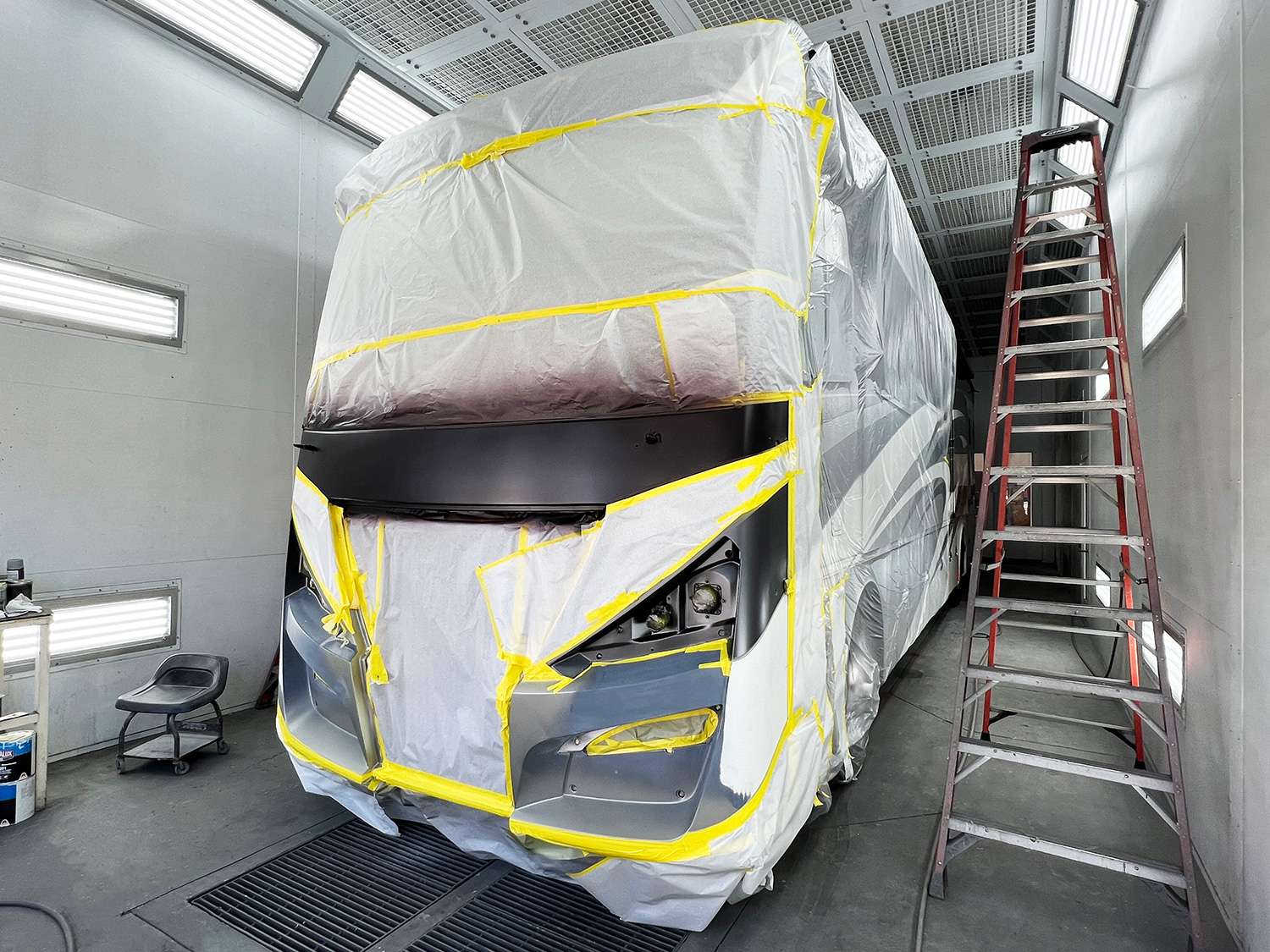
Custom RV paint and graphics covers two very different processes that owners often lump together: color and shapes sprayed into the finish, and printed vinyl applied on top of it. Sprayed graphics live under clear and last as long as the paint. Vinyl is faster, cheaper, and replaceable, but it has an edge you can feel. We build both at our Westminster shop, and the right answer depends on how long you plan to keep the coach.
Sprayed Graphics Versus Applied Vinyl
A sprayed graphic is part of the paint. The shape is taped out, the color is sprayed, the tape comes off, and clear goes over the whole surface so the graphic sits under the same protective layer as the base color. Run your hand across it and you feel nothing. It cannot peel, it cannot lift at the edges, and it fades at exactly the same rate as everything around it because it is the same system.
Vinyl is a printed or cut film with adhesive on the back. It goes on fast, it can carry photographic imagery and gradients that would be impractical to spray, and if you hate it in three years you can heat it and pull it off. The tradeoffs are a visible edge, a service life of roughly five to eight years outdoors in Southern California before the film starts to chalk or shrink, and adhesive residue at removal time.
Cost tells a similar story. A vinyl package on a 34 foot coach might be $1,500 to $4,000 installed on a clean surface. The equivalent sprayed scheme is $5,000 to $12,000 or more because it is all labor. Owners keeping a coach ten or more years usually come out ahead spraying. Owners refreshing a look on a coach they will sell in three years are usually better served by vinyl.
- Sprayed: no edge, no lifting, ages with the surrounding paint
- Sprayed: requires masking and remasking for every color stage
- Vinyl: fastest turnaround, easiest to change later
- Vinyl: photographic gradients and fine detail are practical
- Vinyl: expect five to eight years outdoors before replacement
- Vinyl removal on old film adds adhesive cleanup labor
Layout and Taping Time Drives the Invoice
Owners assume the expensive part of a custom scheme is the exotic paint. It is not. On a typical multi-color sweep across a 36 foot coach, the paint materials might be a few hundred dollars and the layout and masking is thirty to sixty hours. Every curve gets laid out with fine line tape, checked from a distance for flow, adjusted, then backed up with paper and plastic to protect everything that is not being sprayed in that stage.
Then it happens again. A three color scheme means three separate mask-spray-unmask cycles, and each cycle requires re-taping the areas that were exposed for the previous color. The vehicle gets walked, checked, and taped four or five times before it is done. At $210 per hour, that sequence is the whole invoice, and it is why adding one more color to a design costs far more than the price of a quart of paint.
This is also why we do the layout in tape and photograph it for you before spraying. A design that looks balanced on a computer rendering can read wrong on a real vehicle where the eye follows the window line and the wheel arches. Standing back thirty feet and looking at the taped layout catches proportion problems while they are still adjustable.
Candy, Pearl, and Multi-Stage Complexity
A candy finish is a transparent tinted layer over a reflective base, usually a metallic silver or gold. The color you see is light passing through the tint, bouncing off the base, and coming back through. That means the depth of the color is controlled entirely by how many coats go on, and any variation in coat thickness shows up as a light or dark band. On a vertical wall twelve feet tall, keeping that consistent is a real skill and it takes time.
Pearls behave similarly. A tri-coat pearl is a base color, a translucent pearl layer, then clear, and the appearance shifts with the viewing angle. Both candy and pearl are unrepairable in the conventional sense: you cannot spot repair them cleanly, because any repair has to rebuild the same number of layers at the same thickness. When we quote a candy or pearl scheme we tell owners plainly that future damage means refinishing full panels.
The cost premium is significant. Where a solid two-tone might add 15 to 25 hours to a repaint, a candy or tri-coat scheme can add 40 to 80 hours and a materials bill several times higher. It is a legitimate choice for a show coach or a vehicle the owner intends to keep indefinitely. It is a poor choice for a rental unit or anything that lives in tight campgrounds.
- Candy: color depth depends on coat count, so consistency is everything
- Tri-coat pearl: appearance shifts with viewing angle by design
- Neither can be spot repaired without rebuilding all layers
- Expect 40 to 80 additional hours over a solid two-tone
- Best suited to coaches the owner plans to keep long term
Reproducing a Discontinued Factory Graphic Package
This is one of the most common requests we get. A coach from 2008 gets damaged on one side, the graphic package was discontinued a decade ago, and the manufacturer cannot supply the panel. We solve this two ways. If the graphic is vinyl, we photograph and measure an undamaged section, rebuild the artwork to scale, color match the print, and produce a replacement. Modern wide format printing can reproduce most factory gradients closely enough that a seam at a logical break is invisible.
If the graphic was sprayed, we reverse engineer it. The undamaged side becomes the template: we measure every curve relative to fixed points like the window openings and wheel arches, transfer those measurements to the repair side, and lay it out in tape. Color is matched with spray-out cards against the existing finish, tinted for age, and sprayed in the original sequence.
Neither approach is cheap, but both are usually far cheaper than a full repaint. Reproducing a graphic section typically runs $1,500 to $5,000 depending on complexity and how much of the panel has to be refinished around it. We will tell you honestly when the reproduction cost approaches the cost of a new full-body scheme, because at that point many owners choose to redesign rather than restore.
Clearing Over Vinyl, and When to Skip It
Clearing over vinyl means applying clear coat on top of applied film so the graphic ends up under the same protective layer as the paint. Done correctly, it buries the film edge, protects the print from ultraviolet exposure, and lets the whole surface be polished as one piece. It looks close to a sprayed graphic and costs meaningfully less than spraying the design.
It is not always the right move. Clear over vinyl means the graphic is permanent: you cannot peel it later without stripping and refinishing the panel. Some films are not rated for clear coat and will bubble or wrinkle when solvent and heat hit them. Cast vinyl with a compatible adhesive system handles it well, calendered film usually does not. We confirm film specification before quoting this option.
Our general recommendation is to clear over lettering and simple stripe work that you intend to keep, and to leave photographic wraps and anything you might change uncleared. If the point of choosing vinyl was reversibility, clearing over it removes the only real advantage the material had. Cost wise, clearing a coach after vinyl application adds roughly 12 to 25 hours depending on how much of the vehicle has to be cleared to avoid a visible edge where the clear stops. On most coaches that means clearing the full sidewall rather than just the graphic area.
Fleet Lettering and Business Identification
We do a steady volume of commercial work: box trucks, service vans, trailers, and multi-unit fleets that need consistent identification. Fleet work is mostly cut vinyl and printed panels rather than sprayed graphics, because the priority is consistency across vehicles and the ability to update phone numbers, license numbers, and service listings without repainting. A sprayed logo is beautiful and permanent, which is exactly the wrong property when a company rebrands or a phone number changes. Vinyl lets a fleet stay current without pulling trucks out of service for weeks at a time.
Consistency across a fleet is a production discipline problem. We build a template from the first unit, record every measurement relative to fixed reference points, and apply the same template to each subsequent vehicle so the logo sits at the same height and the same distance from the door edge on all of them. Owners with mixed vehicle types get a proportional layout system rather than a single fixed template.
Pricing on fleet work drops meaningfully per unit after the first vehicle because the design and template labor is a one time cost. A first unit might be $1,500 to $3,000 with the artwork development included, with subsequent identical units running considerably less. Deposits of 50 percent apply on anything above $2,000, and we schedule multi-unit work in batches to keep the install crew efficient.
- Cut vinyl for lettering, printed panels for logos and imagery
- Reflective film is available where visibility at night matters
- Templates built from the first unit keep a fleet visually consistent
- Per unit cost drops sharply after artwork development is done
- Regulatory lettering such as license numbers is sized to be legible at distance
Design Revisions Before Spraying Are Cheap
Changing a design while it is still tape costs an hour or two. Changing it after color is down costs the entire stage over again, including sanding off what was sprayed, re-masking, and re-shooting. We build the workflow around that reality: rendering first, then a full scale tape layout on the actual vehicle, then photographs from thirty feet at multiple angles, then your written approval before anything gets sprayed.
The approval step is not paperwork for its own sake. Colors read differently at scale, and a stripe that looks bold on a screen can look thin on a real sidewall. Proportions that work on a 30 foot floor plan can crowd the windows on a 40 foot coach. Seeing it taped on your own vehicle catches those problems while they still cost nothing to fix.
Once you sign off and we start spraying, a change request means quoting the rework honestly at the same $210 per hour. We do not hide that, and we do not pretend a mid-job redesign is a small adjustment. Owners who take the layout review seriously almost never end up in that conversation. Bring your spouse, bring photographs of schemes you liked on other coaches, and walk around the taped layout in daylight before you approve it. Thirty minutes spent at that stage is the cheapest hour on the whole project.
Questions
Frequently asked questions
Should I choose sprayed graphics or vinyl?
It comes down to how long you are keeping the coach. Sprayed graphics live under clear coat, have no edge to lift, and age at the same rate as the surrounding paint, so they still look right in year twelve. Vinyl installs in days instead of weeks, costs roughly a third as much, and can be removed if you change your mind, but it will start chalking and shrinking somewhere around year five to eight outdoors here. If the coach is a long term keeper, spray it. If you may sell within a few years, vinyl is the better economic call.
Why does adding one more color cost so much?
Because each color is a full masking cycle. Adding a third color to a two color scheme does not mean one more pass with a spray gun, it means the entire vehicle gets re-masked, sprayed, cured, and unmasked again. On a 36 foot coach that cycle is eight to twenty hours of taping and paper work depending on how intricate the shape is. At $210 per hour plus $55 per paint hour in supplies, one additional color routinely adds $2,000 to $5,000. The paint itself is a small part of that.
Can you recreate my discontinued factory graphics?
In most cases yes. If the original is vinyl, we photograph and measure an intact section, rebuild the artwork to scale, match the print colors, and produce replacement panels. If the original was sprayed, we use the undamaged side as a template, measure every curve against fixed reference points like window openings, and lay it out in tape on the repair side. Perfect reproduction of a complex photographic gradient is difficult and we will show you a printed proof before committing. Simple stripe and sweep packages reproduce very accurately.
How long does a custom paint scheme take?
Vinyl packages are typically one to two weeks including surface preparation and any correction needed before application. Sprayed custom work runs three to six weeks on top of whatever base paint work is happening, because each color stage needs its own mask, spray, and cure cycle. Candy and tri-coat schemes push toward the long end. We schedule custom work as a booth block and collect a 50 percent deposit on anything above $2,000, which is what reserves that block on the calendar.
Can I see the design before you spray it?
Yes, and we require it. You get a rendering first, then we lay the design out in fine line tape on your actual vehicle and photograph it from thirty feet at several angles so you can judge proportion at real scale. Nothing gets sprayed until you approve that layout in writing. Changes at the tape stage cost an hour or two of labor. Changes after color is down mean sanding, re-masking, and re-spraying the affected stage at full rate, so we make the review step deliberate.
Will custom graphics affect my resale value?
Conservative, well executed schemes in colors that read as factory tend to be neutral or slightly positive, especially if they replace faded original graphics. Highly personalized designs, bright multi-color candy work, and anything with names or slogans narrow your buyer pool. Vinyl is the safer route if resale is a concern because a buyer can have it removed. Sprayed custom work is permanent short of a repaint. If you are unsure, we usually suggest a restrained sprayed base with vinyl accents you can change.
Can you paint or letter my work trucks and trailers to match?
Yes. We handle commercial fleet work regularly, including box trucks, service vans, enclosed trailers, and mixed fleets. For consistency we build a template from the first unit, recording every placement measurement against fixed reference points, then apply that template across the fleet so identification sits identically on each vehicle. Artwork development is a one time cost, so per unit pricing drops substantially after the first vehicle. We can also handle regulatory lettering sized for legibility, and reflective film where night visibility matters.
What happens if the coach gets damaged after custom paint?
Solid color and simple two-tone sprayed schemes repair well. We can blend into them the same way we would blend any paint, with the added step of reproducing the graphic edge where it crosses the repair. Candy and tri-coat pearl schemes are the hard case, because those finishes depend on consistent layer count and cannot be spot repaired without visible banding. On those we generally refinish full panels between natural breaks. That future repair cost is worth weighing before you commit to a multi-stage finish.
Standard on every job
What is included
These are not upgrades. They are how the work is run on every vehicle that comes through the building.
Full teardown where it is needed
We do not estimate through a closed panel. If the damage path runs behind trim or skin, we open it and document what is actually there.
Written, itemized scope
Parts, labor hours, and materials listed separately against the posted rate, so every line is something you can question.
Direct carrier communication
We talk to the adjuster so you are not relaying technical detail between two parties who both expect you to already understand it.
Supplement handling
When teardown finds more than the original inspection, we document and submit the supplement rather than absorbing it into a vague overage.
Correct repair sequence
Structural before cosmetic, every time. A straight body over a bent frame is a repair that fails its second life.
Systems tested under load
Electrical, plumbing, generator, and climate systems are run and verified before delivery, not just reconnected and assumed good.
Photo documentation throughout
Before, during, and after. Useful for your records, and decisive if a claim is ever revisited.
Delivery walkthrough
We go over what was done, what was replaced, and what to watch, in person, with the vehicle in front of you.
How the work runs
Our six step repair process
The same sequence on every vehicle, whether it is a single coach or a fleet of box trucks.
- 01
Assessment and documentation
We put the vehicle on the floor, pull panels where we need to see behind them, and photograph everything. Hidden damage found now is damage that does not become a supplement argument later.
- 02
Written estimate
You get a line by line estimate with parts, labor hours, materials, and the posted rate applied to each. Nothing is bundled into a single number you cannot check.
- 03
Carrier coordination
If a claim is involved we deal with the adjuster directly, submit the documentation, and handle supplements when teardown reveals more than the first inspection showed.
- 04
Authorization and scheduling
Once the scope is approved we confirm the deposit, order parts, and give you a realistic slot. Special order parts drive the timeline more often than labor does.
- 05
Repair
Structural first, then body, then paint, then systems and interior. The sequence is not negotiable because each stage has to be right before the next one covers it up.
- 06
Quality check and delivery
Multi point inspection, systems tested under load, paint inspected under corrected lighting, and a walkthrough with you before the vehicle leaves.
Keep reading
Related pages
Related services
Vehicles we repair
Talk to a repair specialist today
Tell us what happened and we will tell you what the repair actually involves, what it costs, and how long it takes. We work directly with every major carrier and serve Westminster owners and fleets from our 35,000 square foot facility.
Posted labor rates are published on our prices page. Diagnostic and systems assessment fees are credited against an authorized repair.