Why choose us
The Honest Case for Bringing Your Vehicle to Our Shop
In short
Everything happens in one building in the right sequence, our labor rates are published rather than quoted verbally, and our carrier documentation is built to be verified. We are also plainly the wrong shop for some jobs, and that list is on this page too.
Every shop page says the same four things: quality, experience, service, and value. None of them are checkable. Here are the specific, checkable reasons instead, followed by the situations where you should go somewhere else.
- Square feet, one building
- 35,000Square feet, one building
- Vehicles monthly
- 75+Vehicles monthly
- Posted body and paint rate
- $210 per hourPosted body and paint rate
- Operating since
- 2015Operating since
One building
Everything under one roof, performed in the right order
Structural, body, laminate and fiberglass, refinishing, fabrication, systems, interior, and detail are all performed here. That is the whole argument, and it is more practical than it sounds. Sublet work moves your vehicle between buildings, inserts it into someone else's schedule at someone else's priority, and divides responsibility for the result. None of that appears on the estimate you were given, and all of it appears in the calendar.
Sequence is the other half. Structural correction first, then body and laminate, then refinishing, then systems and interior reinstallation, then quality control and delivery. That order is not a preference. Body work fitted to a chassis still out of specification is fitted to the wrong geometry. Paint seals everything under it. Interior panels installed before the outside is right have to come out again. Each stage covers the previous one, so anything left wrong gets sealed in and only reappears later.
Having every discipline in the same building also changes how problems get solved. When a body technician finds a bracket that has to be made rather than ordered, fabrication is thirty steps away and the part exists that afternoon. When prep uncovers a substrate issue, the laminate technician who did the repair is still here and can look at it. Those conversations happen in person in minutes instead of by email between companies over days.
Published rates
You can audit our invoice, which is the point
Our labor rates are posted publicly. Body and paint $210 per hour. Mechanical $260 per hour. Diagnostics $285 per hour, credited against an authorized repair. Detail $95 per hour. Parts markup, materials calculation, deposit schedule, and tax treatment are all published alongside them. Almost nobody in this trade does this, and the reason it is unusual is that it removes a lever.
An estimate you cannot break apart is an estimate you have to accept on faith. When the rate is public and the hours are itemized, you can ask why an operation is priced at fourteen hours rather than nine, and a shop that knows its work can answer that question comfortably. Publishing the numbers commits us to defending them on every job, which is exactly the accountability an owner should want.
It also makes claims cleaner. When a carrier estimate and our estimate can be compared line by line, the disagreement becomes specific: this operation, these hours, this part. Specific disagreements get resolved. Vague ones turn into weeks of phone calls with your vehicle sitting in a bay while two organizations talk past each other.
Documentation
Files built so an adjuster can verify them without trusting us
A large share of our work is insurance billed, and the quality of the file has more effect on how a claim goes than anything said on the phone. So the documentation is built deliberately: photographs at each disassembly stage rather than one after shot, moisture readings recorded with their locations, structural measurements printed from the rack before and after correction, part numbers with actual supplier lead times, and written reasoning under each labor line explaining why the operation is needed and why it takes the hours it takes.
The reason this matters more on our vehicles than on cars is unfamiliarity. The adjuster reviewing your file has spent most of the week on sedans and pickups. A bonded sidewall, a laminated floor, or a molded front cap does not resemble anything in that experience, and an adjuster who cannot follow the reasoning is an adjuster who defers, requests more information, and adds a week to your timeline every time.
What we will not do is overstate. If part of what we find is deferred maintenance rather than storm or collision damage, the file says so. Padding a file feels like advocacy and functions as sabotage: it invites scrutiny of every other line, it slows the whole approval, and it costs the shop credibility on the next twenty claims it submits with the same carrier.
Capacity
Room to hold your vehicle, and room to hold several of them
35,000 square feet does one thing that a customer feels directly: it lets a vehicle stay where it is. A coach that goes on the rack stays in that area through the body stage rather than being shuffled out to make room and shuffled back two days later. Every reposition costs setup time, risks contact damage in a crowded yard, and forces a technician to reacquaint himself with where the job stood. In a constrained shop that happens constantly, and none of it shows up on an invoice. It shows up as a longer repair.
For fleets, capacity is the whole conversation. A department running shuttle buses or a company running box trucks cannot surrender the entire fleet at once. Scheduled groups solve that, and scheduled groups require staging space plus enough bays to run several jobs at different stages at the same time. We agree the rotation before the first unit arrives so a manager can plan coverage around it rather than react to it.
Capacity also buys honesty about timelines. A shop under physical pressure has an incentive to promise a date it cannot hold, because the alternative is losing the job to someone who will. We would rather tell you at the counter that a discontinued part has a long lead time and let you decide, than take the vehicle in and explain it to you in the third week.
In shop only
Why we do not come to you
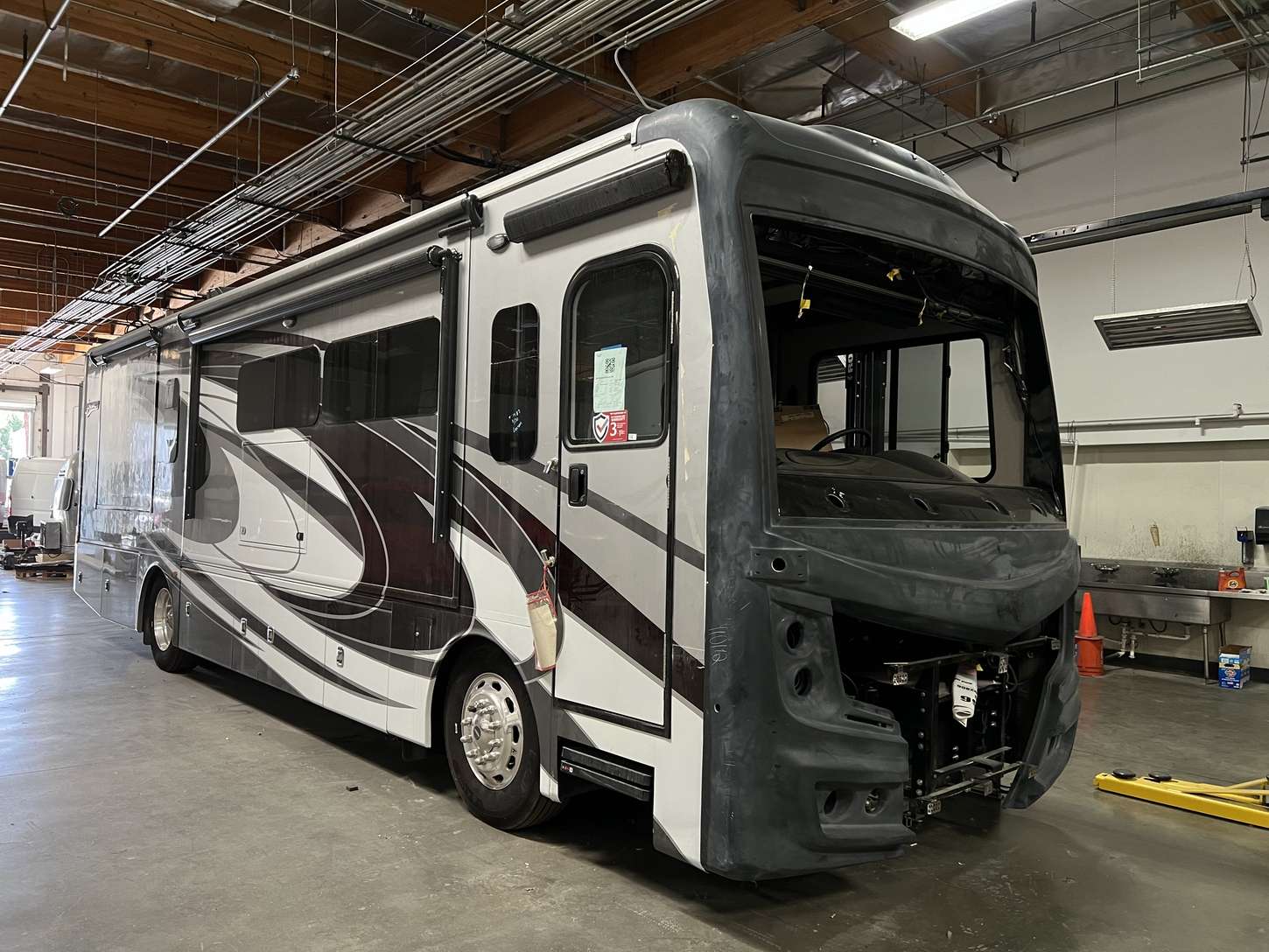
There is no mobile division here and there will not be one. The equipment that makes this work correct does not travel: a full frame rack, a downdraft booth sized for a coach, heavy chassis lift capacity, and the compressed air and extraction infrastructure regulated refinishing requires. A technician in your driveway can form an opinion. He cannot perform a structural pull, a compliant refinish, or a laminate repair with a cure cycle, and on a bonded vehicle an opinion formed without opening anything is worth very little.
Some shops do offer mobile visits for this category, and the honest description of that service is inspection and small repair. If that is what you need, take it. What we would caution against is accepting a mobile assessment as the basis for a claim scope on a laminated vehicle, because the damage that determines the cost is behind a surface that still looks intact, and nobody is pulling that surface off in a parking lot.
Practically, this means one phone call before a tow. If your unit is not drivable, call us before the tow is dispatched so we can confirm space and stage the right equipment for the arrival. Sending a forty foot coach to a facility that cannot receive it that day is an expensive way to lose a week.
Fit
When we are the wrong shop for you
This section is here because a page that only lists reasons to say yes is an advertisement, not information.
You want the cheapest possible cosmetic patch
If the goal is to make a damaged area look acceptable for as little money as possible, we are the wrong building. Our repairs rebuild the substrate under a bonded panel rather than filling over it, and that costs more in labor than a smoothing and painting operation does. There are shops that will do the cheaper version. What we will not do is perform the cheaper version and describe it as a repair.
You need someone to come to you
We have no mobile service, no roadside recovery, and no on site fleet route technician. Every repair happens at our facility because the rack, the booth, the extraction system, and the lift capacity are here. If what you need is a technician in your driveway or in your yard, that is a legitimate service and it is somebody else's.
You want a repair figure over the phone
We will tell you what a category of repair generally involves and what drives the range, and we will look at photographs and give you a useful read. We will not give you a firm price for a bonded sidewall from a description, because the visible damage and the actual damage are routinely different sizes, and a number invented at the counter becomes the number you feel cheated by later.
You need it done this week regardless
Some jobs can be turned quickly and we will say so. Many cannot, and the reason is almost always parts. RV components are frequently discontinued, back ordered for months, or manufacturer ordered against a specific unit. A shop that promises a date it cannot control is buying your authorization with a schedule it will renegotiate later.
You are looking for a shop that will tell the carrier whatever you want
We document what we find and we write what the repair requires. If a portion of the damage is deferred maintenance rather than a covered loss, the file will say so, because a file that overstates is a file that gets picked apart and slows everything down for you. Advocacy and fabrication are different activities and only one of them helps your claim.
If none of those describe your situation, and you are in Westminster or anywhere else in Southern California with a vehicle that a normal body shop cannot physically accept, we are probably the right call. Send photographs and a description and we will tell you what the repair involves before you move the vehicle anywhere.
Questions
Frequently asked questions
What is the single strongest reason to bring a coach here rather than to a body shop
Physical capability, and everything that follows from it. A general body shop cannot get a full size motorhome into a booth, cannot anchor a heavy chassis to a rack designed for unibody cars, and cannot lift a loaded commercial unit. When such a shop takes the job anyway, the parts it cannot perform get sublet, which means your vehicle travels between buildings, sits in someone else's queue at someone else's priority, and ends up with responsibility for the finished result divided between two or three companies. Keeping structural, laminate, body, paint, fabrication, systems, and interior under one roof removes every one of those handoffs.
Why do you publish labor rates when almost nobody else does
Because a total you cannot break apart is a total you cannot question. Body and paint is $210 per hour, mechanical is $260 per hour, diagnostics are $285 per hour and credited against an authorized repair, and detail is $95 per hour. When you can see the rate and see the hours, you can ask why an operation is fourteen hours instead of nine, and that is a conversation an honest shop can have. When all you receive is one number, your only tool is suspicion. Published rates also make the carrier conversation cleaner, because two estimates can be compared line by line instead of argued about in the abstract.
Does the sequence of the repair really matter that much
It is the difference between a repair that holds and one that comes apart quietly. Structural correction has to happen before body work, because body work performed on a chassis that is still out of specification is fitted to the wrong geometry. Body has to finish before paint, because paint seals everything under it. Systems and interior go back after paint, because a wiring run or a wall panel installed first is a wiring run or wall panel that has to come out again. Every stage covers the one before it, so anything left wrong is sealed in and reappears at delivery, or worse, six months later.
How does documentation quality change what happens to my claim
Adjusters approve what they can verify. That is not obstruction, it is the structure of the job: an adjuster who authorizes work he cannot support is exposed. The difficulty on our vehicles is that the person reviewing your file has probably spent the week on passenger cars, and a bonded sidewall assembly resembles nothing in that experience. So we build files that explain themselves, with staged teardown photographs, moisture readings and their locations, printed structural measurements before and after, part numbers with real lead times, and written reasoning under each labor line. A file like that gets approved faster and gets picked apart less often.
What does capacity mean in practice for a fleet operator
It means you do not have to give up the whole fleet at once. We schedule units in planned groups: a set in, worked, out, then the next set, with the sequence agreed before the first vehicle arrives. That is only possible with yard space to stage arrivals and enough bays to run several jobs at different stages simultaneously. A shop that can hold three vehicles has to turn a group of six into two engagements weeks apart. Running roughly 75+ vehicles a month is what the layout exists to support, and for a fleet the relevant measure is unit downtime rather than labor hours.
Are you more expensive than a general body shop
On the invoice, usually yes. On the hourly rate, not dramatically. The difference is almost always hours rather than rate, and the hours reflect construction. A panel on a coach is bonded into a laminated wall assembly rather than bolted to a frame, so replacing it involves substrate work that an automotive estimate would never contain. What we would ask you to compare is not the two totals but the two scopes. If one estimate contains substrate reconstruction and moisture remediation and the other does not, they are not quotes for the same job, and the cheaper one is cheaper because it is smaller.
What happens if I am not satisfied with the finished work
Call us and bring it back. We would rather look at a complaint in the first month than have it become a review that neither of us can do anything about. Bring the invoice, and if you can, photographs of what is bothering you in daylight. If it is our workmanship we correct it. If it is something outside the scope you authorized, we will show you the file and explain why, and if you disagree, the state registration gives you a complaint route to the Bureau that does not depend on our cooperation. Both of those are better outcomes than silence.
Should I get more than one estimate
Yes, and we say that without reservation. Bring us the other estimate too. What is genuinely useful about a second opinion on this type of vehicle is not the total, it is the scope: whether the other shop planned for substrate work, whether moisture was measured or assumed, whether structural measurement is in the plan or only mentioned, and whether parts have real lead times attached. Those four comparisons will tell you far more than the two numbers at the bottom. An owner who understands why two estimates differ is an owner who is very difficult to take advantage of.
Talk to a repair specialist today
Tell us what happened and we will tell you what the repair actually involves, what it costs, and how long it takes. We work directly with every major carrier and serve Westminster owners and fleets from our 35,000 square foot facility.
Posted labor rates are published on our prices page. Diagnostic and systems assessment fees are credited against an authorized repair.