Services
RV Collision Repair Westminster CA: Tow-In to Reassembly
In short
Most RV collision jobs run 2 to 10 weeks and land somewhere between $4,000 and $60,000, because the damage hiding behind a laminated sidewall is rarely visible at drop-off. Our Westminster shop writes a paid estimate at $210 per hour body labor and credits it back against an authorized repair.
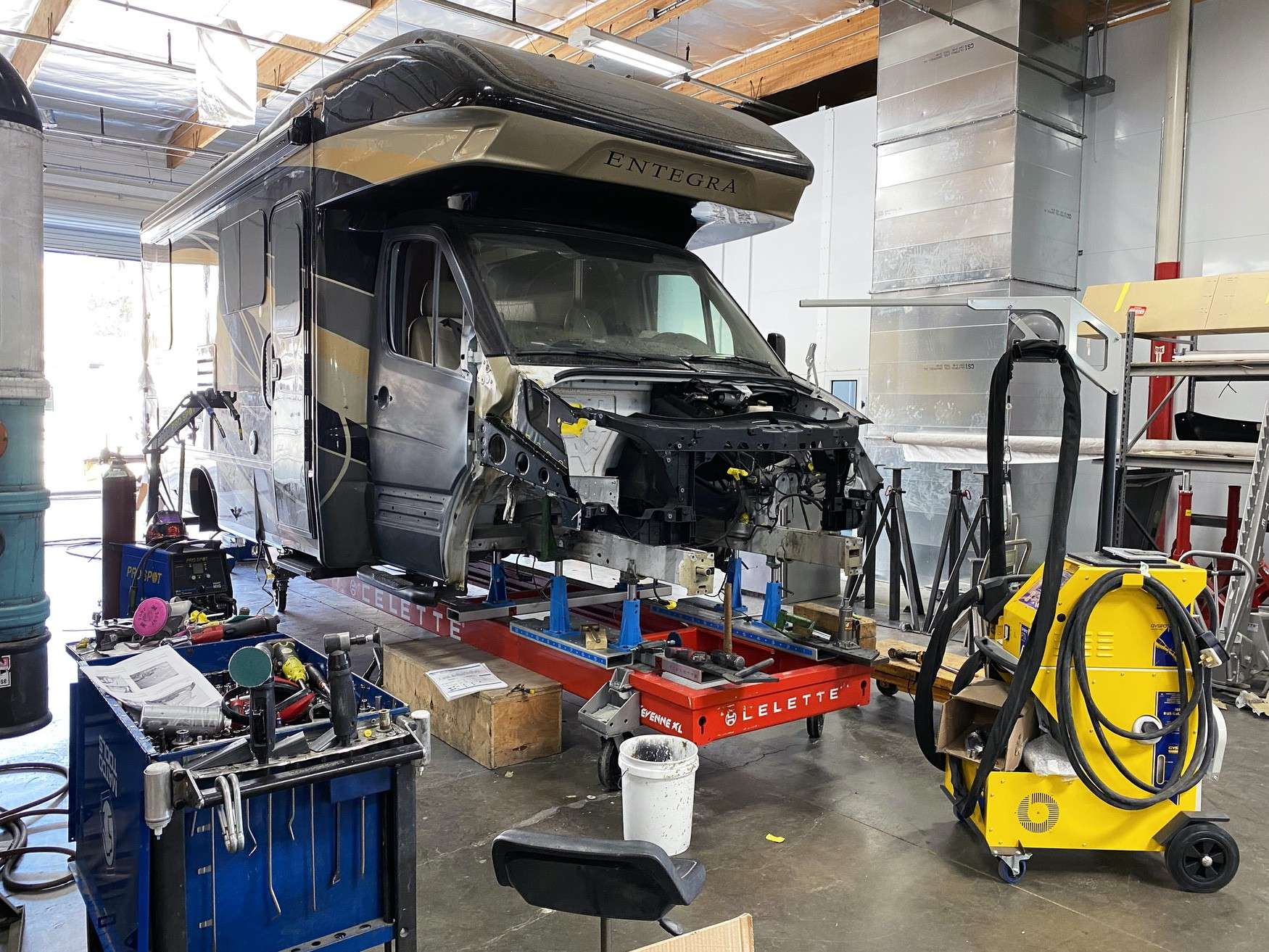
RV collision repair Westminster CA owners can plan around starts with a real teardown, not a guess made in the parking lot. We have been rebuilding wrecked motorhomes, fifth wheels, travel trailers, vans, and commercial trucks since 2015, and we move roughly 75 or more vehicles a month through a 35,000 square foot facility. Damage on a coach hides behind sidewall lamination and cabinetry, so the first honest number comes after panels come off.
What Happens When a Damaged Coach Arrives
Most collision jobs start with a phone call and a set of photos, then a tow or a drive-in. When the unit lands in our Westminster yard we do a walkaround with a camera, note every point of contact, and pull moisture readings around the impact zone before anything comes apart. A coach that hit a low overhang at fifteen miles per hour can look like a scuffed cap and still have a cracked roof-to-wall joint eight feet away from the visible mark.
The next step is a paid estimate. We charge for the time it takes to inspect, document, and write the job at our $210 per hour body and paint rate, and that charge is credited back against an authorized repair. Owners sometimes push back on paying to be looked at. The reason we work this way is that an honest RV estimate takes hours of real effort, not a five minute glance, and a guessed number helps nobody once the adjuster is involved.
Once you approve the direction, we collect a 50 percent deposit on any repair above $2,000, order long lead parts immediately, and schedule teardown. Parts ordering happens first on purpose. Sidewall skins, corner caps, and radius windows for a discontinued floor plan can take six to twelve weeks to arrive, and there is no sense holding a stall hostage while a molded cap crosses the country on a truck.
Teardown and the Damage Nobody Sees on Day One
Teardown is where the estimate becomes real. We pull the damaged skin, interior wall panels, insulation, and any cabinetry in the impact path so we can see framing, wiring, plumbing, and the actual crush pattern. On a motorhome that took a corner hit, it is common to find a bent aluminum stud two bays away from the dent, a pinched wire loom, and compressed block foam that will hold water later if nobody replaces it.
Water damage is the most frequent surprise. An impact opens a seam, the coach sits outside for a few months, and by the time it reaches us the luan behind the skin is soft and the floor edge is spongy. That is not collision damage anymore, it is rot, and it changes both the scope and the insurance conversation. We document it separately with photos and moisture readings so the adjuster can see what the hit caused and what predates it.
We photograph every stage. Before teardown, after skin removal, after framing exposure, and again after repair. That record is what supports a supplement request and it is what protects you if somebody later questions the work. If we find damage that changes the plan significantly, we stop, call you, and walk through the options before spending another hour. Nobody likes a surprise invoice, and neither do we.
- Bent or cracked framing members behind a skin that still looks fine
- Delaminated sidewall spreading outward from the impact seam
- Soft luan and rotted floor edge from water that entered after the accident
- Pinched or chafed wiring, crushed 12 volt runs, and damaged slide harnesses
- Cracked roof-to-wall joint, separated corner molding, and failed butyl
- Compressed block foam that no longer supports the laminated panel
How Coach Construction Changes the Repair Plan
Three very different structures show up under the same word RV. A gas or diesel motorhome sits on a ladder frame or a purpose built chassis with a body built on top, so the frame and the body can be damaged independently. A fifth wheel or travel trailer is usually a laminated box on a welded steel trailer frame with an aluminum cage inside the walls. An older stick and tin trailer is a wood frame with aluminum sheet stapled and screwed over it.
Those differences drive the whole repair sequence. On a ladder frame coach, a rear hit can push the body back on its mounts without deforming the rails, and the fix is body mount and structure work rather than frame correction. On a laminated trailer, the wall itself is the structure, so a puncture is a structural repair and not a cosmetic one. On a stick and tin unit, the wood frame behind the skin is what rots, and the aluminum is the easy part.
We explain this up front because it is why two coaches with the same size dent get very different numbers. A dent in aluminum sheet over solid wood framing might be a panel section and a paint blend. The same dent on a laminated wall can mean the adhesive bond broke across two feet of panel, and that is a bond repair, a panel replacement, or both.
Structural Measurement and Frame Correction
When the hit is hard enough to move structure, guessing is not an option. We measure known reference points against factory dimensions where the builder published them, and against the undamaged side of the same unit where nobody did. Diagonal measurements across the frame, ride height at each corner, axle centerline to hitch or kingpin, and door and window openings all tell you whether the box is still square.
Correction happens with hydraulic pulling equipment anchored to the frame, applied slowly, with measurements taken between pulls. Steel trailer frames can usually be pulled and reinforced. Aluminum structure behaves differently, work hardens, and often needs section replacement rather than straightening. Motorhome chassis rails carry manufacturer limits on heat and on repair versus replacement, and we follow those limits rather than forcing a rail back into place.
Some units should not be repaired. If the frame is folded ahead of the axles, if the kingpin box is torn, or if the correction cost passes what the coach is worth, we say so and put it in writing for your carrier. That conversation is easier in week one than in week six, which is why measurement happens early rather than after the body work is underway.
- Diagonal frame measurements compared side to side for square
- Ride height and spring hanger position checked at each corner
- Axle centerline referenced to the kingpin or hitch point
- Door, window, and slide openings measured for racking
- Before and after numbers documented in the repair file
Why Coach Collision Work Is Not Car Collision Work
A production car has a published repair procedure, a parts catalog that stays current for a decade, and a body shop network trained on that exact platform. Most coaches have none of that. A builder may have produced four hundred units of a floor plan in one model year, changed the sidewall graphic the next year, and retired the mold. There is no procedure library telling you the correct sequence for pulling a laminated wall off that chassis.
So the work leans on experience and on measurement. We learn how the unit was assembled by taking it apart carefully, we keep the trim and fasteners that can be reused, and we fabricate what cannot be bought. Sheet aluminum, extrusion, and fiberglass panel stock all get used to build replacements for parts that no longer exist. That fabrication time is real labor and it appears on the estimate as such.
The other big difference is size and mass. A 40 foot coach does not fit on a standard frame rack, does not go into a standard booth, and cannot be shuffled around a small shop while it is in pieces. Our 35,000 square foot facility exists for that reason. Space is not a luxury on this work, it is what lets a torn down coach sit safely while parts are in transit.
Estimates, Supplements, and the Adjuster Conversation
Almost every significant RV collision job needs at least one supplement. The first estimate covers what can be seen. The supplement covers what teardown reveals. This is normal and adjusters who handle RV claims expect it, but it does add calendar time, because the carrier has to review photos, sometimes send a field appraiser, and issue a revised authorization before we can order the additional parts.
We write supplements with photographs, moisture readings, part numbers, and labor times attached to each line. Vague supplements get denied. Specific ones get paid. If your carrier uses an estimating system with no RV specific labor times, we provide our own documented times and explain the operations, because the software has no entry for removing a laminated sidewall or resetting a slide topper.
You choose your own shop in California. Your carrier can recommend one, and can tell you what it will pay, but the choice of repairer is yours. What matters most is that the shop and the adjuster agree on scope before parts are ordered. We would rather spend an extra week getting the authorization right than start a job that stalls halfway through for money reasons.
- Photo documentation at every teardown stage, tied to specific line items
- Moisture meter readings recorded with location and percentage
- Part numbers, supplier quotes, and lead times attached to each part line
- Written labor times for operations the estimating software does not list
- A running file you can request a copy of at any point
Realistic Timelines and What Makes a Job Run Long
A light hit with available parts runs about two to four weeks. A moderate job with one supplement and a molded cap on order runs six to ten weeks. A heavy structural rebuild with frame correction, sidewall replacement, and a full repaint can run three to six months. Those ranges are wide because RV scope is genuinely wide, and anyone quoting a firm date before teardown is telling you what you want to hear.
Parts are the single largest driver. A discontinued front cap can take three months or never arrive at all, at which point we build one. Insurance approval cycles add one to three weeks per supplement. Paint adds a week or more on its own, because the whole unit has to be masked, prepped, sprayed, and cured before reassembly can start.
We give you a scheduled start, a parts status you can check, and updated completion estimates as the job moves. What we will not do is promise a date that depends on a supplier we do not control. If you have a trip planned, tell us at intake. Sometimes we can stage the work so the coach is roadworthy for a season and finish cosmetics later.
- Two to four weeks for light damage with parts on the shelf
- Six to ten weeks for moderate damage with one supplement
- Three to six months for structural rebuilds and full repaints
- One to three weeks added per insurance supplement review cycle
- Six to twelve weeks or longer for discontinued molded caps and skins
In this category
Services we perform
Minor Collision Repair
Minor collision work on an RV usually runs $1,500 to $6,000 and takes one to three weeks. Minor means skin damage only, with no fr...
Read moreMajor Collision Repair
Major collision work on a motorhome or trailer runs $8,000 to $150,000 or more and commonly takes three to nine months, most of it...
Read moreFrame Straightening
RV frame straightening runs $3,000 to $20,000 or more depending on whether we are correcting a bent A frame, sectioning a damaged...
Read moreChassis Repair and Alignment
RV chassis repair and alignment typically runs $1,200 to $9,500 or more, with a straightforward heavy chassis alignment near the l...
Read moreStructural Damage Assessment
An RV structural damage assessment costs $285 to $1,800 depending on how much teardown it takes, billed at $285 per hour of diagno...
Read moreQuestions
Frequently asked questions
How much does RV collision repair actually cost?
The honest range is wide. A scuffed corner and a paint blend can land between $1,800 and $5,000. A moderate side hit with panel work, one supplement, and a partial repaint usually runs $8,000 to $25,000. Structural jobs with frame correction, sidewall replacement, and a full repaint routinely pass $40,000 and can exceed $80,000 on a large diesel coach. Body and paint labor is $210 per hour, mechanical is $260 per hour, and paint supplies add $55 per paint hour. The variable that moves the number most is not the labor rate, it is how much hidden damage teardown finds and how long the parts take to arrive.
Why do you charge for an estimate?
Because a real RV estimate is hours of work, not a walk around the parking lot. We photograph the damage, pull moisture readings, research part availability, price the parts, and write labor times for operations that most estimating software does not list. That inspection time bills at our $210 per hour body rate and is credited back against the repair once you authorize it. If you take the estimate elsewhere, you have paid for a documented, itemized scope with part numbers and photographs, which carries real value on its own once you sit down with an adjuster.
The adjuster wrote a number far below your estimate. What now?
This is common on the first pass, because the initial carrier estimate is usually written from photos and covers only visible damage. We respond with a supplement that documents what teardown found: photographs at each stage, moisture readings with locations, supplier quotes with part numbers, and written labor times for the operations involved. Most gaps close once the adjuster sees the evidence. If the carrier still disagrees, you can request a field appraiser or invoke the appraisal clause in your policy. We supply whatever documentation that process needs, and we do not perform extra work until the money is authorized.
How long will my motorhome be in the shop?
Light collision work is generally two to four weeks. Moderate damage with a supplement and ordered parts runs six to ten weeks. Heavy structural work with frame correction and a repaint runs three to six months. The two things that stretch a schedule are parts and insurance approvals, and neither one is under our control. A discontinued molded cap can take three months to source, and each supplement cycle adds one to three weeks of review. We give you a start date, a parts status list, and revised completion estimates as the job progresses rather than one date we cannot hold.
Can a bent frame be fixed, or is the coach totaled?
It depends on where the damage sits and what the coach is worth. Steel trailer frames can usually be pulled straight with hydraulic equipment and reinforced, and we verify the result with diagonal measurements against the undamaged side. Aluminum structure work hardens and often needs section replacement instead of straightening. Motorhome chassis rails carry manufacturer limits on heat and on repair versus replacement, and we respect those limits. If the frame is folded ahead of the axles, the kingpin box is torn, or correction costs approach the value of the unit, we tell you and put it in writing for your carrier.
Do I have to use the shop my insurance company sends me to?
No. In California you choose the repair facility. Your carrier can recommend shops in its network and can tell you what it will pay for a given repair, but the decision is yours. What matters is that the shop and the adjuster agree on scope and price before parts get ordered, because a job that stalls halfway through over money is far worse than a job that starts a week later with everything authorized. We work directly with adjusters, write documented supplements, and keep you copied on the correspondence so nothing gets decided without you.
What happens if you find more damage after teardown?
We stop and call you. Then we photograph the additional damage, write it up with part numbers and labor times, and send it to your carrier as a supplement. Nothing extra gets repaired until it is authorized, either by the insurer or by you directly. Additional damage is the norm rather than the exception on RV collision work, because laminated walls and cabinetry hide everything behind them. Budget mentally for the scope to grow after teardown, and expect one to three weeks of review time per supplement cycle before those additional parts can be ordered.
Can I keep using the RV while it waits on parts?
Sometimes, and it depends on what has been torn down. If the coach is still weathertight and roadworthy, we can occasionally hold the parts, leave the unit assembled, and bring it in when the shipment lands. That works well for slow moving special order items. Once the skin is off, the unit stays here, because an open wall in Southern California weather turns a repair into a rot job in a matter of weeks. Tell us at intake if you have a trip planned. We can often sequence the work so the coach is usable for a season and finish cosmetic items afterward.
Keep reading
Related pages
Other service areas
Vehicles we repair
Talk to a repair specialist today
Tell us what happened and we will tell you what the repair actually involves, what it costs, and how long it takes. We work directly with every major carrier and serve Westminster owners and fleets from our 35,000 square foot facility.
Posted labor rates are published on our prices page. Diagnostic and systems assessment fees are credited against an authorized repair.