Commercial Trucks
Box Truck Repair for Dock Damage and Door Faults
In short
Box truck repair runs from about $1,500 for a door and rail repair to past $30,000 for structural body rebuilds. Almost everything we see on these trucks comes from two events: a loading dock impact at the rear, or a low clearance strike at the top front corner. Both damage more than they appear to.
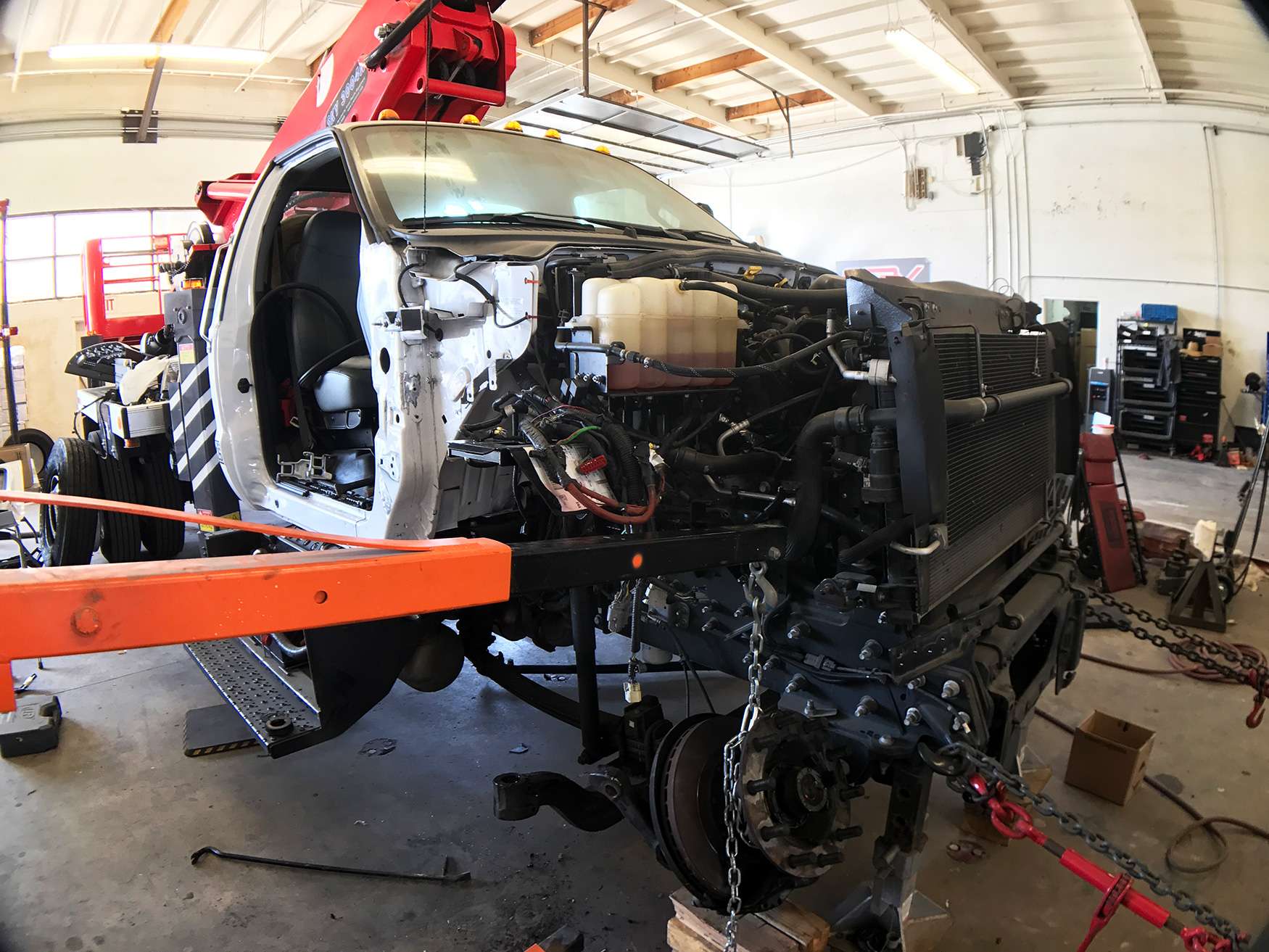
Box truck repair is dominated by two accidents, and Westminster operators will recognize both. Backing into a dock a little too hard, and driving under something a little too low. The first crushes corner posts and rear rails and jams roll up doors. The second peels the top front edge and opens the roof to water. This page covers those and everything that follows from them.
Corner Posts Do More Than Hold the Corner
The vertical posts at the rear corners of a box body carry the rear frame, locate the door track, and tie the side walls to the rear header. When a dock impact crushes one, three things go wrong at once: the rear opening loses square, the door track is no longer straight, and the wall to header joint is loaded in a direction it was not built for.
That is why a bent corner post is never just a bent corner post. We measure the rear opening diagonally, check the door track for straightness through its full travel, and inspect the header and side wall connections before quoting.
Repair is usually post replacement rather than straightening, because a crushed extrusion does not return to dimension and a door track that is close is a door that binds every day. On most bodies the post is an available part, which keeps this from becoming a fabrication job.
- Measure the rear opening diagonally before pricing anything
- Check the door track for straightness through full travel
- Inspect the wall to header joint on the damaged side
- Look at the rear frame and its connection to the body floor
- Replace crushed extrusions rather than straightening them
Roll Up Doors That Bind After an Impact
A roll up door is a set of hinged panels running in tracks with a counterbalance spring and cables. It is a precise assembly and it tolerates very little distortion. After a rear impact, the most common complaint is that the door has become hard to raise or catches partway, and owners usually ask for a new door.
Nine times out of ten the door is fine and the opening is not. We straighten or replace the affected post and track first, then run the door through its travel and address whatever panels, hinges or rollers were actually damaged. Replacing a door onto a distorted track produces a new door that binds.
The counterbalance spring is the safety item on this assembly. It stores a great deal of energy, and adjusting or replacing one is not a job for someone without the right tools. When a door has become heavy to lift, the spring is frequently the reason and the fix is straightforward for someone equipped to do it.
Translucent Roof Panels and Low Clearance Strikes
Most box bodies use a translucent fiberglass roof panel so the interior has daylight without a light circuit. It is thin, it takes ultraviolet exposure, and it goes brittle over the years. A low clearance strike at the front top edge does not just scratch it, it usually cracks it well back from the point of contact.
Water follows immediately. A cracked roof panel drips onto cargo and soaks the wood floor from above, and because the crack is often at the front where nobody looks, it can go unnoticed for a season.
Replacement means removing the roof bows or the retaining rails, fitting a new panel, and sealing the perimeter properly. It is a straightforward job on most bodies and runs roughly $2,200 to $6,500 depending on body length and how much of the front header and rail also took damage.
Liftgates and the Load Path Into the Body
A liftgate hangs off the rear of the frame and the body, and it puts a large cantilever load into that connection every cycle. What we see is cracked welds at the liftgate mounting, elongated bolt holes, and a rear body frame that has begun to sag on one side.
This is worth catching early because the failure is progressive. A crack that gets welded once and not addressed at the cause will crack again in the same place, and each cycle takes a little more of the parent material with it. The correct repair adds material and reworks the load path rather than just filling the crack.
Liftgate mechanical and hydraulic work bills at the $260 rate. The mounting and structural side is body work at $210. On an estimate we separate them so a maintenance manager can see which is which.
- Inspect liftgate mounting welds at every service interval
- Check bolt holes for elongation and crushed spacers
- Look for rear body frame sag on the loaded side
- Repair the load path, not just the crack
- Separate mechanical and structural line items on the estimate
Wood Floors, Rub Rails and the Damage Nobody Reports
The floor takes daily abuse from pallet jacks, dropped freight and moisture, and it fails from the underside as often as the top. Once a board has softened, the fastener holding it down works loose and the fastener hole becomes a water path into the crossmembers underneath.
Rub rails on the interior walls take the same treatment. They exist to keep freight off the wall panels, and once they are torn loose the wall panel starts taking the hits directly. Replacing a rub rail is inexpensive. Replacing a wall panel that has been punched through for a year is not.
A worked example: rear corner dock damage with one post replaced, door track straightened and the door serviced, no frame involvement, typically 16 to 26 hours of body labor at $210 for $3,360 to $5,460, plus $1,000 to $3,200 in post, track, door components, hardware and refinish materials.
Questions
Frequently asked questions
My roll up door binds after backing into a dock. Do I need a new door?
Usually not. A roll up door is a precise assembly running in tracks, and it tolerates very little distortion in the opening. After a dock impact the door is normally fine and the corner post and track are not. We measure the rear opening diagonally, check the track for straightness through full travel, and repair or replace the post first. Then we run the door and address whatever panels, hinges or rollers were genuinely damaged. Installing a new door into a distorted track gives you a new door that binds, which is an expensive way to learn the opening was the problem.
How much does box truck repair cost?
The range is about $1,500 to past $30,000. Door service and rail work sits at the low end. Rear corner dock damage with one post replaced and the door serviced is typically $4,500 to $8,500. Translucent roof panel replacement after a low clearance strike is $2,200 to $6,500. Liftgate mounting repair with structural rework runs $3,000 to $9,000. A full body rebuild after a serious impact can pass $30,000. Body and paint labor is $210 per hour, mechanical is $260, and authorized repairs above $2,000 carry a 50 percent deposit.
Water is getting into my box. Where should I look first?
The roof panel at the front, especially if the truck has ever touched something low. Most box bodies use a translucent fiberglass roof panel that goes brittle with ultraviolet exposure, and a strike at the top front edge cracks it well back from the contact point. Because the crack is at the front where nobody looks, it drips onto cargo and soaks the wood floor from above for a season before anyone notices. After that, check the rear header seal, the corner post joints, the marker light gaskets, and any fastener that has backed out along the top rail.
The weld at my liftgate mount cracked again. Why?
Because the first repair filled the crack instead of fixing the load path. A liftgate puts a large cantilever load into the rear of the frame and body every single cycle, and if the mounting was marginal or the parent material has already been stressed, welding the crack closed puts it right back where it was. Each cycle then takes a bit more parent material. The correct repair adds material, distributes the load into more structure, and addresses elongated bolt holes and crushed spacers at the same time. We also check the rear body frame for sag on the loaded side, which is the usual companion symptom.
Can you replace the wood floor in the box?
Yes. Floors fail from the underside as often as the top, because once a board softens the fasteners work loose and each fastener hole becomes a water path into the crossmembers underneath. We replace the affected boards or the full floor depending on condition, inspect and treat the crossmembers while the floor is open, and re fasten properly rather than into elongated holes. If the rub rails on the walls have been torn loose, replace them at the same time. They exist to keep freight off the wall panels, and a wall panel taking direct hits for a year costs far more than the rail did.
Is a bent corner post a big deal?
Bigger than it looks. The rear corner posts carry the rear frame, locate the door track, and tie the side walls to the rear header. A crushed post means the rear opening is out of square, the door track is no longer straight, and the wall to header joint has been loaded in a direction it was not designed for. All three have to be addressed, not just the visible post. We generally replace rather than straighten, because a crushed extrusion does not return to dimension and a track that is close is a door you fight every day. On most bodies the post is an available part.
How long will my box truck be down?
Door service and minor rail work is one to three business days. Rear corner post replacement with door and track work is one to two weeks. Roof panel replacement is about a week. Liftgate mounting repair with structural rework is one to two weeks. A full body rebuild after a serious impact runs four to eight weeks. We book intake for when parts arrive rather than taking the truck in to sit, and for fleets we sequence so you are down one unit at a time. Realistic dates are what we give you, not optimistic ones.
Do you repaint the box and reproduce our lettering?
Yes. We photograph and measure the graphics, unit numbering and regulatory markings before disassembly, recording distances from body lines and door edges so everything goes back exactly where it was rather than approximately. On color, we spray out and compare against the actual truck in daylight rather than trusting the paint code, since fleet whites drift after a few years of Southern California sun. Where we can, the paint boundary is planned to fall under a decal so the transition is invisible. Your formulas and layouts stay on file for the next truck in the fleet.
How the work runs
Our six step repair process
The same sequence on every vehicle, whether it is a single coach or a fleet of box trucks.
- 01
Assessment and documentation
We put the vehicle on the floor, pull panels where we need to see behind them, and photograph everything. Hidden damage found now is damage that does not become a supplement argument later.
- 02
Written estimate
You get a line by line estimate with parts, labor hours, materials, and the posted rate applied to each. Nothing is bundled into a single number you cannot check.
- 03
Carrier coordination
If a claim is involved we deal with the adjuster directly, submit the documentation, and handle supplements when teardown reveals more than the first inspection showed.
- 04
Authorization and scheduling
Once the scope is approved we confirm the deposit, order parts, and give you a realistic slot. Special order parts drive the timeline more often than labor does.
- 05
Repair
Structural first, then body, then paint, then systems and interior. The sequence is not negotiable because each stage has to be right before the next one covers it up.
- 06
Quality check and delivery
Multi point inspection, systems tested under load, paint inspected under corrected lighting, and a walkthrough with you before the vehicle leaves.
Keep reading
Related pages
Related vehicles
Services we perform
Talk to a repair specialist today
Tell us what happened and we will tell you what the repair actually involves, what it costs, and how long it takes. We work directly with every major carrier and serve Westminster owners and fleets from our 35,000 square foot facility.
Posted labor rates are published on our prices page. Diagnostic and systems assessment fees are credited against an authorized repair.