Commercial Trucks
Refrigerated Truck Repair for Insulated Bodies
In short
Refrigerated truck repair treats a puncture as a thermal breach rather than a dent. Once foam core takes on moisture it does not recover its insulating value, so the wet section has to come out. Work runs from about $2,000 for panel and seal repair to past $35,000 for major insulated body reconstruction.
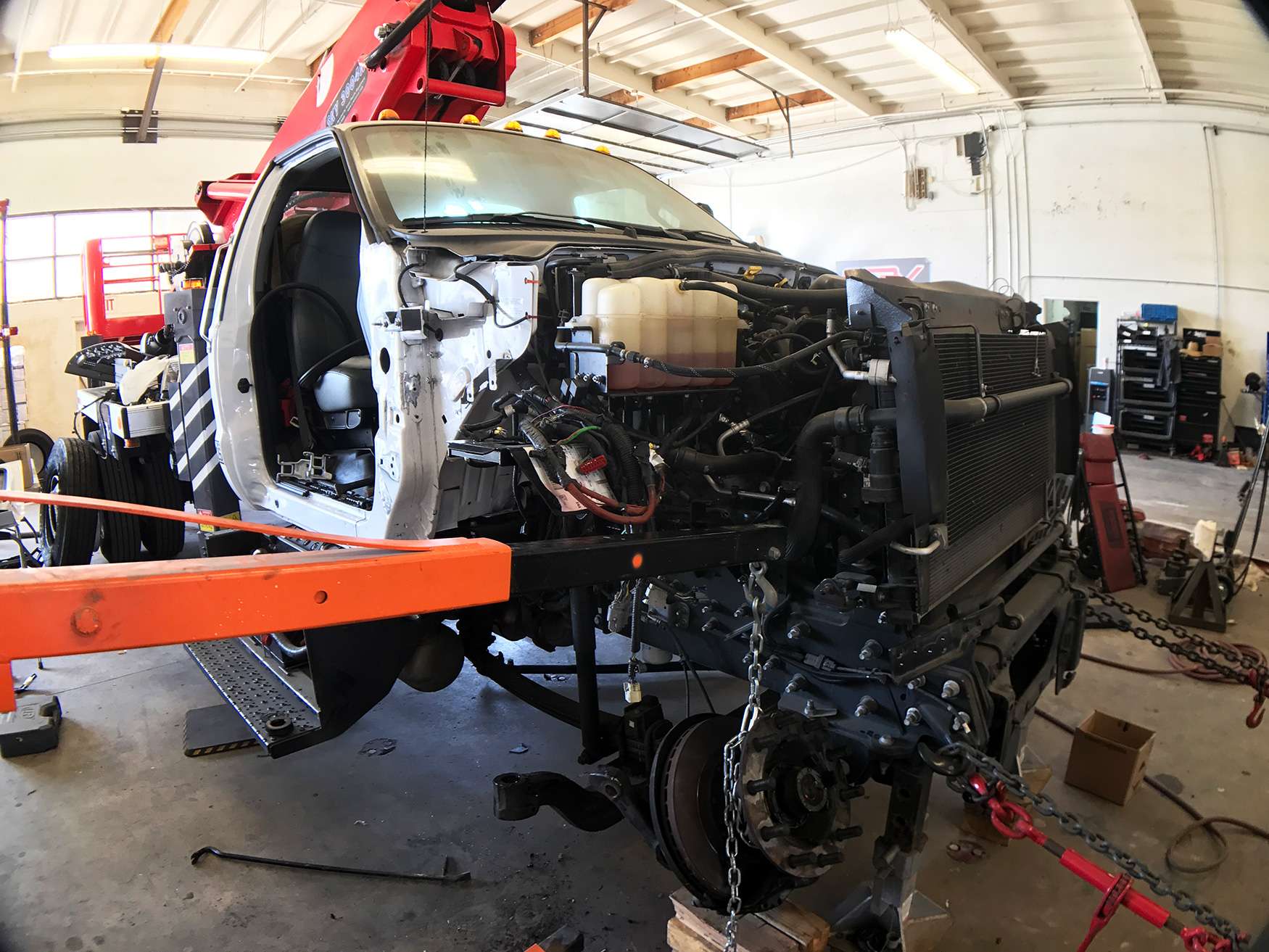
Refrigerated truck repair is the one category where a small hole is a serious problem, and Westminster operators hauling temperature sensitive freight learn that quickly. The insulated body is a sealed sandwich of skin, foam core and liner, and a puncture lets moisture into the core where it stays. We repair the body, the structure and the unit mounting, and we coordinate with your refrigeration service provider on the unit itself.
A Puncture Is a Thermal Breach, Not a Dent
An insulated body is a sandwich: an outer skin, a foam core, and an inner liner, bonded together so the whole panel is both structure and insulation. Punch a hole in the outer skin and you have not just damaged a surface, you have opened a path for moisture into the core.
Foam core takes on water and holds it. It does not dry out in service, because the panel is sealed on both faces and the truck spends its life at temperatures that encourage condensation rather than evaporation. Wet foam loses a large fraction of its insulating value permanently and it adds weight the truck carries for the rest of its life.
That is why we treat a small puncture on a refrigerated body with more seriousness than a much larger dent on a dry van. The repair question is not how it looks. It is how far the moisture traveled and where the sound core starts.
- Probe and meter the core outward from every puncture
- Expect the wet zone to exceed the visible damage
- Section back to dry, sound core before rebuilding
- Seal both faces of the repair, not just the outer skin
- Record panel weight change as an indicator of saturation
Sectioning Out Saturated Core
The correct repair for a saturated area is to cut it out. We open the outer skin, remove the wet foam back to dry material, replace with new core, then close the skin and the liner with joints that seal on both faces. A patch over wet foam is a cosmetic repair with a thermal defect sealed inside it.
How far the moisture traveled is the whole variable, and it is not knowable from outside. On a puncture that has been there a week, the wet zone might be a foot across. On one that has been there through a rainy season, it can run several feet along the panel following the path of least resistance.
So we open first, map the wet area, then price the rebuild. That is the honest sequence and it is why we do not quote refrigerated body repairs from photographs.
Thermal Bridging Introduced by a Bad Repair
The other way a repair ruins an insulated body is by creating a metal path from the outer skin to the inner liner. Any continuous piece of metal spanning the core conducts heat straight through the insulation, and it shows up as a frost line inside the box and a warm stripe on the outside.
It happens when someone repairs a panel with a steel backing plate through the core, or fastens a bracket through the full thickness, or welds a repair that ties the skin to the liner. All of those are reasonable techniques on a dry van and all of them are wrong here.
We design repairs to keep the thermal break intact: bonded joints, non conductive backing, fasteners that stop short of the liner, and any necessary through fastenings isolated with materials that do not conduct. On a body that is going to be operating at temperature for years, that detail is the whole point.
Door Seals, Hinges and the Frame They Hang On
Doors on a refrigerated body do more work than doors on a dry van because the seal is a thermal seal, not a dust seal. A door that is fractionally out of alignment loses temperature continuously, drives the refrigeration unit harder, and builds frost around the opening.
The usual cause is not the seal. It is the door frame, the hinges or the body opening. A dock impact that moved a rear corner post puts both doors out of contact and no amount of new gasket will fix that. We measure the opening, repair the structure, then hang the doors and check seal contact around the full perimeter.
The frame around the opening is also an insulated assembly, so damage there is subject to all the same rules about wet core and thermal bridging. It is the most repaired area on these bodies because it is the area that gets hit.
- Measure the opening before replacing any gasket
- Check seal contact around the full perimeter, not just at the latch
- Inspect the insulated door frame for wet core after any impact
- Look for frost patterns inside as a map of where the seal fails
- Verify hinge mounting has not elongated its fasteners
Unit Mounting, Bulkheads and Who Does What
The refrigeration unit hangs on a bulkhead at the front of the body, and that bulkhead carries a heavy, constantly vibrating assembly. Cracked welds, elongated fasteners and a bulkhead that has begun to work loose are all things we find and repair.
We are clear about scope. We repair the insulated body, the structure, the doors and the unit mounting bulkhead. We do not service the refrigeration unit itself. When a job involves both, we coordinate with your refrigeration service provider on timing so the unit comes off and goes back on without the truck sitting between two shops for a week.
After any body repair that affects the sealed envelope, a temperature pulldown check is the right verification. A worked example: puncture repair with core sectioning across a two foot area and liner repair, typically 16 to 26 hours at $210 for $3,360 to $5,460, plus $900 to $2,600 in skin, core, liner, adhesive and finish materials.
Questions
Frequently asked questions
There is a small hole in my reefer body. Can it just be patched?
Not if you want the panel to keep insulating. The body is a sandwich of skin, foam core and liner, and a hole in the skin opens a path for moisture into the core. Foam takes on water and holds it, because the panel is sealed on both faces and the truck operates at temperatures that encourage condensation rather than drying. Wet foam permanently loses a large share of its insulating value and adds weight you carry forever. The correct repair opens the skin, removes wet core back to dry material, replaces it, and seals both faces. A patch over wet foam seals a defect inside the panel.
How much does refrigerated truck repair cost?
The range is about $2,000 to past $35,000. A puncture repair with core sectioning across a two foot area and liner repair is typically $4,500 to $8,000. Door frame repair after a dock impact with insulated frame reconstruction runs $6,000 to $14,000. Rear corner post replacement with door realignment and seal work is $7,000 to $16,000. Major insulated body reconstruction can pass $35,000. Body labor is $210 per hour, mechanical is $260, and authorized repairs above $2,000 carry a 50 percent deposit.
Why can you not quote from photographs?
Because the variable that drives the price is invisible in a photograph: how far moisture traveled inside the panel. A puncture that has been there a week might have a wet zone a foot across. The same puncture left through a rainy season can have moisture running several feet along the panel, following whatever path was easiest. We open the skin, probe and meter the core, and map where sound material starts before pricing the rebuild. Quoting these from a picture would mean either padding the number heavily or issuing a supplement, and neither is a good way to treat an operator.
My box builds frost around the door. Is the seal bad?
Usually the seal is fine and the opening is not. A door on a refrigerated body forms a thermal seal, and a door that is fractionally out of alignment loses temperature continuously, drives the unit harder and builds frost at whatever point it is not contacting. Dock impacts that moved a rear corner post put both doors out of contact, and new gaskets will not fix that. We measure the opening, repair the structure, then hang the doors and check seal contact around the full perimeter. The frost pattern inside is actually a useful map of exactly where the seal is failing.
Do you service the refrigeration unit?
No, and we are clear about that up front. We repair the insulated body, the structure, the doors and the bulkhead the unit mounts to, including cracked welds, elongated fasteners and a bulkhead that has begun to work loose from vibration. The refrigeration unit itself stays with your refrigeration service provider. Where a job needs both, we coordinate the timing so the unit comes off and goes back on without the truck sitting idle between two facilities for a week. After any body repair affecting the sealed envelope, a temperature pulldown check with your provider is the right verification.
What is thermal bridging and why do you keep mentioning it?
It is a metal path running from the outer skin through to the inner liner, and it conducts heat straight through your insulation. It shows up as a frost line inside the box and a warm stripe outside. Repairs create it when someone uses a steel backing plate through the core, fastens a bracket through the full panel thickness, or welds in a way that ties the skin to the liner. Those are all reasonable techniques on a dry van body and all wrong here. We use bonded joints, non conductive backing, fasteners that stop short of the liner, and isolation where a through fastening is unavoidable.
Will the repair affect my temperature performance?
Done correctly, no. Done incorrectly, significantly. The two failure modes are wet core sealed inside the panel and thermal bridging introduced by the repair method, and both are invisible until the truck is running at temperature and the unit is working harder than it used to. That is why we section back to dry material rather than patching, keep the thermal break intact through the repair, and seal both faces. After a repair that affects the sealed envelope, run a pulldown check with your refrigeration provider so you have a verified baseline rather than an assumption.
How long will my reefer be down?
A puncture repair with core sectioning is five to ten business days including cure time for the bonded joints. Door frame repair with insulated frame reconstruction is two to three weeks. Rear corner post replacement with door realignment is two to four weeks. Major body reconstruction runs four to eight weeks. Cure times on structural adhesives are real and we do not rush them, since a joint that was hurried is a joint that admits moisture into the core later. We coordinate with your refrigeration provider so unit removal and reinstallation do not add days to the schedule.
How the work runs
Our six step repair process
The same sequence on every vehicle, whether it is a single coach or a fleet of box trucks.
- 01
Assessment and documentation
We put the vehicle on the floor, pull panels where we need to see behind them, and photograph everything. Hidden damage found now is damage that does not become a supplement argument later.
- 02
Written estimate
You get a line by line estimate with parts, labor hours, materials, and the posted rate applied to each. Nothing is bundled into a single number you cannot check.
- 03
Carrier coordination
If a claim is involved we deal with the adjuster directly, submit the documentation, and handle supplements when teardown reveals more than the first inspection showed.
- 04
Authorization and scheduling
Once the scope is approved we confirm the deposit, order parts, and give you a realistic slot. Special order parts drive the timeline more often than labor does.
- 05
Repair
Structural first, then body, then paint, then systems and interior. The sequence is not negotiable because each stage has to be right before the next one covers it up.
- 06
Quality check and delivery
Multi point inspection, systems tested under load, paint inspected under corrected lighting, and a walkthrough with you before the vehicle leaves.
Keep reading
Related pages
Related vehicles
Services we perform
Talk to a repair specialist today
Tell us what happened and we will tell you what the repair actually involves, what it costs, and how long it takes. We work directly with every major carrier and serve Westminster owners and fleets from our 35,000 square foot facility.
Posted labor rates are published on our prices page. Diagnostic and systems assessment fees are credited against an authorized repair.