Business Fleets
Construction Fleet Repair for Work Truck Operators
In short
Construction fleet repair deals with vehicles that live on dirt. Service bodies, tool storage, equipment mounts, rust, and abrasion are the daily reality rather than edge cases. We work with contractors in Westminster and across Orange County to repair work trucks around job schedules instead of pulling them off a site at the wrong moment.
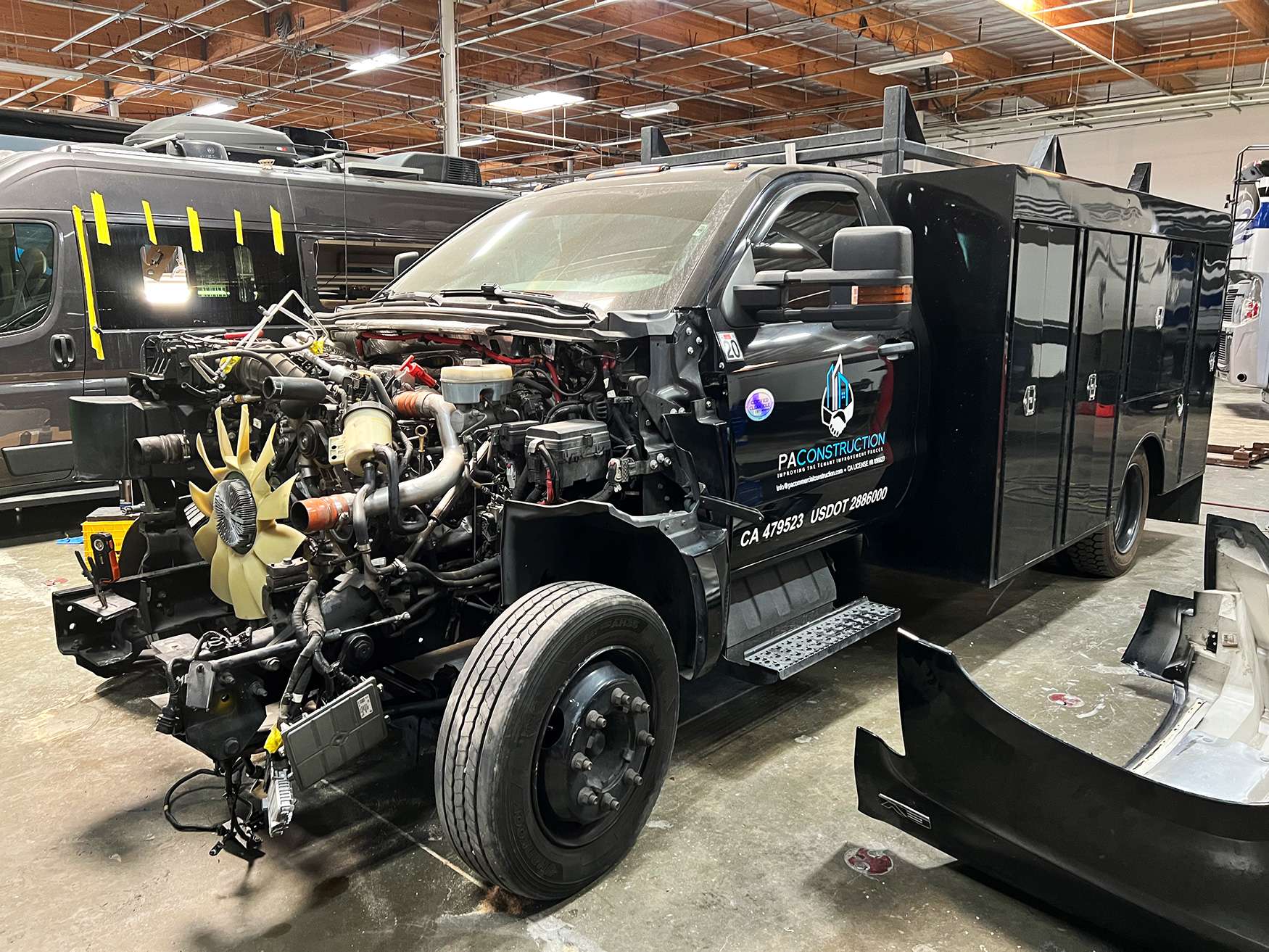
Construction fleet repair is a different animal because the vehicles never see a clean environment. A work truck runs on dirt, hauls tools that shift and gouge, carries mounted equipment that loads the frame, and gets backed into by people thinking about the job rather than the paint. We repair service bodies, flatbeds, dump bodies, and utility trucks for contractors in Westminster and throughout Orange County, scheduled around the work rather than against it.
Trucks That Live on Dirt
Construction vehicles accumulate damage in ways that office fleets never do. Constant exposure to grit, unpaved access roads, material spillage, and congested staging areas produces a steady baseline of abrasion, dents, and undercarriage wear that no single incident explains. None of it is dramatic on any given day. All of it compounds into a repair bill nobody budgeted for. The truck that looks merely tired at the start of a season is frequently the one needing metal replaced by the end of it.
The problem for a contractor is that a work truck rarely gets pulled from service for cosmetic reasons, so damage sits and grows until something structural or functional actually fails. By the time it fails, the repair is considerably larger than it needed to be. A rusted through service body floor started life as a chipped coating three years earlier that would have cost almost nothing to address.
We approach construction fleets with that timeline in mind rather than pretending each visit is unrelated to the last. When a truck comes in for collision work, we tell you what else we see, ranked by how quickly it will turn into a bigger bill. You decide what to address now and what waits. What you should not do is discover the problem when a compartment floor drops an expensive tool onto a jobsite in front of a client.
Service Bodies and Tool Storage
The service body is the truck as far as your crew is concerned, and its failures are the ones they actually complain about. Doors that will not latch, compartments taking on water in the first rain, shelving that has torn loose from its mounts, and locks that stopped working months ago are the problems that cost you real money, because each one leads directly to lost tools or ruined equipment.
We repair compartment structures, door frames and hinges, latching hardware, seals, shelving mounts, and body to frame mounting points. Water intrusion into a tool compartment deserves the same seriousness we give water intrusion into a coach wall, because the contents are worth several times the panel protecting them and the damage is progressive rather than immediate. A compartment that has been wet for a year is rarely just a seal problem by the time somebody finally mentions it.
Corrosion at the compartment floor and lower door edges is the most common structural failure we see on older service bodies. Those areas hold moisture and abrasive material against bare metal, often under a layer of tools that nobody moves for a year. We cut out and replace the failed sections rather than coating over them, because coating over active corrosion buys a season at most and then costs you the repair twice.
- Compartment door frames, hinges, latches, and locks
- Seal replacement to stop water intrusion into tool storage
- Shelving, drawer, and interior mount repair
- Corroded compartment floor and lower panel section replacement
- Body to frame mount inspection and repair
- Rear step, bumper, and grab handle repair
Rust, Abrasion, and Chemical Exposure
Construction vehicles face corrosion accelerators that ordinary fleets simply do not encounter. Concrete residue, form release agents, fertilizer and soil amendments, roofing materials, and constant abrasive contact all attack coatings far faster than weather alone ever would. A finish that would last a decade on a commuter vehicle can fail in a few seasons on a work truck carrying the wrong material every day.
Repair here means addressing the substrate rather than the appearance, which is the distinction that separates a lasting repair from an expensive delay. We remove corrosion back to sound metal, treat the surface, replace sections that have lost structural thickness, and refinish with coatings selected for the actual exposure. A cosmetic respray over compromised metal is a repair that fails on a schedule you could predict in advance.
For fleets hauling corrosive materials regularly, protective coatings on the high exposure areas make straightforward economic sense. Bed liners, rocker and lower panel protection, and undercarriage treatment cost far less than the section replacement they prevent, and they extend the point at which a truck stops looking like an asset a client wants to see parked outside their property. Applied at the right time, that protection is one of the few maintenance decisions on a work truck that clearly pays for itself.
- Corrosion removed back to sound metal before refinishing
- Section replacement where metal has lost structural thickness
- Coatings selected for abrasion and chemical exposure
- Bed liner and lower panel protection on high exposure areas
- Undercarriage treatment for trucks working unpaved sites
Equipment Mounts, Racks, and Cranes
Anything bolted to a work truck transfers load into the frame, and that transferred load is what eventually cracks something expensive. Ladder racks, pipe racks, cranes, compressors, welders, and toolbox mounts all concentrate stress at their attachment points. The failure reliably shows up at the mount long before it shows up in the equipment itself, which is why the equipment usually gets blamed for a problem the mounting created.
We inspect and repair mounting structures as a matter of course on construction fleet work rather than waiting for you to ask. Cracked welds, elongated bolt holes, deformed mounting plates, and frame damage underneath a mount are all findings we look for specifically. On crane equipped trucks the mounting integrity is unambiguously a safety item, and we treat it that way even when the truck came in for something unrelated.
When we install or repair a mount, we address how the load enters the frame rather than simply reattaching the bracket that came loose. A mount that keeps failing is almost always a mount that was never distributing load correctly to begin with, and reattaching it the same way produces the same result a few months later at your expense rather than ours.
- Ladder and pipe rack mount inspection and repair
- Crane and boom mounting structure and frame reinforcement
- Cracked weld repair at high stress attachment points
- Elongated fastener hole and mounting plate correction
- Toolbox, compressor, and welder mount reinforcement
Repairs Timed to the Job Schedule
Pulling a truck off an active site is expensive in ways that never appear on a repair invoice. Crews stand around waiting for tools that are locked in a compartment thirty miles away. Material does not get moved. A superintendent spends an afternoon rearranging logistics instead of running the job. The invoice might be modest while the true cost of the timing is several times larger.
We schedule construction fleet work against your job calendar for exactly that reason. Between projects, during a permitting delay, or in the gap after a phase completes are all dramatically cheaper windows than the middle of a pour. Tell us your schedule and we will fit the work into it rather than asking you to fit your job around a slot that happened to be open in our bay.
For genuinely urgent damage that grounds a truck, we prioritize the items that restore function first and leave the rest for later. Full cosmetic completion can follow on a scheduled return visit once the pressure is off. A truck that works and looks rough beats a perfect truck still sitting in a bay, and every contractor we work with reaches that conclusion within about ten seconds of being asked.
Getting a Truck Ready for Resale or Return
Work trucks eventually leave the fleet, either sold outright or returned at lease end, and the condition at that moment determines a real amount of money. Construction vehicles routinely give up thousands of dollars at disposal because nobody addressed accumulated damage that would have cost a fraction of that to correct while the truck was still working. The gap between a truck that looks maintained and one that looks used up is usually a few hundred dollars of attention nobody spent.
Pre disposal work is worth scoping deliberately rather than comprehensively, because some repairs cost more than the value they restore. We will tell you which items actually move the number and which ones do not. Typically the ones that matter are body damage visible in listing photographs, corrosion that signals neglect to a buyer, and anything a lease inspector will flag as a functional defect rather than fair wear.
For lease returns, the inspection standard is usually written down and quite specific about tolerances. Bring us the return condition requirements and we will scope directly against them rather than guessing at what an inspector will accept. Call (949) 799-3387 or email info@ocrvcenter.com to arrange fleet intake and we will work from your document rather than a general assumption. Scoping against the actual standard is what keeps a return inspection from producing charges nobody planned for.
Questions
Frequently asked questions
Can you repair a rusted out service body or does it need replacement?
Most of the time it can be repaired, and repair is usually the better economic decision on a chassis with service life remaining. We cut out corroded sections back to sound metal, treat the surface, and weld in replacement material rather than coating over compromised areas, because coating over corrosion buys a season at best. Replacement makes sense when corrosion has spread through the majority of the structure or when the underlying truck is near retirement. We will show you both paths with real numbers rather than defaulting to the larger job.
Do you work on equipment mounts and crane installations?
Yes, and mounting structures get specific attention on every construction fleet vehicle we handle. Ladder racks, pipe racks, cranes, compressors, and welders all concentrate load at their attachment points, and failures appear at the mount long before they appear in the equipment. We look for cracked welds, elongated fastener holes, deformed mounting plates, and frame damage under a mount. On crane equipped trucks this is a safety matter rather than a maintenance item, and we treat it accordingly rather than simply reattaching a loose bracket.
How do you schedule work around an active job site?
We schedule against your job calendar rather than ours. The cheapest windows are between projects, during a permitting delay, or in the gap after a phase completes, and a truck pulled from an active site costs far more than the invoice suggests once crew downtime and logistics disruption are counted. Give us your schedule and we will fit the work into it. For urgent damage that grounds a truck, we prioritize restoring function first and schedule cosmetic completion for a later return visit rather than holding the vehicle.
Is protective coating worth the cost on construction vehicles?
On high exposure areas, usually yes. Concrete residue, form release agents, soil amendments, roofing materials, and constant abrasive contact attack coatings far faster than weather alone, which is why a finish that lasts a decade on a commuter vehicle fails in a few seasons on a work truck. Bed liners, rocker and lower panel protection, and undercarriage treatment cost meaningfully less than the section replacement they prevent. We will tell you which specific areas on your vehicles justify the treatment based on what you actually haul.
What should we fix before selling or returning a work truck?
Only the items that move the disposal number, and they are more predictable than most contractors expect. Body damage visible in listing photographs, corrosion that signals neglect to a buyer, and functional defects a lease inspector will flag are the ones that matter. Repairs that cost more than the value they restore are not worth doing, and we will tell you which is which rather than scoping everything. For lease returns, bring us the written return condition standard and we will scope directly against it instead of guessing at the requirement.
Do you handle dump bodies and flatbeds as well as service bodies?
Yes. Dump bodies, flatbeds, stake beds, utility bodies, and enclosed service bodies all come through the shop. Each has its own failure pattern. Dump bodies crack at hinge points and floor seams under repeated load. Flatbeds fail at headboard mounts and along deck edges. Utility bodies corrode at compartment floors and lower door edges. Knowing where a given body type fails means we inspect those areas specifically instead of only addressing the damage that brought the truck in.
Our truck was backed into on site. Who handles the claim?
That depends on whether the incident involved a third party, and the answer changes the documentation required. If another contractor or their equipment caused the damage, the file needs enough detail to establish what happened and what it cost to correct. We produce dated photographs, damage descriptions, teardown findings, and an itemized scope tying each operation to a specific damage point. That package supports a claim against another party's coverage or your own, and it is substantially harder to dispute than a summary invoice.
How do we set up an account for our construction fleet?
Call (949) 799-3387 or email info@ocrvcenter.com with your fleet size, vehicle and body types, and your typical project schedule. We will structure intake around how you actually operate, including purchase order handling if your accounting requires it and any documentation your project owners ask you to retain. Assessments are paid and credited against an authorized repair. Our facility has operated since 2015, is licensed by the California Bureau of Automotive Repair under ARD00288521, and holds EPA identification CAL000367879.
Keep reading
Related pages
Others we work with
Services we perform
Talk to a repair specialist today
Tell us what happened and we will tell you what the repair actually involves, what it costs, and how long it takes. We work directly with every major carrier and serve Westminster owners and fleets from our 35,000 square foot facility.
Posted labor rates are published on our prices page. Diagnostic and systems assessment fees are credited against an authorized repair.