Buses and Municipal Fleet
School Bus Repair Scheduled Around Your Calendar
In short
School bus repair runs from about $2,000 for panel and door work to past $40,000 for structural body repairs. Two things separate this work from ordinary bus repair: matching a specific yellow across a fleet of different ages, and getting heavy work into the summer window so routes are never short.
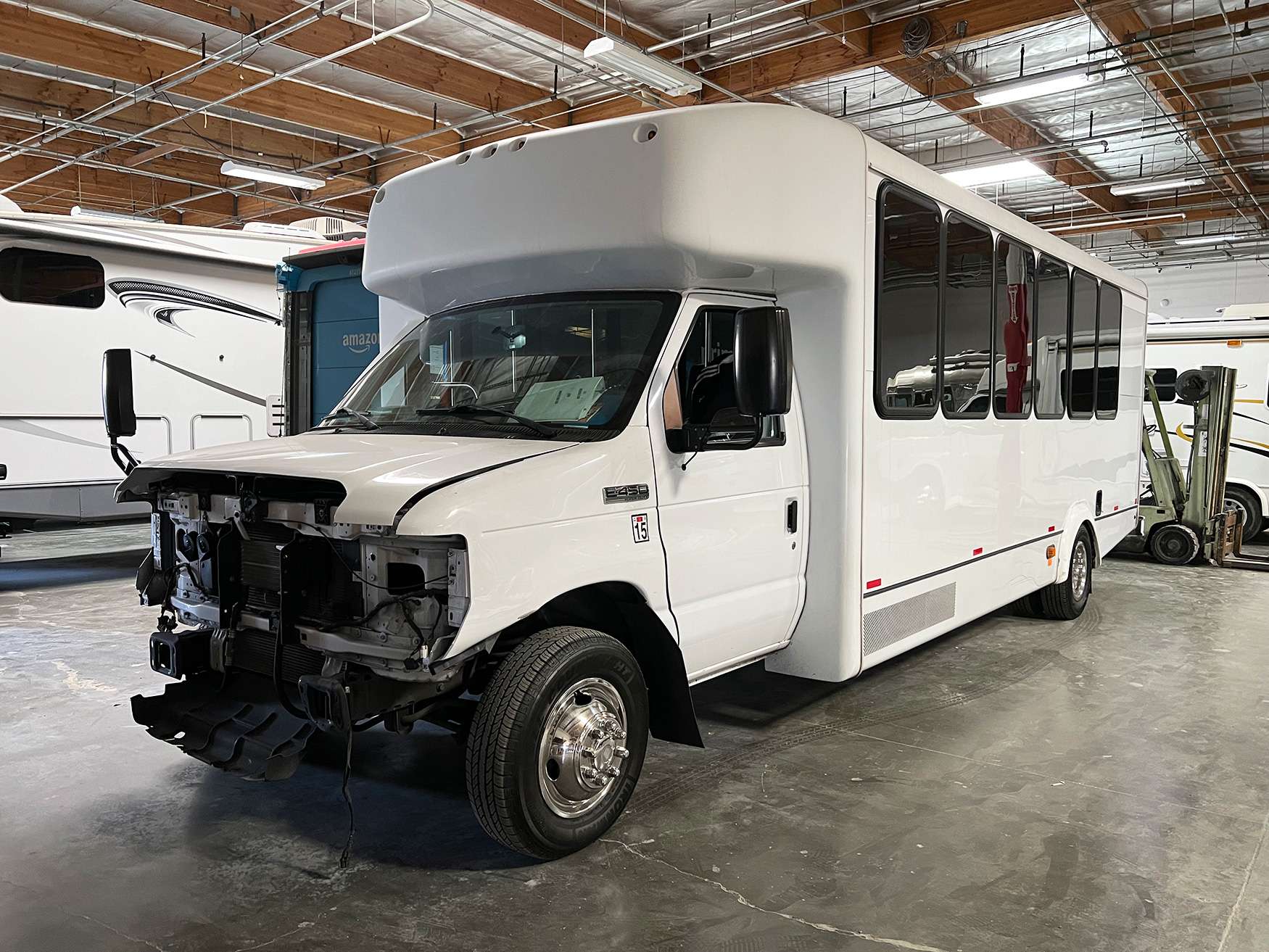
School bus repair is calendar driven work, and every transportation director in Westminster and across Orange County knows the reason. A bus out of service in October is a route problem, while the same bus in July is just a repair. This page covers body panels and rub rails, stop arms and crossing gates, seat frames and anchorage, entrance doors, and how we build a summer schedule that actually holds.
Body Panels Between the Rub Rails
A school bus body is sheet panels fastened to a steel cage, with horizontal rub rails running the length of the body at defined heights. Those rails are structural, not trim. They stiffen the side, they take the first contact in a side impact, and they are the reference line for how panel damage is assessed.
Damage confined between the rails is usually a straightforward panel repair or replacement. Damage that has deformed a rail is a different job, because a bent rail means load went into the cage behind it and the posts have to be inspected.
So we assess against the rails, and we say clearly on the scope document which category the damage falls into. That distinction is frequently the difference between a five thousand dollar job and a twenty thousand dollar one, and a supervisor needs to see it in writing rather than as a surprise.
- Assess damage relative to the rub rail lines
- Inspect cage posts behind any deformed rail
- Check panel fastener lines for pulled or elongated holes
- Look for buckling above and below the damaged area
- Photograph the rail condition before disassembly
Matching a Specific Yellow Across an Aging Fleet
School bus yellow is a defined color and it is one of the harder ones to match on a repair, because it fades in a distinctive way and because a fleet is never all the same age. A panel sprayed to the correct formula next to a bus that has been in Southern California sun for nine years does not look right, and everybody who sees that fleet every day notices.
The way we handle it is to spray out and compare in daylight against the actual bus, not against a chip. Then we set the blend boundary by what the eye sees, which on a bus body often means carrying the refinish to a rail line or a panel joint rather than stopping mid panel.
Regulatory markings, unit numbers and district lettering all get photographed and measured before disassembly so they go back exactly where they were. On a fleet, consistency of that layout across units matters to the people looking at them daily.
Stop Arms, Crossing Gates and Their Mounts
Stop arms and crossing gates get damaged constantly, usually by contact rather than mechanism failure, and the repair that matters is the mount rather than the arm. These assemblies mount through the body panel into structure, and repeated impacts elongate the mounting and let the whole assembly work.
When an arm comes in bent, we inspect the mount, the panel around it and the structure behind. Replacing an arm onto a mount that has been working for two years produces an assembly that rattles loose again on the same schedule.
The electrical side is straightforward and worth doing properly: connectors that have been repeatedly flexed, grounds that have corroded, and switch assemblies that have taken water. We document the wiring as we go so a future technician is not tracing an undocumented repair.
Entrance Doors, Mirrors and Daily Wear Items
The entrance door on a school bus cycles more than almost anything else on the vehicle, and it is a linkage rather than a simple hinge. Worn pivots, a loose control rod, a seal that has taken a set and a stepwell that has been worn through are all normal high mileage findings rather than damage.
Mirrors are the other constant. Crossover mirrors and their arms get contacted regularly, and the mount into the front body panel is what fails rather than the mirror itself. As with stop arms, the correct repair addresses the mount and the panel behind it.
These are exactly the items to bundle into a summer visit. A bus that is already in the shop for body work can have its door linkage, mirror mounts, stepwell and seals addressed for a fraction of what a separate visit would cost, and that is the kind of thing we will put on the scope document as an optional line rather than doing without asking.
- Door linkage pivots, rods and seals
- Stepwell surface and its edge trim
- Crossover mirror mounts and the panels behind them
- Emergency exit latches, seals and buzzer circuits
- Roof hatch seals and their operating mechanisms
Seat Frames and Anchorage
Seat frames anchor into floor structure, and the anchorage is the part that matters. Over years of service, floors take moisture from cleaning, from wet weather and from spills, and the fasteners in a compromised floor lose their grip long before anything visible happens.
When we have a floor open for any reason, we inspect the anchorage. Where a floor section has softened, the repair replaces the structure and re anchors properly rather than putting a longer fastener into damaged material.
Frame and cushion repair itself is straightforward work and is often bundled with body repairs during a summer visit. We scope it separately so it can be approved or deferred on its own rather than being tangled up with a collision line item.
Building a Summer Schedule That Holds
The summer window is short and every district in the region wants it, so the schedule that works is the one built in spring rather than in June. We scope units in advance, identify long lead parts and order them against the deposit so material is on the shelf when the bus arrives, then run units through in sequence.
What breaks a summer schedule is almost always a part, not a bay. A body panel or a door assembly that turns out to be eight weeks away in mid July is a bus that misses the start of the year. Scoping in spring is what prevents that, and it costs nothing to do early.
A worked example: side panel damage between the rails on two panels with refinish and decal reproduction, no cage involvement, typically 20 to 32 hours of body and paint at $210 for $4,200 to $6,720, plus $1,000 to $3,200 in panel, rail, hardware, decal and refinish materials.
- Scope units in spring, not in June
- Order long lead parts against the deposit before the bus arrives
- Sequence buses so route coverage is never short
- Bundle wear items into the same visit as body work
- Confirm completion dates in writing before the window opens
Questions
Frequently asked questions
Can you do our heavy work over the summer?
Yes, and the way to make that work is to scope in spring rather than in June. Every district in the region wants the same window, and what breaks a summer schedule is almost never bay space, it is a part. A body panel or door assembly that turns out to be eight weeks out in mid July is a bus that misses the start of the year. If we scope in spring, identify long lead items and order them against the deposit, the material is on the shelf when the bus arrives and the schedule holds. Early scoping costs nothing.
How much does school bus repair cost?
The range is about $2,000 to past $40,000. Side panel damage between the rub rails on two panels with refinish and decal reproduction is typically $5,000 to $10,000. Stop arm or crossing gate replacement with mount and panel repair runs $1,500 to $4,000. Entrance door linkage rebuild with seal and stepwell work is $2,000 to $5,000. Structural repair involving deformed rails and cage posts is $15,000 to $40,000. Body and paint labor is $210 per hour, mechanical is $260, and authorized repairs above $2,000 carry a 50 percent deposit.
Can you match our yellow across buses of different ages?
We can get it right, and the method matters. School bus yellow fades distinctively, and a fleet is never all the same age, so a panel sprayed exactly to formula next to a nine year old bus reads as wrong to everyone who sees that fleet daily. We spray out and compare in daylight against the actual bus rather than against a chip, then set the blend boundary by what the eye sees, which on a bus body usually means carrying the refinish to a rail line or a panel joint rather than stopping mid panel. Your formulas stay on file for the next unit.
Our stop arm keeps coming loose. Is the arm defective?
Usually the mount is the problem, not the arm. Stop arms and crossing gates mount through the body panel into structure, and repeated contact elongates that mounting and lets the whole assembly work against the panel. Replacing the arm onto a mount that has been loosening for two years gives you a new arm that comes loose on the same schedule. We inspect the mount, the panel around it and the structure behind, and repair the load path properly. On the electrical side we address flexed connectors, corroded grounds and switch assemblies that have taken water, and document the wiring for whoever works on it next.
What is the difference between damage between the rails and rail damage?
It is often the difference between a five thousand dollar repair and a twenty thousand dollar one. Rub rails on a bus body are structural, not trim: they stiffen the side, they take first contact in a side impact, and they are the reference for how damage is assessed. Damage confined between the rails is usually a straightforward panel repair or replacement. A deformed rail means load went past it into the cage behind, and the posts have to be inspected. We state clearly on the scope document which category your damage falls into, because a supervisor needs that in writing rather than as a later surprise.
Can you handle seat frames and floor anchorage?
Yes, and the anchorage is the part that matters. Seat frames anchor into floor structure, and floors take moisture over the years from cleaning, wet weather and spills. Fasteners in a compromised floor lose their grip well before anything visible appears. Whenever we have a floor open for any reason, we inspect the anchorage, and where a section has softened we replace the structure and re anchor properly rather than driving a longer fastener into damaged material. We scope seat work as its own line so it can be approved or deferred separately from a collision repair.
Do you certify the bus after repair?
No. We repair to the body manufacturer's published procedures, document the work with photographs and measurements, and return that file to your department. Whether the unit satisfies your inspection and re approval process is a determination for your inspection authority using our documentation. Be cautious of any shop offering to certify compliance outcomes on your behalf. What we will do is make sure the file is complete enough that your process has everything it needs, formatted the way your maintenance system wants it if you tell us during scoping rather than after the invoice.
How long is a bus out of service for typical body work?
Panel damage between the rails with refinish is one to two weeks. Stop arm or mirror mount repair is two to four business days. Entrance door linkage rebuild is three to six business days. Structural repair involving rails and cage posts is three to six weeks. The variable is nearly always parts rather than labor, which is why we scope early and order against the deposit. For a summer program we sequence units so route coverage is never short, and we give you completion dates in writing before the window opens rather than adjusting them halfway through.
How the work runs
Our six step repair process
The same sequence on every vehicle, whether it is a single coach or a fleet of box trucks.
- 01
Assessment and documentation
We put the vehicle on the floor, pull panels where we need to see behind them, and photograph everything. Hidden damage found now is damage that does not become a supplement argument later.
- 02
Written estimate
You get a line by line estimate with parts, labor hours, materials, and the posted rate applied to each. Nothing is bundled into a single number you cannot check.
- 03
Carrier coordination
If a claim is involved we deal with the adjuster directly, submit the documentation, and handle supplements when teardown reveals more than the first inspection showed.
- 04
Authorization and scheduling
Once the scope is approved we confirm the deposit, order parts, and give you a realistic slot. Special order parts drive the timeline more often than labor does.
- 05
Repair
Structural first, then body, then paint, then systems and interior. The sequence is not negotiable because each stage has to be right before the next one covers it up.
- 06
Quality check and delivery
Multi point inspection, systems tested under load, paint inspected under corrected lighting, and a walkthrough with you before the vehicle leaves.
Keep reading
Related pages
Related vehicles
Services we perform
Talk to a repair specialist today
Tell us what happened and we will tell you what the repair actually involves, what it costs, and how long it takes. We work directly with every major carrier and serve Westminster owners and fleets from our 35,000 square foot facility.
Posted labor rates are published on our prices page. Diagnostic and systems assessment fees are credited against an authorized repair.