RVs and Motorhomes
Diesel Pusher Repair for Rear Engine Coaches
In short
Diesel pusher repair covers the heaviest coaches on the road: rear mounted diesel, raised rail chassis, air ride suspension and air brakes. Work runs from about $3,000 for air system and bay door repairs to past $150,000 for structural collision rebuilds. Mechanical labor is $260 per hour and body and paint is $210 per hour.
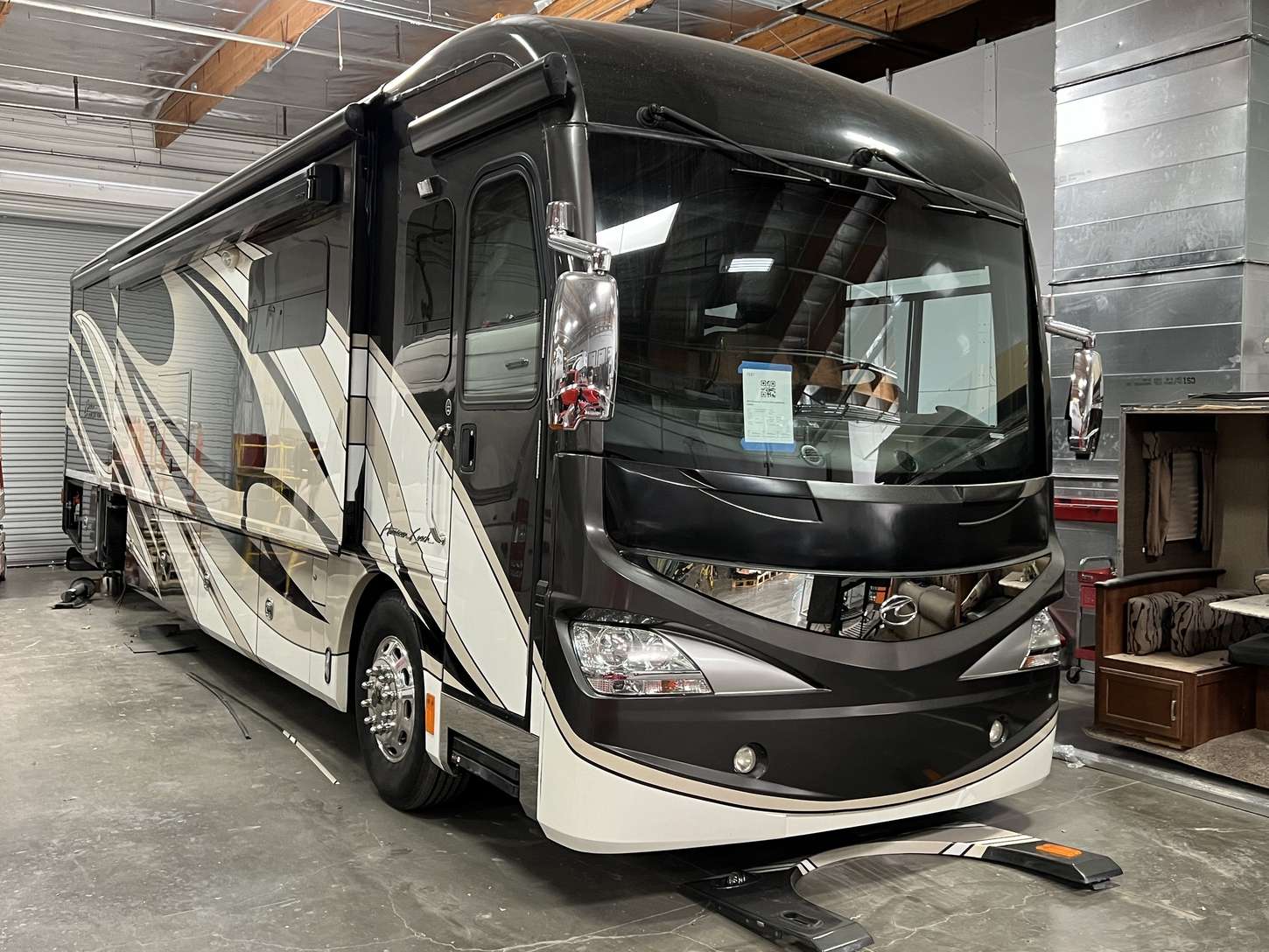
Diesel pusher repair is where RV work and heavy truck work meet, and it is a large share of what rolls onto our floor from Westminster and the rest of Orange County. The engine sits at the back, the chassis uses raised rails, the coach rides on air bags and stops on air brakes, and the structural cage is far heavier than any gas coach. That changes the tools, the hours and the rate that applies to the job.
Rear Engine Layout Changes Every Repair Behind the Axle
Putting the engine at the back solves noise and traction and creates a repair problem. The radiator, the charge air cooler, the exhaust aftertreatment, the generator and the engine itself are all packed into the last eight feet of the coach, behind a rear cap that also has to look good and stay sealed. A rear impact does not just break fiberglass. It reaches cooling package mounts, air lines, wiring harness and sometimes the engine cradle.
So on any rear hit we open the engine bay before quoting. We check the radiator and CAC for core damage and mount distortion, we pressure test the air system, and we look at the cradle and the rear frame extension for displacement. A cap that looks like a $9,000 repair turns into a $40,000 repair when the cooling package mounts have moved, and finding that after the fact helps nobody.
Side radiator coaches have their own version of this. The cooling package sits behind a grille in the rear sidewall, which means a side swipe on that panel can put debris straight through a radiator core that costs more than the body work.
- Inspect radiator and charge air cooler cores and mounts
- Pressure test the air system before and after body work
- Check the rear frame extension and engine cradle for displacement
- Verify generator slide tray and its mounting are square
- Look for chafed or crushed air lines and harness at the rear
Air Suspension, Leveling and the Faults That Mimic Each Other
A pusher rides on air bags with height control valves, and it levels on either the same bags or a separate hydraulic system depending on the build. When a coach sags on one corner overnight, owners usually assume a bag has failed. Nine times out of ten it is a fitting, a line, a height control valve or a dump valve, and the bag is fine.
Diagnosis is a soap and listen job done properly: charge the system, isolate circuits, and find the leak rather than replacing parts in sequence. Diagnostic labor is $285 per hour and is credited against the repair you authorize, which is the fair way to handle a job where the finding is most of the value.
Leveling faults matter beyond convenience. A coach that levels unevenly puts twist into the body, and on a laminated sidewall that twist eventually shows up as a bond failure or a slide room that will not run. Chasing a leveling fault early is cheaper than the wall repair it causes.
Air Brakes and What We Will and Will Not Sign Off
Air brake work on a coach is heavy truck work: chambers, slack adjusters, S cams, foundation hardware, dryer and governor. It bills at the $260 mechanical rate because it takes heavy duty tooling and a technician who works on that equipment regularly. It is also safety critical, so we do not do partial repairs on a system we have not fully inspected.
The most common thing we find on a coach that sits for months at a time is a wet system. Air dryers have a cartridge with a service life, and a coach parked eight months a year still cycles moisture into the tanks. Water in the system corrodes valves and ices up lines on a cold morning trip. Draining tanks and replacing a dryer cartridge is cheap maintenance that prevents a very expensive failure.
- Drain tanks and check for water and oil carryover
- Replace the air dryer cartridge on schedule, not on failure
- Inspect slack adjuster stroke at each wheel end
- Check chamber diaphragms and mounting hardware
- Test compressor build time and governor cut in and cut out
Basement Bays on a Raised Rail Chassis
The raised rail design that lets a pusher swallow a full width pass through bay is also what makes bay damage structural. On many coaches the bay walls and floor tie into the chassis and help resist twist across the middle of the vehicle. A curb strike that crushes a bay door frame can therefore change how the whole body carries load.
We measure the openings on any bay damage, because a bay door that will not latch square is usually reporting a structural problem rather than a hinge problem. Repair means restoring the opening first and hanging the door second, and any shop that does it in the other order will be doing it twice.
Bay doors themselves are a parts issue on older coaches. Painted, radiused, model specific doors from a builder who has closed mean we fabricate. That is a real capability of our floor and it is usually the difference between repairing a coach and parting it out.
What Extra Mass Does to the Bill
A pusher weighs two to three times what a gas coach weighs, and that shows up in the estimate in three ways. Structural members are heavier, so straightening takes more setup and more pull. Components are heavier, so removal and reinstallation takes lifting equipment and often two technicians. And more of the job sits at the $260 mechanical rate instead of the $210 body rate, because chassis, air and drivetrain work is involved on most collision jobs.
A worked example: a rear corner impact on a 40 foot pusher with cap damage, one bay door and no cooling package involvement typically runs 45 to 70 hours of body and paint at $210 for $9,450 to $14,700, plus 8 to 14 hours of mechanical at $260 for $2,080 to $3,640, plus $3,000 to $9,000 in cap section, door, hardware and refinish materials.
The same hit with a displaced cooling package mount and a bent frame extension moves into the $40,000 to $80,000 range, because the rear structure comes apart and the cooling package has to come out and go back with the mounts corrected. Repairs above $2,000 carry a 50 percent deposit.
Questions
Frequently asked questions
Why is diesel pusher repair more expensive than a gas coach?
Three reasons. The structure is heavier, so straightening and panel work take more setup, more pull and more time. The components are heavier, so removal and reinstallation needs lifting equipment and often two technicians instead of one. And more of the work falls at the mechanical rate of $260 per hour rather than the body rate of $210, because a pusher collision usually involves air suspension, air brakes, the cooling package or the chassis itself. A rear hit on a pusher is a chassis job wearing a fiberglass cover, and pricing it like a panel repair would be dishonest.
My coach sags on one side overnight. Do I need new air bags?
Probably not. Air bags are durable and they are usually the last thing at fault. Far more often the leak is at a fitting, a line that has chafed, a height control valve that is not closing, or a dump valve that is weeping. The correct approach is to charge the system, isolate it circuit by circuit, and find the actual leak instead of replacing components in order until the sag stops. That diagnostic time bills at $285 per hour and is credited against the repair you authorize. Fixing a fitting is a small bill. Replacing four bags to chase a fitting is not.
Can you work on the engine, or only the coach?
We handle chassis, drivetrain, air system, brake, suspension, generator and cooling package work at $260 per hour, and that covers most of what a pusher needs after a collision or during routine service. Where we will send you elsewhere is deep internal engine work or a repair that requires manufacturer specific programming and proprietary tooling, and we will tell you that before billing you diagnostic time to discover it. On collision jobs the split matters less than it sounds, because the majority of what we touch back there is mounts, coolers, lines, harness and structure.
What does a rear end collision on a pusher typically cost?
It depends almost entirely on whether the cooling package and frame extension are involved. Cap damage plus a bay door with no cooling package involvement typically runs $15,000 to $28,000 all in. Once the radiator or charge air cooler mounts have moved, or the rear frame extension is displaced, the same job goes to $40,000 to $80,000 because the rear structure comes apart and the cooling package has to come out and go back with corrected mounts. Severe hits with engine cradle involvement and full body paint can pass $150,000. We open the engine bay before quoting for exactly this reason.
How often should the air dryer be serviced on a coach that sits?
More often than owners expect, because a coach that sits is harder on an air system than one that runs. The dryer cartridge has a service life measured in time as well as cycles, and a vehicle parked eight months a year still pulls humid air into the tanks. Water in the system corrodes valves from the inside, carries oil into places it should not be, and can ice up a line on the one cold morning you actually need to leave. Draining the tanks regularly and replacing the cartridge on schedule is inexpensive maintenance that prevents valve and chamber failures costing many times more.
My bay door will not latch square anymore. Is that just a hinge?
Rarely. On a raised rail pusher the bay walls and floor tie into the chassis and help the body resist twist, so a bay opening that has changed shape is usually reporting a structural problem. If we hang a new door on a distorted opening it will not latch square either, and you will have paid for a door to learn that. We measure the opening first, restore the structure, then fit the door. On older coaches where a painted model specific door is no longer available, we fabricate one and refinish it to match the surrounding panel and graphics.
Do you have room for a 45 foot coach with a tag axle?
Yes. Our floor is 35,000 sq ft with bay length and door height sized for full length coaches, and we take roughly 75 vehicles a month across all categories. Tag axle coaches are routine here, including alignment and suspension work that a lot of shops cannot physically get the vehicle in for. If you have already been turned away because of length, that is a facility limitation rather than a comment on the repair. Call and we will tell you honestly whether your coach fits and what the realistic schedule looks like.
How long does a major pusher repair take?
Air system and brake work is typically three to seven business days. Bay door and opening repair with paint is two to four weeks. A rear collision without cooling package involvement is four to eight weeks. Once the cooling package and frame extension are in scope, expect eight to sixteen weeks, most of it waiting on structural components and molded caps rather than labor. We stage large jobs so the coach is not sitting idle during a long parts wait, and the 50 percent deposit on work over $2,000 is what lets us order the day you approve rather than weeks later.
How the work runs
Our six step repair process
The same sequence on every vehicle, whether it is a single coach or a fleet of box trucks.
- 01
Assessment and documentation
We put the vehicle on the floor, pull panels where we need to see behind them, and photograph everything. Hidden damage found now is damage that does not become a supplement argument later.
- 02
Written estimate
You get a line by line estimate with parts, labor hours, materials, and the posted rate applied to each. Nothing is bundled into a single number you cannot check.
- 03
Carrier coordination
If a claim is involved we deal with the adjuster directly, submit the documentation, and handle supplements when teardown reveals more than the first inspection showed.
- 04
Authorization and scheduling
Once the scope is approved we confirm the deposit, order parts, and give you a realistic slot. Special order parts drive the timeline more often than labor does.
- 05
Repair
Structural first, then body, then paint, then systems and interior. The sequence is not negotiable because each stage has to be right before the next one covers it up.
- 06
Quality check and delivery
Multi point inspection, systems tested under load, paint inspected under corrected lighting, and a walkthrough with you before the vehicle leaves.
Keep reading
Related pages
Related vehicles
Services we perform
Talk to a repair specialist today
Tell us what happened and we will tell you what the repair actually involves, what it costs, and how long it takes. We work directly with every major carrier and serve Westminster owners and fleets from our 35,000 square foot facility.
Posted labor rates are published on our prices page. Diagnostic and systems assessment fees are credited against an authorized repair.